Chandra Wibowo
The legislative landscape for the cryptocurrency industry in the United States is at a critical juncture as the August 5th deadline for advancing the CLARITY Act, a landmark crypto market structure bill, approaches. Despite widespread anticipation and significant lobbying efforts, the bill’s prospects for passage before Congress’s summer recess appear increasingly dim. However, industry leaders and analysts suggest that even a failure to pass this week will not halt the sector’s persistent growth and evolution.
Matt Hougan, Chief Investment Officer at Bitwise, a prominent cryptocurrency investment firm, characterized the current situation as one where the CLARITY Act could be relegated to a "walking dead" state if it fails to gain traction this week. In a recent blog post, Hougan acknowledged that while many, including himself, had framed this week as "make or break" for the bill, the underlying reality is that the crypto industry has achieved a level of progress and integration that cannot be easily reversed. "The reality is that Washington is always late to major technology shifts, and it has rarely mattered as much as people feared," Hougan stated, emphasizing a historical pattern of regulatory bodies playing catch-up with technological advancements.
The urgency surrounding the CLARITY Act stems from an impending August 5th deadline for the Senate to advance the bill before its summer recess. The concern among industry stakeholders is that a failure to secure passage now could see the legislation languish, potentially until after the midterm elections in November, when legislative priorities often shift. This delay could push a decision on the CLARITY Act into the following year, a scenario that many in the crypto space are keen to avoid.
Fading Prospects for CLARITY Act Passage This Year
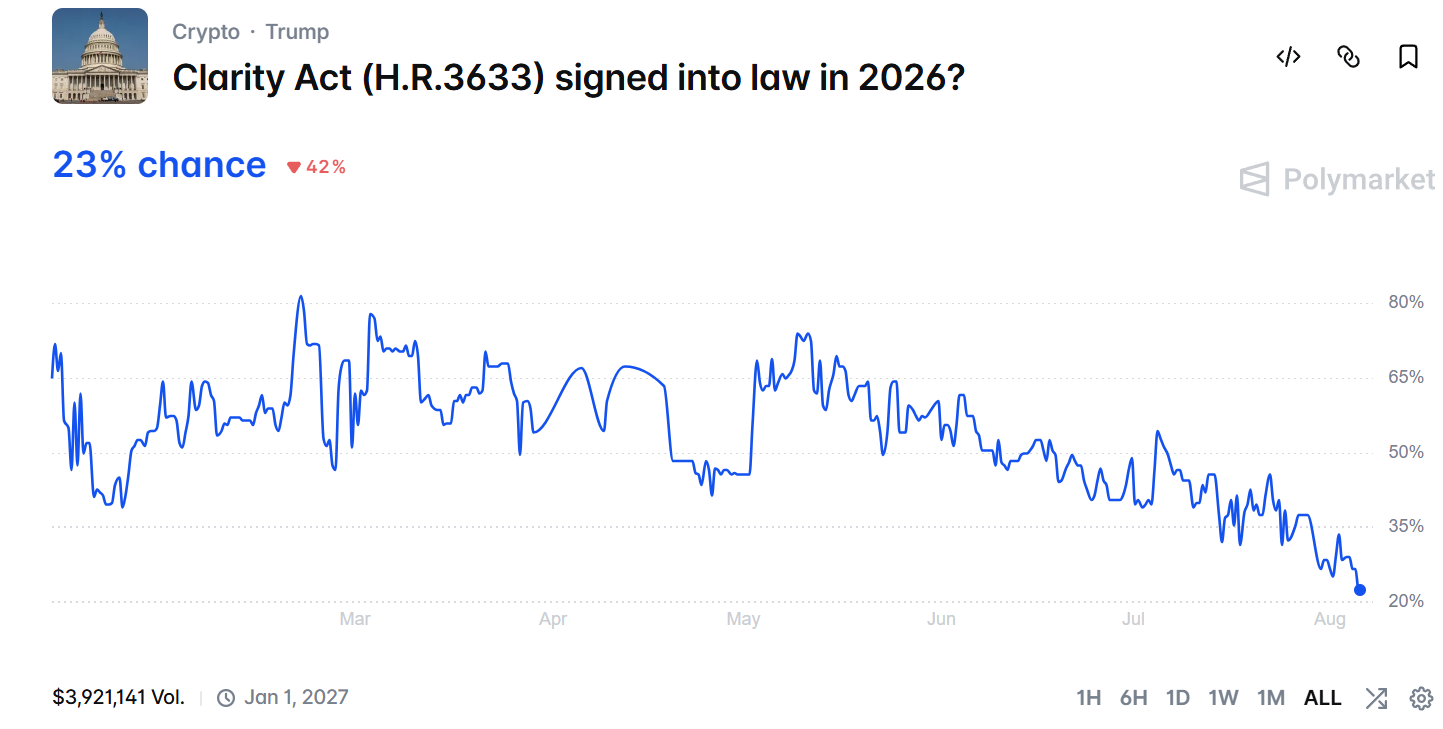
Market observers and research firms have progressively lowered their expectations for the CLARITY Act’s passage in the current legislative session. In July, Galaxy Research revised its probability assessment for the CLARITY Act becoming law in 2026 down to a mere 30%. Data from Polymarket, a decentralized prediction market, further illustrates this pessimism, showing a current chance of only 23% for the bill to be signed into law this year, a stark decline from an optimistic 82% in February.
This shift in sentiment is rooted in ongoing challenges related to bipartisan support. Greg Cipolaro, Global Head of Research at NYDIG, a financial institution specializing in Bitcoin, noted on July 24th that while the latest draft of the CLARITY Act represented a more comprehensive effort, it still lacked the crucial bipartisan consensus needed for advancement. "The central investor takeaway is that Republicans have produced a substantially more complete bill, but not yet one with a credible path to 60 votes," Cipolaro commented, highlighting the significant hurdle of achieving the supermajority required to overcome potential procedural objections in the Senate.
According to sources speaking anonymously to Punchbowl News, a key factor influencing the bill’s progression is the White House’s stance on a bipartisan ethics deal. Without visible progress on this front, coupled with movement on issues concerning illicit finance and stablecoin yield, Senate Democrats are reportedly prepared to deny cloture, effectively blocking the crypto bill from moving forward. This interconnectedness of legislative priorities underscores the complex political dynamics at play.
The "Walking Dead" Scenario and Potential Pathways Forward
Should the CLARITY Act fail to advance before the August recess, Hougan predicts it will enter a "walking dead" state – stalled and lacking momentum, but not definitively defeated. He suggests that there remains a possibility for the bill to be considered later in the year, either in September or potentially in a December "lame duck" session when Congress reconvenes.
"Congress often bundles multiple bills into a year-end ‘omnibus’ package, forcing legislators to vote on a single bill that includes things they like and things they hate. Maybe the Clarity Act can pass that way," Hougan hypothesized, pointing to a common legislative tactic that could provide a lifeline for stalled legislation. This strategy often involves attaching less controversial or more popular measures to a larger, must-pass bill, thereby leveraging broader support to push individual components through.

Industry Resilience: "Crypto Will Be Fine," Says Bitwise CIO
In the event of the CLARITY Act’s failure to pass this year, Hougan asserts that the cryptocurrency industry will not be left in regulatory limbo. Instead, the sector would likely revert to a joint interpretation issued in March by the Securities and Exchange Commission (SEC) and the Commodity Futures Trading Commission (CFTC). This interpretation categorizes Bitcoin and other similar assets as digital commodities, effectively superseding the SEC’s earlier 2019 staff guidance.
SEC Chair Paul Atkins has publicly affirmed the agency’s readiness to address regulatory concerns within the crypto market. Last week, he stated that the SEC is "ready, willing, and able to come out with rules that address the same issues as CLARITY and other aspects of the crypto market." This suggests a continued commitment from regulatory bodies to provide some form of regulatory framework, even in the absence of comprehensive legislation.
However, the durability of rules issued by regulatory agencies differs significantly from legislation passed by Congress. Such interpretations are susceptible to legal challenges and can be reversed or modified by subsequent administrations. SEC Chair Atkins himself acknowledged this limitation in March when the joint interpretation was released, stating, "Only Congress can ensure that regulation in this area is future-proofed through comprehensive market structure legislation." This highlights the inherent instability of relying solely on agency guidance for long-term regulatory certainty.
Ryan Louvar, Chief Legal Officer at WisdomTree, another investment firm, has echoed concerns that the absence of clear legislative action will continue to impede market development, despite regulatory efforts. "A market cannot function well when its participants cannot tell in advance which agency’s rules apply to them," Louvar stated during a congressional hearing in July. This ambiguity poses a significant challenge for businesses operating within the crypto space, affecting investment decisions, product development, and overall market stability.
Despite these regulatory uncertainties, Hougan remains optimistic about the industry’s ability to adapt and thrive. He suggests that even without the CLARITY Act, the industry would still have approximately two and a half years to accelerate its development before a potential change in administration could lead to a different regulatory approach. This timeframe provides a buffer for innovation and growth.
"Washington is dysfunctional. It seems crazy to me that we can’t get our act together to pass legislation that would improve investor protections and spark new innovation," Hougan remarked. However, he quickly pivoted to a broader perspective, emphasizing that the current legislative struggles are not a reflection of crypto’s fundamental value or its role in the global financial system. "But it’s not a referendum on crypto’s validity as a pillar of the global financial infrastructure. That ship has long since sailed. At this point, crypto has enough momentum that it will reshape finance for decades, regardless of what happens in the next few days."
Historical Context and the Evolving Regulatory Landscape
The CLARITY Act, formally known as the "Commodity Innovation and Digital Assets Act," is part of a broader, multi-year effort by lawmakers to establish a clear regulatory framework for digital assets in the United States. The bill aims to define the roles of the SEC and CFTC in overseeing various crypto assets, provide clearer rules for stablecoins, and establish mechanisms for market oversight. Its introduction and subsequent debate reflect the growing influence and complexity of the cryptocurrency market, which has evolved significantly since the emergence of Bitcoin in 2009.
Early regulatory approaches to digital assets were largely reactive, often relying on existing securities and commodities laws. This led to significant uncertainty and legal battles, as exemplified by numerous enforcement actions initiated by the SEC against crypto companies. The CLARITY Act, along with other proposed legislation like the Lummis-Gillibrand Responsible Financial Innovation Act, represents a proactive attempt to create bespoke regulations tailored to the unique characteristics of digital assets.
The challenges in passing such legislation are multifaceted. They include the inherent complexity of the technology, the diverse range of digital assets and their potential use cases, and the partisan divisions that often characterize legislative debates in Washington. Different factions within Congress hold varying views on the level of regulation required, with some advocating for a more permissive approach to foster innovation, while others prioritize robust investor protection and systemic risk mitigation.
The current legislative push gained significant momentum following the collapse of FTX in late 2022, which highlighted the vulnerabilities within the crypto ecosystem and spurred calls for greater regulatory oversight. However, the path to consensus has proven arduous, with ongoing debates over classification of digital assets, jurisdictional authority between regulators, and the specific safeguards needed for market participants.
The inclusion of stablecoins as a key component of the CLARITY Act reflects their growing importance as a bridge between traditional finance and the digital asset ecosystem. Regulations governing stablecoins are crucial for ensuring their stability, preventing illicit use, and fostering confidence among mainstream investors and institutions.
Implications of Legislative Stalemate
The failure of the CLARITY Act to pass this year, or even its prolonged "walking dead" status, carries several implications for the cryptocurrency industry and the broader financial landscape.
Firstly, the continued regulatory uncertainty could stifle innovation and deter institutional investment. Businesses operating in the crypto space may face challenges in planning for the future, as the lack of a clear and stable regulatory framework can increase operational risks and compliance costs. Investors, particularly institutional ones, often prefer clarity and predictability before committing significant capital.
Secondly, the absence of comprehensive legislation could lead to a patchwork of regulations at the state level, further complicating compliance and creating an uneven playing field across the United States. Some states have moved to establish their own digital asset frameworks, which can create both opportunities and challenges for businesses seeking to operate nationwide.
Thirdly, the US could fall behind other jurisdictions that are actively developing comprehensive regulatory frameworks for digital assets. Countries like the European Union, with its Markets in Crypto-Assets (MiCA) regulation, are moving forward with established rules, potentially attracting innovation and investment that might otherwise flow to the United States.
However, as Hougan pointed out, the underlying momentum of the crypto industry is a powerful force. The increasing adoption of blockchain technology, the development of decentralized finance (DeFi) applications, and the growing interest from traditional financial institutions suggest that the crypto sector is poised for continued growth regardless of immediate legislative outcomes. The resilience of the industry, demonstrated by its ability to adapt to market downturns and evolving regulatory landscapes, suggests a long-term trajectory of integration into the global financial system.
The coming weeks will be pivotal in determining the immediate fate of the CLARITY Act. While the political machinations in Washington continue, the underlying technological and economic forces driving the cryptocurrency revolution appear to be on an irreversible course. The debate over regulation is not a question of whether crypto will be a part of the future of finance, but rather how and when that integration will be formally recognized and governed by clear, predictable rules. The current legislative stalemate, while frustrating for industry participants, underscores the complex and dynamic relationship between technological innovation and governmental oversight.