George Chandra Eka
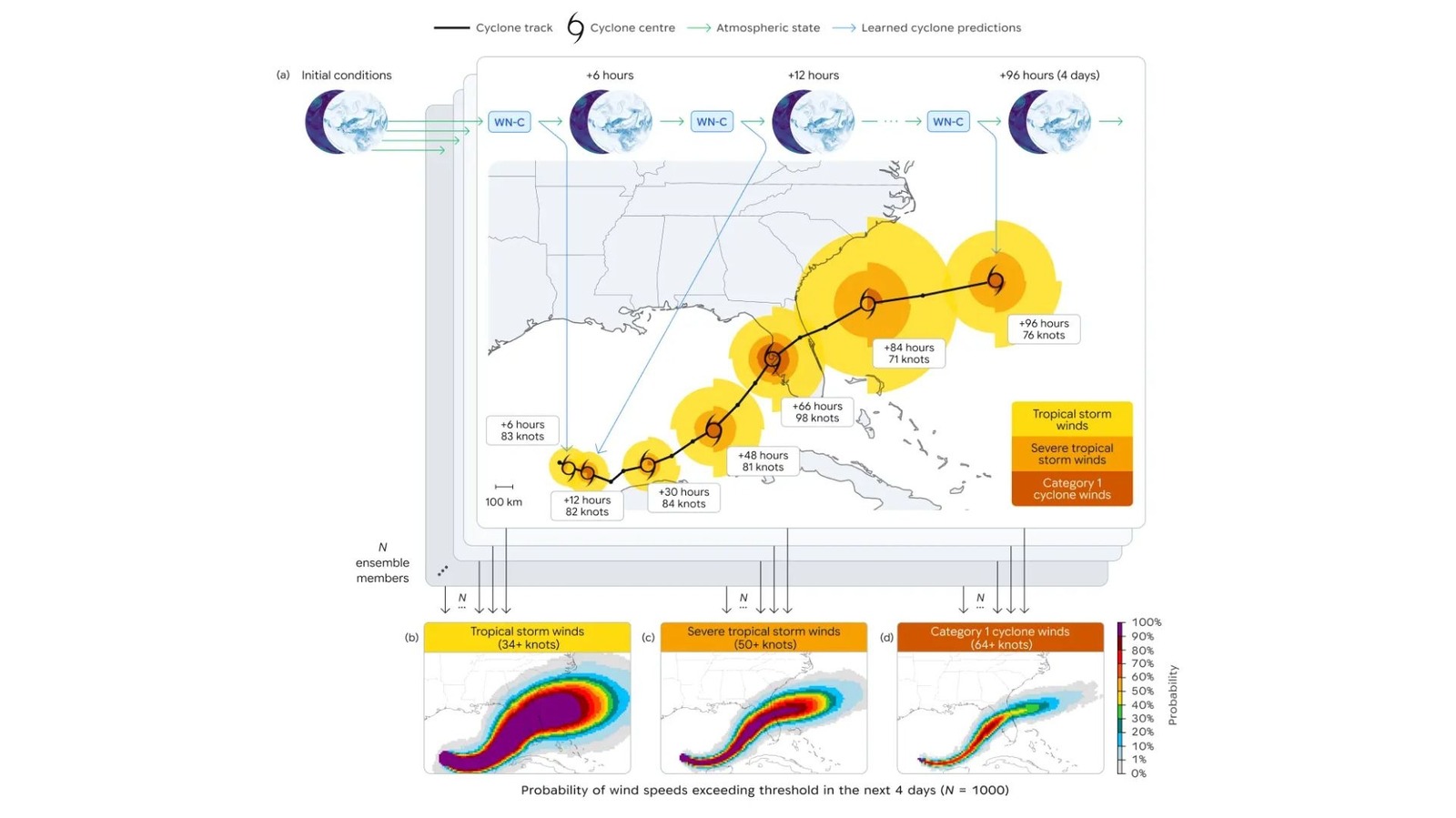
In a significant leap forward for global disaster preparedness, Google DeepMind and Google Research, in collaboration with leading meteorological institutions worldwide, have open-sourced their groundbreaking WeatherNext AI weather prediction model. This advanced system is capable of delivering comprehensive 15-day forecasts, predicting both the track and intensity of tropical cyclones with unprecedented speed and accuracy, thereby empowering forecasters with earlier warnings for potentially devastating storms. The release of WeatherNext’s code and model weights on GitHub signals a major step towards democratizing access to cutting-edge predictive technology, inviting the global scientific community to further enhance and integrate these capabilities into operational forecasting.
The Evolving Landscape of Weather Prediction
For decades, the prediction of tropical cyclones—variously known as hurricanes, typhoons, or simply cyclones depending on their geographical basin—has presented one of meteorology’s most formidable challenges. These powerful rotating storm systems, fueled by warm ocean waters, are notoriously difficult to forecast due to their complex atmospheric dynamics, rapid intensification potential, and often erratic paths. Traditional Numerical Weather Prediction (NWP) models, while highly sophisticated, demand immense computational resources and often struggle to simultaneously achieve high resolution for a storm’s core intensity and broad-scale accuracy for its global track. This dichotomy has historically necessitated the use of multiple models, each optimized for different aspects of a cyclone’s behavior, adding layers of complexity and potential for discrepancies in forecasts.
The consequences of inaccurate or delayed cyclone warnings are dire. Annually, tropical cyclones cause billions of dollars in economic damage globally and tragically result in significant loss of life. From the devastating impacts of Hurricane Katrina in the United States to Super Typhoon Haiyan in the Philippines, and Cyclone Fani in India, the human and economic toll underscores the critical need for more precise and timely predictions. Improved forecasts translate directly into more effective evacuation orders, better resource allocation for emergency services, and greater resilience for communities in harm’s way. The ability to predict a storm’s trajectory and intensity with greater confidence and further in advance can mean the difference between widespread catastrophe and a more managed response.
WeatherNext: A Breakthrough in AI-Driven Meteorology
WeatherNext distinguishes itself by addressing the traditional forecasting dichotomy with a single, unified AI model. Unlike conventional approaches that often combine global models for track prediction with specialized local models for intensity, WeatherNext was trained to simultaneously predict both crucial elements. This innovative architecture allows the model to process a vast array of atmospheric data holistically, identifying intricate patterns and correlations that might be missed by siloed systems.
The model’s development involved an intensive training regimen, leveraging nearly 20 terabytes of global atmospheric data. This massive dataset includes a comprehensive range of meteorological observations, such as satellite imagery, radar data, ground-based sensor readings, and atmospheric reanalysis data, which provides a consistent, spatially complete reconstruction of the atmospheric state over time. Crucially, WeatherNext also integrated historical information from the International Best Track Archive for Climate Stewardship (IBTrACS), a global repository of tropical cyclone historical data. IBTrACS provides critical ground truth data on past storm tracks and intensities, allowing the AI to learn from historical events and refine its predictive capabilities. By feeding this immense volume of diverse data into deep learning algorithms, WeatherNext has learned to discern subtle precursors and evolving conditions that dictate a cyclone’s future behavior.
One of WeatherNext’s most compelling features is its remarkable computational efficiency. Researchers have stated that the model can generate a full 15-day forecast in less than a minute when run on a Tensor Processing Unit (TPU), Google’s custom-designed AI accelerator. This speed is a game-changer for operational meteorology. Traditional high-resolution NWP models can take hours to run on supercomputers, limiting the frequency of forecast updates and the ability to run extensive ensemble forecasts (multiple model runs with slightly varied initial conditions to assess uncertainty). WeatherNext’s rapid execution enables forecasters to quickly generate and analyze multiple scenarios, providing a more robust understanding of the probability distribution of potential outcomes, including "potentially devastating tail-risks." This agility allows for more frequent updates as new data becomes available, offering forecasters a dynamic and responsive tool in rapidly evolving storm situations.
A Collaborative Endeavor for Global Impact
The development of WeatherNext was not solely a Google undertaking but a testament to the power of collaborative science. Researchers from Google DeepMind and Google Research worked in concert with a distinguished roster of global meteorological agencies. Key contributors included the National Hurricane Center (NHC) in the United States, a leading authority on Atlantic and Eastern Pacific hurricane forecasting; the Cooperative Institute for Research in the Atmosphere (CIRA), a research institute known for its expertise in satellite meteorology and atmospheric science; and the UK Met Office, one of the world’s foremost weather and climate centers. These partnerships were vital, providing invaluable domain expertise, historical data, and critical validation capabilities that ensured WeatherNext’s scientific rigor and practical applicability.
A study detailing WeatherNext’s methodology and performance was published in the prestigious scientific journal Nature, affirming its scientific credibility and highlighting its potential to significantly advance the field. Concurrently, Google also shared a more accessible version of their findings in a blog post, aiming to inform a broader audience about this important development. The active involvement of national and international weather agencies from the outset suggests a clear pathway for the model’s eventual integration into operational forecasting workflows globally, building on existing infrastructure and expertise.
The Open-Source Advantage
Google’s decision to open-source both the code and the model weights behind WeatherNext on GitHub is a strategic move with profound implications for the scientific community and disaster preparedness worldwide. Open-sourcing fosters transparency, allowing independent researchers and meteorologists to scrutinize the model’s workings, validate its results, and contribute to its improvement. This collaborative approach accelerates scientific discovery, potentially leading to faster iterations and enhancements that would be difficult to achieve within a single organization.
For meteorological agencies, particularly those in developing nations with limited access to supercomputing resources or advanced AI research teams, the open-source release of WeatherNext offers an unprecedented opportunity. It democratizes access to state-of-the-art predictive technology, enabling them to leverage sophisticated AI tools without the prohibitive costs associated with proprietary software or extensive in-house development. This could be particularly impactful in regions frequently impacted by tropical cyclones, such as Southeast Asia, the Caribbean, and parts of Africa, where early and accurate warnings can save countless lives and protect fragile economies. The ability for local experts to adapt and fine-tune the model to regional specificities further enhances its utility and relevance.
Google’s Broader AI for Social Good Initiatives
WeatherNext is not an isolated project but part of Google’s broader commitment to applying artificial intelligence to address critical societal challenges. The company’s research teams have a history of leveraging AI for "AI for Social Good" initiatives, demonstrating how advanced technologies can contribute to human well-being and disaster resilience. Last year, Google introduced the second generation of WeatherNext, indicating a continuous investment in refining and expanding its weather forecasting capabilities.
Beyond cyclone prediction, Google has also made strides in other areas of severe weather forecasting. Notably, its AI-powered tools have been developed to predict flash floods, another devastating natural phenomenon that claims many lives globally each year. By combining AI with diverse data sources, including historical flood events, topographical data, and real-time precipitation measurements, Google’s flash flood prediction tools aim to provide localized warnings, giving communities crucial time to prepare and evacuate. These parallel efforts underscore a strategic vision to build a suite of AI-driven forecasting tools that can collectively enhance global disaster preparedness and response across various hazards.
Implications for Disaster Preparedness and Future Outlook
The implications of WeatherNext’s open-source release are far-reaching. For disaster preparedness, earlier and more accurate 15-day forecasts offer an extended window for decision-making. This additional lead time can be critical for:
- Evacuation Planning: Allowing authorities to issue evacuation orders sooner, providing residents more time to secure their homes, gather essential supplies, and safely relocate. This reduces panic and improves the efficiency of evacuation routes.
- Resource Mobilization: Enabling emergency services, aid organizations, and governments to pre-position resources such as food, water, medical supplies, and search-and-rescue teams in anticipated impact zones, thereby expediting post-storm relief efforts.
- Infrastructure Protection: Giving utilities, transportation networks, and critical infrastructure providers more time to implement protective measures, such as securing power grids, moving sensitive equipment, or halting maritime and air traffic, minimizing damage and facilitating faster recovery.
- Economic Mitigation: Assisting industries like agriculture, shipping, and tourism in making informed decisions to minimize losses, for example, by harvesting crops early, rerouting vessels, or adjusting travel plans.
Looking ahead, the integration of AI models like WeatherNext into operational forecasting will likely foster a new era of human-AI collaboration in meteorology. Forecasters will not be replaced but rather augmented by these powerful tools, allowing them to focus on interpreting nuanced predictions, communicating risks effectively, and making critical decisions with greater confidence. The speed and comprehensive nature of WeatherNext could also facilitate more sophisticated ensemble forecasting techniques, providing a clearer picture of forecast uncertainty and the range of possible storm outcomes.
However, the widespread adoption and integration of AI models will also require addressing challenges such as model explainability (understanding why an AI makes a particular prediction), data governance, and ensuring equitable access and training for meteorological professionals worldwide. Continuous research and development will be essential to further refine these models, adapt them to evolving climate patterns, and expand their capabilities to other severe weather phenomena.
In conclusion, Google’s open-sourcing of the WeatherNext AI model represents a monumental contribution to global disaster resilience. By offering an advanced, efficient, and accessible tool for predicting tropical cyclones, the initiative promises to empower communities, save lives, and mitigate the devastating impacts of these powerful natural forces, marking a new frontier in the application of artificial intelligence for the common good.