Sisilia Frederika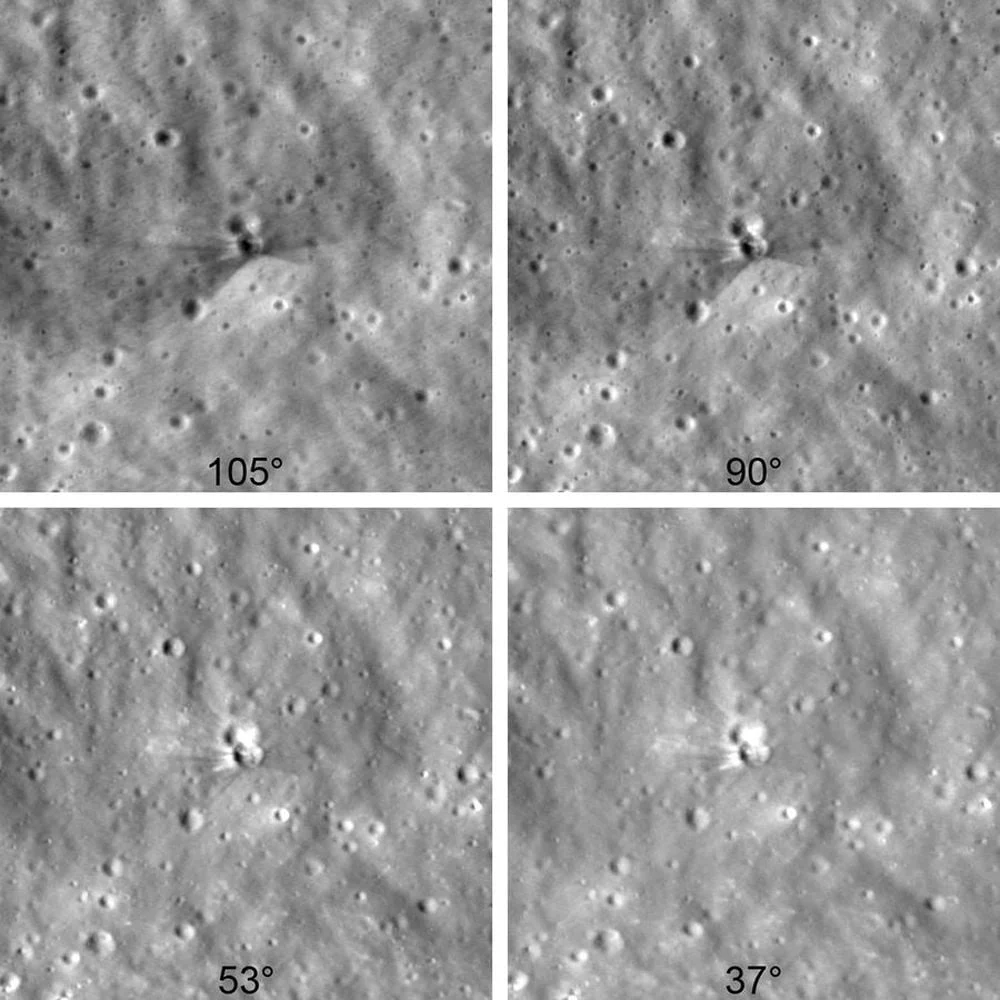
The lunar landscape, a silent witness to billions of years of cosmic bombardment, has recorded a new entry in its geological history following the high-velocity impact of a man-made object. On August 5, 2024, an upper stage from a SpaceX Falcon 9 rocket collided with the Moon’s near side, an event triggered by a complex interplay of orbital mechanics and environmental factors. The impact, which occurred near the Einstein crater, was the culmination of a mission designed to deliver a pair of lunar landers into space, marking a rare instance where terrestrial hardware has unintentionally added to the Moon’s cratered topography.
The rocket stage in question was utilized to launch two high-profile commercial missions: Firefly Aerospace’s Blue Ghost and ispace’s Resilience. While the primary mission of delivering these payloads toward their lunar trajectories was successful, the spent upper stage remained in a chaotic orbit that eventually brought it into a terminal conflict with the Moon. Weighing approximately 4,000 kilograms, the booster slammed into the lunar surface at a speed of nearly 9,000 kilometers per hour. This hypervelocity impact resulted in the immediate excavation of a fresh crater, providing NASA and the international scientific community with a unique opportunity to study the effects of human-made debris on the lunar environment.
Technical Specifications and Chronology of the Impact
The events leading to the impact were closely monitored by NASA’s Center for Near Earth Object Studies (CNEOS). Typically tasked with tracking asteroids and potential planetary threats to Earth, CNEOS applied its sophisticated trajectory modeling to the Falcon 9 upper stage as it became clear that a lunar collision was imminent. The tracking process involved the gradual refinement of the impact area as the stage’s orbit evolved under the influence of Earth’s gravity, the Moon’s gravity, and solar radiation pressure.
CNEOS generated two primary potential landing ellipses to predict where the debris would land. The first, a red ellipse, was calculated based on a standard orbital path, while the second, a blue ellipse, accounted for the specific nuances of the lunar terrain and gravitational anomalies. Both ellipses measured approximately 3.3 kilometers in length and 640 meters in width. Ultimately, the actual impact site, marked by a cyan indicator in NASA’s subsequent analysis, fell within these calculated zones, proving the high degree of accuracy in modern orbital tracking.
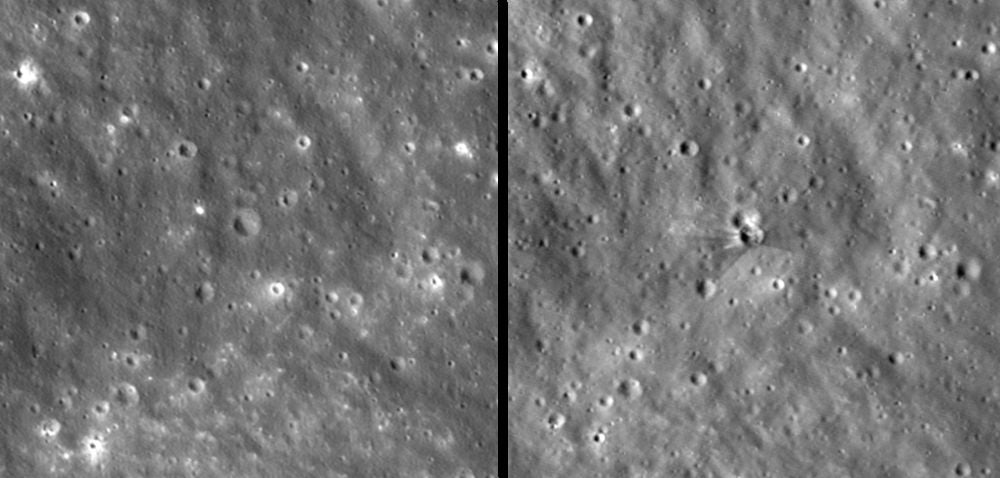
Following the impact on August 5th, the task of visual confirmation fell to a fleet of lunar orbiters. The first to respond was the Republic of Korea’s Pathfinder Lunar Orbiter, known as Danuri. Operated by the Korea Aerospace Research Institute (KARI), Danuri captured initial imagery of the site just hours after the event. These images confirmed the CNEOS coordinates were accurate to within approximately one kilometer, providing the necessary data for a more detailed follow-up by NASA’s Lunar Reconnaissance Orbiter (LRO).
The LRO Imaging Mission: A Feat of Precision
Between August 11th and 12th, six days after the initial impact, the LRO performed a series of imaging passes over the site. The delay was a result of the LRO’s polar orbit; the spacecraft orbits the Moon from pole to pole while the Moon rotates beneath it. It took several days for the rotation of the Moon to bring the new crater directly into the LRO’s field of view.
Capturing a fresh, relatively small crater from an altitude of 96 kilometers is a significant technical challenge. To achieve the necessary resolution, mission controllers at NASA’s Goddard Space Flight Center had to execute a precise "off-nadir" maneuver. This involved tilting the entire LRO spacecraft toward the crater as it passed overhead. The Lunar Reconnaissance Orbiter Camera (LROC), which consists of both narrow-angle and wide-angle units, required perfect timing. Because the LRO travels at high orbital velocities, being off by even a few seconds would have resulted in the crater drifting out of the frame or appearing severely distorted.
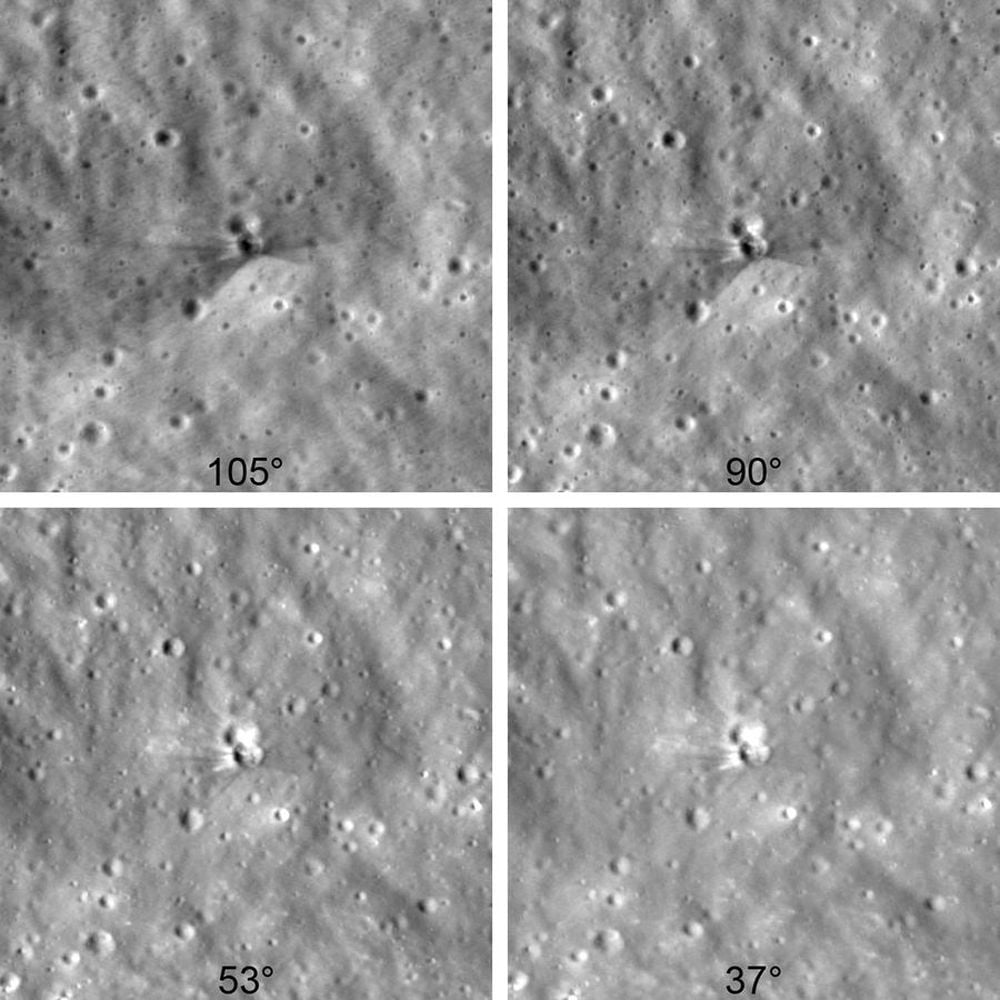
The maneuver was a success. The resulting images, enlarged three times for public release, show a stark "before and after" contrast. Because the images were taken at different times of the lunar day, the varying angles of sunlight highlighted different geological features. The shadows and light play allowed NASA personnel to calculate the physical dimensions of the new feature. The crater is estimated to be approximately 18 meters wide and 3 meters deep.
Analysis of the Crater and Ejecta Patterns
The images provided by the LROC offer more than just a confirmation of the crash; they provide a wealth of data regarding the composition of the lunar surface at the impact site. One of the most striking features of the new crater is the presence of bright "rays" and splotches surrounding the impact point. These are known as ejecta—material that was buried beneath the surface and thrown outward by the force of the collision.

In the lunar environment, surface material is constantly darkened by "space weathering," a process caused by the continuous bombardment of solar wind and micrometeorites. This creates a mature, darker layer of regolith. When a high-velocity impact occurs, it excavates "fresh" material from beneath this weathered layer. This fresh material has not yet been exposed to the same level of radiation and appears significantly brighter than the surrounding terrain. By studying the distribution and brightness of this ejecta, scientists can gain insights into the depth of the lunar soil and the energy dynamics of the impact.
The four-panel image released by NASA, each captured from a different angle, demonstrates how the appearance of the crater changes based on the observer’s perspective. These varying views are essential for creating three-dimensional models of the site and understanding the exact geometry of the crater’s rim and floor.
SpaceX Response and Environmental Factors
In the wake of the impact, SpaceX addressed the incident, characterizing it as an anomalous "one-off" event. The aerospace company, led by Elon Musk, maintains a policy of responsible space debris disposal. Under normal circumstances, Falcon 9 upper stages are directed toward a controlled re-entry into Earth’s atmosphere, where they incinerate, or they are placed into heliocentric (sun-centric) orbits where they pose no threat to planetary bodies.
However, the company noted that a rare combination of gravitational perturbations and heightened solar activity influenced the trajectory of this specific booster. Solar activity can increase the density of the very thin outer layers of an atmosphere or exert pressure on a spacecraft via solar radiation, slightly altering its path over time. When combined with the complex "three-body" gravitational relationship between the Earth, Moon, and the sun, the booster was pulled into a lunar-crossing orbit from which it could not escape. SpaceX reiterated that they continue to follow all applicable international rules and regulations regarding space debris and are working to minimize the likelihood of such occurrences in future lunar-bound missions.
Broader Implications for Lunar Exploration and Sustainability
The impact of the SpaceX booster highlights a growing concern in the era of the "New Space Race": the management of space junk in the lunar vicinity. As more nations and private companies target the Moon for exploration, resource extraction, and eventual habitation, the volume of spent rocket stages and decommissioned satellites in cislunar space is expected to rise.
Unlike Earth, the Moon has no atmosphere to burn up incoming debris. Every object that enters a lunar-impact trajectory will eventually strike the surface. While the Moon is already covered in millions of natural craters, the addition of human-made debris raises questions about the preservation of the lunar environment and the safety of future lunar bases.
Furthermore, this event underscores the importance of international cooperation in space situational awareness. The coordination between NASA’s CNEOS, the South Korean Danuri mission, and the LRO team demonstrates how shared data can turn a potential orbital accident into a scientific opportunity. The ability to predict and then image an impact site with such precision is a testament to the current state of orbital tracking technology.
As missions like Firefly’s Blue Ghost and ispace’s Resilience become more frequent under programs such as NASA’s Commercial Lunar Payload Services (CLPS), the lessons learned from the August 5th impact will likely inform future protocols for booster disposal. For now, the 18-meter wide crater near Einstein stands as a permanent, man-made addition to the lunar surface—a reminder of the increasing footprint of humanity in the solar system.