Sisilia Frederika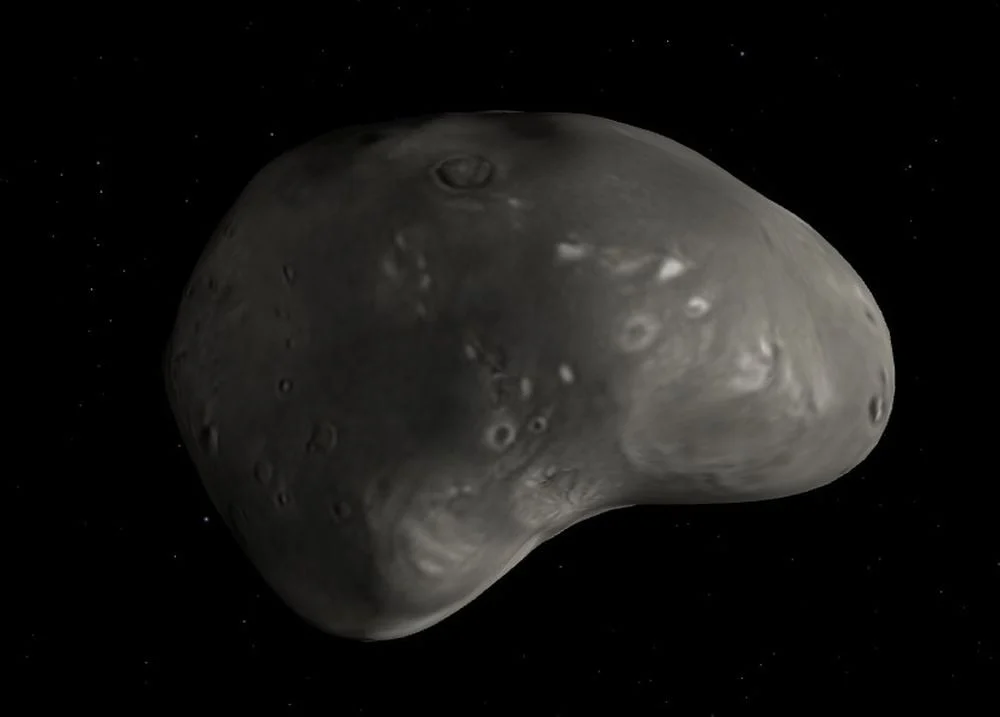
The Martian moon Deimos has long presented a geological paradox to planetary scientists, appearing remarkably smooth and dust-covered in stark contrast to its heavily cratered and scarred sibling, Phobos. However, a new study published in Nature Astronomy suggests that this deceptive tranquility is the result of a singular, violent event in the moon’s ancient history. Research led by Sabina Raducan of the University of Bern indicates that a "subcatastrophic" impact at Deimos’ south pole is responsible for both the moon’s distinctive shape and the thick layer of pulverized rock, or regolith, that masks its more ancient craters. This finding, supported by data from the European Space Agency’s (ESA) Hera spacecraft during its March 2025 Mars flyby, provides a new framework for understanding the evolution of small planetary bodies and the internal structure of the Martian satellites.
The Mystery of the Martian Moons
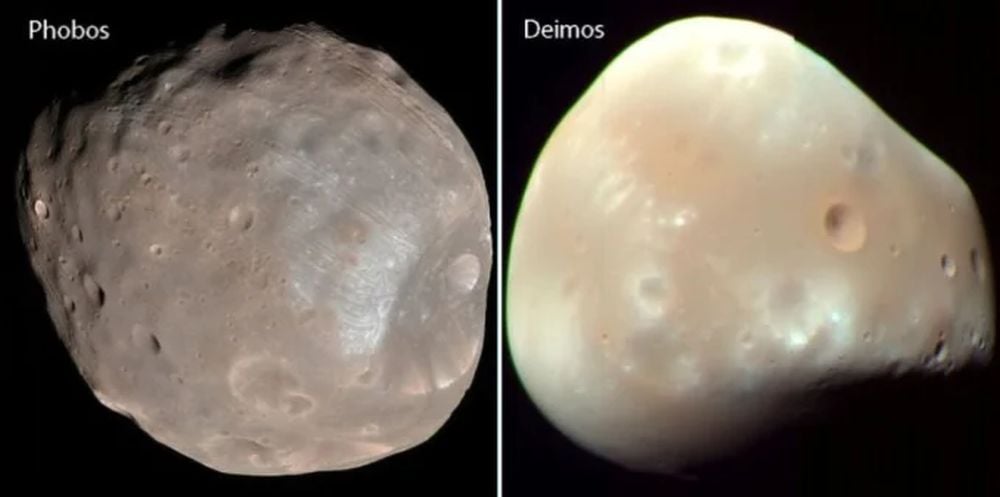
Mars possesses two small, irregularly shaped moons: Phobos, which orbits closer to the planet at a distance of approximately 6,000 kilometers, and Deimos, the smaller and more distant moon orbiting at about 23,460 kilometers. Both moons have long been classified as "oddballs" of the Solar System. Measuring just 26 kilometers and 12 kilometers across respectively, their lumpy, potato-like appearances initially led astronomers to believe they were D-type asteroids captured by Mars’ gravity. However, their nearly circular, equatorial orbits contradict the captured asteroid hypothesis, leading many modern researchers to propose that they formed from a massive impact on the Martian surface that ejected debris into orbit.
Regardless of their ultimate origin, both moons have endured billions of years of bombardment. Phobos is famous for its deep grooves and the massive Stickney Crater, which nearly shattered the moon. Deimos, however, has always appeared "soft" by comparison. High-resolution imagery from past missions, such as NASA’s Mars Reconnaissance Orbiter (MRO), showed a surface largely devoid of sharp features, seemingly blanketed in a fine-grained dust that filled in its depressions. The mechanism behind this global blanketing remained a subject of debate until the recent simulations conducted by the University of Bern.
The Hera Flyby and the Discovery of Buried Craters
In March 2025, the ESA’s Hera spacecraft performed a critical gravity-assist maneuver at Mars while en route to the Didymos asteroid system. This flyby offered a rare opportunity to observe Deimos from a close vantage point. Hera utilized this encounter to test its autonomous navigation systems, locking onto surface features to calibrate its instruments. During this process, the spacecraft’s imaging suite revealed subtle topographic variations that indicated the presence of ancient craters buried beneath the surface dust.
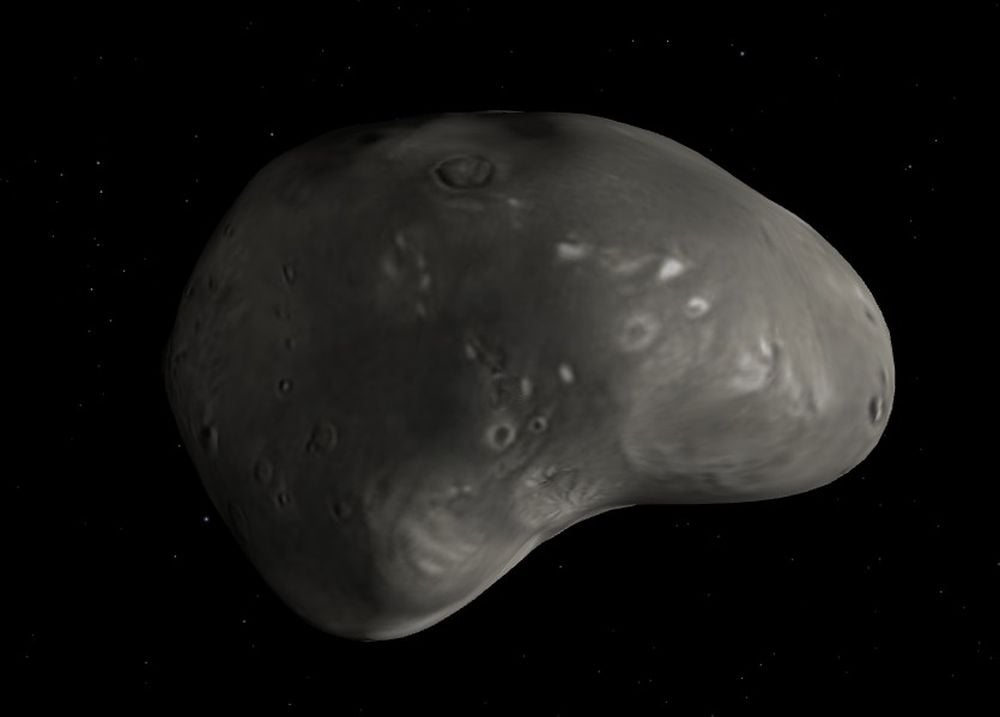
These observations were pivotal for the research team. Sabina Raducan, who serves as the co-chair of the Hera Impact Physics Working Group, noted that the side of the moon imaged by Hera contained "hidden" craters that pre-date the current surface layer. These features suggested that Deimos was not always smooth; rather, a transformative event occurred that globally redistributed material. The spectroscopic analysis of these images was further refined by team member Sir Brian May, the Queen guitarist and astrophysicist, whose work helped distinguish the faint outlines of these buried structures.
Simulating the South Polar Impact
The focal point of the new research is a massive 10-kilometer-wide depression located at Deimos’ south pole. Given that Deimos itself is only 12 kilometers in diameter, this crater is a "subcatastrophic" feature—an impact large enough to alter the moon’s geology without completely destroying it. To investigate whether this single impact could account for the moon’s global regolith, Raducan’s team employed the Bern Smoothed Particle Hydrodynamics (SPH) code.
The SPH simulation is a sophisticated computational tool designed to model large-scale deformations and high-velocity impacts. Running on a high-performance computing cluster at the University of Bern, the code simulated Deimos as a collection of millions of interacting particles. These particles were programmed with specific physical properties, including gravity, material strength, and cohesion.
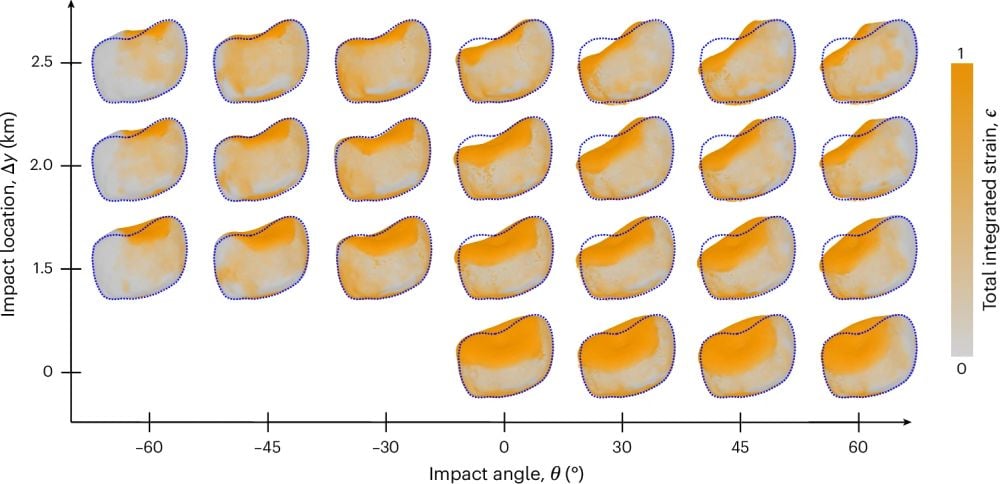
The research team conducted approximately 100 simulations, each requiring a week of processing time. They varied the mass of the impactor and the angle of approach to see which scenario best matched Deimos’ current morphology. The most accurate results came from a simulation involving a small asteroid, approximately 300 to 360 meters in diameter, striking the south pole at a 45-degree angle with a velocity of 8.2 kilometers per second.
The results were striking: the impact excavated the 10-kilometer depression and ejected a massive plume of debris. Because of Deimos’ extremely low gravity, much of this ejecta did not escape into space but instead rained back down across the entire moon. The simulation showed that this "ejecta blanket" reached depths of up to 200 meters in certain areas. This thick layer of loosely packed dust and rock is what gives Deimos its smooth appearance, effectively "paving over" the craters that existed prior to the south polar event.
Deimos as a "Rubble Pile"
The success of the simulations provided more than just a history of the surface; it offered a look into the moon’s interior. For the 10-kilometer crater to form and then partially collapse into its current "smoothed out" state, the moon must have very low surface cohesion (estimated at less than 100 Pascals). Furthermore, the preservation of buried craters suggests that the interior of Deimos is highly porous.
In a solid, cohesive body, the shock waves from a massive impact would likely erase smaller, pre-existing features. However, in a "rubble pile"—a body composed of fragmented rocks held together primarily by gravity—the shock waves are dampened by the voids between the rocks. This suggests that Deimos is structurally similar to asteroids like Bennu, Ryugu, and Dimorphos.
ESA’s Hera project scientist, Michael Kueppers, emphasized the importance of this finding. "This simulation implies that Deimos is a rubble-pile body, akin to many asteroids," Kueppers stated. While this does not definitively prove Deimos is a captured asteroid, it suggests that whether it formed from Martian ejecta or elsewhere, the process of accretion resulted in a fractured, low-density interior.
Scientific Implications and Future Missions
The "subcatastrophic impact" hypothesis provides a unified explanation for Deimos’ shape, its anomalous smoothness, and its internal physics. It also offers a predictive model that can be tested by future missions. One such mission is the Japan Aerospace Exploration Agency’s (JAXA) Martian Moons eXploration (MMX), which is scheduled for launch in the near future.
The MMX mission is designed to be the most comprehensive study of the Martian moons to date. While its primary goal is to land on Phobos and return a sample to Earth, it will also perform multiple flybys of Deimos. MMX is equipped with a LIDAR system for topographic mapping and a gamma-ray/neutron spectrometer to determine elemental composition. These instruments will allow scientists to measure Deimos’ bulk density and regolith properties with unprecedented precision.
If MMX finds that the regolith is indeed hundreds of meters deep and composed of material consistent with a single large impact event, it will confirm Raducan’s findings. Alternatively, if the regolith appears to be the result of billions of years of micro-meteorite bombardment—a process known as space weathering—scientists will have to re-evaluate the timeline of the south polar crater.
Conclusion
The study of Deimos is more than an exercise in planetary curiosity; it is a vital component of understanding the history of the inner Solar System. Small bodies like Deimos serve as "time capsules," preserving the records of the violent processes that shaped the planets. The realization that a single impactor, barely 300 meters wide, could fundamentally reshape a 12-kilometer moon highlights the dynamic and often chaotic nature of planetary evolution.
As the Hera mission continues its journey and the MMX mission prepares for its departure, the secrets of the Martian moons are finally being unraveled. The transition of Deimos from a mysterious "oddball" to a well-understood rubble-pile moon marks a significant milestone in Martian science. For now, the image of Deimos as a dusty, potato-shaped moon hides a much more violent past—one defined by a singular strike that blanketed a world in the remnants of its own destruction.