admin
admin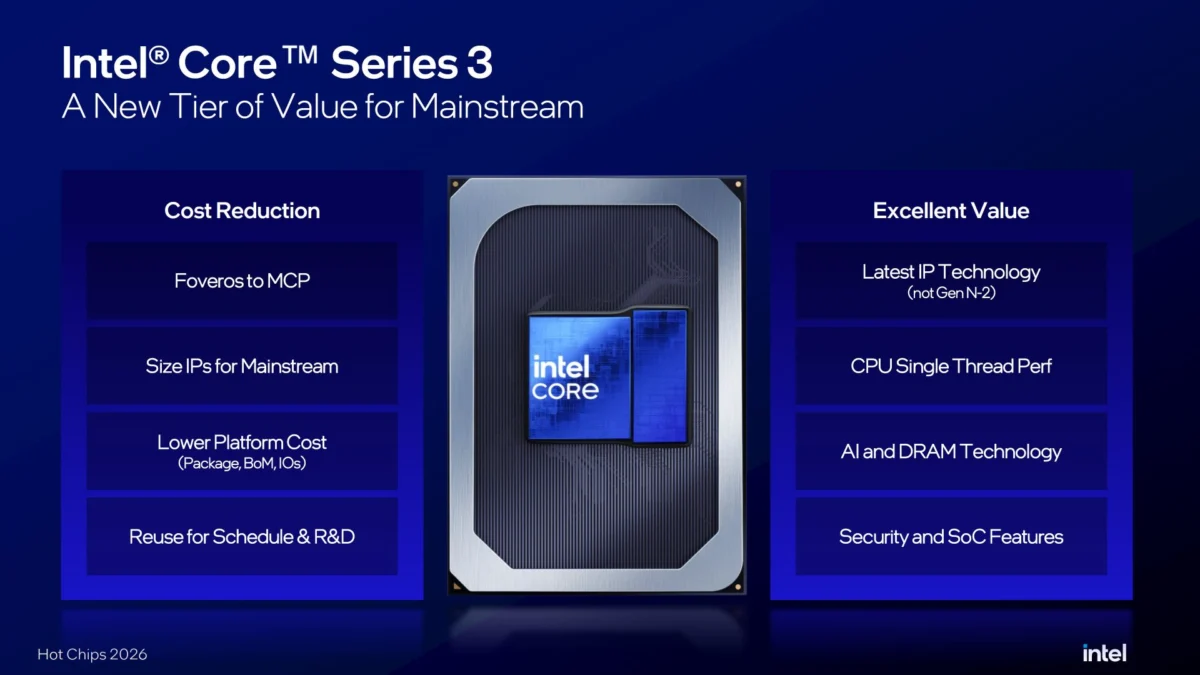
The global semiconductor landscape is currently witnessing a significant shift as Intel maneuvers to balance high-end architectural innovation with the economic realities of the mainstream PC market. During the Hot Chips 2026 symposium, Intel provided a comprehensive technical disclosure regarding its Wildcat Lake "Core Series 3" processors. These CPUs represent a strategic pivot for the company, moving away from the "performance at any cost" mentality of the flagship Ultra series to a "value-optimized" framework. By surgically removing specific high-cost components and adopting a more efficient packaging strategy, Intel aims to deliver a product that maintains modern feature sets—such as advanced AI capabilities and next-generation connectivity—while significantly lowering the barrier to entry for everyday consumers and edge computing deployments.

The Genesis of Wildcat Lake and Project Firefly
The development of Wildcat Lake is inextricably linked to Intel’s broader "Project Firefly" initiative. This internal program was conceived to bridge the gap between traditional high-power laptop architectures and the ultra-slim, high-efficiency designs popularized by competitors like Apple’s MacBook Neo. The objective was to create a hardware ecosystem that could support thin-and-light chassis without necessitating complex cooling solutions or bulky thermal vents.
Wildcat Lake serves as the silicon foundation for this initiative. While it shares the same underlying architectures as the more premium Panther Lake "Core Ultra Series 3" chips, the design philosophy focuses on "right-sized compute." This means prioritizing the features that mainstream users utilize most—web browsing, productivity suites, and light content creation—while pruning the excessive overhead required for professional-grade workstations. Beyond consumer laptops, Intel has positioned Wildcat Lake as a versatile solution for the "essential edge," targeting sectors such as robotics, smart building management, retail terminals, and intelligent meeting platforms where reliability and cost-efficiency are paramount.

Strategic Packaging: The Shift to Organic MCP
One of the most significant architectural departures in Wildcat Lake is the move away from Intel’s sophisticated Foveros 3D packaging. In the premium Panther Lake series, Foveros is used to stack chiplets on a passive base die, facilitating high-density interconnects. However, this technology adds substantial complexity and cost to the manufacturing process.
For Wildcat Lake, Intel engineers opted for a Multi-Chip Package (MCP) on an organic substrate. By eliminating the base die, Intel successfully reduced assembly costs and mitigated potential yield losses associated with 3D stacking. During the Hot Chips presentation, Intel disclosed that while they briefly considered a monolithic (single-die) design, the MCP approach was ultimately chosen because it provided the best balance of flexibility and cost. The organic MCP package allows Intel to mix and match tiles produced on different process nodes, optimizing each component for its specific function without the price tag of an all-in-one high-end package.

Implementing UCIe: A Milestone for Industry Standards
A critical technical highlight of Wildcat Lake is the integration of the Universal Chiplet Interconnect Express (UCIe) standard. Intel noted that when Wildcat Lake was in its initial definition phase around 2022, the UCIe specification had not yet been finalized. However, as the industry moved toward standardization, Intel made the strategic decision to adopt UCIe for the die-to-die (D2D) interface in the two-die Wildcat Lake configuration.
This transition presented unique engineering challenges. Because Wildcat Lake lacks the base die found in Foveros-based chips, it utilizes a much larger bump pitch of 110 microns, compared to the 36 microns used in Foveros. This disparity in density meant that the UCIe interface required a higher gigatransfer-per-second (GTps) rate and a larger physical area for the I/O controllers. Consequently, the die-to-die interface on Wildcat Lake is approximately 70% larger than its counterpart on Panther Lake. Despite this increase in area, Intel maintains that the overall cost savings achieved by moving to the organic MCP package far outweigh the silicon real estate "tax" imposed by the larger UCIe interface.

Right-Sized Compute: Quantifying the Reductions
To achieve a 38% reduction in the compute tile die size (which encompasses both the CPU and GPU), Intel performed a series of calculated subtractions from the Panther Lake template. These changes were designed to ensure that the "Core Series 3" remains competitive in the entry-to-mid-tier segment without cannibalizing the market for "Core Ultra" products.
Key modifications to the compute tile include:

- NPU Scaling: A reduction in the number of Neural Processing Unit (NPU) engines, though still maintaining enough power to deliver 40 platform TOPS for AI tasks.
- Core Count Adjustment: A decrease in the number of high-performance P-cores.
- Cache Optimization: A reduction in the Last Level Cache (LLC) to save space.
- Feature Removal: The total removal of the Image Processing Unit (IPU) and Pro Media engines, which are typically reserved for high-end creative professional workflows.
Despite these cuts, Wildcat Lake remains a formidable performer compared to previous generations. Intel reports that these chips deliver up to 2.7x faster AI performance and up to 2.1x faster productivity speeds than the Core 100 series (Raptor Lake U Refresh). Furthermore, the architecture is highly energy-efficient, operating at 64% lower processor power than its predecessors, which facilitates the "all-day battery life" promised by the Project Firefly ecosystem.
IO Tile and Platform Cost Savings
The optimization efforts extended to the IO tile, which saw a 15% reduction in die area. Intel streamlined the IO feature set to focus on mainstream essentials. While the "Core Ultra" series offers extensive PCIe lanes and numerous high-speed ports, Wildcat Lake provides a more focused array:

- Connectivity: Integrated support for Thunderbolt 4, Wi-Fi 7, and Bluetooth 6.
- Reduced Complexity: A more limited number of PCIe lanes and USB ports, sufficient for standard laptop configurations but lacking the "over-provisioning" of the Ultra series.
- Audio: Simplified audio configurations to reduce controller complexity.
The physical footprint of the chip has also been minimized. The Core Series 3 with MCP measures 35x25x1.23mm, a significant reduction from the 50x25x1.5mm dimensions of a comparable Panther Lake part. This smaller package is a boon for motherboard designers, as it saves valuable board space and simplifies power delivery routing.
On the platform level, Intel identified further Bill of Materials (BOM) savings. By moving to a 64-bit DRAM bus (down from 128-bit), manufacturers can utilize a 6-layer Type3 PCB instead of a more expensive 8-layer board. Additionally, the integration of the Wi-Fi 7 silicon and the USB Power Delivery (PD) controller directly into the package eliminates the need for external components, further driving down the total system cost.

Manufacturing Excellence and Yield Recovery on 18A
The compute tile of Wildcat Lake is manufactured using Intel’s cutting-edge 18A process node. Utilizing a new process node often carries risks regarding defect rates and yield, but Intel has implemented a robust "Die Yield Recovery" strategy.
According to the Hot Chips disclosure, the 18A compute die allows for a 29% recovery rate. This means that if a portion of the die—such as a specific P-core, Xe GPU core, or NPU engine—is defective, the chip can often be salvaged and binned as a lower-tier SKU rather than being discarded. However, Intel emphasized that certain "essential" IPs are non-recoverable to ensure platform consistency and battery life standards. These include the Low Power (LP) E-cores, the display pipes, and the primary I/O controllers. By keeping these elements consistent across the entire Wildcat Lake stack, Intel ensures that even the lowest-tier Core Series 3 chip provides a reliable and uniform user experience.

Market Implications and Broader Impact
The introduction of Wildcat Lake is a clear indication that Intel is preparing for a protracted battle in the "AI PC" era. As AI-driven features become standard in operating systems like Windows, the demand for affordable hardware capable of local AI processing is expected to surge. By delivering 40 TOPS in a cost-optimized package, Intel is positioning itself to capture the massive "volume" segment of the market that might otherwise be tempted by ARM-based alternatives or aggressive pricing from competitors.
Industry analysts suggest that Wildcat Lake could be a pivotal product for Intel’s foundry ambitions as well. Successfully deploying a mainstream product on the 18A node using UCIe interconnects serves as a powerful "proof of concept" for potential external foundry customers. It demonstrates that Intel can handle complex chiplet designs and new interconnect standards at scale while managing costs effectively.

In conclusion, Wildcat Lake "Core Series 3" is not merely a "cut-down" version of its premium siblings; it is a meticulously engineered solution designed to meet the specific economic and technical requirements of the global mainstream market. By prioritizing packaging efficiency, adopting industry-standard interconnects like UCIe, and "right-sizing" the compute and I/O tiles, Intel has created a platform that brings next-generation performance to a broader audience. As these chips begin to populate the laptop and edge computing markets, they will likely play a crucial role in defining the price-to-performance ratio for the next generation of personal computing.