Sisilia Frederika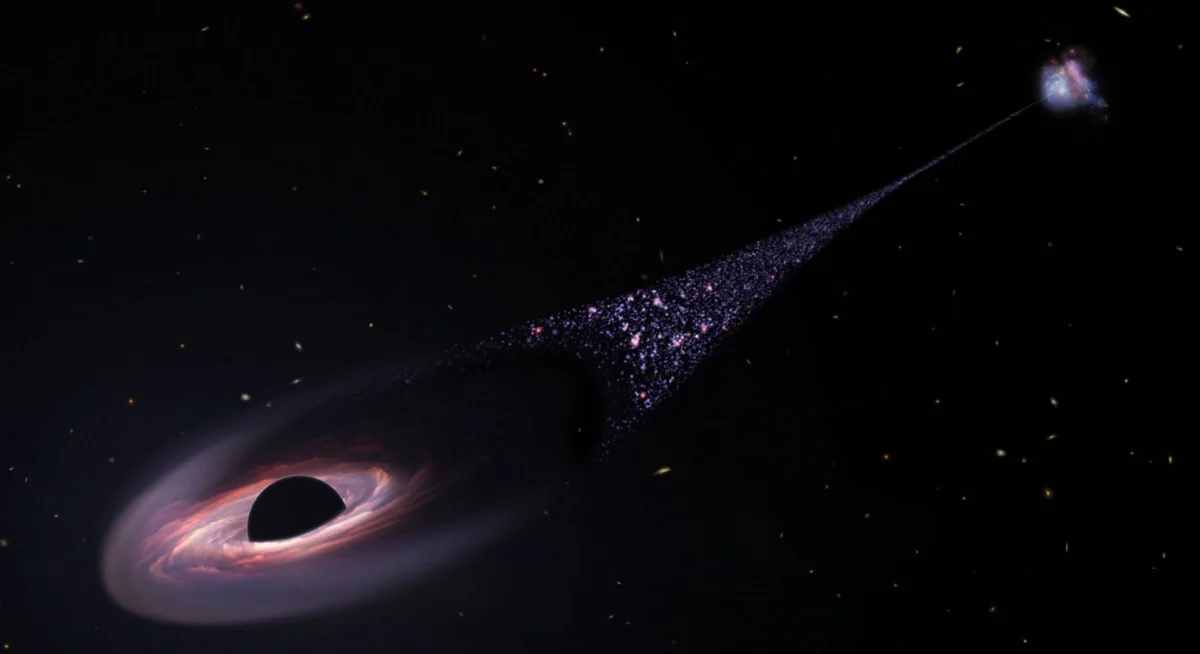
In the vast, silent reaches of the cosmos, 7.5 billion light-years from Earth, a cosmic event of unprecedented violence has left a permanent scar on the fabric of intergalactic space. Astronomers have recently completed a forensic reconstruction of a "runaway" supermassive black hole (SMBH), designated RBH-1, which was ejected from its home galaxy following a cataclysmic merger. This discovery, facilitated by the combined prowess of the Hubble Space Telescope and the James Webb Space Telescope (JWST), marks the first time scientists have successfully traced such an object back to its point of origin, providing a rare glimpse into the extreme gravitational forces that govern the evolution of galaxies.
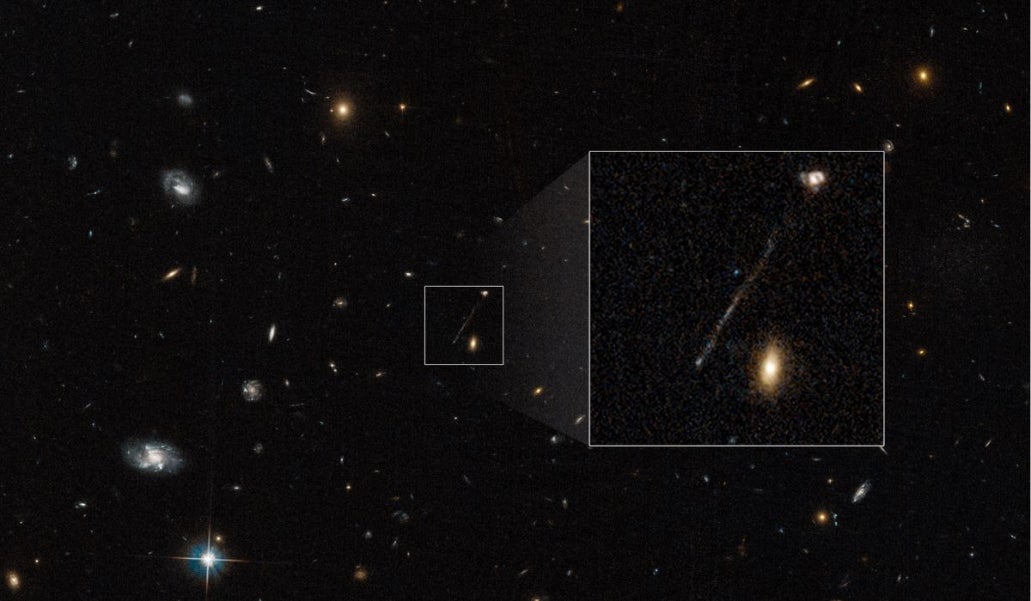
The saga of RBH-1 began in September 2022, when researchers first noticed a bizarre anomaly in deep-space imagery. Extending from a distant galaxy was a narrow, luminous filament stretching over 202,000 light-years—a distance more than double the width of our own Milky Way. At the tip of this celestial bridge lay an "unresolved feature," a concentrated point of energy devoid of starlight but possessing immense mass. Moving at a staggering velocity of approximately 1,000 kilometers per second (620 miles per second), this object was not merely drifting; it was a projectile, plowing through the tenuous gas of the circumgalactic medium and triggering a "wake" of newborn stars in its path.
The Discovery and the Trail of Stars
Initial observations of the 202,000-light-year streak were met with skepticism, as some astronomers suggested the feature might be an imaging artifact or a thin, edge-on galaxy. However, spectroscopic analysis quickly dispelled these doubts. The streak was composed of young, hot blue stars, formed from the compression of intergalactic gas. As the supermassive black hole—a dense, invisible anchor of gravity—hurtles through space, it creates a bow shock. This shock compresses the surrounding gas to the point of gravitational collapse, sparking the birth of new stars.
This "trail of breadcrumbs" led directly back to the center of a host galaxy, which researchers have since named GX. The distance and velocity of RBH-1 suggested a violent expulsion, a phenomenon long predicted by Albert Einstein’s General Theory of Relativity but rarely seen in such a dramatic, observable fashion. To understand how a black hole containing the mass of millions of suns could be kicked out of its home, a team led by Tousif Islam, a professor at the University of California, Santa Barbara’s Kavli Institute for Theoretical Physics (KITP), turned to advanced computational modeling.
The Physics of the Gravitational Kick
The ejection of a supermassive black hole is the result of a process known as gravitational wave recoil. According to General Relativity, when two massive objects like black holes orbit each other, they warp the geometry of spacetime, emitting ripples known as gravitational waves (GWs). As the black holes spiral closer and eventually merge, these waves carry away immense amounts of energy.
If the merging pair is perfectly symmetrical—possessing equal mass and identical spin—the gravitational waves are emitted uniformly in all directions. However, the universe is rarely so balanced. In cases where the black holes have different masses or misaligned spins, the gravitational waves are emitted asymmetrically. This "lopsided" emission creates a net momentum in one direction, acting like a rocket engine. When the two holes finally coalesce into one, the resulting single black hole receives a "kick" or recoil in the opposite direction of the strongest wave emission.
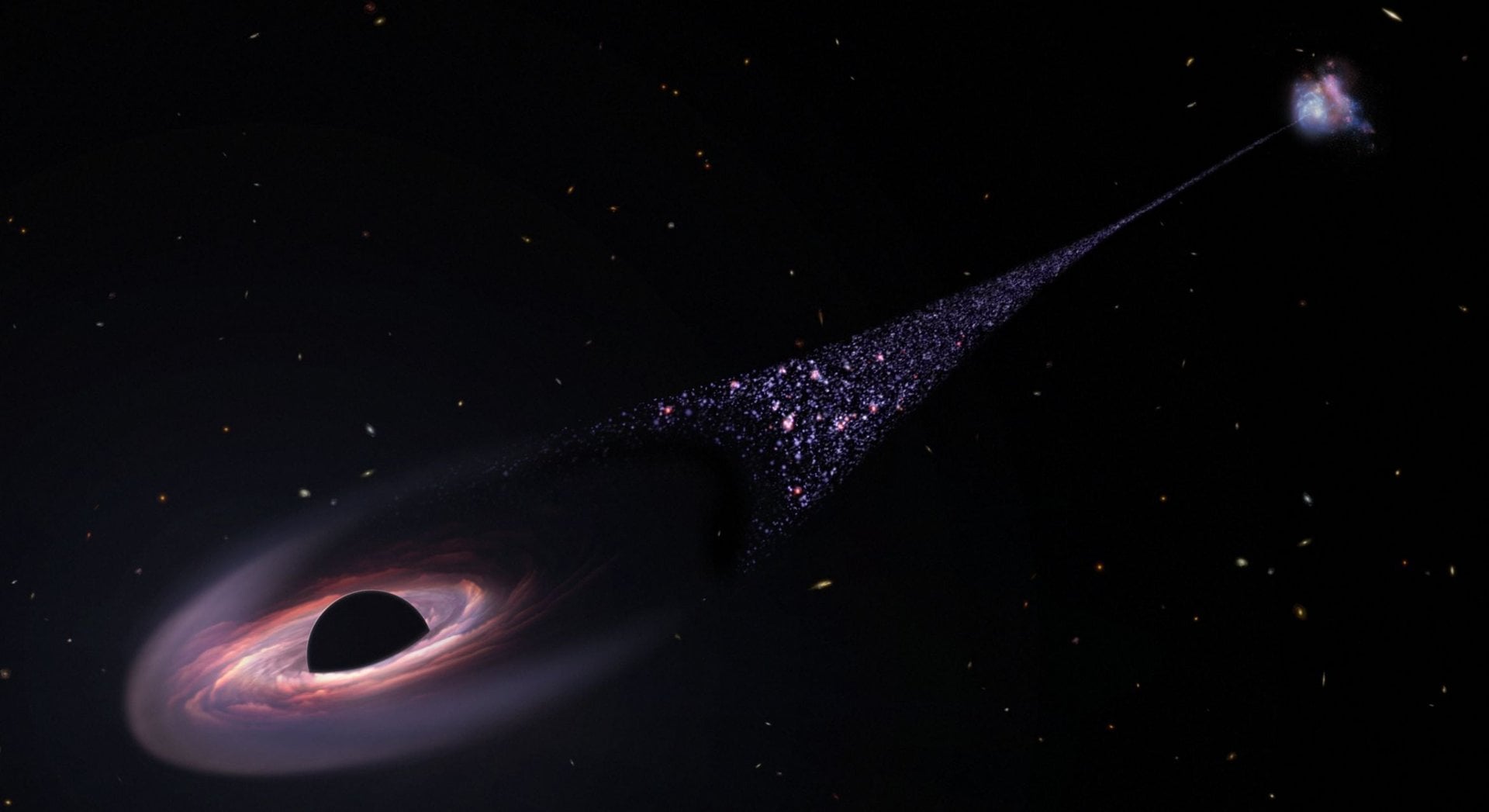
In the case of RBH-1, the kick was so powerful that it exceeded the escape velocity of its host galaxy. The black hole was essentially fired into the intergalactic void, destined to wander the darkness forever.
Reconstructing the Collision: The UCSB Study
The study, published in the prestigious journal Physical Review Letters, utilized a "forensic" approach to simulate the conditions of the merger. Tousif Islam and his colleagues, including co-author Tejaswi Venumadhav, an associate professor of physics at UCSB, conducted hundreds of thousands of simulations using supercomputers. Their goal was to find the specific combination of mass, spin, and orbital mechanics that could produce a recoil velocity of 1,000 km/s.
By a process of elimination, the team narrowed down the characteristics of the "progenitor" black holes. Their findings revealed a highly chaotic and asymmetric event:
- Mass Ratio: The two parent black holes were not equals. The larger of the two was at most six times more massive than the smaller one.
- Spin Dynamics: Both black holes were spinning at extreme speeds. The more massive of the pair was rotating at approximately 70% to 75% of the maximum speed allowed by the laws of physics.
- Misalignment: Crucially, the spins of the two black holes were not aligned with their orbital plane. They were tilted and "wobbling" (precessing) as they spiraled inward.
"I was initially surprised by how extreme this sounds," noted Professor Venumadhav in a statement regarding the study’s findings. "But then I realized it probably had to be the case in order to have produced the dramatic feature visible in telescopes." The extreme tilt and high spin rates were the only way to generate the necessary "kick" to launch a multi-million-solar-mass object at such a high velocity.
A Chronology of Galactic Mergers
The timeline of RBH-1 provides a window into the "middle ages" of the universe. The light we observe today left the galaxy GX roughly 7.5 billion years ago. However, the merger event itself occurred even earlier. Based on the length of the star trail and the velocity of the black hole, the team estimates that the two progenitor galaxies began their final collision approximately 70 million years before the ejection of RBH-1.
This 70-million-year period represents the time it took for the two galaxies to merge, for their respective central black holes to sink to the new galactic center via dynamical friction, and for the final "inspiral" and merger to take place. Recent observations from the James Webb Space Telescope have shown that supermassive black holes existed much earlier in the universe’s history than previously thought—some appearing as early as 500 million years after the Big Bang. By the time RBH-1 was ejected (around 6 billion years after the Big Bang), the universe was already populated with mature, massive galaxies that had grown through successive mergers.
The galaxy GX still bears the scars of this ancient collision. Astronomers noted that the galaxy appears disturbed, with its own rotation misaligned—a direct consequence of the smaller galaxy’s impact 70 million years prior.
Broader Implications for Gravitational Wave Astronomy
The study of RBH-1 is more than just a curiosity; it is a vital piece of evidence for the burgeoning field of multi-messenger astronomy. While the Laser Interferometer Gravitational-Wave Observatory (LIGO) has detected dozens of mergers between stellar-mass black holes (objects 10 to 100 times the mass of the sun), it is currently unable to detect the low-frequency waves produced by supermassive black hole mergers.
General Relativity predicts that between 5% and 10% of all galactic mergers should result in the ejection of the central black hole. If this is true, the universe may be filled with "rogue" black holes wandering between galaxies, invisible except for the rare instances where they interact with gas to form star trails like the one seen with RBH-1.
The detection of these events is a primary objective for the next generation of space-based observatories. The Laser Interferometer Space Antenna (LISA), a joint mission between NASA and the European Space Agency (ESA) scheduled for launch in the 2030s, will consist of three spacecraft flying in a triangular formation millions of kilometers apart. LISA will be sensitive enough to detect the low-frequency ripples from SMBH mergers, allowing scientists to "hear" the collisions that produce runaway objects like RBH-1 long before the light from the resulting star trails reaches our telescopes.
Conclusion: A New Era of Forensic Astrophysics
The reconstruction of the RBH-1 event marks a milestone in our ability to interpret the history of the universe. By combining the visual data from Hubble and Webb with the theoretical frameworks of General Relativity and advanced numerical simulations, astronomers are moving from merely observing the cosmos to "reconstructing" its most violent crimes.
The discovery confirms that the growth of galaxies is not a peaceful, additive process, but one defined by high-speed collisions and the occasional, violent expulsion of the very anchors that hold galaxies together. As we refine our ability to track these runaway giants, we may find that the intergalactic void is far more populated—and far more dynamic—than we ever dared to imagine. The story of RBH-1, a black hole kicked out of its home 7.5 billion years ago, is a testament to the enduring power of Einstein’s vision and the relentless curiosity of those who seek to map the dark corners of the universe.