Chandra Wibowo
Pineapple Financial has achieved a significant milestone in the tokenization of real-world assets, successfully migrating over $1 billion in residential mortgage records onto the Injective blockchain. This strategic move marks a pivotal step in the company’s ambitious plan to bring its entire historical loan portfolio onto the decentralized ledger, promising enhanced transparency, efficiency, and accessibility for financial instruments. The initiative positions Pineapple Financial at the forefront of a burgeoning trend in the financial sector, leveraging blockchain technology to unlock the liquidity and verifiability of traditionally illiquid assets like mortgages.
The scale of this undertaking is substantial. Injective, a layer-1 blockchain specifically engineered for financial applications, now hosts these foundational mortgage records. This is not a repackaging of existing mortgage-backed securities into new digital tokens; rather, each individual mortgage is represented by an immutable on-chain record directly linked to its underlying loan file. This approach ensures the integrity and authenticity of the data, creating a verifiable digital twin for each loan.
According to information released by Injective, Pineapple Financial has aspirations to migrate more than 29,000 funded mortgages, collectively valued at over $10 billion, onto the Injective network. This comprehensive migration is designed to create a transparent and auditable digital repository for a significant portion of the company’s assets. Each on-chain record is meticulously detailed, incorporating over 500 distinct data points. This wealth of information is critical for facilitating robust verification processes, establishing clear audit trails, and enabling sophisticated risk analysis. Pineapple Financial’s dedicated dashboard provides a clear view of this progress, indicating that the migration has already encompassed 2,079 mortgage records. This represents a notable increase from the initial launch phase in December 2025, when the initiative began with 1,259 records.
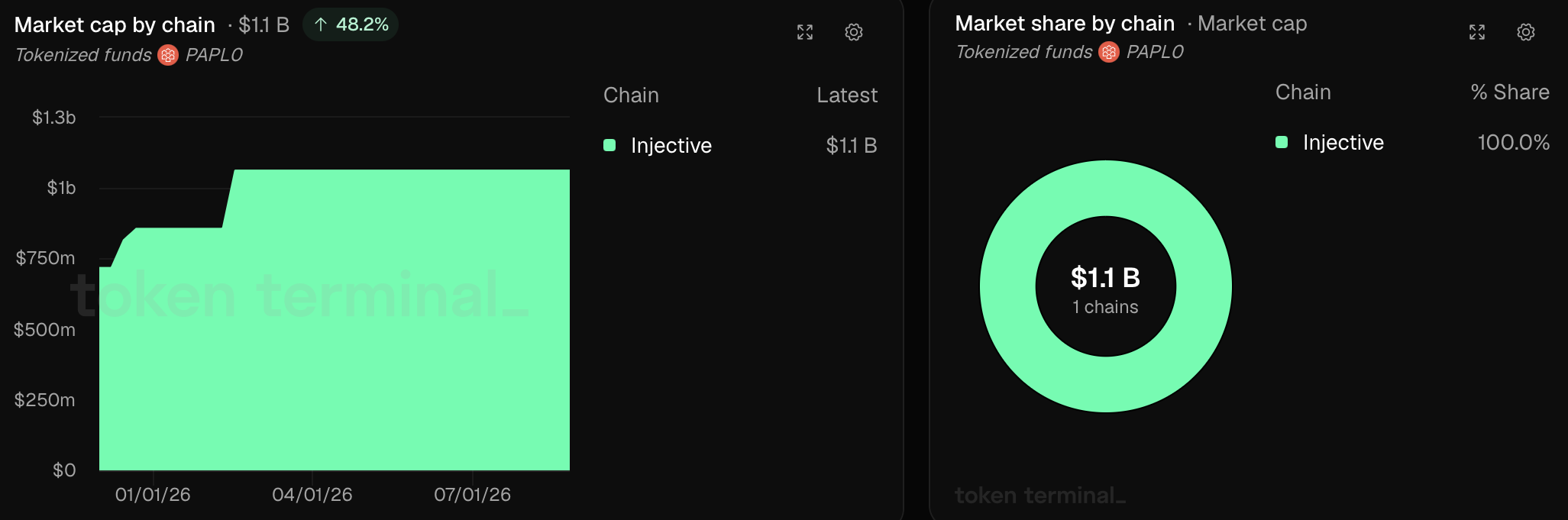
The economic impact of this migration is already being reflected in the performance of the associated on-chain asset. The PAPL0 token, which serves as the on-chain tracker for these mortgage records, boasts an asset market capitalization of approximately $1.1 billion. Data from Token Terminal reveals that this market cap has seen a remarkable increase of 48.2% over the past nine months. It is crucial to emphasize that these PAPL0 tokens represent the mortgage records themselves, not direct ownership of the underlying loans. This distinction is vital for understanding the nature of the asset and its associated value within the blockchain ecosystem.
Beyond the direct mortgage migration, Pineapple Financial’s engagement with Injective extends to a broader strategic partnership. This includes the establishment of a $100 million Injective (INJ) digital asset treasury. Pineapple Financial actively stakes INJ from this treasury, underscoring its commitment to the Injective ecosystem. Kraken plays a significant role in this arrangement, serving as a primary validator for these staked holdings, thereby contributing to the security and stability of the network. This multifaceted relationship highlights a deep integration between Pineapple Financial’s traditional financial operations and the decentralized infrastructure of Injective.

The Accelerating Wave of Real Estate Tokenization
The migration of mortgage records by Pineapple Financial arrives at a time when the tokenization of real estate is rapidly gaining momentum. Traditionally, real estate has been characterized by its illiquidity, making it difficult to divide, transfer, and access for investors. Blockchain technology offers a compelling solution by enabling the fractionalization of ownership and the creation of liquid digital representations of real estate assets and associated financial instruments.
This trend is not isolated to Pineapple Financial. In June, Apex Group, a prominent financial services provider, joined forces with established players like Goldman Sachs, Archax, and LRC Group to launch a tokenized real estate fund. In this innovative structure, shares of the fund are issued as digital tokens through Goldman Sachs’ Digital Asset Platform. This model provides investors with blockchain-based ownership of fund shares, moving beyond mere on-chain recording of property data to actual digital ownership.
Geographical hubs are also embracing real estate tokenization. Dubai, for instance, has been actively expanding its initiatives in this sector. In February, the Dubai Land Department initiated the second phase of a pilot program that had already seen approximately $5 million in property tokenized, with transactions recorded on the XRP Ledger. These developments underscore a global recognition of blockchain’s potential to revolutionize real estate transactions and investments.
However, despite these significant advancements, tokenized real estate still represents a relatively nascent segment within the broader market for tokenized real-world assets (RWAs). According to RWA.xyz, the tokenized real estate sector currently holds a distributed value of approximately $226.5 million, showing a growth of 11.7% over the preceding 30 days. This figure, while growing, is dwarfed by the total value of tokenized RWAs across all sectors, which stands at an impressive $38.8 billion. This comparison highlights both the immense potential for growth in tokenized real estate and the substantial existing market for other tokenized real-world assets.
Implications and Future Outlook
The move by Pineapple Financial to tokenize its mortgage records on Injective has several profound implications for the financial industry. Firstly, it significantly enhances transparency and auditability. By creating immutable on-chain records for each mortgage, all relevant parties—from originators and servicers to investors and regulators—can access verified information about the loan’s lifecycle. This can reduce information asymmetry and build greater trust within the financial ecosystem.
Secondly, the initiative promises to improve operational efficiency. Traditional mortgage servicing involves a complex web of manual processes, paperwork, and intermediaries. Tokenization can streamline many of these operations, potentially reducing costs and settlement times. For instance, the ability to verify loan data instantly on-chain could expedite due diligence processes for future transactions or securitizations.
Thirdly, this migration lays the groundwork for greater financial innovation. With mortgage records securely and verifiably on the blockchain, new financial products and services can be built upon this foundation. This could include more sophisticated forms of fractional ownership, collateralized lending against mortgage portfolios, or automated compliance checks. The data-rich nature of the on-chain records further supports advanced analytical tools for risk management and portfolio optimization.
The broader context of real-world asset tokenization underscores the strategic importance of Pineapple Financial’s actions. As institutions increasingly explore ways to leverage blockchain technology, the successful tokenization of a substantial mortgage portfolio serves as a powerful case study. It demonstrates the feasibility and tangible benefits of bringing traditionally opaque financial instruments into the transparent and efficient realm of decentralized finance.
The partnership with Injective is also noteworthy. Injective’s focus on financial applications suggests a deliberate choice by Pineapple Financial to align with a platform built to support complex financial transactions. The layer-1 blockchain’s architecture, designed for high throughput and low transaction costs, is well-suited for managing the vast amounts of data associated with a mortgage portfolio.
While the current market capitalization of PAPL0 at $1.1 billion is substantial, it represents only a fraction of the total value of mortgages Pineapple Financial intends to migrate. The projected $10 billion in tokenized mortgages indicates a significant expansion phase is still underway. The continued growth of the PAPL0 token’s market cap, up 48.2% in nine months, reflects growing market confidence and interest in this novel approach to mortgage asset management.
The implications for regulatory frameworks are also significant. As more real-world assets are tokenized, regulators will need to adapt and develop clear guidelines to ensure investor protection and market integrity. The transparency offered by blockchain technology could, in fact, simplify regulatory oversight in certain aspects, enabling more efficient monitoring of asset flows and compliance.
In conclusion, Pineapple Financial’s successful migration of over $1 billion in residential mortgage records onto the Injective blockchain is a landmark achievement. It not only showcases the practical application of blockchain technology in transforming traditional finance but also signals a significant step towards a future where real-world assets are more accessible, transparent, and efficient through tokenization. The company’s ambitious plans to tokenize over $10 billion more underscore the transformative potential of this technology for the mortgage industry and the broader financial landscape. The ongoing evolution of the tokenized real estate market, coupled with these large-scale initiatives, points towards a future where digital assets and traditional finance become increasingly intertwined.