Lina Irawan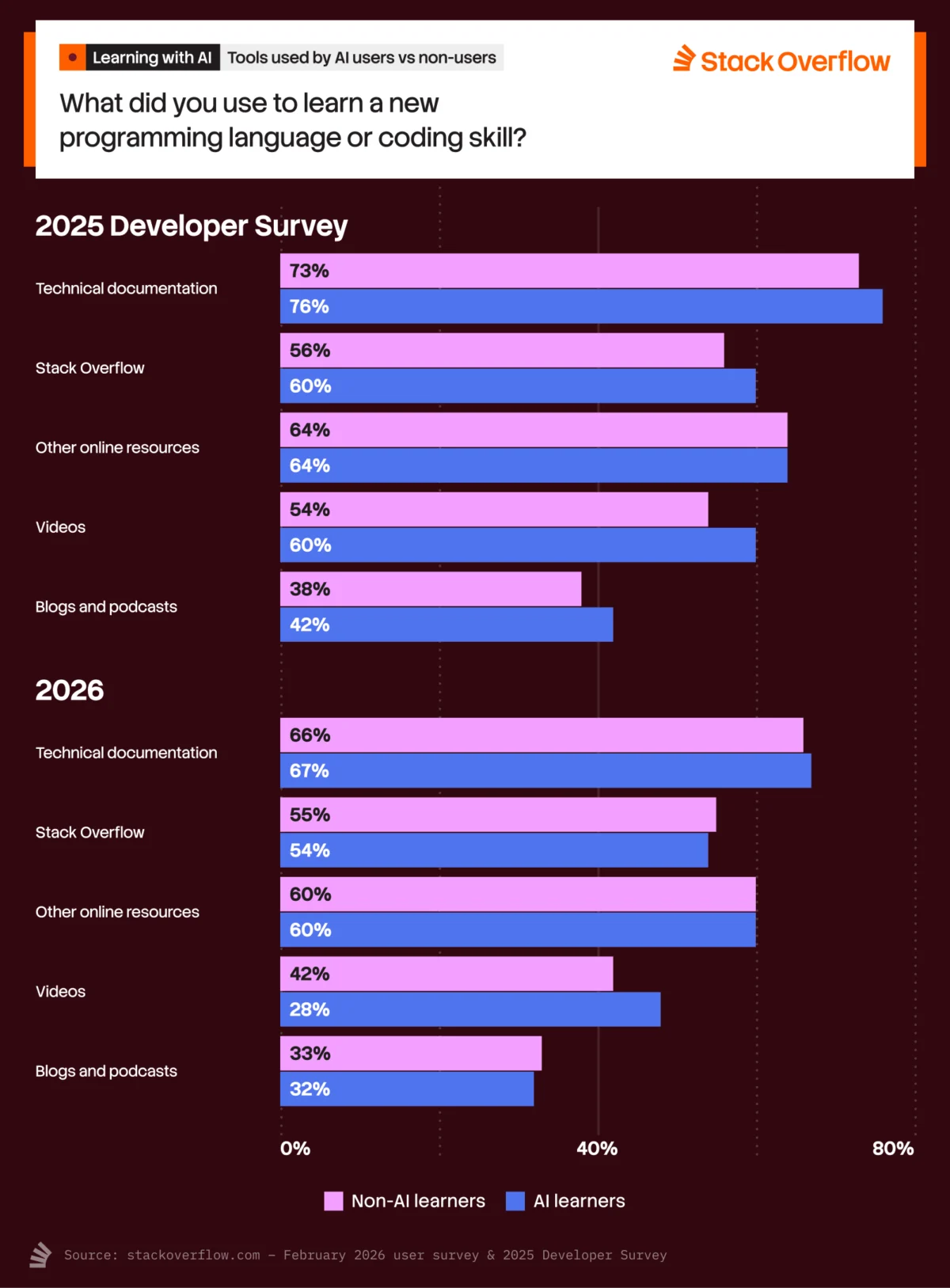
The landscape of professional development within the software engineering sector is undergoing a profound transformation as artificial intelligence moves from a novelty tool to a primary educational resource. According to recent data released by Stack Overflow, in partnership with OpenAI, the reliance on AI for learning to code has seen a dramatic surge, even as significant barriers regarding trust and the quality of information persist. This shift represents a broader disruption in how knowledge is acquired, verified, and applied in high-stakes technical environments. While developers are increasingly turning to Large Language Models (LLMs) to bridge skills gaps and accelerate productivity, the industry is simultaneously grappling with "cognitive offloading"—a phenomenon where over-reliance on automated tools may potentially hamper the deep critical thinking skills required for complex problem-solving.
The Rapid Ascent of AI in Technical Learning
The trajectory of AI adoption among developers has been characterized by an unprecedented growth rate over the last 24 months. Stack Overflow’s February pulse survey, which gathered insights from nearly 900 respondents, indicates that 64% of developers now use AI as a primary tool for learning. To put this into perspective, this is a significant leap from the 44% reported in early 2025 and the 37% recorded in 2024. This trend suggests that AI is no longer just a supplementary tool but is rapidly becoming the foundational layer for technical education.
The primary drivers for this adoption are rooted in the practicalities of modern software development: "starting from scratch" (28.2%) and "efficiency" (26.3%). For many, the "blank page" problem—the initial hurdle of starting a new project or learning a new syntax—is effectively solved by AI’s ability to generate boilerplate code and provide immediate, context-aware explanations. However, this efficiency comes with a trade-off. Research conducted by Microsoft suggests that while AI can accelerate the completion of tasks, the "cognitive offloading" associated with these tools might weaken the long-term retention of knowledge. When a developer relies on an AI to provide a solution rather than working through the logic independently, the mental pathways required for mastery may not be fully formed.
A Timeline of Tool Consolidation
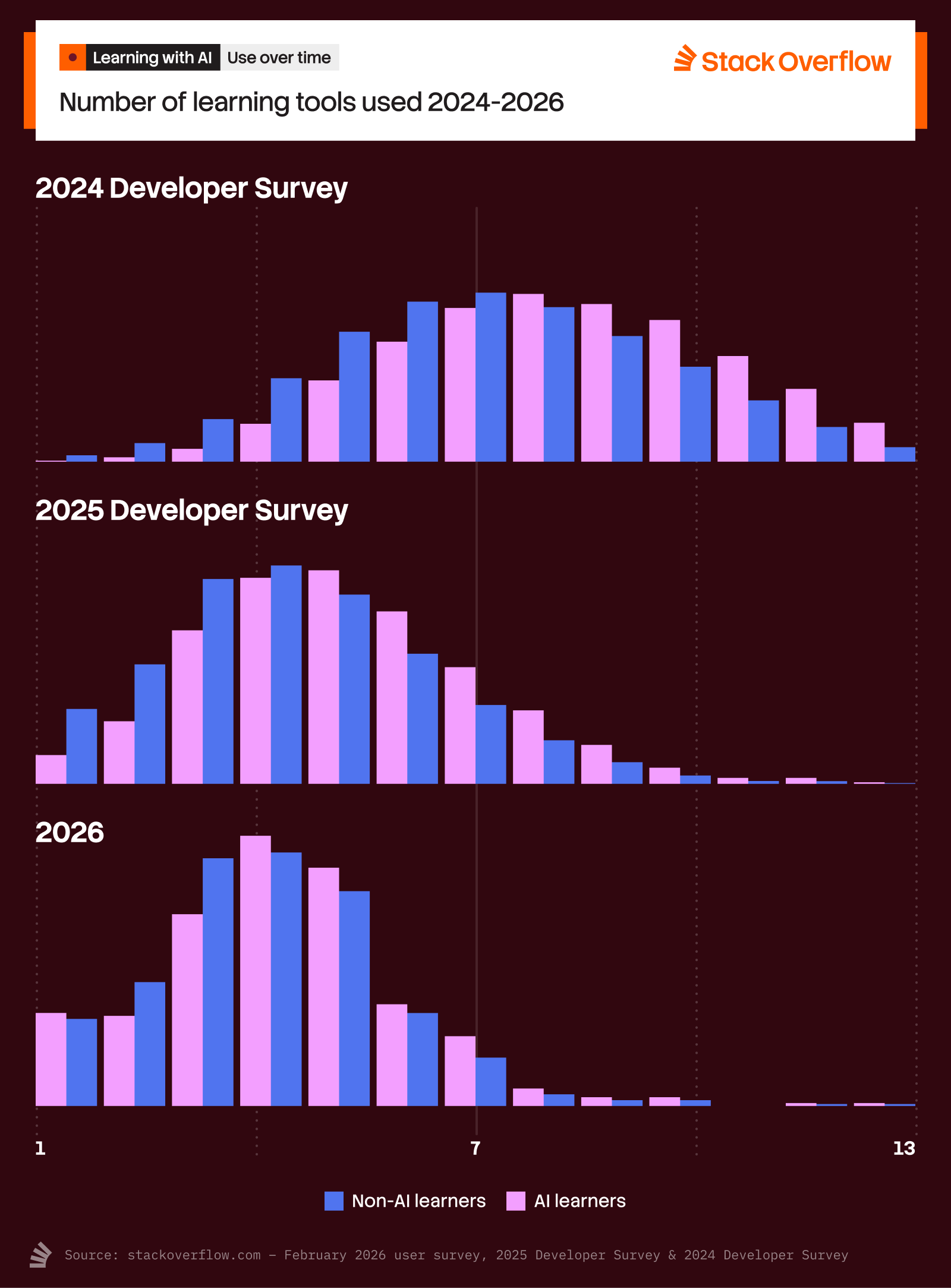
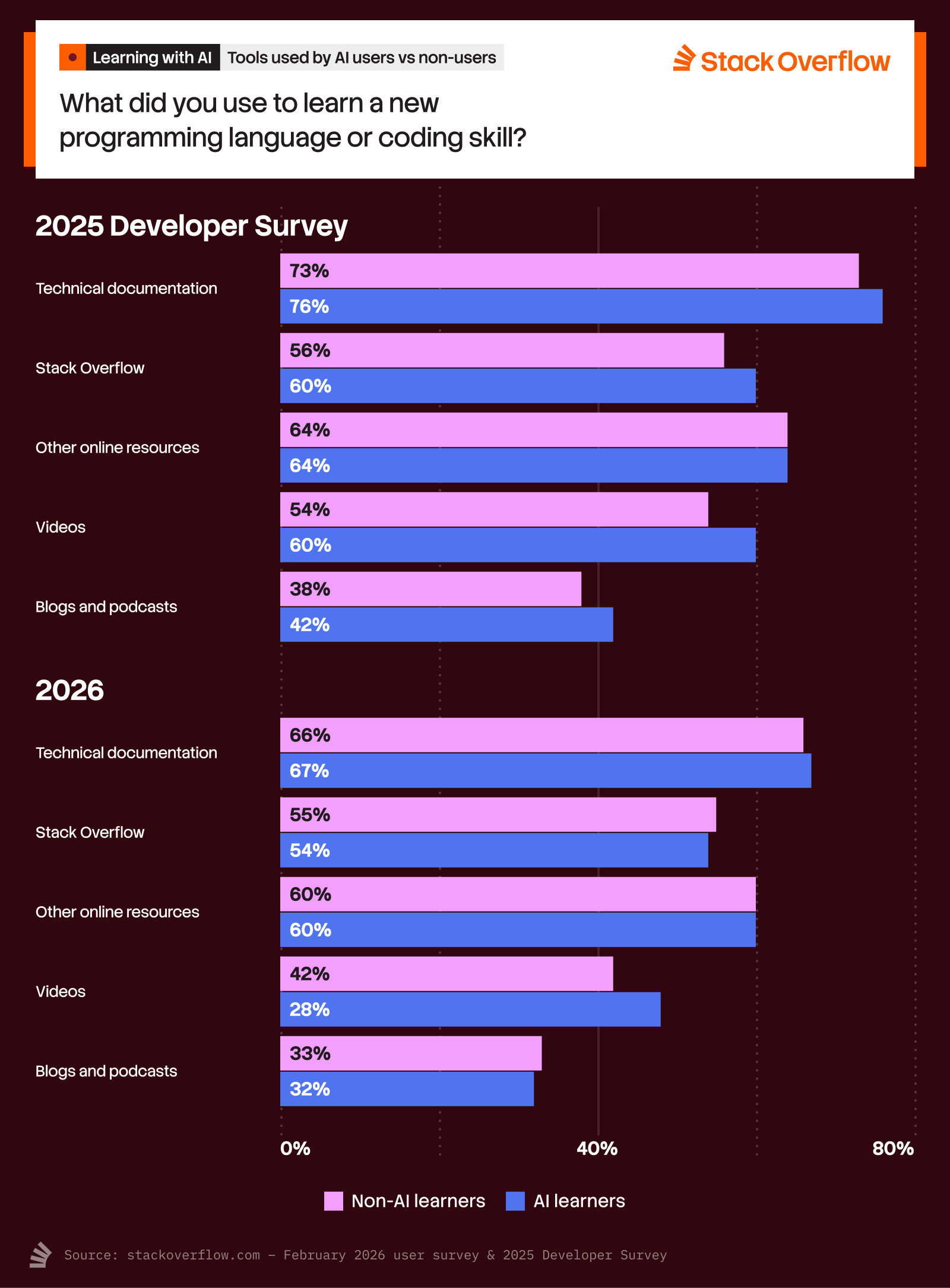
One of the most striking findings in the recent data is the consolidation of learning resources. As AI usage has climbed, the diversity of tools used by developers has inversely declined. In 2024, approximately 49% of developers reported using eight or more online resources to learn how to code. By early 2025, that figure plummeted to 9%, and the most recent pulse survey shows it has further dipped to 7%.
This consolidation suggests that AI is acting as a centralized hub, subsuming the roles previously held by disparate tutorials, documentation sites, and forums. This trend is not limited to those who use AI; even developers who eschew AI tools are reporting the use of fewer resources overall. This may be a systemic shift in the digital ecosystem, where search algorithms and content hubs are increasingly optimized for the types of summarized, direct answers that AI users have come to expect. The "less is more" trend is particularly prevalent among younger developers (ages 18-34), who appear to be leading the charge toward a more streamlined, albeit more centralized, learning experience.
The Experience Gap: Who Turns to AI First?
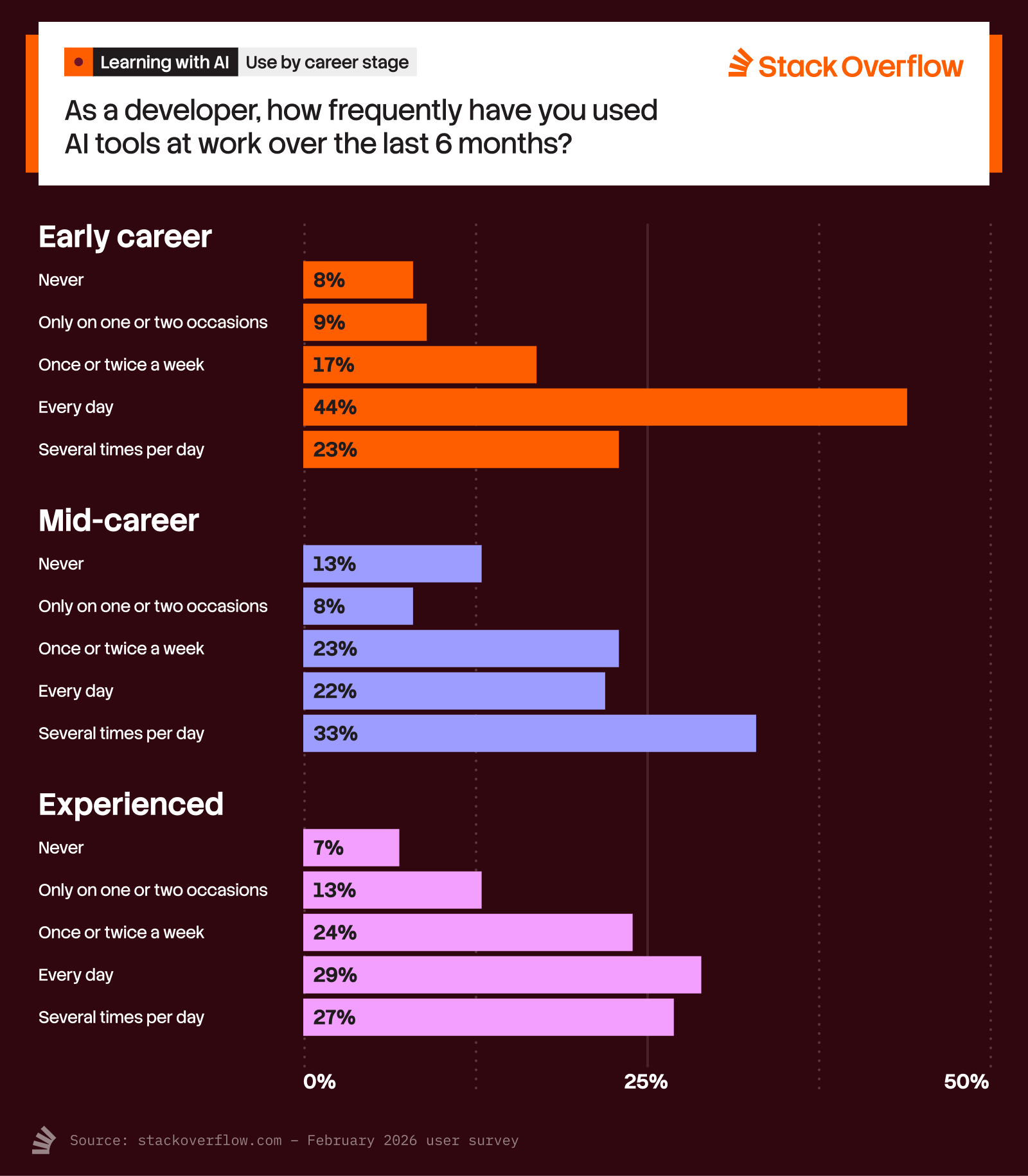
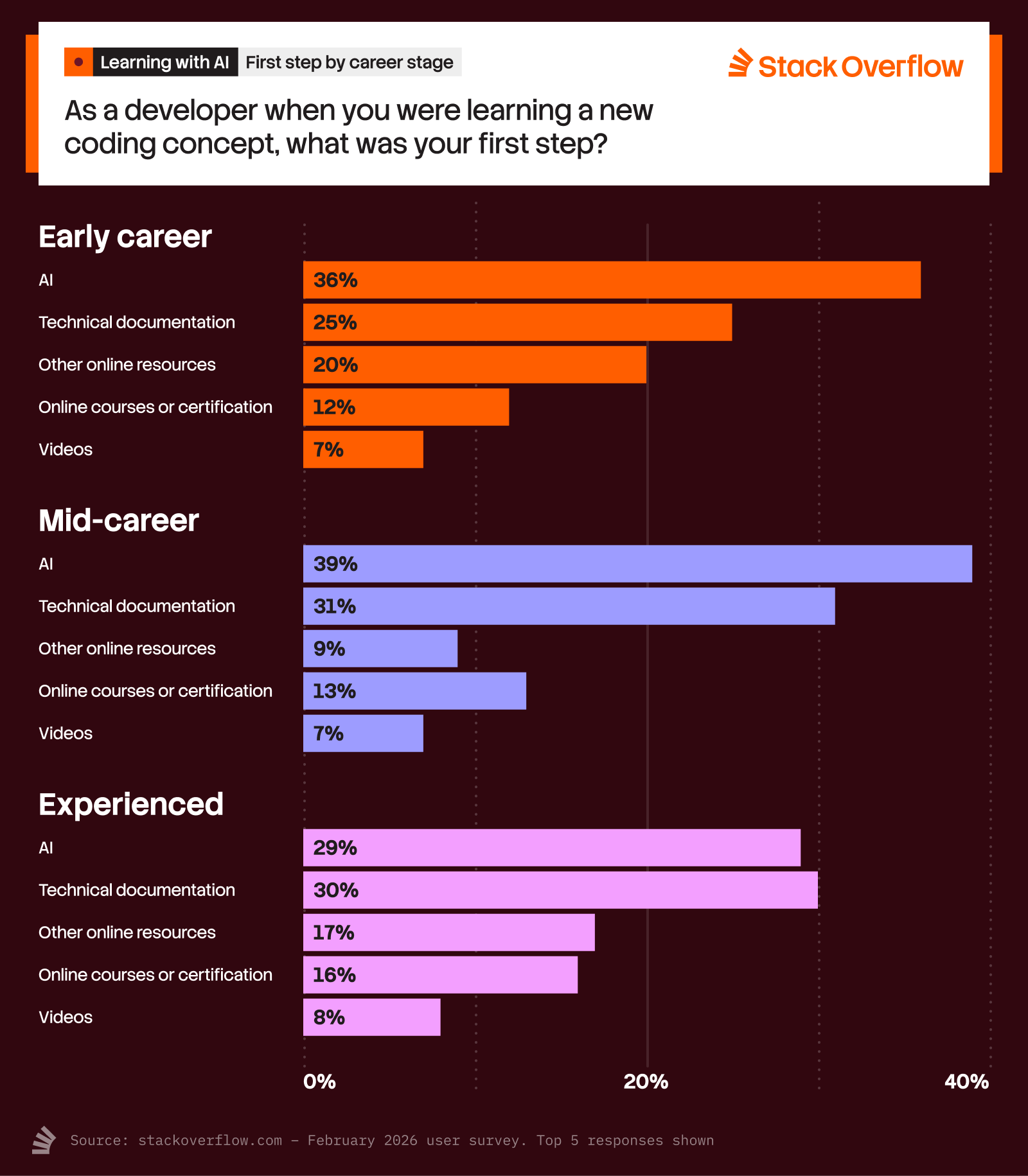
The adoption of AI is not uniform across all levels of professional experience. A clear generational and career-stage divide has emerged regarding "first-step" resources. Early-career developers (36%) and mid-career developers (39%) are significantly more likely to turn to AI as their first point of contact when faced with a learning challenge. In contrast, experienced developers remain divided, with 30% still favoring traditional technical documentation as their first step, compared to 29% who favor AI.
This disparity highlights a fundamental difference in how different cohorts view authority and reliability. For seasoned professionals, the primary source—the official documentation—remains the gold standard for accuracy. For newer developers, the speed and conversational nature of AI provide a lower barrier to entry. However, the survey also reveals that time is a major differentiator. Among developers who do not use AI to learn, 35% cite "lack of time" as their primary barrier. Paradoxically, those who do use AI cite time as a much lower concern (7%), suggesting that AI is successfully addressing the "time tax" inherent in traditional learning, even if it introduces new risks regarding accuracy.
The Trust Barrier and the "AI Tax"
Despite the efficiency gains, trust remains the most significant hurdle for the widespread acceptance of AI in professional workflows. Approximately 38% of respondents identified a "lack of trust in results" as the primary barrier to using AI for learning. This skepticism is more pronounced among experienced developers, who are often more attuned to the nuances and edge cases where LLMs are prone to "hallucinations" or providing outdated information.
Information architect Jessica Talisman describes this challenge as the "AI tax." According to Talisman, LLMs often mimic the structure of credible information—using citations and footnotes—without actually maintaining the "provenance" or the auditable trail of where that information originated. In traditional academic and technical systems, the value of knowledge is tied to its relationship with established facts and peer-reviewed sources. AI, by obscuring these relationships, forces the user to perform an additional "validation step."
The survey data supports this: only 1% of developers use AI in isolation. Instead, the vast majority (58%) use AI in conjunction with technical documentation, while 50% use it alongside community-driven platforms like Stack Overflow. This "hybrid" approach ensures that while AI provides the initial speed, human-curated resources provide the necessary verification.
Human Intervention and the Social Aspect of Learning
The research also underscores the enduring importance of human-centric environments in the learning process. A study involving Chinese university students found that despite the availability of online resources, students still overwhelmingly preferred face-to-face instruction. Interestingly, 62% of students reported that "humorous teachers" significantly improved their learning and memorization. This suggests that the ability to hold attention and provide emotional context—qualities currently lacking in AI—remains a critical component of effective education.
This human element extends to the professional world. Surveys by Owl Labs in the U.S. and Europe indicate that many organizations are pushing for hybrid or in-office models specifically to "reinforce team cohesion" and "improve collaboration." The implication for developer learning is clear: while AI can provide the "what" and the "how," the "why" and the nuanced mentorship required for career growth still largely occur in human-to-human interactions.
The Future of Certification and Job Search
As AI becomes more integrated into the learning journey, questions arise about how these skills should be validated. Currently, there is a palpable resistance to AI-driven certification and recruitment. While 57% of developers agree that AI tools have improved for learning, only 44% would value a certification issued by an AI platform.
The skepticism is even more pronounced when it comes to "agentic" job searches—where AI agents represent a candidate to employers. Only 16.9% of developers would "absolutely" use such a service. For the 23.8% who would consider it "under certain conditions," the top requirements are human intervention at every step (46.2%) and a transparent data usage policy (42.2%). This suggests that while developers are comfortable using AI to write code or learn a new language, they are not yet ready to cede control of their career trajectories to automated systems.
Implications for the Industry
The data from Stack Overflow and its partners paints a picture of an industry in transition. The "efficiency vs. trust" trade-off is the defining tension of the current era. As AI tools become more prevalent, the "AI tax"—the time spent verifying automated output—may become a standard part of the developer’s workflow.
Furthermore, the consolidation of learning resources suggests that the "discoverability" of information is changing. If developers are using fewer tools, the platforms that survive must offer high-density, high-accuracy information that can serve as a "ground truth" for AI validation. This places a premium on community-curated content and official documentation, which now serve as the critical guardrails for an AI-augmented workforce.
Ultimately, the rise of AI in developer education does not signal the end of traditional learning but rather a shift in its purpose. Learning is no longer just about acquiring information; it is increasingly about developing the discernment to navigate an environment where information is abundant but its reliability is not guaranteed. As the industry moves forward, the most successful developers will likely be those who can harness the speed of AI while maintaining the rigorous, skeptical mindset of a traditional engineer. The future of technical mastery lies not in choosing between human knowledge and artificial intelligence, but in mastering the intersection of the two.