Clarissa Hana
The digital landscape, increasingly defined by data exchange and online service subscriptions, has a persistent vulnerability: the direct exposure of users’ primary email addresses. In a significant stride towards bolstering online privacy, the Brave browser, renowned for its privacy-centric features, has rolled out version 1.94, introducing a novel "Email Aliases" functionality. This innovative feature empowers users to generate unique, disposable email addresses for each new online service they sign up for, effectively shielding their real inbox from the ever-growing threat of spam, data breaches, and intrusive marketing.
This development addresses a critical privacy gap that has long persisted despite advancements in web browsing security. While Brave has previously implemented robust data isolation techniques to prevent websites from correlating user identities through cookies or cache data, the fundamental reliance on a single, primary email address for account creation and communication remained a point of exposure. When users register with their personal email, that address is stored on the servers of potentially numerous third-party websites. This creates a direct link between the user’s identity and their communication channel, a link that can be exploited in various malicious ways.
The Genesis of Email Aliases: Addressing a Pervasive Privacy Concern
The impetus behind Brave’s Email Aliases feature stems from a deep understanding of the modern internet user’s experience. Signing up for a new service, whether it’s a social media platform, an online store, or a news outlet, invariably requires an email address. This seemingly innocuous requirement opens the door to a cascade of privacy risks.
Historically, the process has been straightforward: enter your email, receive a confirmation, and begin using the service. However, the consequences of this simple act can be far-reaching. If a website suffers a data breach, as evidenced by numerous high-profile incidents in recent years, the email addresses stored on its servers can be compromised. This leaked information can then be sold to data brokers, used for targeted advertising without consent, or, more ominously, become fodder for phishing and other social engineering attacks. Brave’s announcement highlights this concern, stating, "If a website you signed up for is hacked, your information can be leaked and end up with data brokers or worse. Your email address then circulates far beyond the company you originally trusted with it, and can show up in phishing campaigns for years afterward."
The introduction of Email Aliases directly confronts this vulnerability. By providing a unique, temporary email address for each service, users can effectively compartmentalize their online identities and communications. This means that if one service is compromised, only the alias associated with that service is exposed, leaving the user’s primary email address untouched. This significantly reduces the attack surface for phishing campaigns, which often leverage leaked email addresses to craft convincing, yet malicious, messages. Furthermore, it helps to curb the deluge of unsolicited marketing emails that plague many inboxes, as aliases can be easily deactivated or blocked.
Technical Underpinnings and User Experience
The implementation of Brave’s Email Aliases is integrated into the browser’s existing privacy architecture, requiring a foundational step for users: the creation of a free Brave Account. This account serves as the central hub for managing primary email registration and generated aliases. Crucially, this is a separate offering from Brave Premium, indicating a commitment to making core privacy features accessible to all users.
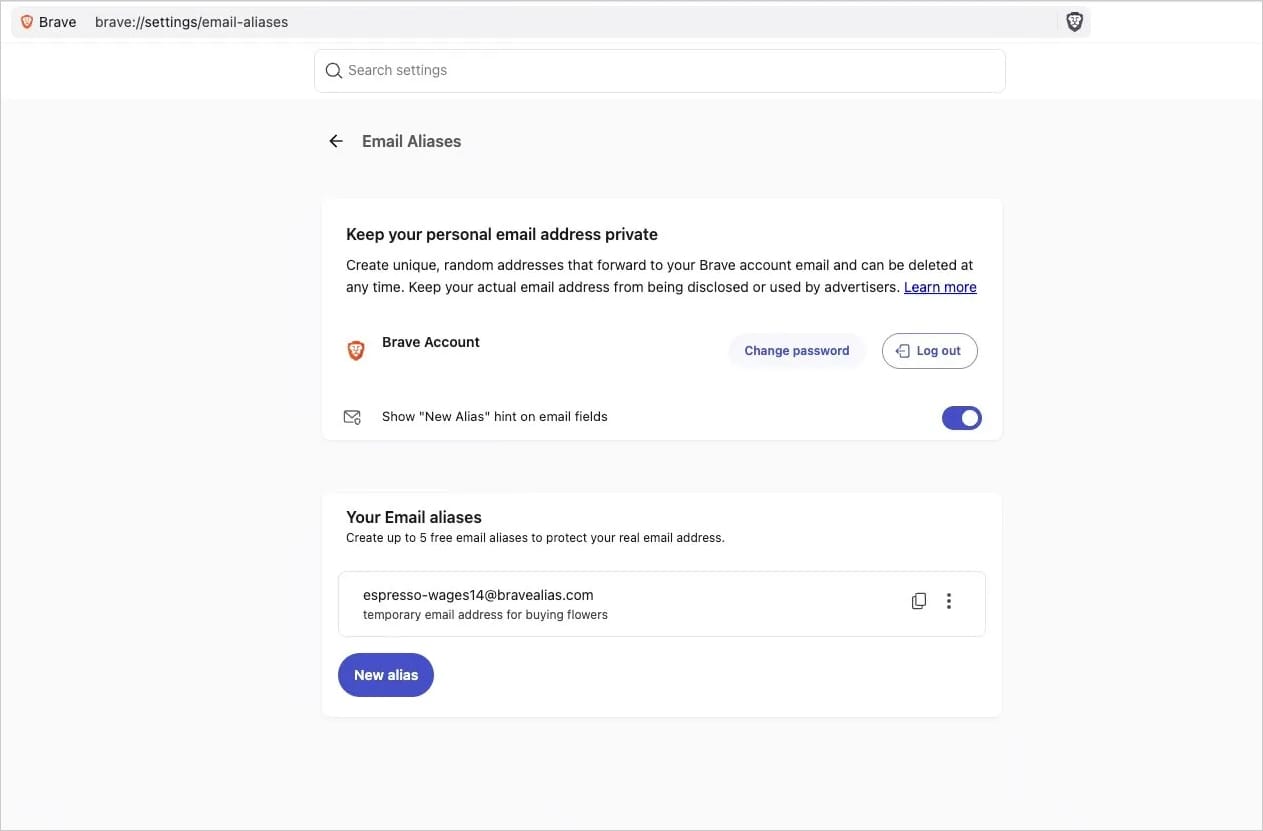
Upon registering their primary email address with their Brave Account, users can then leverage the new feature to generate aliases. When encountering a signup form for a new service, users can opt to use the Email Aliases feature. Brave will then generate a unique alias, which the user can associate with that specific website. All incoming emails from that service will be automatically forwarded to the user’s primary inbox, ensuring they don’t miss important communications. However, the website itself will only ever see the alias, not the user’s real email address.
To manage these aliases, users can access their Brave Account page. This interface allows for the generation of new aliases, the viewing of existing ones, and potentially the deactivation or deletion of specific aliases if a service is no longer needed or if the alias is being abused. This granular control empowers users to actively manage their digital footprint.
Security Beyond the Alias: Brave Accounts and OPAQUE Protocol
The introduction of Brave Accounts, a prerequisite for the Email Aliases feature, also brings to light Brave’s commitment to robust authentication security. In a separate announcement, Brave detailed its adoption of OPAQUE (Password Authenticated Key Exchange), a protocol standardized as RFC 9807. OPAQUE is a sophisticated method for user authentication that significantly enhances security by ensuring that neither user passwords nor their cryptographic hashes are ever transmitted to Brave’s servers.
This design choice mitigates common security risks associated with traditional authentication systems. It effectively prevents adversaries from gaining access to user credentials through methods like password logging, memory-scraping attacks on server infrastructure, or the bulk cracking of leaked password databases. By design, OPAQUE ensures that even if Brave’s servers were somehow compromised, the raw password information would not be exposed. This represents a proactive approach to security, anticipating and defending against sophisticated cyber threats.
However, Brave is transparent about the limitations of OPAQUE, noting that it does not protect users from phishing attacks that trick them into revealing their credentials directly, nor does it compensate for the use of weak or easily guessable passwords. This underscores the importance of a multi-layered approach to online security, where user vigilance remains a critical component.
Pricing and Future Development
Brave’s commitment to privacy is evident in its initial rollout of the Email Aliases feature. The service is offered free of charge, allowing users to generate up to five distinct email aliases. This generous free tier enables users to experiment with and benefit from the feature without immediate financial commitment.
Looking ahead, Brave has indicated plans to introduce a paid "Premium" version of the service. This paid tier is expected to lift the restriction on the number of aliases, providing unlimited alias generation for users who require a more extensive solution for managing their online presence. This tiered approach allows Brave to offer a valuable privacy tool to its entire user base while also providing an avenue for monetization to support ongoing development and innovation.
Technical Safeguards for Forwarded Messages
Privacy preservation extends to the handling of forwarded messages. Brave has implemented stringent measures to ensure that the content of emails routed through the alias system remains confidential and is handled with minimal exposure.
Firstly, the primary email address and all generated aliases are stored in an encrypted state on Brave’s servers. This means that even if unauthorized access to Brave’s infrastructure were to occur, the sensitive association between aliases and the user’s real email would remain protected.
Secondly, the forwarding process itself is designed to be as transparent and secure as possible. Forwarded messages undergo automated spam and malware filtering, a standard practice for email services. Beyond these essential checks, Brave states that the content of the messages is not scrutinized. This commitment to minimal inspection is crucial for maintaining user trust and ensuring that the privacy of their communications is respected.
Furthermore, the operational lifespan of forwarded messages on Brave’s servers is intentionally brief. Messages are reportedly deleted within seconds of being delivered to the user’s primary inbox. This ephemeral handling of data minimizes the risk of any message being intercepted or retained unnecessarily. Any notes or metadata attached to the aliases are either stored locally on the user’s device or, if synced via Brave Sync, are protected by end-to-end encryption, ensuring that only the user can access this information.
Navigating Early Adoption Challenges
As with any new technology, users embracing Brave’s Email Aliases feature may encounter some initial hurdles. Brave itself has cautioned that forwarded messages might, in the early stages, land in users’ spam folders. This is a common phenomenon for new email providers or forwarding services as their sending reputation is being established. Internet service providers and email gateways often employ sophisticated algorithms to detect spam, and newly introduced sending patterns can sometimes trigger these filters.
Users are advised to be mindful of this possibility and to check their spam or junk folders during the initial period of using the alias feature. Proactively marking forwarded messages as "not spam" can help train these filters and improve the deliverability of future emails. As Brave establishes a robust sending reputation, this issue is expected to diminish, ensuring a seamless experience for users.
Broader Implications for Online Privacy
The introduction of Brave’s Email Aliases feature is more than just a technical upgrade; it signifies a broader shift in how privacy is being integrated into the core functionalities of web browsing. In an era where data is often described as the "new oil," users are becoming increasingly aware of the value of their personal information and the potential for its exploitation. Features like disposable email aliases empower individuals to regain a measure of control over their digital identities.
This innovation has several significant implications:
- Reduced Spam and Phishing: By decoupling primary email addresses from online service registrations, the volume of targeted spam and phishing attempts is likely to decrease significantly for users who adopt this feature. This not only saves users time and frustration but also reduces their exposure to potentially harmful scams.
- Enhanced Data Breach Resilience: In the unfortunate event of a data breach, the impact on users who have utilized email aliases will be considerably lessened. Their primary email address, a critical gateway to many online accounts and personal communications, will remain secure.
- Greater Control Over Digital Footprint: The ability to generate and manage unique aliases for each service provides users with unprecedented control over their online presence. They can effectively "prune" their digital connections by deactivating aliases associated with defunct or untrustworthy services.
- Catalyst for Industry-Wide Change: As more users demand greater privacy and innovative solutions like Brave’s Email Aliases gain traction, it could pressure other browser developers and online service providers to adopt similar privacy-enhancing measures. This could lead to a more privacy-respecting internet ecosystem overall.
- Support for Decentralized Identity: While not a fully decentralized identity solution, this feature aligns with the broader movement towards giving users more ownership and control over their data and digital interactions, moving away from centralized, vulnerable systems.
The ongoing evolution of online threats necessitates continuous innovation in privacy protection. Brave’s proactive approach with features like Email Aliases and its secure authentication methods for Brave Accounts demonstrates a clear commitment to safeguarding its users in an increasingly complex digital world. As the internet continues to permeate every aspect of our lives, tools that empower users to navigate it with greater security and privacy will undoubtedly become indispensable. The successful integration and adoption of this feature could well set a new standard for privacy-conscious browsing.