Sisilia Frederika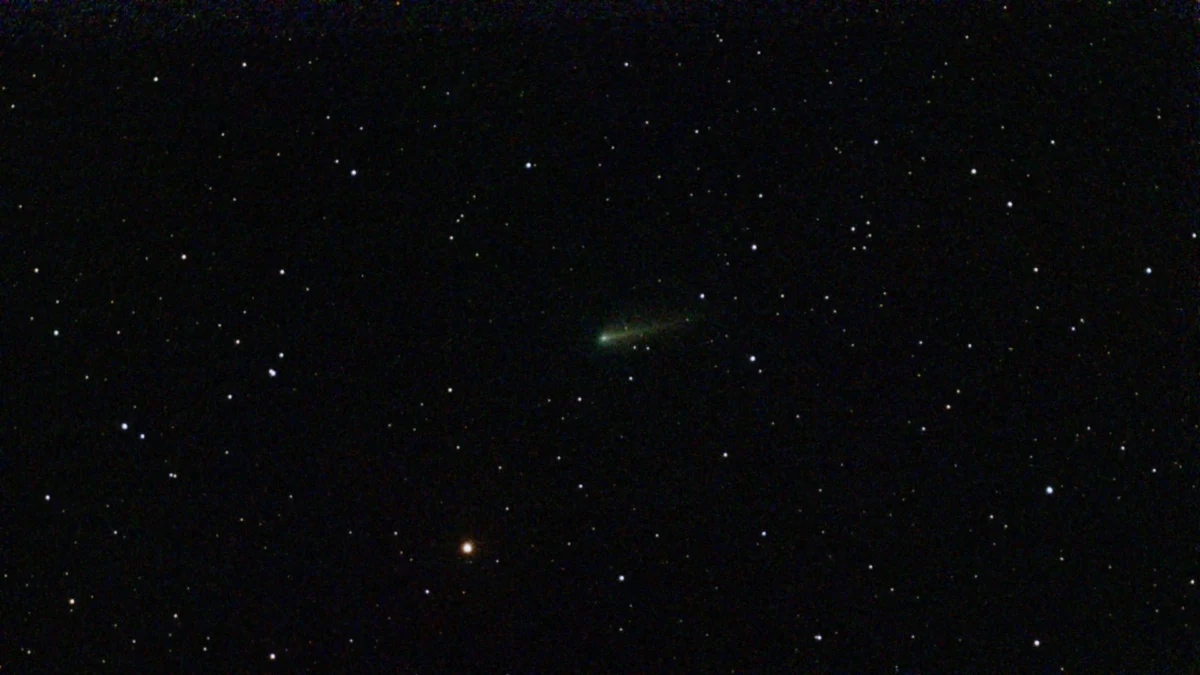
The astronomical community is turning its attention toward the dawn sky as Comet 220P/McNaught undergoes a series of unexpected brightness outbursts, significantly increasing its visibility to amateur observers. Currently traversing the inner solar system on its outbound journey, the comet has defied typical fading patterns, flaring back into the range of binocular visibility. This surge in activity coincides with a remarkably busy period for celestial events, positioned between the total solar eclipse of August 12 and the deep partial lunar eclipse scheduled for August 28, 2026. While many periodic comets fade quietly as they retreat from the Sun, 220P/McNaught is exhibiting volatile behavior that suggests its 2026 apparition may conclude with further dramatic displays.
Discovery and Orbital Characteristics
Periodic comet 220P was first identified on May 20, 2004, by Robert H. McNaught, one of the most prolific comet hunters in history. Observing from the Siding Spring Observatory in New South Wales, Australia, McNaught captured the object during his work with the Siding Spring Survey. The comet was later confirmed to be a short-period visitor with an orbital period of approximately 5.5 years.
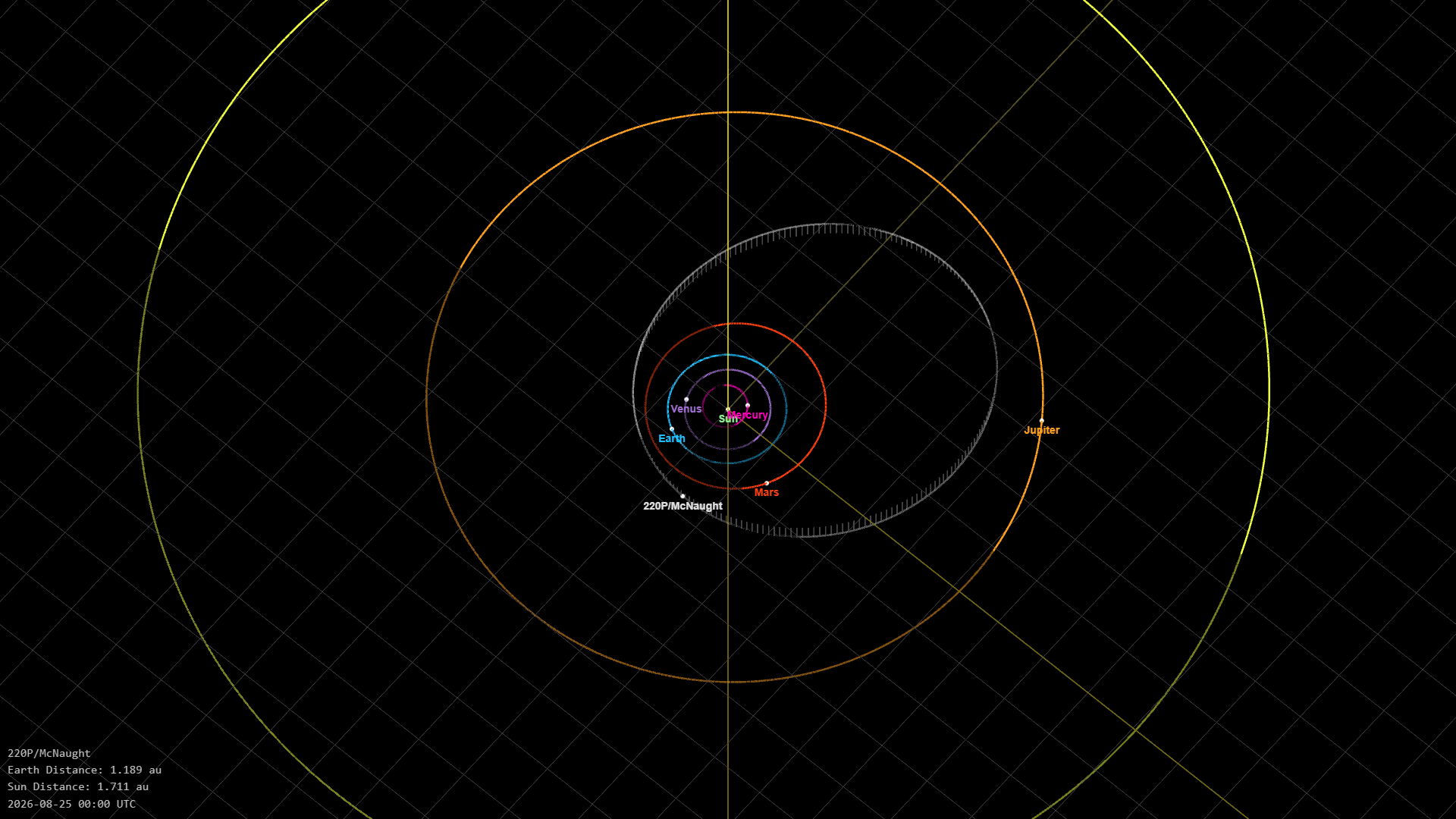
Classified as a Jupiter-family comet, 220P/McNaught is under the heavy gravitational influence of the solar system’s largest planet. It exists in a 2:1 orbital resonance with Jupiter, a configuration that provides a level of long-term stability but also subjects the comet to frequent gravitational perturbations. These interactions often shepherd such objects into the inner solar system, where solar radiation begins the process of sublimation—turning the comet’s icy nucleus into a gaseous coma.
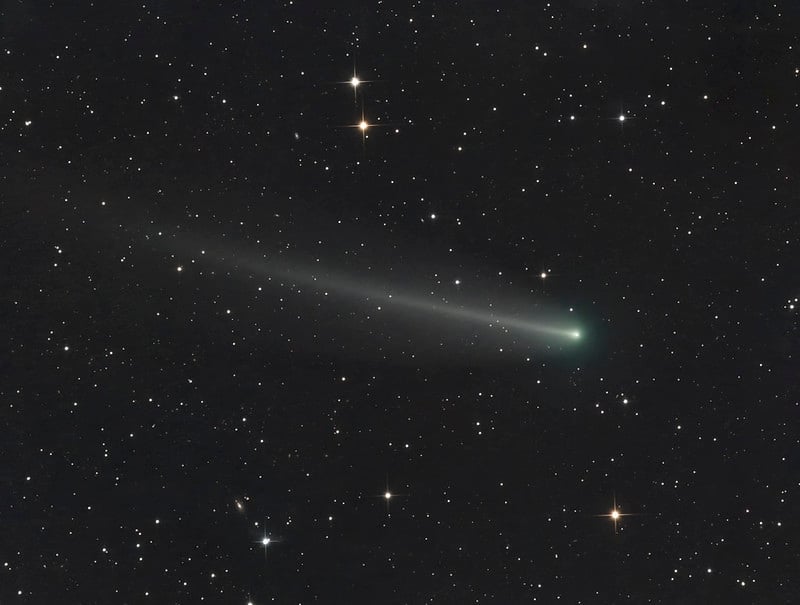
The comet’s current path brought it to perihelion—its closest approach to the Sun—on June 14, 2026. During this pass, it reached a distance of 1.6 Astronomical Units (AU) from the Sun, placing it just outside the orbit of Mars. While this distance is relatively modest for a comet, the internal composition of 220P appears particularly sensitive to solar heating, leading to the erratic behavior observed throughout the summer of 2026.
A Summer of Volatility: The 2026 Outbursts
The 2026 apparition of 220P/McNaught has been defined by two major outbursts that have caught researchers and amateur astronomers by surprise. Typically, comets follow a predictable light curve, brightening as they approach the Sun and dimming as they recede. However, 220P has deviated sharply from this model.
In early June, as the comet neared perihelion, it experienced a massive eruption. This event vaulted the comet’s brightness by nearly 10 magnitudes, representing an 8,000-fold increase in luminosity. Such extreme outbursts are rare in the catalog of known comets; the June event is currently ranked alongside the historic 2007 flare-up of 17P/Holmes and the 2013 outburst of Comet 289P/Blanpain. This initial flare brought the comet to a peak magnitude of +8, making it an easy target for binoculars in dark-sky locations.
Following a brief period of stabilization, a second significant outburst occurred in early August. This secondary event saw the comet’s brightness increase by approximately 7 magnitudes, or roughly 600 times its baseline luminosity. As of late August, the comet is maintaining a respectable magnitude of +9. This sustained brightness is particularly noteworthy because the comet is now outbound, moving away from its primary heat source.
Morphological Changes and Observer Reports
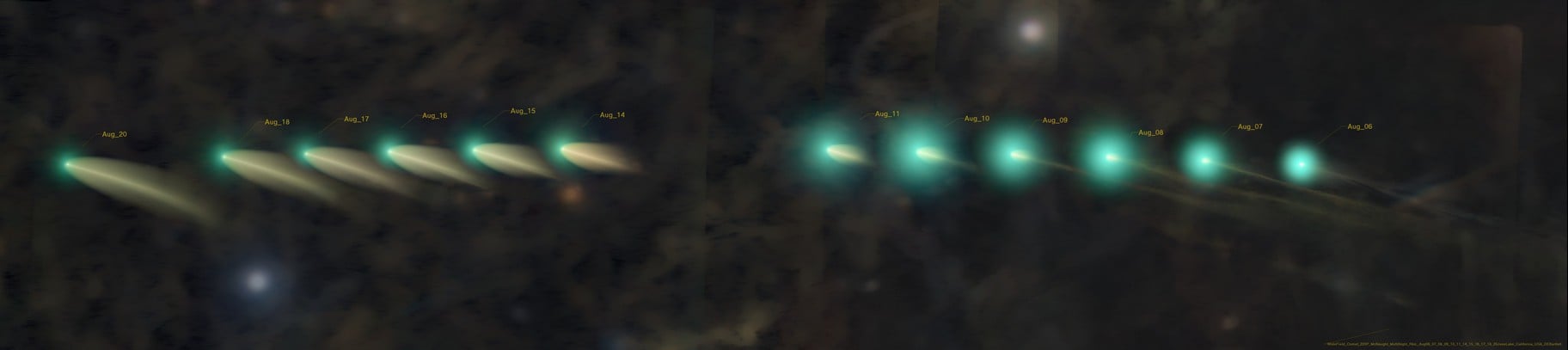
Astrophotographers and visual observers have noted that 220P/McNaught currently exhibits a "multi-personality" appearance. Analysis of image sequences, such as those compiled by veteran astrophotographer Dan Bartlett, reveals a highly dynamic structure that changes almost nightly.
During the peak of the outbursts, the comet’s coma—the envelope of gas and dust surrounding the nucleus—displays a distinct blue-green hue. This coloration is a hallmark of diatomic carbon (C2) and cyanogen (CN) gas being ionized by solar radiation. Observers have reported that the coma expands rapidly following an outburst before gradually dissipating and contracting.
The tail of 220P has been equally inconsistent. While a faint dust tail was visible during the early stages of the August outburst, it appeared to vanish around August 10, only to begin unfurling again in the third week of the month. This behavior suggests that the nucleus is experiencing localized "jets" or surface collapses, where fresh layers of volatile ices are suddenly exposed to space, creating temporary surges in dust and gas production.
Viewing Guide: Positioning in the Dawn Sky
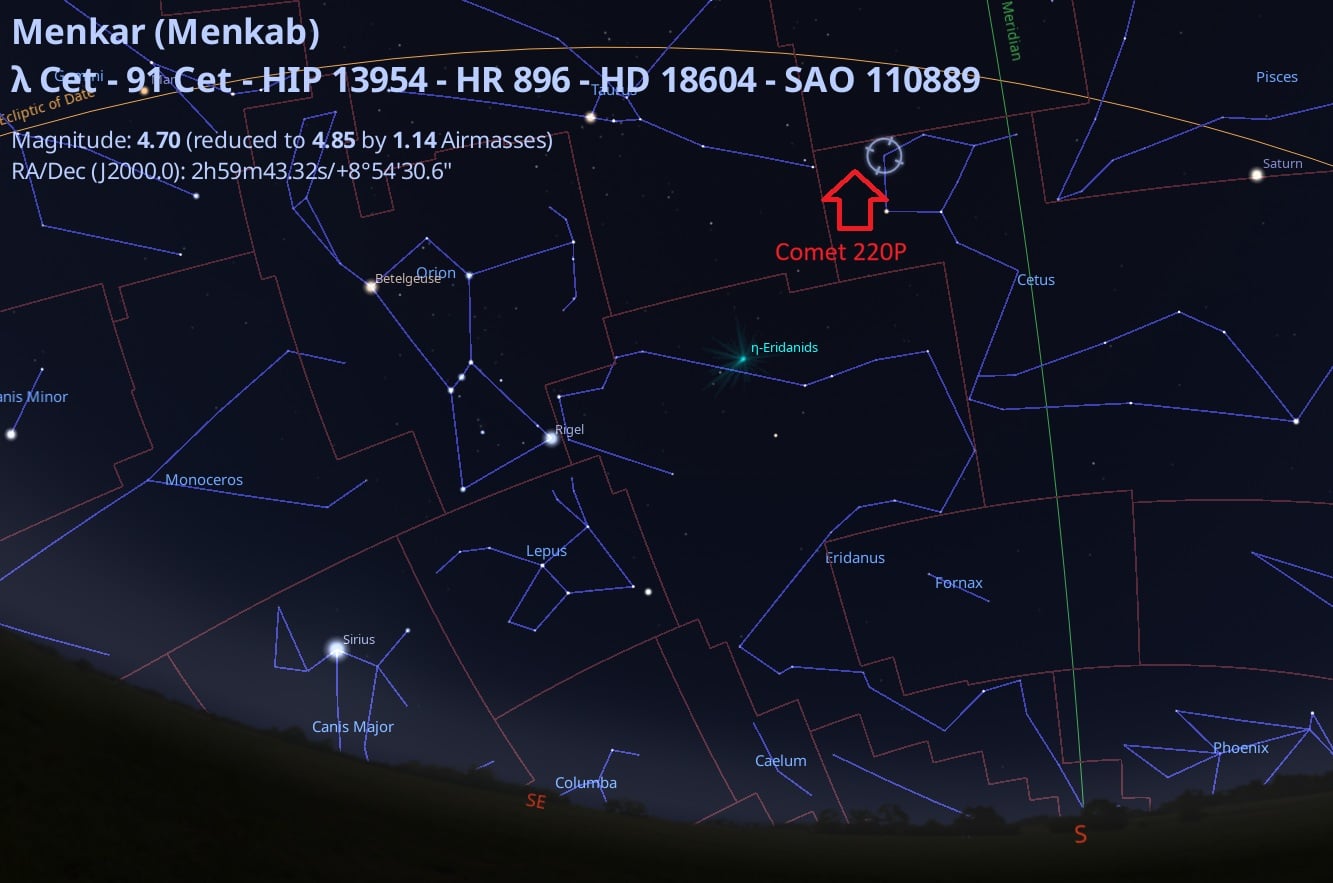
For observers in the Northern Hemisphere, Comet 220P/McNaught is currently well-placed for viewing in the pre-dawn hours. The comet is located high to the south about an hour before sunrise.
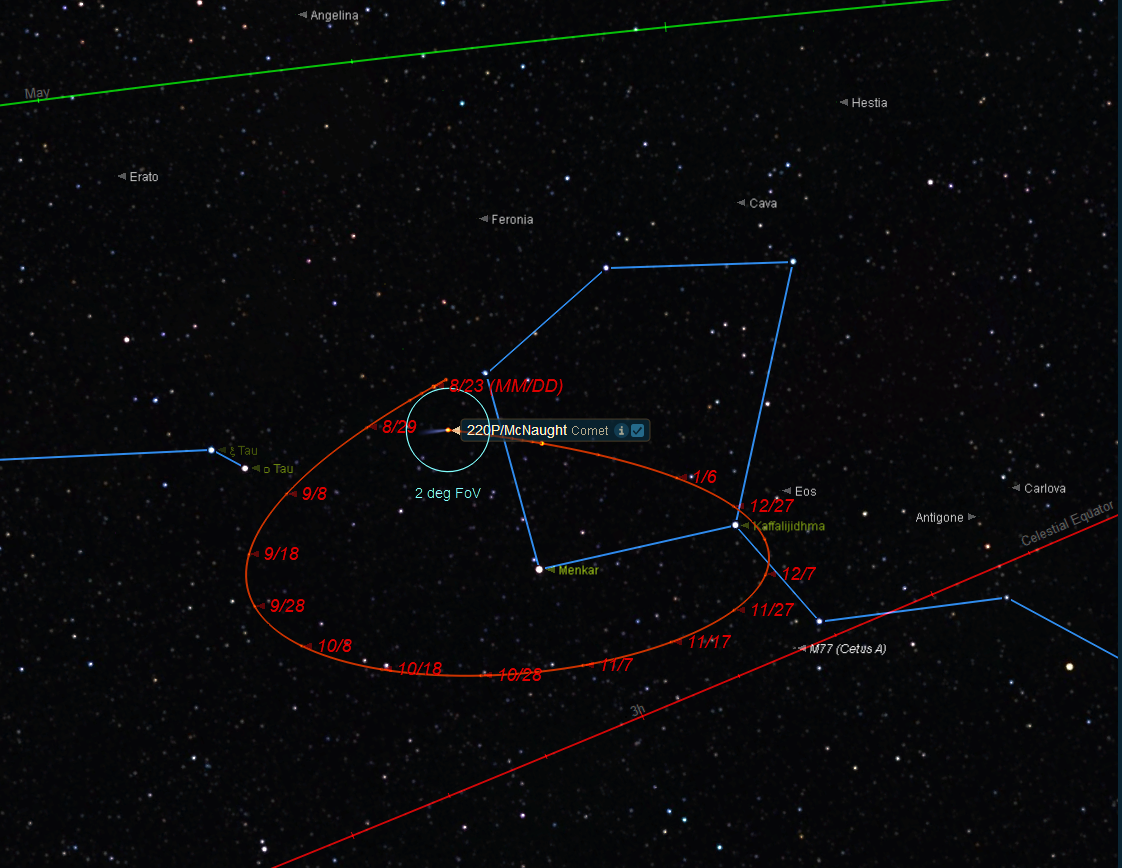
As of late August 2026, the comet is situated between the stars Omicron Tauri and Lambda Ceti. Throughout the remainder of the year, its apparent path will take it through the "Circlet of Pisces" asterism. A key navigational marker for observers is the +2.5 magnitude star Alpha Ceti (Menkar), which the comet will appear to circle as it moves through the constellation Cetus.
While a magnitude of +9 is technically within the reach of 7×50 or 10×50 binoculars under dark skies, observers should manage expectations. Unlike the pinpoint light of a star, a comet’s brightness is "diffuse," spread across the area of its coma. This makes it appear fainter than a star of the same magnitude. For many, the comet will look like a small, fuzzy "ghost" or a faint, out-of-focus globular cluster.
The rise of "smart telescopes" or "smartscopes," such as the Unistellar SeeStar or Dwarf Lab units, has made capturing 220P significantly easier for the general public. These automated systems use stacked exposures to cut through light pollution, allowing even urban observers to resolve the green tint of the coma and the structure of the tail.
Technical Analysis and Scientific Implications
The repeated outbursts of 220P/McNaught raise questions about the structural integrity of its nucleus. Comets are often described as "dirty snowballs" or "icy dirtballs," consisting of a fragile matrix of water ice, frozen carbon monoxide, carbon dioxide, and silicate dust. When a comet experiences a magnitude jump as large as the one seen in June, it often indicates a significant physical event on the nucleus.
Potential causes for these outbursts include:
- Subsurface Pressure Buildup: Volatile gases trapped beneath a crust of dust and non-volatile material can build pressure as the comet heats up. Eventually, the crust fractures, leading to an explosive release of gas and dust.
- Phase Transitions: Amorphous water ice can transition to a crystalline state when heated, a process that releases energy and can trigger outbursts.
- Rotational Instability: If the comet’s rotation increases due to outgassing jets, it may begin to shed material or even fragment.
Given that 220P is a relatively small body and is currently outbound, the fact that it continues to flare suggests it may be entering a period of fragmentation. Astronomers are closely monitoring the comet to see if the nucleus splits, an event that would likely result in a final, spectacular increase in brightness before the comet fades permanently into the outer solar system.
Timeline of Upcoming Milestones
As the 2026 apparition continues, several key dates remain on the astronomical calendar:
- August 28, 2026: Deep partial lunar eclipse. The comet will be visible in the same sky, providing a unique photographic opportunity for wide-field imagers.
- October 12, 2026: Closest approach to Earth. The comet will pass at a distance of 1.043 AU. Although it will be further from the Sun than it was in June, its proximity to Earth may keep its apparent magnitude high, especially if another outburst occurs.
- Late 2026: The comet is expected to fade below magnitude +12, becoming a target exclusively for large amateur telescopes and professional observatories.
- March 12, 2029: The comet reaches aphelion, its furthest point from the Sun, at a distance of 4.679 AU.
- Late 2031: Expected return to perihelion for its next inner solar system pass.
Conclusion: The Unpredictable Nature of Cometary Science
Comet 220P/McNaught serves as a reminder of the inherent unpredictability of the solar system. While orbital mechanics allow for the precise calculation of a comet’s path years in advance, the physical behavior of the comet itself remains elusive. The 2026 season has already proven that 220P is far more active than its previous apparitions suggested.
Whether the comet has a "final act" in store for its October Earth approach remains to be seen. For now, it remains a primary target for backyard astronomers and a subject of study for professionals seeking to understand the mechanisms of cometary outbursts. In an era of increasingly automated sky surveys, the erratic behavior of objects like 220P/McNaught continues to provide valuable data on the evolution and decay of the solar system’s most primitive building blocks. Observers are encouraged to take advantage of the current window of visibility, as the comet’s "multi-personality" nature ensures that no two nights of observation will be exactly the same.