Sisilia Frederika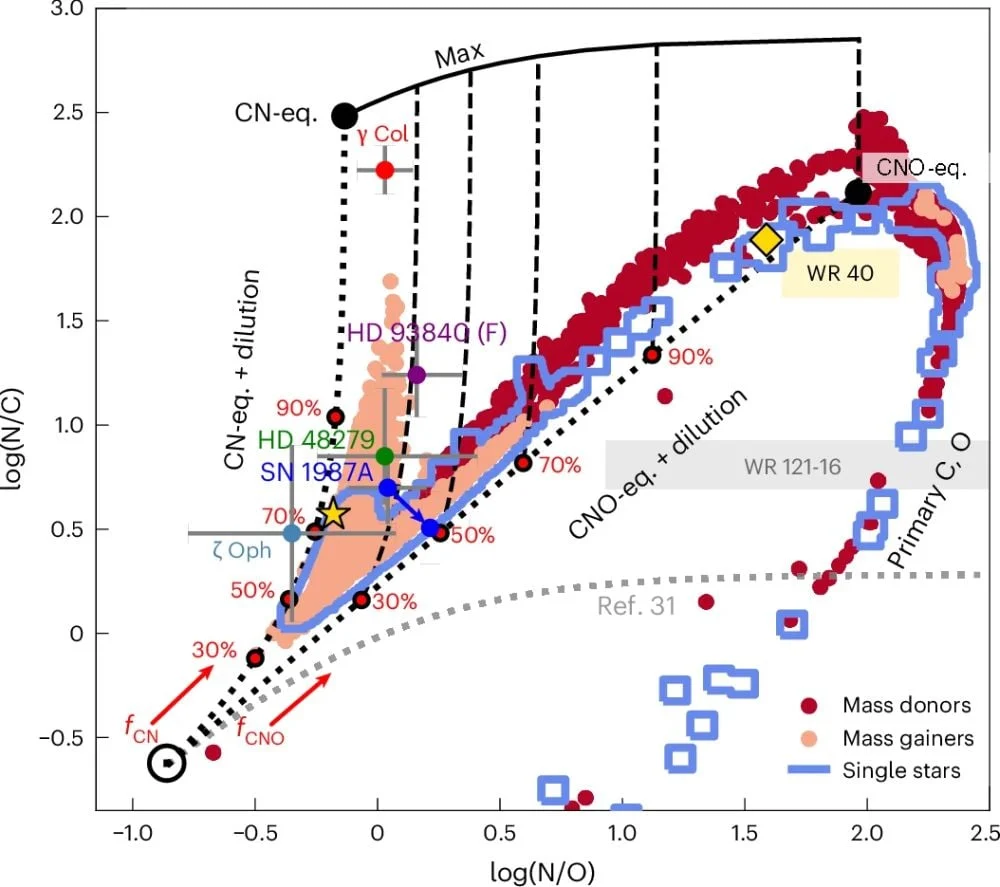
The vast majority of massive stars in the universe are not solitary wanderers but are instead born into complex binary systems where the gravitational influence of a sibling star dictates their ultimate fate. Within these stellar pairings, the process of mass transfer—where one star siphons material from its companion—is a fundamental yet elusive phenomenon that fundamentally reshapes the evolution of the cosmos. Despite its prevalence, identifying stars that have undergone such a transformation has long been a challenge for astrophysicists, as the "mass gainers" often appear as ordinary, solitary stars once the interaction is complete. However, a groundbreaking study led by researchers from the Max Planck Institute for Astrophysics and the Max Planck Institute for Radioastronomy has introduced a novel "forensic" technique to uncover these hidden histories. By analyzing the specific chemical abundances of nitrogen, carbon, and oxygen on a star’s surface, scientists can now reconstruct the dramatic events of a star’s past, even millions of years after its companion has vanished.
The Prevalence of Stellar Interaction in Binary Systems
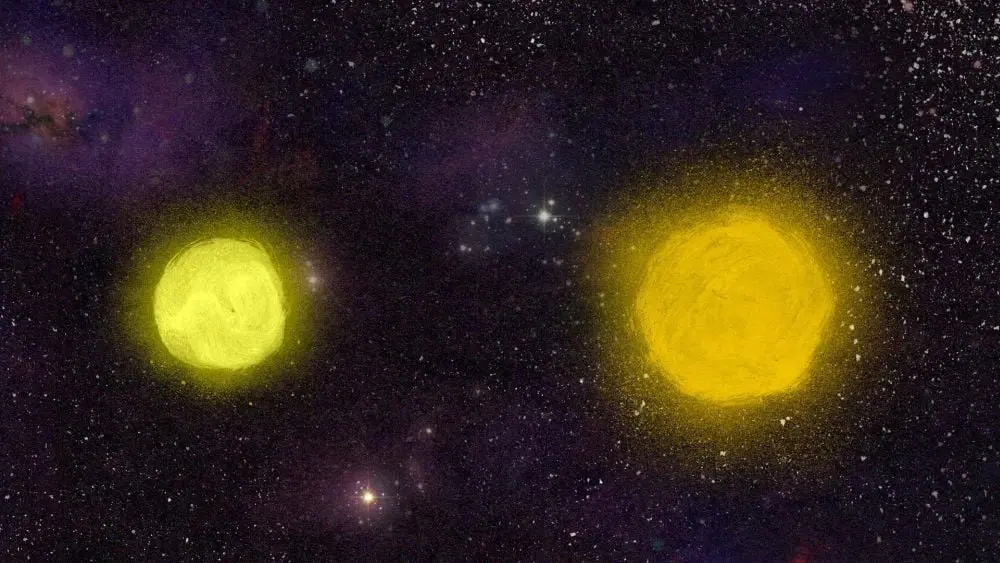
In the high-stakes environment of stellar evolution, massive stars rarely exist in isolation. Current astronomical data suggests that approximately 70% of massive stars are born in close binary systems, where the proximity of a companion makes mass transfer not just possible, but nearly inevitable. As stars age, they exhaust the hydrogen fuel in their cores and begin to expand into giants. In a binary system, this expansion often causes the outer layers of one star to cross the Roche lobe—the theoretical boundary where the gravity of the companion star becomes dominant.
Once this threshold is crossed, material begins to flow from the donor star to the accretor. This process can have profound consequences: the stars may eventually merge into a single, more massive entity, or the mass transfer may trigger a supernova explosion. In many cases, the donor star is eventually stripped of its envelope or destroyed, leaving the accreting star to continue its life looking like a "normal" single star. To an observer, there is often no obvious structural indication that the star’s evolution was forever altered by a long-gone partner.
The Challenge of Observing Transient Events
One of the primary difficulties in studying mass transfer is the timeframe in which it occurs. While a massive star may live for tens of millions of years, the active phase of mass transfer is remarkably brief, typically occupying less than 0.1% of the star’s total lifespan. This creates a statistical "needle in a haystack" problem for astronomers; the chances of catching a star in the middle of a mass-transfer event are exceedingly low.
Furthermore, the physical complexity of these interactions presents a hurdle for computational modeling. Harim Jin and Norbert Langer, the lead authors of the study published in Nature Astronomy, note that traditional hydrodynamic models require immense computational resources and time to simulate the entire sequence of mass accretion. Consequently, astrophysicists have struggled to determine the "efficiency" of these interactions—specifically, how much of the stripped mass is actually absorbed by the gainer versus how much is lost to the surrounding interstellar medium.
A Chemical Solution: The CNO Fingerprint
To overcome these observational gaps, the Max Planck team turned to the internal chemistry of the stars themselves. The core of a massive star acts as a nuclear furnace, primarily utilizing the CNO (Carbon-Nitrogen-Oxygen) cycle to fuse hydrogen into helium. This process does more than just produce energy; it fundamentally alters the elemental ratios within the star’s interior. In the core, carbon and oxygen are gradually depleted, while nitrogen and helium become significantly more abundant.
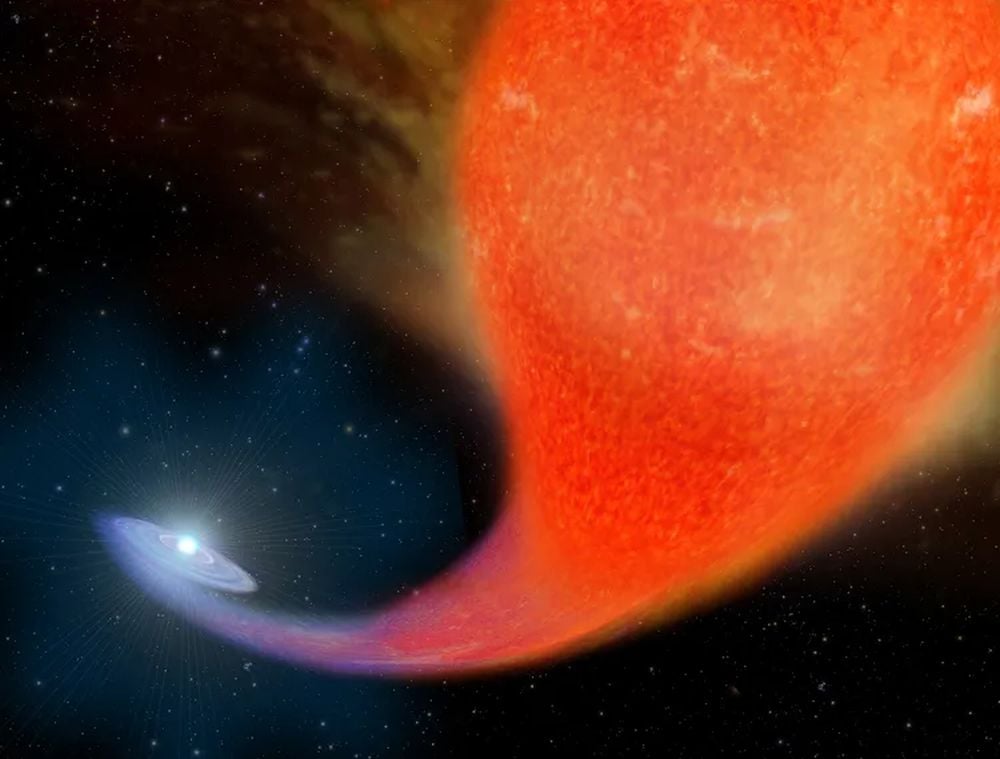
In a solitary, non-rotating star, these chemical changes remain locked deep within the interior, shielded by a "pristine" outer envelope that retains the chemical composition of the gas cloud from which the star was born. However, during a mass transfer event, the donor star is stripped of its outer layers, eventually exposing and transferring the "processed" material from its deeper regions onto the surface of the gainer.
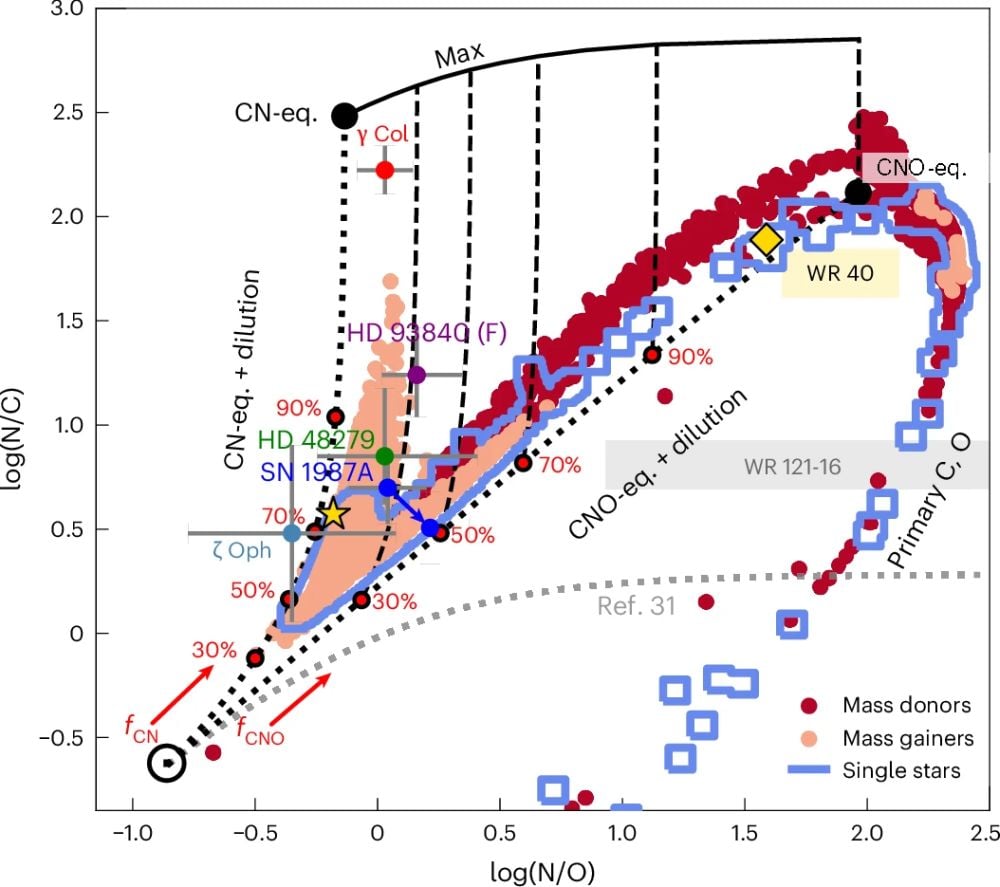
The researchers discovered that this accreted material creates a unique chemical signature on the surface of the mass gainer. By plotting the ratio of nitrogen to carbon against the ratio of nitrogen to oxygen—a method known as a CNO abundance diagram—the researchers found that mass gainers occupy a distinct and predictable region of the graph. This "fingerprint" allows astronomers to distinguish them from both pristine solitary stars and the stripped-envelope donor stars.
Re-evaluating Gamma Columbae: A Case Study in Mass Accretion
The practical utility of this new method was immediately demonstrated through the analysis of Gamma Columbae (γ Columbae), a bright star located approximately 1,050 light-years from Earth. With a mass roughly six times that of the Sun and an age of 24 million years, Gamma Columbae has long been an object of curiosity for the scientific community. Previous hypotheses suggested that the star was a "stripped-envelope" remnant—the exposed core of a much larger star that had lost its outer layers.
However, applying the CNO fingerprinting technique revealed a different story. The surface chemistry of Gamma Columbae showed a high nitrogen-to-carbon ratio and a moderate nitrogen-to-oxygen ratio, accompanied by a clear enrichment of helium. These data points aligned perfectly with the team’s models for a mass gainer rather than a donor.
"For Gamma Columbae, we show that it is a mass gainer instead, whose companion star probably formed a stripped-envelope supernova," the researchers stated. Their analysis concluded that approximately 17% of Gamma Columbae’s current mass consists of material accreted from its former companion. This discovery allowed the team to reverse-engineer the entire system: if Gamma Columbae gained 0.8 solar masses to reach its current state, the donor star must have originally been a massive heavyweight of at least 14 solar masses.
SN 1987A and the Legacy of Stellar Mergers
The implications of this research extend to some of the most famous events in modern astronomy, including SN 1987A. Located in the Large Magellanic Cloud, SN 1987A was the closest supernova observed in centuries and has been the subject of intense scrutiny since its explosion was first detected. While a consensus had grown that the progenitor of the supernova was the result of a stellar merger, the specific dynamics of that merger remained debated.
Using their chemical modeling approach, Jin and Langer were able to provide a more detailed reconstruction of the event. "We can now confidently reconstruct the masses of both stars before the merger and demonstrate that a significant amount of mass was ejected during the merger process," explained Norbert Langer. This level of detail provides a vital link between the life of a binary system and the spectacular nature of its death, helping to explain why certain stars explode as Type II supernovae.
Broader Impact on Galactic Evolution
Understanding the hidden lives of massive stars is not merely an exercise in stellar archaeology; it is essential for understanding the evolution of galaxies as a whole. Massive stars are the primary engines of "stellar feedback." They emit intense ultraviolet radiation, drive powerful stellar winds, and eventually distribute heavy elements throughout the galaxy via supernova explosions. These processes regulate star formation and influence the chemical enrichment of the interstellar medium.
If 70% of these influential stars are shaped by binary interactions, then our models of galactic evolution must account for mass transfer. The ability to identify "hidden" mass gainers means that astronomers can now more accurately calculate the frequency of these interactions and their impact on the total energy and material output of a stellar population.
Harim Jin emphasized the transformative nature of this "forensic" approach: “It’s like finding a fingerprint at a crime scene—once you know what to look for, you can reconstruct the entire sequence of events, even if the original suspects are long gone.”
The Future: Large-Scale Surveys and Big Data
The study arrives at a pivotal moment for observational astronomy. Two major spectroscopic surveys—WEAVE (WHT Enhanced Area Velocity Explorer) and 4MOST (4-metre Multi-Object Spectroscopic Telescope)—are currently beginning to collect high-resolution data on hundreds of thousands of stars across the Milky Way and its neighbors.
These surveys will provide the precise chemical abundance measurements needed to apply the CNO fingerprinting method on a massive scale. By moving from the study of individual stars like Gamma Columbae to the analysis of entire populations, astronomers expect to build a comprehensive map of how mass transfer has shaped our galaxy over billions of years.
As these data sets grow, the technique developed by Jin and Langer will likely become a standard tool in the astrophysical toolkit. By reading the chemical stories written on the surfaces of stars, researchers are finally beginning to peel back the veil on the "hidden lives" of the most massive and influential objects in the night sky, revealing a universe far more interactive and interconnected than previously imagined.