Sisilia Frederika
The fundamental mechanics governing the centers of galaxies have long remained one of the most complex enigmas in modern astrophysics. For decades, the prevailing scientific consensus suggested that the supermassive black holes (SMBHs) residing at the hearts of most galaxies were surrounded by two distinct, independently formed structures: nuclear star clusters (NSCs) and nuclear stellar discs (NSDs). However, groundbreaking research led by the Leibniz Institute for Astrophysics Potsdam (AIP) has fundamentally challenged this "separate-origin" hypothesis. Through the use of sophisticated, high-resolution hydrodynamical simulations, a global team of researchers has demonstrated that these central structures are not isolated phenomena but are instead the products of a unified, co-evolutionary process driven by the dynamics of the galactic bar.
This study, published in the journal Astronomy & Astrophysics, provides a critical missing link in our understanding of how the Universe has evolved from the emergence of the first galaxies to the complex structures observed today. By bridging the gap between theoretical models and empirical observations, the research team—led by AIP postdoctoral researcher SungWon Kwak—has offered a new framework for interpreting the dense, high-energy environments found at the cores of barred spiral galaxies, including our own Milky Way.
The Architecture of the Galactic Core
To appreciate the significance of these findings, it is necessary to understand the components of a galactic center. At the very heart lies the supermassive black hole, an object with a mass millions or even billions of times that of our Sun. Surrounding this gravitational anchor is the nuclear star cluster, an incredibly dense assembly of stars that represents the most crowded stellar environment in a galaxy. Extending further out is the nuclear stellar disc, a flattened structure of stars and gas that rotates around the center.
Until recently, these two features were viewed as disparate entities. Astronomers hypothesized that they formed through different channels—perhaps the cluster formed through the inward migration of globular clusters, while the disc formed through the gradual accumulation of gas. This theory was supported by the fact that observational surveys of various galaxies showed no clear statistical correlation between the masses and sizes of clusters and discs. Furthermore, previous generations of astrophysical simulations struggled to replicate the simultaneous growth of both structures with any degree of realism.
The AIP-led study utilized the Stellar Feedback in Galaxies and its Effects (SMUGGLE-Ring) project to address these discrepancies. SMUGGLE is an advanced physics framework designed to model the intricate dance between star formation, radiation, and the gas-rich environments of galaxies. By applying this framework to a barred galaxy simulation, the researchers were able to track the evolution of the galactic core over several billion years with unprecedented detail.
The Galactic Bar: A Cosmic Conveyor Belt
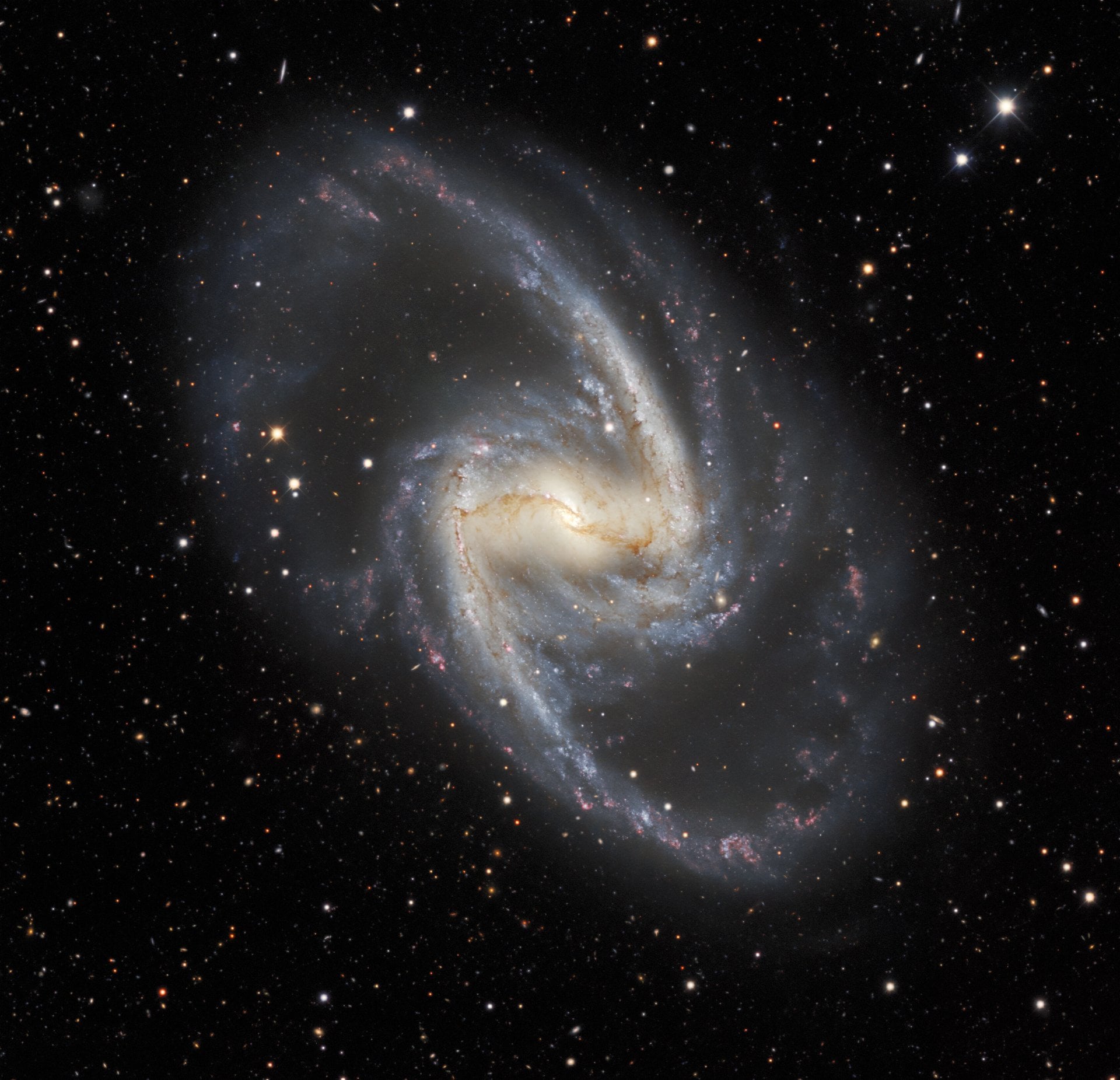
The central revelation of the research is the pivotal role played by the galactic bar—a linear structure of stars and gas that crosses the center of many spiral galaxies. In the simulation, the bar acts as a "cosmic conveyor belt," a dynamic gravitational engine that breaks the circular symmetry of the galaxy and forces gas to lose angular momentum. As the gas slows down, it is funneled inward toward the galactic center.
This influx of gas creates a high-pressure reservoir at the core. As the density of this gas increases, it triggers intense bursts of star formation. The simulation revealed that this single reservoir of gas feeds the growth of both the nuclear star cluster and the nuclear stellar disc simultaneously. This "shared nursery" explains why the two structures are so deeply intertwined despite their different appearances.
As new stars are born, the most massive among them eventually reach the end of their lives and explode as supernovae. These explosions generate powerful shock waves that ripple through the dense central gas, repeatedly triggering subsequent generations of star formation. Over the course of billions of years, the simulation showed that hundreds of millions of solar masses’ worth of stars are produced in this manner, contributing to the steady growth of the galactic nucleus.
Resolving the Observational Paradox
One of the most significant contributions of the AIP study is its explanation for why previous observations failed to find a link between clusters and discs. In the simulation, the structural relationship between the two components was shown to be highly dynamic. During different phases of a galaxy’s life, the relative growth rates of the cluster and the disc vary.
"The apparent disconnection does not mean that the stars themselves differ fundamentally in age, chemical composition, or motion," noted Dr. Cristina Chiappini, a senior scientist at AIP and co-author of the study. Instead, the simulation showed that while they grow from the same gas source, their physical dimensions and masses can appear unrelated depending on when they are observed. During periods of sustained growth, the disc might expand more rapidly outward, while the cluster becomes more compact and dense. This evolutionary variance explains why a "snapshot" observation of a distant galaxy might not reveal the underlying connection that the simulation made clear over a multi-billion-year timeline.
The Impact of Dark Matter and the Dark Gap
The accuracy of the AIP simulation was bolstered by the inclusion of "live" dark matter particles. In many previous astrophysical models, dark matter was treated as a static gravitational field—a "fixed background potential." However, the SMUGGLE-Ring project allowed for a realistic dynamical interaction between the stars and the dark matter halo.
Dr. Ivan Minchev, a co-author of the study, highlighted the importance of this approach: "The realistic dynamical treatment between stars and the dark matter halo using live particles in our model allows us to form a realistic bar that evolves in time and then naturally forms nuclear structures."
This dynamic modeling led to the emergence of a "dark gap" around the bar region. This gap is a phenomenon observed in many real-world galaxies where there is a noticeable deficiency of matter in specific zones around the galactic bar. The presence of this gap in the simulation serves as a "smoking gun," confirming that the model accurately reflects the complex gravitational interactions between visible matter and dark matter. The rotation of the stellar bar interacts with the dark matter halo in a way that shapes the distribution of gas and stars throughout the inner galaxy.

Observations of NGC 1365 and Merging Clusters
The simulation also provided a fascinating parallel to recent real-world observations of the galaxy NGC 1365, a prominent barred spiral galaxy located approximately 56 million light-years away. In the simulation, the researchers witnessed a massive star cluster—weighing roughly 30 million solar masses—spiraling inward from the galactic bar and eventually merging with the central nuclear star cluster.
This specific event is highly relevant to current astronomical data. Observations of NGC 1365 have identified a similarly massive star cluster currently situated within its bar. Based on the AIP simulation, it is highly probable that this cluster is on a collision course with the galaxy’s center. When it eventually merges with the nuclear star cluster, it will cause a sudden jump in mass and size, potentially altering the gravitational environment surrounding the supermassive black hole. This suggests that the growth of galactic centers is not just a steady "drip" of gas, but also a series of "cannibalistic" events where smaller clusters are absorbed into the central mass.
Collaborative Research and Future Implications
The success of this study was the result of an extensive international collaboration. Led by SungWon Kwak of AIP, the team included experts from the Observatoire de la Côte d’Azur (France), the SNU Astronomy Research Center (South Korea), the Università di Bologna (Italy), the Osservatorio di Astrofisica e Scienza dello Spazio di Bologna (Italy), the Kavli Institute for Astrophysics and Space Research at MIT (USA), the University of California, Riverside (USA), Tsinghua University (China), and the Universität Potsdam (Germany).
This diversity of expertise allowed the team to cross-reference their simulation data with various observational datasets, ensuring that the SMUGGLE-Ring results were grounded in physical reality.
The implications of this research extend far beyond the classification of star clusters. By proving that the galactic bar, the nuclear star cluster, and the nuclear stellar disc are part of a single, integrated system, scientists can now develop more accurate models of galaxy evolution. These models are essential for interpreting data from next-generation observatories, such as the James Webb Space Telescope (JWST) and the upcoming Extremely Large Telescope (ELT), which are capable of peering into the dust-shrouded hearts of distant galaxies.
As we continue to explore the "dark" and "dense" regions of the Universe, the AIP study serves as a reminder that the most complex structures in the cosmos are often more connected than they appear. The "cosmic conveyor belt" of the galactic bar does more than just move gas; it serves as the primary architect of the galactic core, weaving together the stars and clusters that define the identity of a galaxy across eons of time.