Clarissa Hana
Attackers have begun actively exploiting a critical-severity vulnerability in Citrix NetScaler appliances, according to recent intelligence from cybersecurity firm Previdian. The flaw, officially designated as CVE-2026-19490, presents a significant authentication bypass risk, allowing unprivileged threat actors to gain unauthorized access remotely. This development follows Citrix’s urgent plea to administrators in mid-August to patch the vulnerability, underscoring the escalating threat landscape for organizations relying on these widely deployed network devices.
The Nature of CVE-2026-19490
CVE-2026-19490 is a critical authentication bypass vulnerability that can be exploited when a Citrix NetScaler appliance is configured as an AAA (Authentication, Authorization, and Accounting) virtual server or as a Gateway. The precise conditions for exploitation depend on the specific NetScaler firmware version and whether SAML (Security Assertion Markup Language) Action is configured. In essence, attackers can bypass traditional authentication mechanisms, potentially gaining access to sensitive resources or internal networks without needing valid credentials.
Citrix, in its security bulletin issued on August 19, 2026, acknowledged the severity of the flaw and strongly advised customers to "review the official NetScaler ADC and NetScaler Gateway security bulletin, assess whether their deployments are affected, and upgrade impacted appliances to the recommended builds as soon as possible." Despite the company not initially flagging the vulnerability as actively exploited in its official advisory, new intelligence suggests that exploitation attempts are now underway.
Emergence of Exploitation and Proof-of-Concept
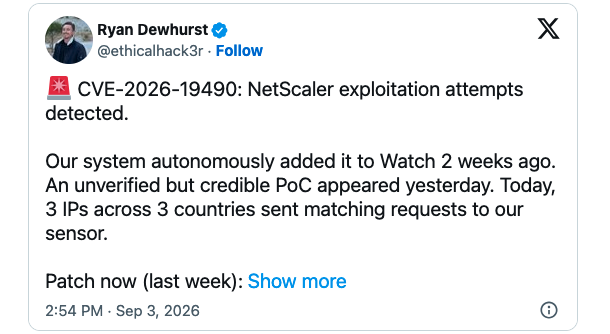
The shift from a theoretical risk to active exploitation appears to be linked to the online publication of a "credible" proof-of-concept (PoC) exploit. Ryan Dewhurst, founder of Previdian and a seasoned security researcher, confirmed to BleepingComputer that his organization’s NetScaler sensors detected exploitation attempts shortly after the PoC became available.

"On 3 September, one of our NetScaler sensors received requests matching the PoC from three distinct source IPs, geolocated to Australia, the United States and Germany," Dewhurst stated. While these findings provide "evidence of exploitation attempts," Dewhurst cautioned that "it does not confirm successful compromise of real-world systems." Nevertheless, the detection of such attempts from multiple geographic locations indicates a growing interest and capability among threat actors to leverage this vulnerability.
Official Warnings and Broader Scrutiny
The escalating threat posed by CVE-2026-19490 has not gone unnoticed by national cybersecurity agencies. The Centre for Cybersecurity Belgium (CCB), Belgium’s National Cybersecurity Coordination Centre, issued a warning on Friday, also highlighting exploitation attempts targeting the vulnerability. The CCB urged administrators to "prioritize patching all vulnerable Citrix NetScaler appliances on their organizations’ networks," emphasizing the urgency of the situation.
This coordinated response from cybersecurity intelligence firms and national agencies underscores the critical nature of the vulnerability and the potential for widespread impact. The fact that a PoC has been released and is being actively used in reconnaissance or attack attempts signals a significant increase in the risk profile for organizations using unpatched NetScaler devices.
Scale of the Vulnerable Landscape
The potential scope of this vulnerability is substantial. Internet threat watchdog Shadowserver tracks a significant number of Citrix NetScaler appliances exposed to the internet. Their data reveals over 22,000 NetScaler ADC (Application Delivery Controller) appliances and nearly 1,700 Gateway instances online. However, determining the exact number of vulnerable devices is challenging. This figure includes devices that may be honeypots, are already patched, or are configured in ways that do not expose them to this specific vulnerability. Nonetheless, the sheer volume of publicly accessible NetScaler devices suggests a large potential attack surface.
A Pattern of Exploited Citrix Vulnerabilities
This incident is not an isolated event for Citrix. The company has faced scrutiny for multiple vulnerabilities in its NetScaler products that have been actively exploited in the wild. In March 2026, Citrix urged administrators to patch two other critical NetScaler flaws, CVE-2026-3055 and CVE-2026-4368. Tragically, just days after this advisory, threat actors began actively exploiting these vulnerabilities.
The Cybersecurity and Infrastructure Security Agency (CISA) in the United States responded swiftly by adding CVE-2026-3055 to its Known Exploited Vulnerabilities (KEV) catalog a week later, mandating federal agencies to patch vulnerable Citrix appliances within a strict three-day deadline. This historical pattern highlights a recurring challenge for Citrix and its customers: the rapid weaponization of disclosed vulnerabilities by malicious actors.
Since November 2021, CISA has added a staggering 23 Citrix vulnerabilities to its KEV catalog, indicating a persistent and significant security challenge. Alarmingly, six of these previously exploited vulnerabilities have also been abused by ransomware gangs, underscoring the severe consequences that can arise from unpatched Citrix devices, including data breaches and operational disruption.
Implications for Organizations and the Cybersecurity Ecosystem
The active targeting of CVE-2026-19490 carries significant implications for organizations worldwide. NetScaler appliances are frequently used to provide secure remote access, manage application traffic, and act as critical network infrastructure components. A successful exploitation of this authentication bypass vulnerability could lead to:
- Unauthorized Access: Attackers could gain entry to internal networks, bypassing firewalls and other security measures that rely on proper authentication.
- Data Breaches: Once inside, attackers could exfiltrate sensitive data, including customer information, intellectual property, and confidential business records.
- Lateral Movement: Compromised NetScaler appliances can serve as pivot points for attackers to move deeper into an organization’s network, potentially compromising other critical systems.
- Service Disruption: In some scenarios, attackers might disrupt services by manipulating configurations or overloading the appliance, leading to denial-of-service (DoS) conditions.
- Ransomware Deployment: As evidenced by past attacks on Citrix vulnerabilities, compromised systems can be used to deploy ransomware, encrypting critical data and demanding hefty payments for decryption.
The rapid release of a PoC and subsequent exploitation attempts highlight the need for proactive vulnerability management and rapid patching. Organizations that rely on Citrix NetScaler devices must:
- Identify Vulnerable Assets: Conduct thorough network inventories to identify all deployed NetScaler appliances and their firmware versions.
- Consult Official Advisories: Regularly monitor Citrix security bulletins and advisories for critical updates and patch recommendations.
- Prioritize Patching: Implement a robust patch management strategy that prioritizes critical vulnerabilities like CVE-2026-19490. Given the active exploitation, immediate patching should be the goal.
- Review Configurations: Assess NetScaler configurations, particularly those involving AAA virtual servers, Gateway functions, and SAML Actions, to understand exposure.
- Enhance Monitoring: Implement advanced security monitoring solutions to detect suspicious activity indicative of exploitation attempts, even if successful compromise is not immediately apparent. This includes monitoring network traffic for unusual patterns and authentication logs for anomalies.
- Incident Response Preparedness: Ensure that incident response plans are up-to-date and capable of addressing potential breaches stemming from such vulnerabilities.
The ongoing trend of actively exploited vulnerabilities in widely used network infrastructure components like Citrix NetScaler underscores the persistent and evolving nature of cyber threats. Organizations must remain vigilant, investing in robust security measures, proactive threat intelligence, and rapid response capabilities to safeguard their digital assets in an increasingly hostile cyber environment. The proactive stance taken by intelligence firms like Previdian and regulatory bodies like CISA and the CCB is crucial in alerting the wider community to these immediate dangers, but the ultimate responsibility for mitigation lies with the end-user organizations. The current situation with CVE-2026-19490 serves as a stark reminder that prompt action is not just recommended, but essential for survival in the modern threat landscape.