Sisilia Frederika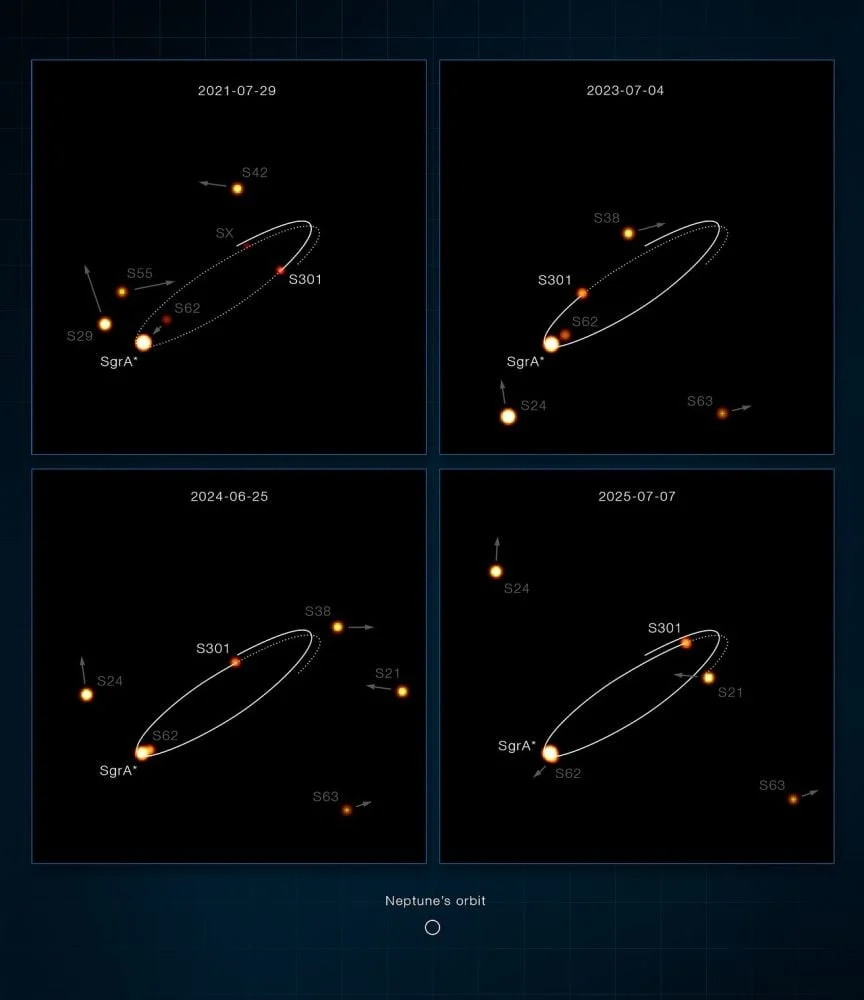
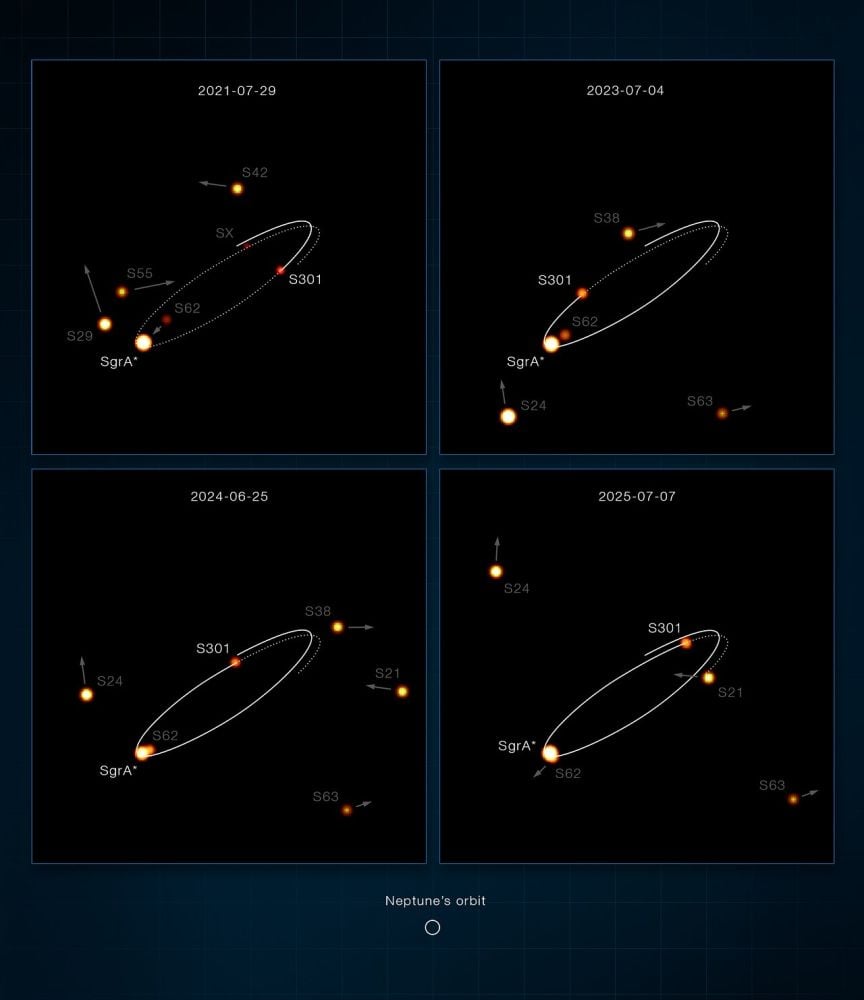
The heart of the Milky Way galaxy, a region long shrouded in cosmic dust and mystery, has revealed its most intimate secret yet. In a landmark study published in Nature, an international team of astronomers has announced the discovery of S301, a star that now holds the title of the fastest and closest object ever observed orbiting Sagittarius A (Sgr A), the supermassive black hole at our galaxy’s center. This celestial body is not merely a record-breaker; it serves as a high-precision probe that allows scientists to measure the "spin" of the black hole itself, a feat previously thought to be decades away from realization.
The discovery, led by K. Abd El Dayem from the Laboratory for Instrumentation and Research in Astrophysics (LIRA) at the Paris Observatory, marks a turning point in our understanding of gravity in its most extreme form. By tracking S301’s rapid trajectory, researchers have found a "laboratory" in space where the fabric of spacetime is visibly twisted by the rotation of a four-million-solar-mass singularity.
The S-Star Cluster: A Galactic Speed Trap
For decades, the Galactic Center has been a focal point for astrophysicists. The discovery of a group of stars known as "S-stars" provided the definitive proof that a supermassive black hole resided at the center of the Milky Way. These stars move in highly elliptical orbits, accelerated to incredible velocities by the immense gravitational pull of Sgr A*.
Until recently, the star S2 was the primary focus of these studies. By monitoring S2’s 16-year orbit, astronomers were able to confirm Einstein’s General Theory of Relativity, specifically observing the Schwarzschild precession—a slight shift in the star’s orbit that occurs because gravity is so strong. However, S301 has now superseded S2 in scientific importance.
S301 completes a full orbit around the black hole in just 8.7 years, nearly twice as fast as S2. At its closest approach, it comes within 12 astronomical units (AU) of the event horizon. To put this in perspective, 12 AU is less than half the distance between the Sun and Neptune. Traveling at a staggering 25,000 kilometers per second—roughly 8% of the speed of light—S301 is the fastest-moving star ever cataloged in the Milky Way.
Unveiling S301: A Decade of Observation
The detection of S301 was an immense technical challenge. The Galactic Center is located approximately 26,000 light-years from Earth and is obscured by dense clouds of gas and dust. To peer through this veil, the team utilized the GRAVITY instrument on the European Southern Observatory’s (ESO) Very Large Telescope Interferometer (VLTI) in Chile.
GRAVITY works by combining the light from all four 8.2-meter telescopes of the VLT, creating a "virtual" telescope with the resolution of a mirror 130 meters in diameter. This allows for unprecedented astrometric precision, enabling astronomers to track the positions of stars with the accuracy of a few micro-arcseconds.
The discovery was the result of a multi-year campaign:
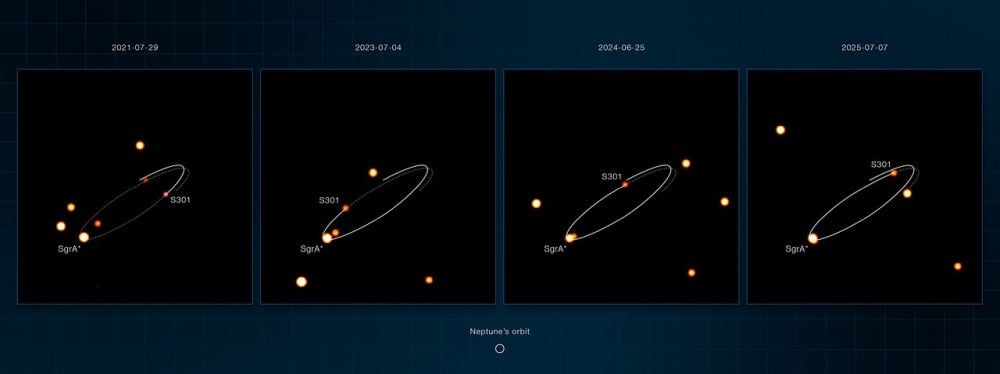
- 2017–2021: Initial data was collected as part of a broader survey of the Galactic Center. While S301 was present in these images, it was too faint to be identified as a distinct, fast-moving object at the time.
- Spring 2023: Researchers identified a faint star roughly 15 milli-arcseconds northwest of Sgr A*. As the months progressed, the object showed significant outward movement.
- 2024–2025: Dedicated observation "pointings" yielded 13 additional astrometric measurements. By combining these with archival data, the team reconstructed 19 distinct positions, outlining a clear elliptical orbit.
"In spring 2023, we discovered a faint star which in the following months moved outward, and which we labeled S301," the researchers noted in their paper. The star is approximately two billion times dimmer than Betelgeuse, requiring over 100 hours of observation time annually to track its movement effectively.
Frame-Dragging and the Lense-Thirring Effect
The primary scientific value of S301 lies in its proximity to the black hole. According to Einstein’s General Theory of Relativity, a rotating massive object does not just pull on space; it drags space along with it. This phenomenon is known as "frame-dragging" or the Lense-Thirring effect.
As Sgr A* rotates, it twists the surrounding spacetime. Any object orbiting close enough to the black hole will feel this "tug" in the direction of the rotation. This causes the star’s orbital plane and its closest point to the black hole (periapsis) to shift in a way that cannot be explained by Newtonian physics or basic relativity alone.
Because S301 is so close—reaching that 12 AU threshold—the Lense-Thirring effect is significantly more pronounced than it is for more distant stars. By measuring the slight "wobble" or precession in S301’s orbit over the next decade, astronomers can calculate the spin of Sgr A*.
"With this star, we hope to measure, within the next 10 years, the spin of the black hole," said Felix Mang, a study co-author and PhD student at the Max Planck Institute for Extraterrestrial Physics (MPE). This timeline is a major acceleration of previous estimates, which suggested such a measurement would require observing dozens of stars over thirty to forty years.
The Mystery of Stellar Migration
The existence of S301 so close to a supermassive black hole poses a significant question for stellar evolution: How did it get there? The environment surrounding Sgr A* is incredibly hostile. The intense tidal forces and radiation fields make it nearly impossible for stars to form in situ.
The research team concludes that S301 likely formed much further away from the galactic center and migrated inward. The most probable mechanism is a "Hills disruption." In this scenario, a binary star system (two stars orbiting each other) drifted too close to the black hole. The immense gravity of Sgr A* tore the binary pair apart. One star was ejected from the galaxy at high speed—becoming what astronomers call a hyper-velocity star—while the other, S301, was captured into a tight, highly relativistic orbit around the black hole.
"Taken together, the properties of S301 suggest a simple and self-consistent picture: a compact main-sequence binary was tidally separated by Sgr A*, leaving behind S301 on the most relativistic stellar orbit known," the authors stated.
Scientific Reaction and Global Impact
The discovery has sent ripples through the global scientific community. Reinhard Genzel, Director at the Max Planck Institute for Extraterrestrial Physics and a 2020 Nobel Prize winner for his work on Sgr A*, emphasized the importance of this new window into the cosmos.
"Decades of carefully tracking stars orbiting our galaxy’s central black hole have led to this breakthrough discovery," Genzel stated. "Because it orbits so close to Sagittarius A*, S301 opens a new window to the fundamental properties of spacetime in this extreme black-hole environment."
For Stefan Gillessen, another lead researcher at MPE, the discovery represents the fulfillment of a long-term goal. "For the first time, we would actually be able to measure very directly the spin of a massive black hole, which would be a key test of Einstein’s theory," he added.
The ability to measure spin is crucial because spin and mass are the two fundamental properties that define a black hole. While the mass of Sgr A* has been well-established (approximately 4.1 million solar masses), its spin remains one of the great unknowns in modern astronomy. Spin determines how a black hole interacts with surrounding matter, how it powers relativistic jets, and how it grew over billions of years.
Future Outlook: The Next Decade of Discovery
The discovery of S301 is just the beginning. As the star continues its 8.7-year journey, every millimeter of its movement will be scrutinized. The team at the Paris Observatory and MPE plan to use the upcoming Extremely Large Telescope (ELT), currently under construction in Chile, to gain even clearer images of S301.
The ELT’s 39-meter primary mirror will provide even greater sensitivity, potentially revealing even smaller, fainter stars that are closer still to the event horizon. However, for the next decade, S301 remains the "gold standard" for testing the limits of physics.
"Without this star, we would need to measure the motion of other stars for several more decades to get anywhere close to measuring the spin of the black hole," said Juan Osorno, an astronomer at LIRA Observatoire de Paris–PSL.
As S301 prepares for its next close approach to the black hole, the world’s most powerful telescopes will be watching. The data gathered from this tiny, fast-moving star may finally solve the mystery of how our galaxy’s central engine operates, proving once again that in the vastness of space, the smallest details often hold the answers to the biggest questions.