Clarissa Hana
A groundbreaking Rowhammer attack, dubbed GPUThor, has emerged, capable of circumventing the error-correcting code (ECC) protections on NVIDIA GPUs. This sophisticated exploit, detailed in a recent paper by researchers at the University of Toronto, opens the door to severe security vulnerabilities, including denial-of-service (DoS) conditions and, more alarmingly, root-level privilege escalation on affected systems. The implications are significant, particularly given the widespread adoption of these GPUs in critical sectors like artificial intelligence (AI) and cloud computing infrastructure.
The research builds upon previous discoveries in GPU-based Rowhammer attacks. While earlier concepts like GPUHammer and GPUBreach demonstrated the theoretical possibility of exploiting memory vulnerabilities on GPUs, the introduction of ECC memory by manufacturers like NVIDIA rendered them largely impractical. GPUThor, however, represents a substantial leap forward, achieving significantly higher and more practical bit-flip rates than its predecessors, effectively negating the protections that had been put in place.
The attack was successfully demonstrated on NVIDIA’s Ampere-class workstation GPUs, specifically those equipped with GDDR6 memory. This includes popular models such as the RTX A4000, RTX A4500, RTX A5000, and the RTX A6000. These graphics processing units are workhorses in demanding computational environments, powering complex AI model training, large-scale data analysis, and the backbone of many cloud-based services. Their compromise could have far-reaching consequences across various industries.
The Evolution of Rowhammer: From CPU to GPU and Beyond
Rowhammer is a well-established class of hardware exploits that targets the physical properties of dynamic random-access memory (DRAM). The fundamental principle involves repeatedly and rapidly accessing specific rows of memory cells – a process metaphorically described as "hammering." This aggressive access pattern can induce electrical interference, causing adjacent memory rows to experience bit flips. A bit flip means the state of a stored bit (either a 0 or a 1) is unintentionally changed. In the context of computer systems, such bit flips can lead to data corruption, program crashes, and, in sophisticated attacks, security breaches.
Historically, Rowhammer attacks primarily focused on CPUs. However, as GPUs have evolved into powerful parallel processing engines with vast amounts of dedicated memory, they have also become attractive targets. The initial GPU-specific Rowhammer attacks, like those developed by the same University of Toronto research team, were significant proof-of-concept demonstrations. They highlighted the potential for memory manipulation on GPUs, but their practical impact was limited by the effectiveness of memory error correction mechanisms.
NVIDIA, in response to such threats, implemented robust error-correcting code (ECC) technologies, most notably SECDED (Single Error Correction, Double Error Detection). ECC memory works by adding redundant bits to data, allowing it to detect and, in many cases, correct single-bit errors. It can also detect double-bit errors, flagging them as potentially corrupted data, though it cannot correct them. This was a critical defense mechanism against earlier Rowhammer exploits, as it would typically correct the bit flips before they could be exploited for malicious purposes.
GPUThor’s Sophisticated Evasion of ECC
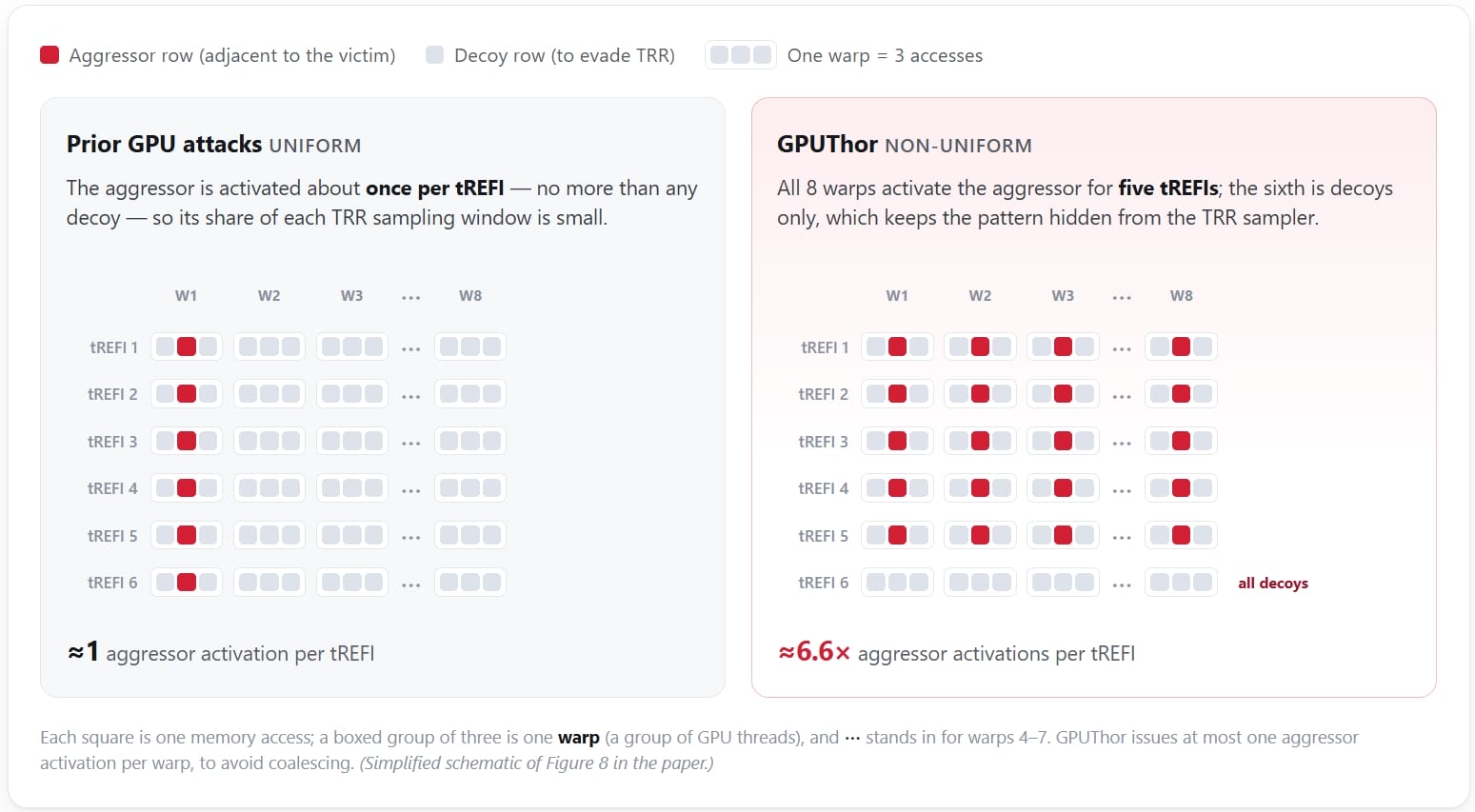
The breakthrough achieved by GPUThor lies in its ability to meticulously bypass these ECC protections. The researchers engineered the attack to operate with a specific, non-uniform hammering pattern and at a carefully calculated rate. This approach was designed to avoid triggering NVIDIA’s Target Row Refresh (TRR) mechanism. TRR is a built-in defense that periodically refreshes memory rows to mitigate the effects of charge leakage and electrical disturbances that can lead to bit flips. By understanding and exploiting two undocumented behaviors of GDDR6 memory – the way repeated memory requests are coalesced and the frequency at which TRR activates – the researchers were able to devise a hammering strategy that effectively blinds the defense systems.

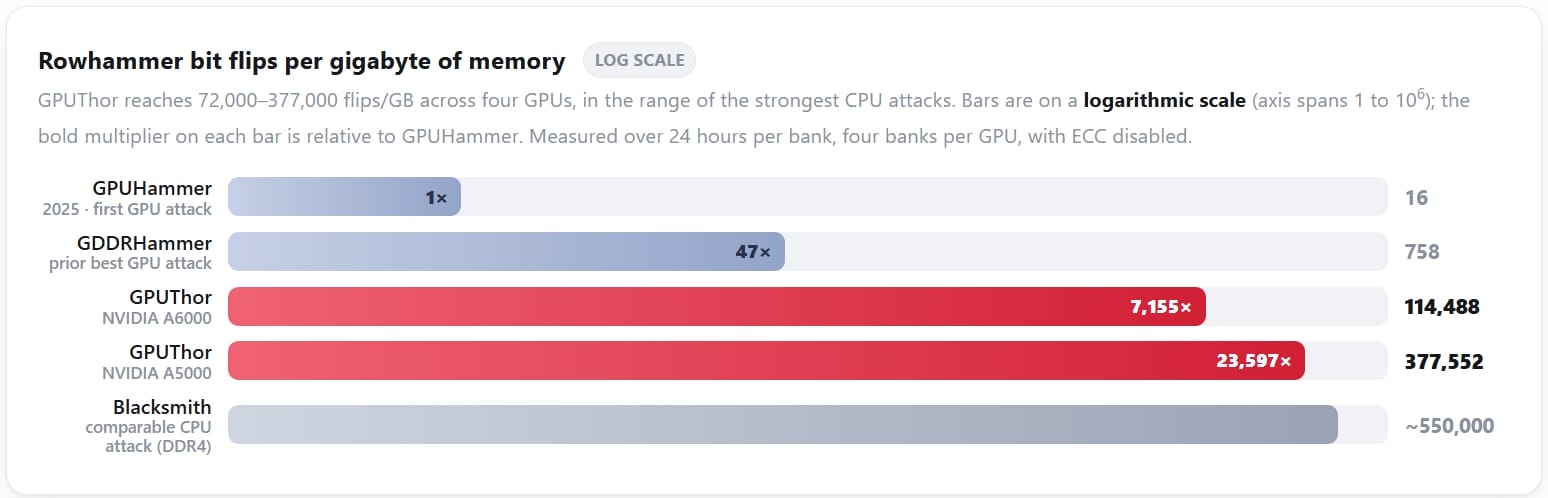
The paper details how GPUThor generates significantly more aggressor-row activations compared to previous GPU-based attacks. The adjusted attack methodology resulted in an impressive increase in bit-flip rates. On the tested Ampere-class GPUs, the attack achieved between 72,000 and 377,000 bit flips per gigabyte of memory without ECC protections enabled.
To put this into perspective, these rates are orders of magnitude higher than those achieved by GPUHammer. The researchers report that GPUThor’s bit-flip rates are between 4,548 and 23,597 times higher than their previous attack. This dramatic improvement brings the effectiveness of GPU-based Rowhammer attacks closer to that of highly sophisticated CPU Rowhammer techniques, such as the Blacksmith attack, which has also been known to bypass DDR4 memory defenses.
The time required to find an exploitable bit flip has also been drastically reduced. With GPUThor, researchers estimate that a successful exploit could be found in approximately 1.1 minutes. In contrast, achieving a similar outcome with GPUHammer would have taken an estimated 21.9 hours. This drastic reduction in the attack window makes GPUThor a far more practical and immediate threat.
Even when ECC was enabled on the tested GPUs, GPUThor demonstrated its potency. The researchers observed 387 instances of double-bit errors, which ECC could detect but not correct. More concerningly, they also documented two instances of triple-bit errors. While ECC is designed to correct single-bit errors and detect multi-bit errors, in these specific cases, the incorrect repair of triple-bit errors by the ECC mechanism led to data corruption. This suggests that even with ECC enabled, the attack can still induce critical data integrity issues.
Exploiting Vulnerabilities: Denial-of-Service and Privilege Escalation
The security implications of GPUThor are twofold: denial-of-service and privilege escalation. The researchers successfully demonstrated the attack’s capability to induce a DoS state on an ECC-enabled RTX A6000. This resulted in the GPU periodically resetting itself, terminating all ongoing workloads. Repeated execution of the attack led to the device eventually being flagged for replacement, effectively rendering it inoperable. This capability alone poses a significant threat to businesses relying on these GPUs for continuous operation, particularly in cloud environments where service availability is paramount.
However, the more alarming aspect of GPUThor is its potential for privilege escalation to root level. The researchers claim that by corrupting GPU page tables – critical data structures that manage memory access – an unprivileged CUDA program can gain arbitrary memory access on the host system. This level of access effectively allows an attacker to bypass normal security restrictions and obtain root privileges, granting them complete control over the compromised system. This could lead to widespread data breaches, installation of persistent malware, and complete system compromise.
Defense Strategies and Industry Responses
The vulnerability extends beyond the initially tested Ampere workstation GPUs. The researchers indicate that server-class Ampere GPUs, such as the A100, may also be susceptible to privilege escalation attacks, despite having mitigations that enhance resilience against DoS conditions. This is attributed to their continued reliance on SECDED-level ECC. Even future GPU architectures, including some Blackwell GPUs, may not be entirely immune. While features like RAS Repair can increase the time required for an attack, they do not necessarily prevent it. Furthermore, the researchers suggest that even GPUs employing advanced memory technologies like HBM3/e and GDDR7 with on-die ECC could potentially be vulnerable if the attack can trigger multi-bit flips.
Following the discovery, the research team responsibly disclosed their findings to NVIDIA on April 29, 2026. NVIDIA has since published an advisory on August 21, 2026, providing guidance to users. The company recommends a multi-layered defense approach:
- Enabling SYS-ECC: Ensuring that system-level ECC is activated provides an additional layer of memory error detection and correction.
- IOMMU/DMA Isolation: Implementing Input/Output Memory Management Unit (IOMMU) and Direct Memory Access (DMA) isolation is crucial. This restricts the ability of devices to access memory outside their allocated regions, mitigating the impact of compromised GPU access.
- Monitoring GPU Error Telemetry: Regularly monitoring GPU error logs and telemetry data can help detect early signs of memory corruption or unusual error patterns that might indicate an ongoing attack.
- Restricting Untrusted Workloads: This is a critical measure, especially in shared environments. It involves preventing the execution of code from untrusted sources on sensitive GPUs, thereby reducing the attack surface.
NVIDIA also emphasized that the risk associated with GPUThor varies significantly based on several factors, including the specific DRAM device used, the memory technology employed, the overall platform design, the in-DRAM defenses implemented, and the system’s configuration. Notably, the company reported that no bit flips were observed on tested GDDR6X or HBM2e GPUs when subjected to the same attack patterns, suggesting potential differences in resilience across memory types.
The researchers, in their paper, echo NVIDIA’s recommendations and add further insights for mitigating the threat. They strongly advise against cross-tenant GPU sharing whenever feasible, particularly in cloud or multi-user environments. Monitoring ECC error counters remains a vital proactive measure. They also reiterate the importance of restricting untrusted CUDA workloads. Looking ahead, the researchers posit that achieving complete protection against advanced Rowhammer attacks will likely necessitate the development of stronger multi-bit ECC capabilities and hardware-level defenses integrated into future GPU designs.
The emergence of GPUThor underscores a persistent arms race in hardware security. As manufacturers implement increasingly sophisticated defenses, researchers continuously find novel ways to circumvent them. The continuous innovation in GPU technology, particularly in the realm of AI and high-performance computing, means that security considerations must evolve in tandem. The widespread adoption of these powerful GPUs means that vulnerabilities like GPUThor have the potential to impact a significant portion of the digital infrastructure, making ongoing vigilance and proactive security measures paramount. The findings serve as a stark reminder that even with advanced error correction, the fundamental physics of memory can still be exploited, necessitating a comprehensive and evolving approach to hardware security.