Sisilia Frederika
The James Webb Space Telescope (JWST) has once again captured the attention of the global scientific community by releasing a high-definition infrared glimpse into the heart of the Carina Nebula, specifically focusing on a feature colloquially known as the Treasure Chest. Located approximately 7,500 light-years from Earth in the southern constellation of Carina, the Keel, this region represents one of the most active and massive star-forming complexes in the Milky Way galaxy. The newly released image, designated as the European Space Agency’s (ESA) Picture of the Month, utilizes the advanced Near-Infrared Camera (NIRCam) to pierce through the thick veils of interstellar dust that have historically obscured the internal dynamics of this cosmic nursery. This latest observation provides critical data on the formation of high-mass stars and the destructive yet creative forces of stellar radiation that shape the galactic landscape.
The Carina Nebula: A Laboratory for Stellar Evolution
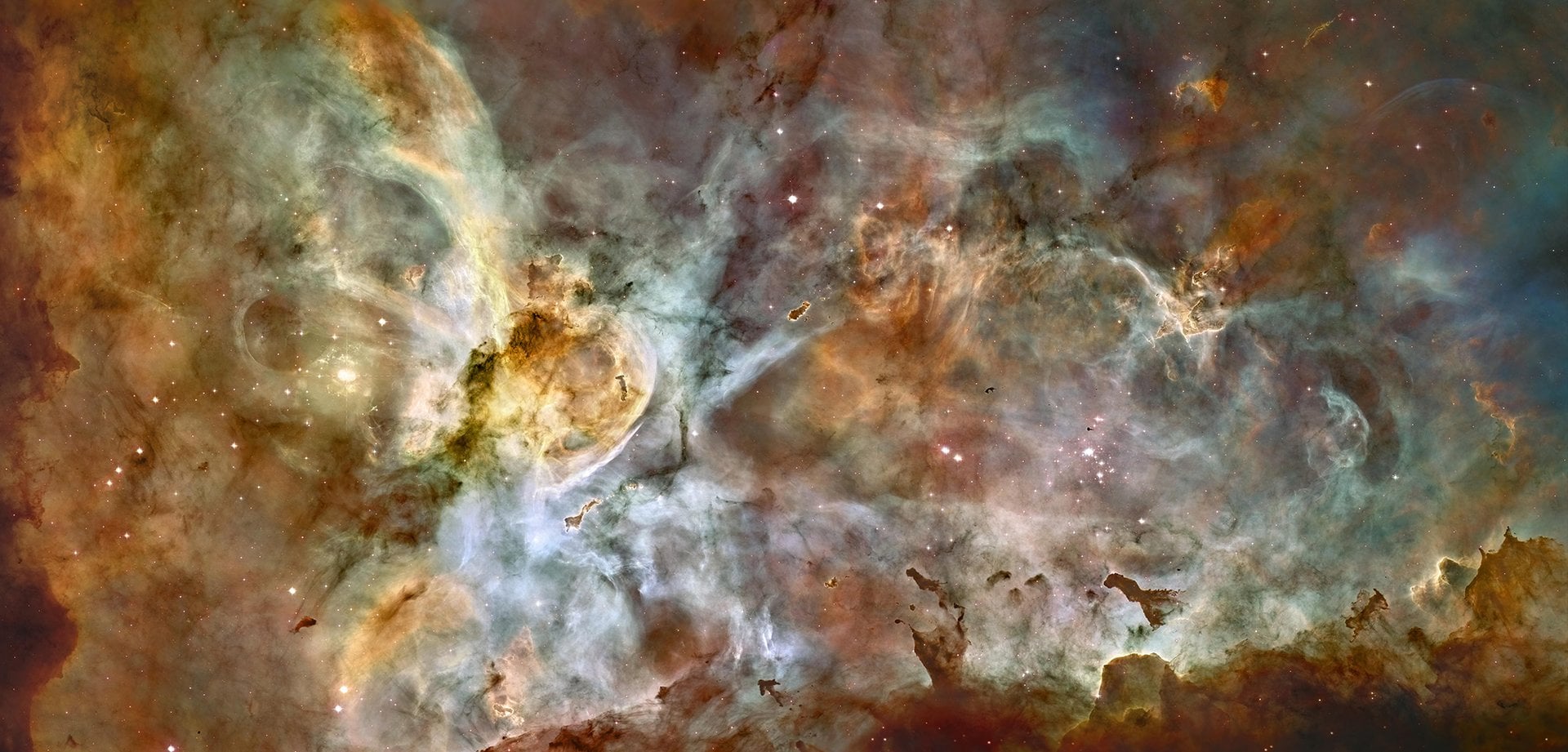
Measuring an expansive 260 light-years across, the Carina Nebula (NGC 3324) serves as a premier laboratory for astronomers. Its relative proximity to Earth—roughly 7,500 light-years—allows for a level of detail that is unattainable in more distant star-forming regions. Unlike smaller nebulae that produce low-mass stars similar to our Sun, Carina is a "high-mass" star-forming region. It contains several of the most massive and luminous stars known in our galaxy, some of which are over 100 times the mass of the Sun.
The nebula is a chaotic environment defined by the "tug-of-war" between gravity and radiation. Gravity pulls gas and dust together to form new stars, while the intense ultraviolet radiation and stellar winds from those same stars push the gas away, creating massive cavities and intricate structures. The Treasure Chest feature is a prime example of this interaction. While previous observations by the Hubble Space Telescope provided a foundation for understanding the nebula in visible light, Webb’s infrared capabilities allow scientists to see "inside" the dust clouds, revealing the protostars and young stellar clusters that were previously invisible.
Analyzing the Treasure Chest and Its O-Type Stars
The feature highlighted in the latest JWST release, the Treasure Chest, is a compact star cluster encased within a "cometary globule." In astronomical terms, a cometary globule is an isolated cloud of gas and dust characterized by a dense, dark "head" and a long, streaming "tail." These structures are shaped by the external influence of nearby massive stars, whose radiation pressure erodes the cloud, leaving behind a wake that resembles the tail of a comet.
Within the Treasure Chest lies a cluster of approximately 70 stars. The most significant among these are the O-type stars. These are rare, blue-white giants that represent the most extreme end of the stellar spectrum. With surface temperatures exceeding 30,000 Kelvin (compared to the Sun’s 5,778 Kelvin), these stars emit a fierce ultraviolet glow. Astronomers estimate that the most massive stars in this specific cluster are roughly 19 times as massive as the Sun.
The "shining jewels" described by the ESA are these young stars, which are estimated to be only 1.3 million years old—a mere blink in the eye of cosmic time. Despite their youth, they are already profoundly impacting their environment. The intense starlight from these O-type stars is currently dissipating the very clouds from which they were born. Over the next several hundred thousand years, the gas of the Treasure Chest will likely be completely blown away, leaving the cluster fully exposed to the rest of the nebula.
The Technological Edge: Why NIRCam Matters
The clarity of the Treasure Chest image is a direct result of the JWST’s Near-Infrared Camera (NIRCam). Traditional optical telescopes, such as Hubble, are limited by the fact that visible light is easily scattered by dust particles. This makes the dense clouds of the Carina Nebula appear as opaque walls. However, infrared light has a longer wavelength, allowing it to pass through dust clouds with minimal interference.
By observing in the near-infrared spectrum, Webb can detect the heat signatures of protostars—stars that are still in the process of gathering mass from their parent clouds. NIRCam’s high resolution also allows astronomers to distinguish individual stars within crowded clusters, providing a more accurate count and mass distribution analysis. This data is vital for refining the "Initial Mass Function" (IMF), a mathematical description of the distribution of initial masses for a population of stars, which is a cornerstone of modern astrophysics.
A Chronology of Discovery in the Carina Nebula
The study of the Carina Nebula has evolved significantly over the last three centuries, marking the progress of human observational technology:
- 1751–1752: Nicolas-Louis de Lacaille first cataloged the nebula during his expedition to the Cape of Good Hope.
- 1830s: Sir John Herschel conducted detailed studies, noting the dramatic brightness changes of the star Eta Carinae.
- 2010: The Hubble Space Telescope released the "Mystic Mountain" image to celebrate its 20th anniversary, showing towering pillars of gas within the nebula.
- July 2022: As part of its first-ever data release, the JWST showcased the "Cosmic Cliffs" of the Carina Nebula. This image revealed hundreds of previously hidden stars and provided a new look at the edge of a massive gaseous cavity.
- August 2024: The release of the "Treasure Chest" image provides a more localized, high-detail look at the internal dynamics of star clusters and cometary globules within the larger nebula structure.
This timeline illustrates a shift from simple cataloging to deep structural and chemical analysis, with Webb providing the most granular data to date.
The Influence of Eta Carinae: The Nebula’s Powerhouse
While the Treasure Chest is the focus of the recent image, its physical structure is heavily influenced by a nearby neighbor: Eta Carinae. Located about 39 light-years away from the Treasure Chest, Eta Carinae is one of the most massive and volatile binary star systems in the Milky Way.
One star in the system is estimated to be 100 times the mass of the Sun and five million times more luminous. In the mid-19th century, Eta Carinae underwent a "Great Eruption," briefly becoming the second-brightest star in the sky and ejecting a massive amount of material that formed the Homunculus Nebula. The radiation and stellar winds from Eta Carinae act as a "cosmic sculptor," carving out the large cavities in the Carina Nebula and pushing against structures like the Treasure Chest. The interaction between the local stars within the Treasure Chest and the external pressure from Eta Carinae creates a complex environment of turbulence and compression that triggers further star formation.
Implications for Planetary Science and Galactic Evolution
Beyond the study of massive stars, the JWST’s observations of the Treasure Chest have implications for our understanding of planetary systems. Data from the cluster suggests that some of these young stars are surrounded by circumstellar disks—rings of gas and dust that are the precursors to planets.
However, the environment of the Carina Nebula is hostile. The intense ultraviolet radiation from O-type stars can cause "photoevaporation," where the gas in a nearby star’s protoplanetary disk is stripped away before planets can fully form. By studying the Treasure Chest, astronomers can observe the survival rates of these disks in high-radiation environments. This helps scientists understand whether planetary systems like our own are common in high-mass star-forming regions or if they require the more "tranquil" conditions found in lower-density areas of the galaxy.
Furthermore, the Carina Nebula provides a snapshot of the processes that occurred during the "Cosmic Noon"—a period billions of years ago when the universe was at its peak of star formation. Because high-mass star-forming regions were more common in the early universe, studying Carina allows for a better understanding of how the first galaxies evolved and how heavy elements (produced in the cores of massive stars) were distributed throughout the cosmos.
Official Perspectives and Scientific Consensus
The release of the Treasure Chest image is part of a broader effort by the NASA/ESA/CSA partnership to make high-level astrophysical data accessible to both the scientific community and the public. Lead researchers, including Megan Reiter of Rice University (credited for the image processing), emphasize that Webb is not just a "pretty picture" machine but a tool for rigorous quantitative analysis.
Astronomers have noted that the Treasure Chest serves as a "fossil record" of the nebula’s recent history. The age of the cluster (1.3 million years) suggests a synchronized burst of star formation likely triggered by a passing shockwave from a previous generation of supernovae or the expansion of the central nebula cavity. The consensus among the astronomical community is that these images represent a significant leap in our ability to model the "feedback" mechanisms of stars—how they give back to the interstellar medium that created them.
Future Outlook: The Lifecycle of the Treasure Chest
As the James Webb Space Telescope continues its mission, the Carina Nebula will remain a primary target for multi-wavelength studies. Future observations are expected to utilize Webb’s Mid-Infrared Instrument (MIRI) to look even deeper into the coldest, densest parts of the Treasure Chest’s "head" to see if even younger protostars are buried within.
In the long term, the stars of the Treasure Chest are destined for a "live fast, die young" trajectory. The massive O-type stars at the cluster’s core will likely end their lives in spectacular supernova explosions within a few million years. These explosions will enrich the surrounding space with heavy elements like iron and gold, seeding the next generation of stars and planets.
The Treasure Chest image is more than a visual spectacle; it is a detailed map of the violent, beautiful, and essential processes that drive the evolution of our galaxy. Through the lens of the JWST, the "shining jewels" of the Carina Nebula continue to provide the data necessary to unlock the secrets of our cosmic origins.