Sisilia Frederika
The dwarf planet Pluto, once thought to be a geologically dormant relic at the edge of our solar system, continues to challenge fundamental assumptions about the behavior of matter in extreme cold. Recent analysis of high-resolution imagery captured by NASA’s New Horizons spacecraft has provided compelling evidence that liquid nitrogen is currently, or has very recently, been welling up from beneath the surface of Sputnik Planitia, the vast nitrogen-ice plain that forms the western lobe of Pluto’s iconic heart-shaped feature. This discovery, led by a team of researchers from the Southwest Research Institute (SwRI), suggests that the dwarf planet possesses a dynamic internal plumbing system capable of generating or retaining enough heat to melt nitrogen, despite surface temperatures that rarely climb above -229 degrees Celsius.
The findings, published in a recent study led by Alan Stern, the principal investigator of the New Horizons mission, indicate that liquid nitrogen is rising through fractures in the massive glaciers of Sputnik Planitia. This phenomenon presents a significant thermal puzzle for planetary scientists. On Earth, water ice melts at 0 degrees Celsius, but on Pluto, the primary constituent of the surface is nitrogen ice, which has a melting point of -209.9 degrees Celsius. Given that Pluto’s surface is consistently twenty degrees colder than the melting point of nitrogen, the presence of liquid on the surface implies a subsurface heat source or a physical process—such as extreme pressure—that allows nitrogen to transition into a liquid state before breaching the crust.
The Discovery at Sputnik Planitia
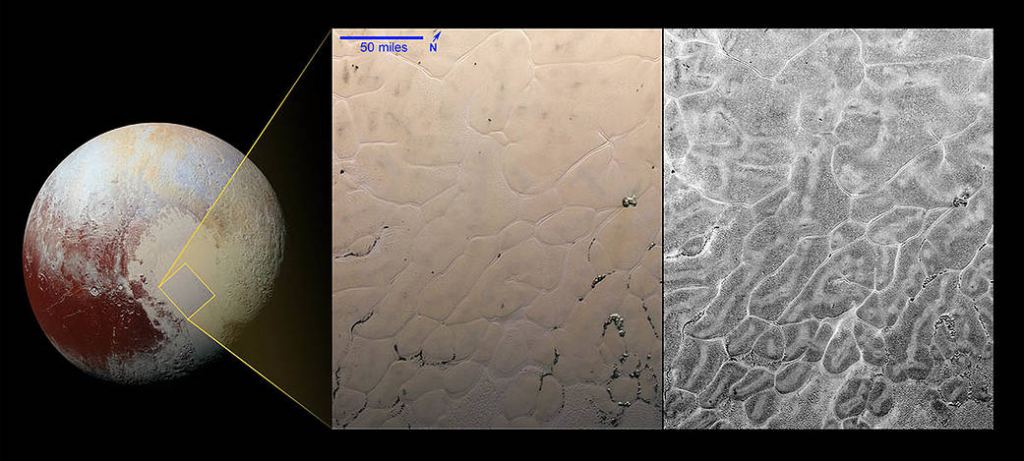
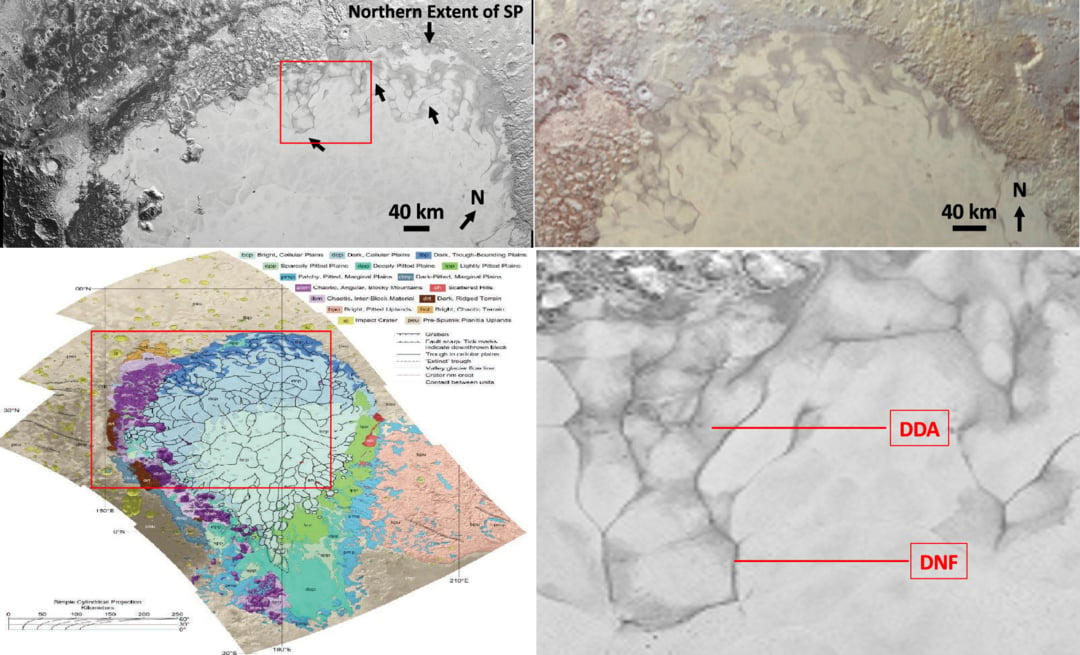
Sputnik Planitia is a massive basin, likely formed by a colossal impact billions of years ago, which has since been filled with nitrogen, carbon monoxide, and methane ices. From a distance, the region appears as a smooth, bright expanse, but New Horizons’ Close Encounter Images (LORRI) reveal a complex, mottled landscape divided into irregular polygons. These polygons are believed to be the surface expressions of giant convection cells, where warmer ice rises from below, cools at the surface, and sinks back down in a process that takes hundreds of thousands of years.

The new study focuses on the northern edge of this basin, where the team identified dark, narrow features and diffuse "wet" looking patches. These markings are not consistent with atmospheric deposition, such as nitrogen snow or rain, because Pluto’s thin atmosphere does not support the liquid phase of nitrogen under current pressure conditions. Instead, the evidence points toward an internal origin. The researchers suggest that liquid nitrogen is being squeezed upward through the boundaries of the convection cells or through cracks in the glacial ice, eventually "wetting" the surface and creating the dark features observed in the 2015 flyby data.
Terrestrial Analogs: From Greenland to the Kuiper Belt
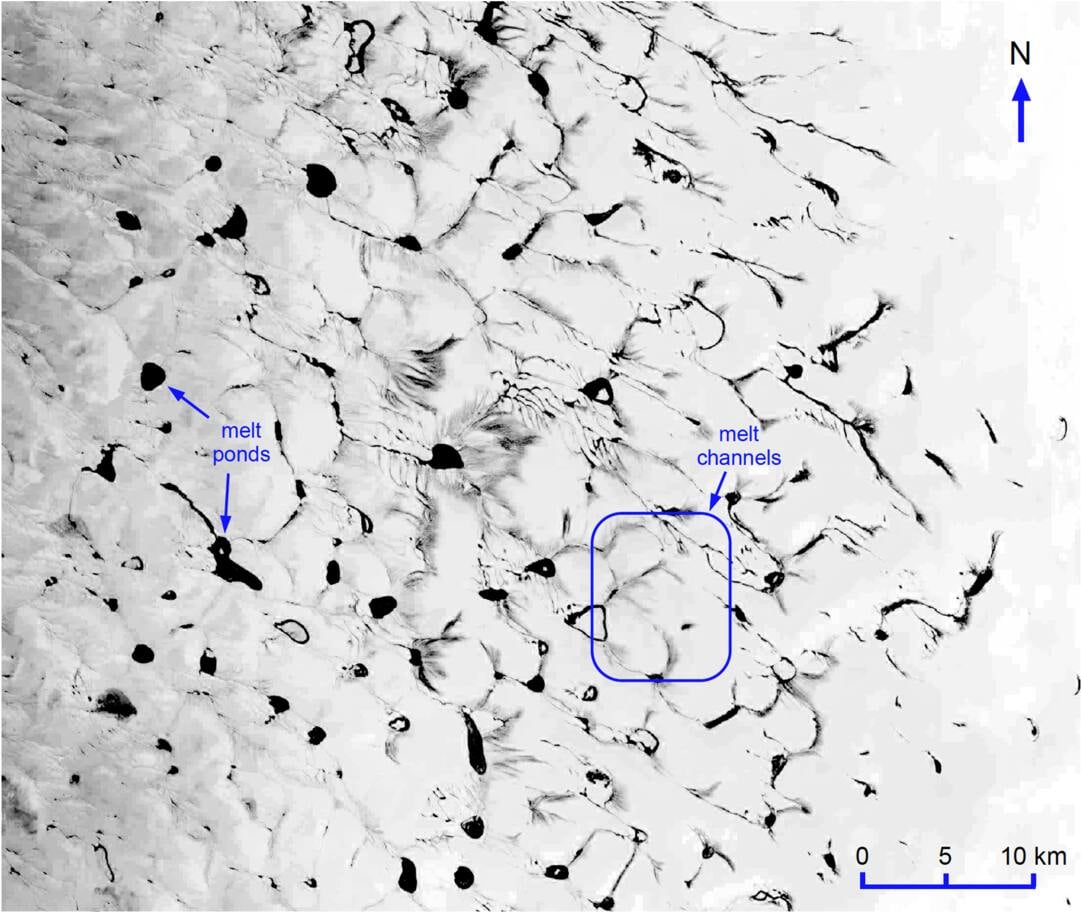
To validate their hypothesis, the SwRI team compared the features on Pluto to terrestrial glacial environments. Using Landsat imagery of Earth’s polar regions, specifically the Greenland and Antarctic ice sheets, the researchers found striking similarities. On Earth, "upwelling" occurs when meltwater at the base of a glacier—caused by geothermal heat or the intense pressure of the ice above—finds a path to the surface. These terrestrial events leave behind dark channels and ponds that mirror the morphology of the features found in Sputnik Planitia.
In Greenland, geothermal activity beneath the ice sheet can melt the basal layer, creating subglacial lakes that occasionally erupt to the surface. In Antarctica, the sheer weight of kilometers-thick ice can lower the melting point of water, allowing it to remain liquid and flow. The researchers argue that a similar mechanism is at play on Pluto. The nitrogen glaciers in Sputnik Planitia are estimated to be several kilometers deep. The weight of this massive ice sheet, combined with even a modest amount of internal heat from Pluto’s core, could be sufficient to reach the melting point of nitrogen at the base of the glacier.
Chronology of a Changing World
The timeline of Pluto’s geological activity has been a subject of intense debate since 2015. Prior to the New Horizons mission, many scientists expected Pluto to be a "cratered wasteland" similar to the Moon. However, the lack of impact craters on Sputnik Planitia suggested a surface that is constantly being renewed.
"The surface of Sputnik Planitia is quite young, probably less than one million years based on modeling of the surface overturn," noted Kelsi Singer, a senior research scientist at SwRI and a co-author of the study. This young age implies that the processes creating the dark, narrow features and liquid upwelling are not ancient relics but are part of an ongoing geological cycle. If the surface is less than a million years old, the liquid nitrogen expression must have occurred within that same narrow window of geological time, suggesting that Pluto remains an "active" world today.
The discovery adds a new layer to the timeline of Pluto’s evolution. It suggests that the dwarf planet has not yet exhausted its internal heat reserves, which may be fueled by the radioactive decay of elements in its rocky core or by the latent heat left over from its formation.
The Role of Cryovolcanism and Pressure-Induced Melting
The process described by the SwRI team is a form of cryovolcanism—a type of volcanic activity where "lava" consists of volatiles such as water, ammonia, or nitrogen instead of molten rock. On Pluto, liquid nitrogen acts as the magma. Because liquid nitrogen is less dense than the surrounding solid nitrogen ice, it naturally seeks to rise once it is formed.
Orkan Umurhan, a computer modeler at the SETI Institute and a collaborator on the study, developed models to test whether nitrogen could realistically melt at the base of Pluto’s glaciers. The models confirmed that the pressure exerted by the thick ice sheets of Sputnik Planitia, when combined with a low-level heat flux from the interior, creates a "sweet spot" for basal melting.
"It’s important to examine the physics taking place in solid nitrogen materials under stress and strain, which can cause them to melt," Umurhan explained. "These processes have never been studied in real detail in the laboratory because they require simulating the extreme pressures and ultra-low temperatures of the outer solar system."
Statements and Scientific Reactions
The scientific community has reacted with cautious excitement to the findings. Alan Stern, who has long advocated for the reclassification of Pluto as a planet due to its geological complexity, noted that the results represent a "paradigm shift" in how we view small, icy bodies.
"Pluto never stops surprising us," Stern said in a press release. "In addition to suggesting that liquids have recently expressed themselves on Pluto’s surface, it also suggests a new kind of time-variable feature on Pluto. We are seeing a world that is as geologically diverse as Mars or Earth, but operating with a completely different set of chemical ‘ingredients’."
Other planetary scientists not involved in the study have noted that these findings may help explain why Sputnik Planitia is so much brighter than the rest of Pluto. The liquid nitrogen effectively "repaves" the surface, covering up dust and darker organic compounds (tholins) that settle from the atmosphere, maintaining the high albedo of the "heart."
Broader Implications for the Outer Solar System
The discovery of liquid nitrogen upwelling on Pluto has profound implications for our understanding of other bodies in the Kuiper Belt and beyond. If a body as small as Pluto can maintain liquid nitrogen near its surface, it is highly likely that similar processes are occurring on other large icy worlds.
- Triton: Neptune’s largest moon, Triton, is often considered a "twin" of Pluto. It is known to have active nitrogen geysers and a surface dominated by nitrogen ice. The mechanisms identified on Pluto provide a new framework for studying Triton’s plumes and its "cantaloupe terrain."
- Eris: The dwarf planet Eris, which is more massive than Pluto but further from the Sun, likely possesses similar nitrogen glaciers. The SwRI study suggests that Eris might also host subglacial liquids.
- The Search for Life: While liquid nitrogen is far too cold to support Earth-like biology, the existence of any liquid medium and a heat source increases the complexity of a planet’s chemistry. Understanding how heat moves through these icy shells is critical for the study of "Ocean Worlds" like Europa and Enceladus, which harbor liquid water oceans beneath their crusts.
Future Exploration and Research Needs
The SwRI study concludes with a call for more detailed laboratory work and future missions. Current data is limited to the single "hemisphere" of Pluto that New Horizons was able to map in high resolution during its fleeting flyby. Large portions of the dwarf planet remain unmapped, leaving open the possibility that liquid upwelling is even more widespread than currently believed.
Future mapping missions—potentially an orbiter rather than a flyby craft—would be required to monitor these features over time to see if they change with Pluto’s seasons, which last for decades. For now, the "wet" cracks of Sputnik Planitia stand as a testament to the unexpected vitality of the outer solar system’s most famous dwarf planet. Pluto is not a frozen tomb, but a world where the very ground can melt, flow, and reshape itself in the cold dark of the Kuiper Belt.