Sisilia Frederika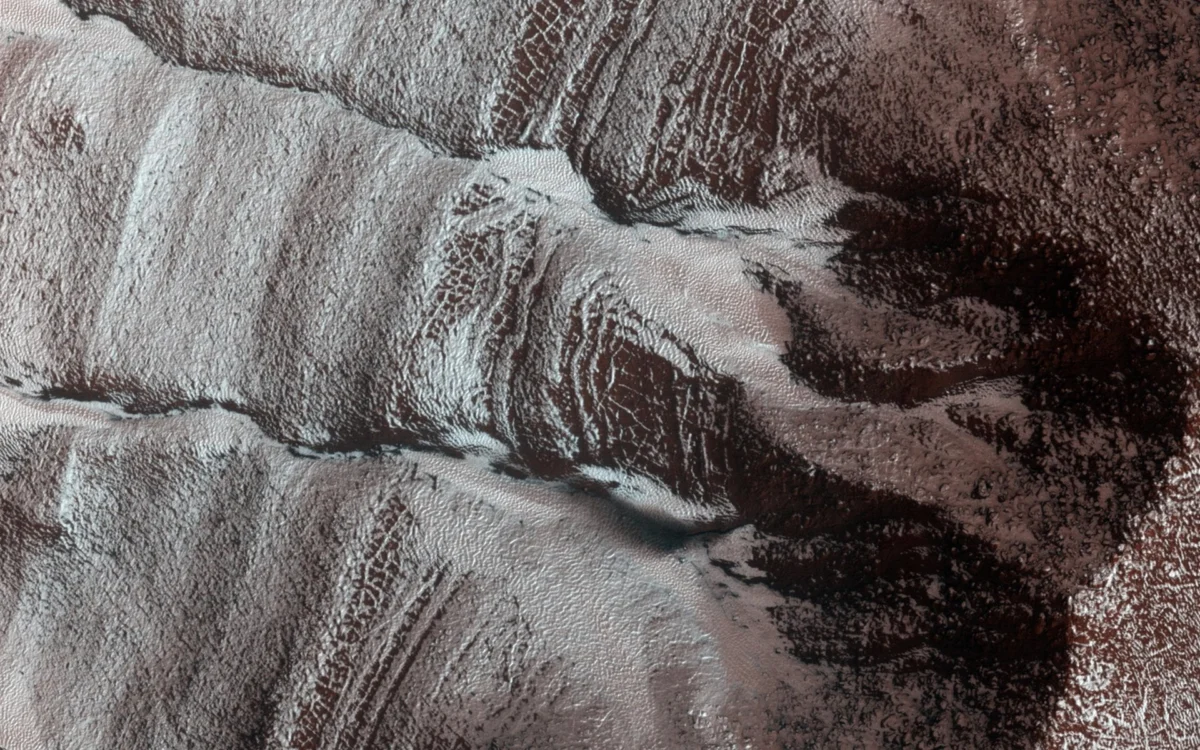
The discovery of Martian gullies at the turn of the 21st century sparked a paradigm shift in our understanding of the Red Planet’s geological activity. Initially identified in images from the Mars Global Surveyor, these features—characterized by alcoves, channels, and depositional aprons—bore a striking resemblance to terrestrial gullies formed by liquid water. However, the prevailing environmental conditions on Mars, defined by a thin atmosphere and average surface temperatures far below the freezing point of water, presented a profound scientific paradox. New research led by Apolline Leclef of the Institut d’Astrophysique Spatiale at Université Paris-Saclay, published in a pre-print on arXiv, provides compelling evidence that these dynamic features are not the work of liquid water, but rather the result of carbon dioxide (CO2) frost fluidization—a process colloquially likened to the "air hockey effect."
The Geological Enigma of Sisyphi Cavi
To investigate the mechanisms behind these changing landscapes, Leclef and her team focused their analysis on a specific region known as Sisyphi Cavi. This system of deep polar pits is located near the Martian south pole, nestled close to the massive polar ice cap. Sisyphi Cavi is a particularly valuable laboratory for planetary geologists because it hosts active gullies while remaining well outside the more temperate "middle latitudes" where such features are typically observed.
The study utilized high-resolution data from two of NASA and ESA’s most enduring orbital assets: the Mars Reconnaissance Orbiter (MRO) and Mars Express. By synthesizing data from the Compact Reconnaissance Imaging Spectrometer for Mars (CRISM) on the MRO and the OMEGA spectrometer on Mars Express, the researchers were able to track the seasonal evolution of the surface composition in Sisyphi Cavi with unprecedented precision. The objective was to correlate the physical changes in the gullies with the presence or absence of specific volatiles, namely water ice and CO2 ice.
Debunking the Liquid Water Hypothesis
For years, the "water-driven" theory remained the most popular explanation for Martian gullies, largely due to Earth-based biases. On Earth, gullies are almost exclusively the result of fluvial erosion—water runoff carving through soil and rock. However, the spectral data from Sisyphi Cavi tells a different story.
Water molecules exhibit a very specific and unmistakable spectral absorption band at 1.5 micrometers (μm). During the Martian spring, as the winter frost begins to vanish, one would expect to see this spectral signature if liquid water or melting water ice were responsible for the gully activity. The researchers found that this 1.5 μm band was entirely absent during the periods of peak gully modification.
Furthermore, while the team detected the presence of salts and clays—minerals that generally require liquid water to form—these were restricted to high plateaus and crater rims. These minerals appear to be ancient remnants of a wetter Martian past rather than products of contemporary seasonal processes. In the immediate vicinity of the active gullies, no such hydrous minerals were found, effectively ruling out liquid water as the modern architect of these features.
The Kieffer Mechanism and the Geyser Theory
With water eliminated, the research team turned their attention to the "Kieffer geyser mechanism," a well-documented Martian phenomenon. Unlike terrestrial geysers, which are powered by hydrothermal pressure, Martian geysers are driven by the sublimation of CO2 ice.
During the Martian winter, a translucent sheet of dry ice (solid CO2) blankets the polar regions. As spring arrives, sunlight penetrates this transparent ice layer and warms the dark, basaltic soil beneath it. This causes the bottom layer of the ice to sublimate directly into gas. As the gas becomes trapped between the soil and the ice sheet, pressure builds until the ice eventually ruptures. The resulting high-velocity jet of CO2 gas carries dark sand and dust into the atmosphere, which then falls back to the surface in fan-like deposits known as "dark spots" or "maculae."
While this process is undeniably dynamic, the timing of these events does not align with gully formation. Data indicates that dark spot activity peaks around the spring equinox. Conversely, the most significant changes to the gullies in Sisyphi Cavi do not begin until mid-to-late spring, a period when the geyser-like venting has largely subsided. This temporal mismatch suggested that a different, more sustained process was at play.
The Air Hockey Effect: CO2 Frost Fluidization
The central thesis of Leclef’s paper proposes that the gullies are formed by a process known as CO2 frost fluidization. This mechanism operates on the same physical principles as an air hockey table. In air hockey, a puck "floats" on a thin cushion of air ejected from the table’s surface, which drastically reduces friction and allows for rapid, effortless movement.
On Mars, as the seasonal CO2 frost sublimates during the late spring, gas is released from the base of the frost layer. If this sublimation occurs on a slope, the gas can act as a lubricant, partially lifting the overlying mass of ice and debris. This creates a "fluidized" flow—a mixture of gas, solid CO2 ice, and regolith (Martian soil) that behaves more like a liquid than a solid.
This fluidized mass can slide down steep slopes with minimal internal friction, gaining enough momentum to carve deep trenches and deposit alluvial-style aprons at the base of the inclines. This "air hockey effect" explains how Mars can produce features that look exactly like water-carved gullies without requiring a single drop of liquid H2O. The process is highly efficient and accounts for the observed timing of gully changes, as it requires the sustained sublimation of thicker frost layers found later in the spring season.
Chronology of Martian Gully Research
The evolution of our understanding of Martian gullies has followed a steady timeline of technological and analytical advancement:
- 2000: The Mars Orbiter Camera (MOC) on the Mars Global Surveyor captures the first high-resolution images of gullies, leading to the "recent liquid water" hypothesis.
- 2006: The Mars Reconnaissance Orbiter (MRO) arrives, providing HiRISE imagery that shows gullies are still actively changing in the present day.
- 2010-2015: Comparative studies between Martian gullies and CO2-rich environments lead to the development of the Kieffer mechanism theory.
- 2017: Research begins to suggest a lack of "hydration" signatures in active gully sites, casting doubt on the water theory.
- 2024: The Leclef et al. study provides a comprehensive spectral and temporal analysis, pointing toward CO2 fluidization as the primary driver in polar regions like Sisyphi Cavi.
Broader Implications for Planetary Science
The confirmation of CO2-driven gully formation has significant implications for our broader understanding of planetary geomorphology. It demonstrates that similar landforms across the solar system do not necessarily imply similar formative processes. This concept, known in geology as equifinality, suggests that different mechanisms can produce nearly identical physical results.
For astrobiologists, these findings are somewhat sobering. The presence of gullies was once viewed as a primary indicator of near-surface liquid water, which is considered a prerequisite for life as we know it. If these gullies are indeed dry, the prospects for finding extant microbial life in these specific features diminish. However, for planetary geologists, the discovery is a testament to the unique and "alien" physics of the Red Planet.
Dr. Leclef’s research highlights the importance of the Martian volatile cycle. Unlike Earth, where the carbon cycle is largely biological and atmospheric, the Martian carbon cycle is a massive, seasonal physical migration. Up to 25% of the Martian atmosphere freezes onto the poles every winter and sublimates back into the atmosphere in the spring. This study proves that this massive movement of mass is not just an atmospheric event, but a powerful geological engine capable of reshaping the planet’s face.
Future Exploration and Data Analysis
The study also underscores the vital role of long-term orbital monitoring. Without decades of overlapping data from the MRO and Mars Express, scientists would not have been able to observe the subtle temporal gaps between geyser activity and gully modification. Future missions, such as the upcoming Martian Moons eXploration (MMX) or potential high-resolution mapping by the European Space Agency, will likely seek to observe these fluidized flows in real-time.
As we look forward, the focus may shift to whether this "air hockey effect" is the universal cause for all Martian gullies or if different mechanisms—perhaps involving brines or melting snow—might still play a role in the more temperate mid-latitude regions. For now, Sisyphi Cavi stands as a clear example of how the Red Planet uses its own unique chemistry to mimic the familiar landscapes of Earth, reminding us that Mars is a world governed by its own distinct set of rules.