admin
admin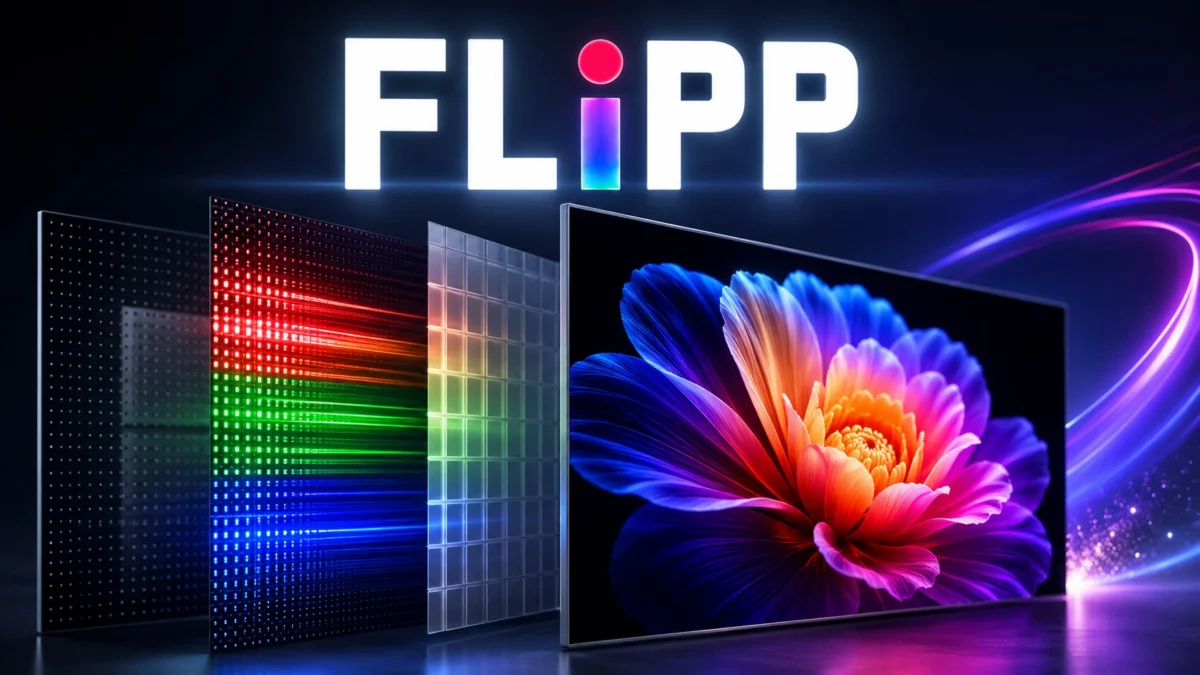
In a significant technological advancement for the display industry, LG Display has officially introduced its latest manufacturing breakthrough, branded as FLiPP. Short for FMM-Less Innovative Pixel Patterning, this new methodology represents a departure from the industry-standard Fine Metal Mask (FMM) technique, which has served as the foundation for high-resolution Organic Light-Emitting Diode (OLED) production for over a decade. Unveiled at the International Meeting on Information Display (IMID) 2026 in Busan, South Korea, FLiPP is positioned to address the primary bottlenecks of current OLED fabrication, promising substantial improvements in panel performance, longevity, and manufacturing scalability.
The introduction of FLiPP comes at a critical juncture as the global display market shifts its focus from smartphone-sized panels to larger formats, including tablets, laptops, and automotive displays. By eliminating the physical constraints of metal masks, LG Display claims to have unlocked a new tier of efficiency that could redefine the cost-to-performance ratio of premium displays.
The Technical Shift: From Physical Masks to Photolithography
To understand the impact of FLiPP, it is necessary to examine the limitations of the traditional Fine Metal Mask (FMM) process. In conventional RGB OLED manufacturing, organic materials are deposited onto a substrate through a fine metal sheet containing millions of microscopic holes. This mask acts as a stencil, ensuring that red, green, and blue subpixels are placed in their exact designated positions.
However, as panel sizes increase and resolutions become denser, FMM faces severe physical limitations. These masks are typically made of Invar—a nickel-iron alloy—and are incredibly thin. When scaled up to fit large mother-glass substrates, such as the Generation 8.5 (G8.5) glass used for mass production, these masks tend to sag under their own weight. This sagging leads to "shadowing" effects, where the organic material is not deposited precisely, resulting in color mixing or misaligned pixels. Furthermore, the physical thickness of the mask limits how close pixels can be placed to one another, effectively capping the "aperture ratio"—the percentage of the pixel area that actually emits light.

LG’s FLiPP technology bypasses these hurdles by utilizing a patterning process rooted in photolithography, a technique more commonly associated with semiconductor manufacturing. Instead of a physical stencil, the process involves a sequential coating of RGB materials across the entire substrate. Following each coating, precision ultraviolet (UV) light is used to "pattern" the pixels, removing unnecessary material with extreme accuracy. This mask-less approach allows for a much tighter arrangement of subpixels, leading to a significantly higher aperture ratio.
Quantifiable Improvements in Performance and Efficiency
The move to a mask-less patterning system yields immediate and measurable benefits for the end-user. According to data released by LG Display during the IMID 2026 presentation, FLiPP technology increases the aperture ratio of OLED pixels by approximately 55% compared to panels produced via the FMM method under identical conditions.
This increase in the light-emitting area has a cascading effect on three critical performance metrics:
- Superior Brightness: Because a larger portion of the pixel area is dedicated to light emission, FLiPP-based panels can achieve 1.6 times (160%) higher peak brightness than current-generation OLEDs. This is particularly relevant for High Dynamic Range (HDR) content and outdoor visibility in mobile devices.
- Extended Lifespan: One of the inherent weaknesses of OLED technology is the degradation of organic materials over time, often leading to "burn-in." With a 55% higher aperture ratio, each pixel can emit the same amount of light while operating at a lower current density. By reducing the "stress" on the organic layers, LG reports that FLiPP panels boast a 2.4 times (240%) longer lifespan.
- Power Efficiency: Efficiency is a paramount concern for portable electronics. LG Display’s internal testing indicates that FLiPP technology results in a 13% reduction in power consumption. This efficiency gain stems from the ability to generate higher luminance with less electrical input, directly translating to longer battery life for laptops and tablets.
Manufacturing Flexibility and the Gen 8.5 Advantage
Beyond the performance of the panels themselves, FLiPP represents a strategic victory in manufacturing logistics. The traditional FMM process is notoriously expensive and rigid. Manufacturers must produce unique, high-precision masks for every different panel size and resolution, adding millions of dollars to R&D and production overhead.
FLiPP eliminates the need for these bespoke metal plates. By using a software-defined photolithography process, LG Display can switch between different panel designs and sizes with much greater agility. This flexibility is expected to drastically reduce the time-to-market for new device form factors.

Perhaps the most significant industrial implication of FLiPP is its compatibility with G8.5 full-glass substrates. The industry is currently racing to establish "Gen 8.5" production lines, which allow for the efficient cutting of medium-to-large panels (13-inch to 27-inch). FMM has historically struggled with G8.5 substrates due to the aforementioned sagging issues. By successfully implementing a mask-less process on G8.5 glass, LG Display positions itself as a dominant force in the burgeoning "IT OLED" market—a sector currently driven by Apple’s transition to OLED for its iPad and MacBook lines, as well as the rising demand for OLED gaming monitors.
Industry Context and Competitive Landscape
The unveiling of FLiPP is seen by analysts as a direct response to rival technologies in the space. Samsung Display, for instance, has been developing its own next-generation patterning techniques, while Chinese manufacturer Visionox has previously showcased its "ViP" (Visionox Intelligent Pixelization) technology, which also utilizes a mask-less approach.
The competition in the "FMM-less" space is essentially a race to see who can achieve the highest yield rates first. While the theoretical benefits of photolithography-based OLED patterning are well-documented, the practical challenge lies in preventing the chemical photoresists from damaging the sensitive organic materials during the etching process. LG’s announcement suggests that they have overcome these chemical compatibility hurdles, though the company has remained tight-lipped regarding the specific "buffer layers" or chemical formulations used to protect the RGB materials during the UV patterning phase.
Market analysts suggest that if LG Display can achieve high yields with FLiPP, it could lead to a significant price drop for high-end OLED panels. By removing the recurring cost of expensive FMM replacements and increasing the number of usable panels per mother-glass, the "OLED premium" currently seen in the laptop and monitor markets could begin to erode, making the technology accessible to mid-range consumer segments.
Chronology of Development and Future Outlook
While the showcase at IMID 2026 in Busan serves as the technology’s public debut, the development of FLiPP has been a multi-year endeavor. LG Display has been hinting at "Next-Gen OLED" advancements since the early 2020s, gradually moving away from its reliance on White-OLED (WOLED) for large panels and refining its RGB OLED capabilities for smaller and medium-sized screens.

The timeline for commercialization remains the subject of industry speculation. During the exhibition, LG Display showcased a "Next-Gen OLED" display alongside an interactive automotive interior concept, demonstrating the technology’s versatility. However, the company has not yet announced a specific commercial product line that will debut FLiPP, nor has it provided a definitive roadmap for mass production.
Industry insiders anticipate that the first wave of FLiPP-enabled devices will likely target the high-end tablet and automotive sectors. The automotive industry, in particular, demands extreme durability and high brightness—two areas where FLiPP’s 2.4x lifespan and 1.6x brightness improvements provide a clear competitive advantage over existing solutions.
Conclusion: A Paradigm Shift in Display Engineering
LG Display’s FLiPP technology represents more than just an incremental update; it is a fundamental shift in how OLED screens are conceived and constructed. By moving away from the physical constraints of fine metal masks and embracing the precision of photolithography, LG is addressing the three "holy grails" of display technology: higher brightness, longer life, and lower production costs.
As the industry moves toward 2027 and beyond, the success of FLiPP will likely be measured by its adoption in mainstream consumer electronics. If the technology performs in the field as well as it has in LG’s labs, it could solidify LG Display’s position as the primary innovator in the global OLED market, effectively ending the era of the Fine Metal Mask and ushering in a new age of "patterned" precision. For now, the tech community awaits the first consumer-ready devices to feature these "Next-Gen" panels, which promise to bring a brighter, more efficient, and more durable visual experience to the masses.