admin
admin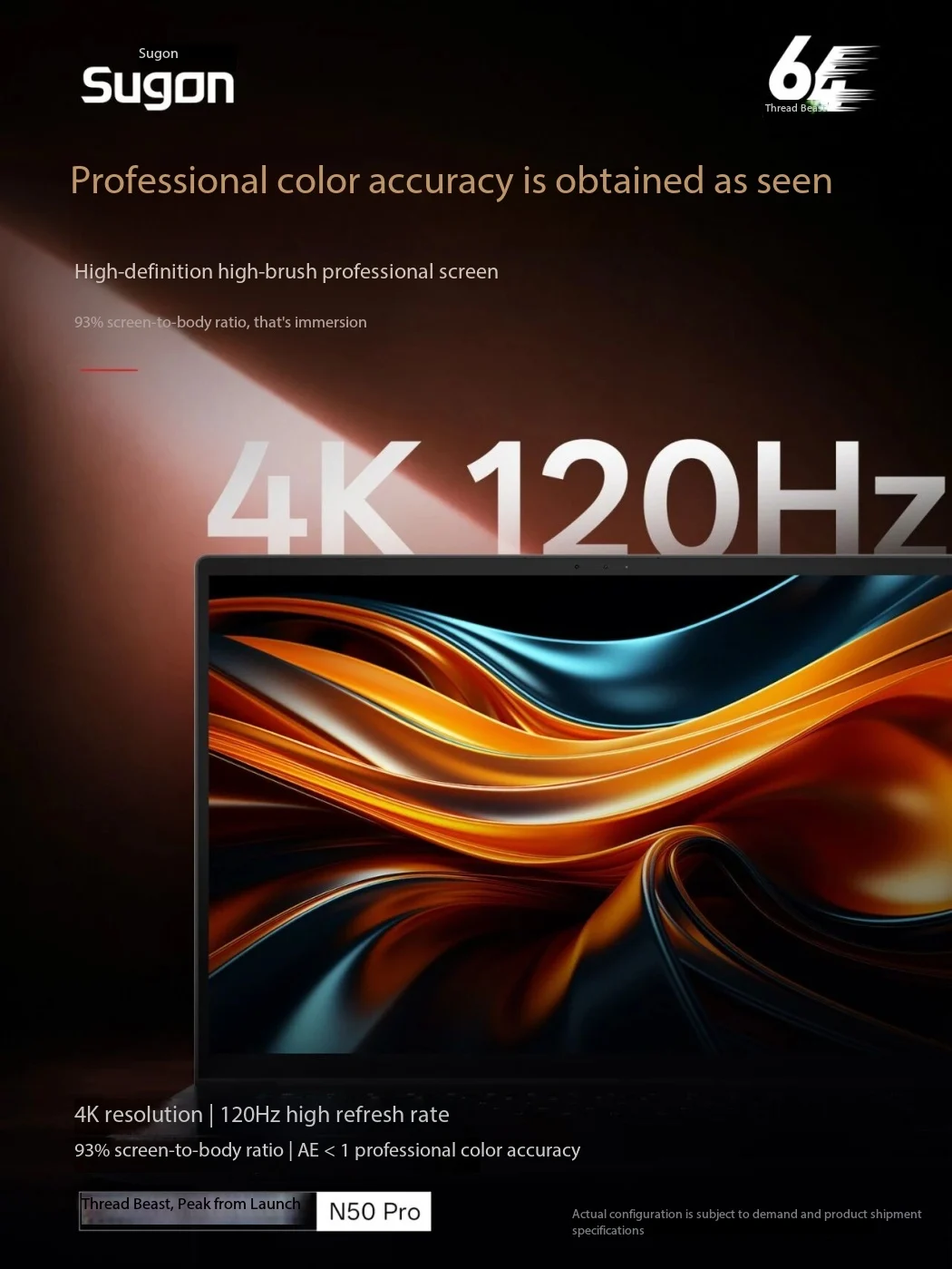
The Chinese technology giant Sugon has officially unveiled its latest flagship mobile workstation, the N50 Pro, a device that the company has branded the "Thread Beast" due to its unprecedented processing capabilities. In a significant leap for mobile computing, the N50 Pro features the world’s first 64-thread mobile central processing unit (CPU), doubling the thread count of the highest-end consumer laptops currently available from traditional industry leaders like Intel and AMD. This release marks a pivotal moment in the high-performance computing (HPC) sector, as Sugon targets the rapidly expanding domestic market for artificial intelligence (AI) development, scientific simulation, and high-end professional content creation.
The N50 Pro arrives at a time when the demand for localized hardware in China is at an all-time high, driven by both internal industrial policy and external geopolitical pressures. By offering a laptop that significantly exceeds the multi-threaded performance of standard workstation laptops, Sugon is positioning itself as a primary provider for engineers, researchers, and AI developers who require server-grade parallel processing in a portable form factor.

Architectural Innovation: The Power of 64 Threads
While the specific model of the processor utilized in the N50 Pro has not been explicitly named in the initial promotional materials, technical analysts point toward the Hygon C86 series as the likely engine behind the machine. Sugon operates under the umbrella of Hygon, a company that famously established a joint venture with AMD years ago to produce x86-compatible processors for the Chinese market.
Industry experts suggest the N50 Pro likely utilizes the newer Hygon C86-5G series. Unlike traditional x86 processors that typically employ Simultaneous Multithreading (SMT) to provide two threads per physical core, the C86-5G architecture is believed to incorporate SMT4 technology. This advancement allows each physical core to handle four independent threads simultaneously. Consequently, a 16-core processor using SMT4 can deliver 64 threads, providing a massive advantage in parallelized workloads such as rendering, compilation, and complex mathematical simulations.
The CPU boasts a single-threaded boost clock frequency of up to 4.30 GHz. While single-core speeds are essential for general responsiveness, the true value of the N50 Pro lies in its multi-threaded efficiency. Sugon’s internal testing indicates that the "Thread Beast" can reduce the time required for fluid dynamics simulations—a staple task in aerospace and automotive engineering—from 2.4 hours on standard high-end hardware to just one hour. This 58% reduction in processing time highlights the practical utility of the 64-thread architecture for specialized industrial applications.

Graphics and AI Acceleration: The 16 GB VRAM Advantage
Parallel to its CPU capabilities, the Sugon N50 Pro is equipped with a dedicated graphics processing unit (GPU) designed to meet the rigorous demands of modern AI workloads. The GPU features 16 GB of dedicated video memory (VRAM) and operates at an unusually high base frequency of 3.3 GHz.
The inclusion of 16 GB of VRAM is a strategic choice aimed at the "local AI" market. As Large Language Models (LLMs) become increasingly integral to professional workflows, the ability to run these models locally rather than relying on cloud infrastructure has become a priority for many Chinese enterprises concerned with data security and latency. Sugon’s promotional data demonstrates the N50 Pro’s prowess in this area, showing the laptop running a 35-billion parameter Mixture of Experts (MoE) model. The system achieved a throughput of over 50 tokens per second, a performance level that allows for real-time interaction and fluid model previewing, which was previously the sole domain of desktop workstations or server clusters.
Memory and Storage: Server-Grade Expandability
To prevent bottlenecks that could stifle the 64-thread CPU, Sugon has outfitted the N50 Pro with robust memory and storage options. The laptop supports up to 128 GB of expandable memory. The use of the term "expandable" suggests the inclusion of SO-DIMM slots rather than soldered LPDDR5X memory, a decision that will likely be welcomed by IT departments and power users who require the flexibility to upgrade hardware over the device’s lifecycle.

On the storage front, the N50 Pro supports up to 8 TB of internal NVMe SSD capacity. This high storage ceiling is critical for professionals working with massive datasets, high-resolution video assets, or extensive virtual machine environments. The combination of 128 GB of RAM and 8 TB of storage effectively bridges the gap between a traditional laptop and a mobile server, allowing users to carry entire project environments in a single 1.69kg chassis.
Display and Industrial Design
Despite the heavy-duty internals, Sugon has maintained a focus on portability and aesthetic refinement. The N50 Pro features an ultra-thin form factor, measuring just 16.9mm in thickness. This puts it in direct competition with premium ultrabooks, despite housing significantly more powerful multi-threaded hardware.
The visual experience is anchored by a 4K resolution display with a 120Hz refresh rate. The panel occupies a 93% screen-to-body ratio, providing an immersive workspace with minimal bezels. For creative professionals, the display offers "professional color accuracy" with a Delta E (ΔE) value of less than 1, ensuring that colors are reproduced with the precision required for high-end photography, color grading, and architectural visualization.

The I/O (Input/Output) suite is equally comprehensive, designed to support a multi-monitor professional setup without the immediate need for external dongles. The configuration includes:
- Two USB Type-C ports (supporting data and video output)
- Three USB Type-A ports for legacy peripherals
- A dedicated HDMI port
- A 3.5mm combo audio jack
- A proprietary charging dock interface for high-wattage power delivery
Chronology of Development and Strategic Context
The launch of the N50 Pro is the culmination of a multi-year effort by Sugon and Hygon to achieve greater independence in the high-end computing space. The history of this development is tied to the 2016 partnership between AMD and THATIC (Tianjin Haiguang Advanced Technology Investment Co. Ltd), which allowed Hygon to license the Zen architecture.
Following the initial licensing, Hygon developed the "Dhyana" CPUs. However, as trade restrictions tightened in 2019, Sugon and its affiliates were placed on various "entity lists" by the U.S. Department of Commerce. This forced a pivot toward domestic architectural refinement. The transition from the C86-4G series to the current C86-5G (the presumed heart of the N50 Pro) represents a significant milestone in China’s ability to iterate on complex x86 designs independently.

The timeline of the N50 Pro’s announcement follows a series of successful deployments of Sugon hardware in Chinese supercomputing centers and government infrastructure. By bringing this technology to a laptop form factor, Sugon is signaling that its domestic chip supply chain is mature enough to move beyond stationary servers and into the highly competitive mobile workstation market.
Broader Market Implications and Official Outlook
The N50 Pro is not merely a hardware release; it is a statement of intent regarding China’s "Xinchuang" (Information Technology Application Innovation) ecosystem. This initiative aims to replace foreign technology with domestic alternatives across critical sectors, including finance, energy, and telecommunications.
While Sugon has not yet released specific pricing or a global launch date, it is widely understood that the N50 Pro will be focused exclusively on the Chinese domestic market. The premium specifications suggest a high price point, likely positioning it as a competitor to the Apple MacBook Pro 16 and the Dell Precision series within the Chinese enterprise sector.

The implications for the global semiconductor market are notable. If the Hygon C86-5G can truly deliver 64 threads of stable performance in a 16.9mm chassis, it challenges the narrative that domestic Chinese chips remain generations behind their Western counterparts in terms of specialized multi-core utility. While Western chips may still hold the lead in raw single-core IPC (Instructions Per Clock) for gaming and general consumer tasks, Sugon’s focus on the "Thread Beast" niche suggests a calculated move to dominate the parallel processing requirements of the AI era.
As of this report, Sugon has not provided details on battery life—a traditional weak point for high-thread-count mobile devices—or thermal management solutions. Maintaining a 64-thread CPU and a 16 GB GPU in a thin chassis will require sophisticated cooling, likely involving vapor chambers or advanced phase-change materials. Further technical reviews will be required to determine how the N50 Pro manages the significant heat output of its "Thread Beast" components during sustained professional workloads.
The N50 Pro represents a bold step forward for Sugon, transitioning from a provider of back-end infrastructure to a creator of high-end professional consumer electronics. For the Chinese professional market, it offers a glimpse into a future where domestic hardware is not just a substitute for foreign products, but a leader in specific performance metrics.