Chandra Wibowo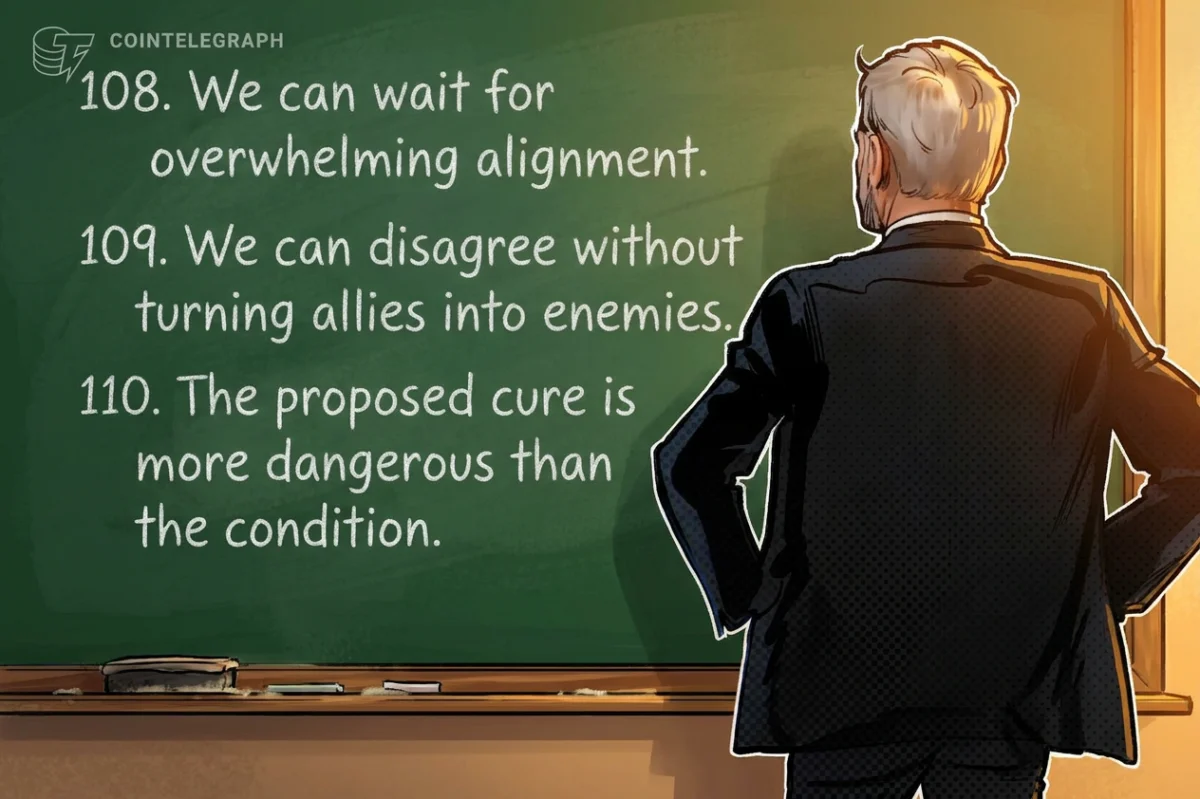
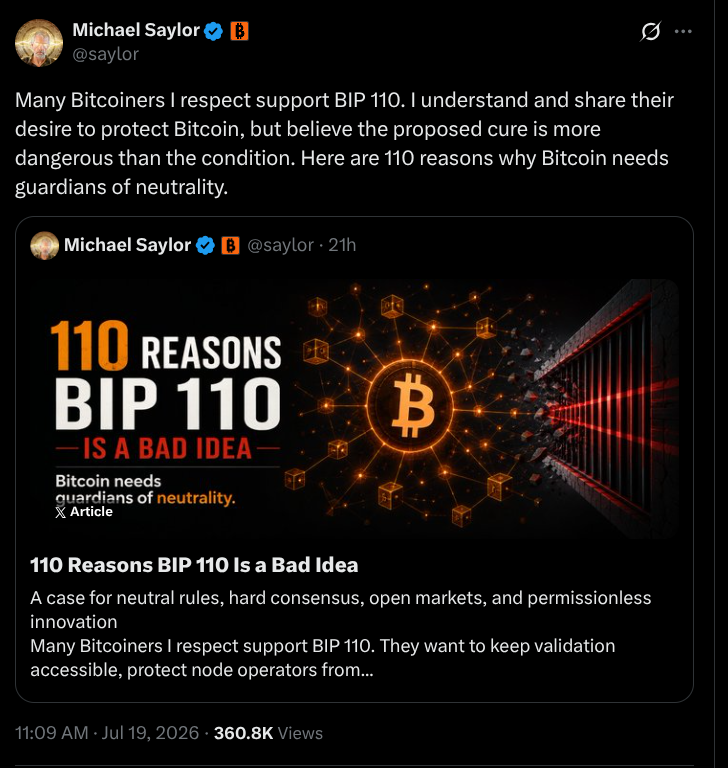
Strategy executive chairman Michael Saylor has publicly articulated a detailed opposition to Bitcoin Improvement Proposal 110 (BIP-110), a contentious measure aimed at temporarily restricting non-monetary transactions on the Bitcoin network. In a comprehensive social media post on Sunday, Saylor outlined what he termed "110 reasons" for his strong stance against the proposal, which seeks to curb the impact of Ordinals inscriptions and other arbitrary data that proponents argue are spamming the network and detracting from Bitcoin’s primary function as a peer-to-peer cash system.
The detailed exposition, spanning approximately 3,700 words on X.com, comes from a prominent figure who leads one of the largest corporate holders of Bitcoin (BTC). Saylor’s argument centers on the principles of "neutral rules, hard consensus, open markets, and permissionless innovation." This extensive critique positions Saylor as a key voice in the ongoing debate surrounding the future direction of the Bitcoin protocol, particularly in light of the emergence of novel use cases like Ordinals.
Background: The Genesis of BIP-110
Bitcoin Improvement Proposal 110 was formally introduced in December 2025. Its primary objective was to address concerns about the increasing volume of non-financial data being inscribed onto the Bitcoin blockchain, a phenomenon largely driven by the popularity of Ordinals, a protocol that allows for the creation of unique, non-fungible tokens (NFTs) on satoshis, the smallest units of Bitcoin. Proponents of BIP-110 argue that this "data bloat" strains network resources, elevates transaction fees, and potentially compromises Bitcoin’s core identity as a robust and efficient medium of exchange. The proposal suggests a temporary fork to enforce stricter rules on what can be inscribed, with the aim of preserving network performance and affordability for everyday transactions.
The introduction of BIP-110 has ignited a significant debate within the Bitcoin development community, echoing historical disagreements such as the "Blocksize Wars" of 2015-2017. During that period, the community grappled with the question of whether to increase the block size limit to improve scalability, a debate that ultimately led to contentious hard forks and the creation of Bitcoin Cash. BIP-110 represents a modern iteration of such fundamental disagreements about the network’s intended purpose and the balance between innovation and stability.
Saylor’s Core Arguments Against BIP-110
In his extensive critique, Michael Saylor acknowledged the valid concerns raised by supporters of BIP-110. He stated, "Many Bitcoiners I respect support BIP 110. They want to keep validation accessible, protect node operators from unwanted costs and content, preserve affordable payments, and keep Bitcoin focused on sound money rather than general-purpose data storage. Those are serious concerns. I share the objectives. I disagree about the remedy." This statement underscores Saylor’s recognition of the problem while diverging on the proposed solution.
Saylor’s "110 reasons" are not merely a list but a structured argument that champions what he views as the foundational principles of Bitcoin. He emphasized the importance of maintaining an open and permissionless environment where innovation can flourish without arbitrary restrictions imposed by a subset of the community. His critique suggests that BIP-110, by attempting to gatekeep specific types of transactions, undermines the very ethos of decentralization and censorship resistance that Bitcoin was designed to uphold.
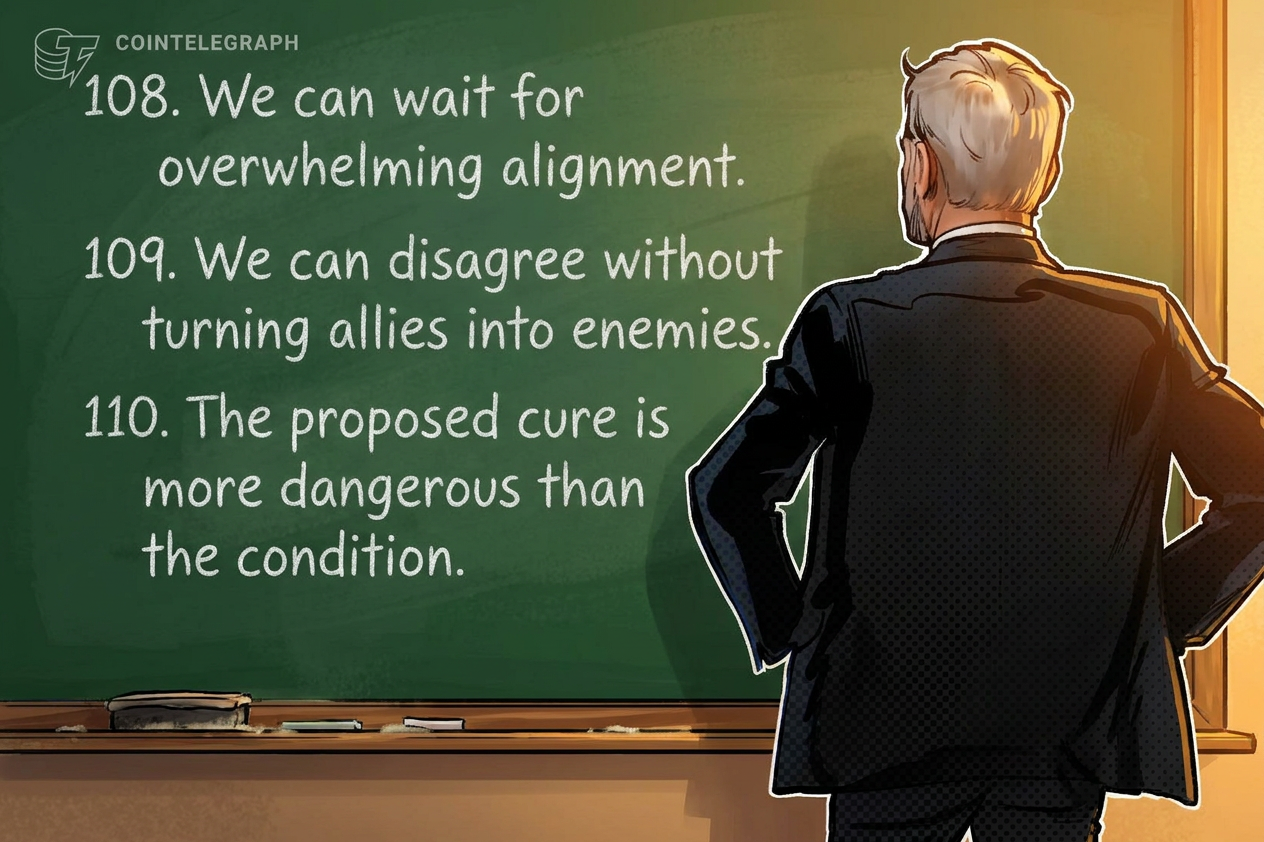
He further elaborated that his critique is directed at the proposal itself, not the individuals advocating for it, stating, "This article critiques the proposal, not the people behind it. I assume good faith. Bitcoin is strongest when we can disagree vigorously without mistaking allies for enemies." This diplomatic approach highlights the complexity of the issue and the need for respectful discourse within the Bitcoin ecosystem, even when fundamental disagreements exist.
Key Figures and Stalwarts in the Debate
The debate surrounding BIP-110 involves several prominent figures within the cryptocurrency space. The proposal was introduced by a pseudonymous Bitcoin developer known as "Dathon Ohm," with backing from Ocean Protocol founder Luke Dashjr. Both Dashjr and Ohm have been vocal about the perceived threat of Ordinals-driven network congestion.
On the opposing side, Saylor’s extensive critique aligns with sentiments expressed by other influential figures. Blockstream CEO Adam Back, a veteran cryptographer and early Bitcoin adopter, has also voiced strong opposition to BIP-110. Back has characterized the proposal as a "quest to police other people" and argued that it is incompatible with Bitcoin’s cypherpunk roots. He believes that Bitcoin’s decentralized nature means that no single entity or group should have the power to impose their views on others, particularly concerning what kind of data can or cannot be transacted on the network.
Luke Dashjr, a vocal proponent of BIP-110, has described the proliferation of Ordinals as a "serious threat" to the network’s integrity and has called for an "imminent fix." He and other supporters argue that BIP-110 is necessary to prevent the network from becoming unusable for its intended purpose of peer-to-peer electronic cash due to excessive data storage. They also contend that the proposed fork would be temporary, lasting only one year, and would not invalidate fee-paying transactions in the long term, thus mitigating fears of a permanent chain split or disruption.
Network Adoption and Technical Thresholds for BIP-110
The activation of BIP-110 is contingent upon significant support from Bitcoin’s decentralized network of nodes. Specifically, the proposal will only be activated if 55% of Bitcoin nodes validating blocks signal their support during a defined "period." A "period" in this context refers to a specific range of blocks, typically spanning hundreds or thousands of blocks, during which node operators can signal their agreement with a proposed change.
Data from recent block periods indicates a low level of adoption for BIP-110. In the last recorded period, period number 475, which spanned blocks 955,584 to 957,599, only 1% of the blocks processed showed support for the proposal. This low figure suggests that, as of the current time, BIP-110 is far from meeting the threshold required for activation, indicating a significant divergence in opinion among the node-operating community.
The Context of Ordinals Activity
The debate over BIP-110 unfolds against a backdrop of fluctuating Ordinals activity. While Ordinals experienced a surge in popularity and transaction volume, particularly in mid-2023, current data shows a notable decline. In the past month leading up to this report, the number of Ordinals inscribed onto the Bitcoin blockchain has hovered below 10,000 per day. This figure represents a significant drop from the peak of over 400,000 inscriptions observed in August 2023.
This decline in Ordinals activity might influence the urgency and perceived necessity of BIP-110 for some participants. However, proponents argue that even at lower levels, the potential for network strain remains a valid concern, and that proactive measures are crucial to prevent future surges from overwhelming the network. The cyclical nature of such trends in decentralized networks underscores the challenge of creating permanent solutions to evolving use cases.
Broader Implications for the Bitcoin Ecosystem
The dispute over BIP-110 highlights a perennial tension within the Bitcoin community: the balance between protocol evolution, innovation, and maintaining core functionalities. Saylor’s extensive critique, by championing principles of permissionless innovation and open markets, suggests a belief that the network should adapt to new use cases rather than restrict them. This perspective aligns with a vision of Bitcoin as a versatile digital asset capable of supporting a wide range of applications beyond simple monetary transactions.
Conversely, supporters of BIP-110 prioritize the network’s stability, efficiency, and its primary role as a peer-to-peer cash system. Their concerns about transaction fees and network congestion are rooted in the desire to ensure Bitcoin remains accessible and affordable for everyday use, preventing it from becoming prohibitively expensive due to specialized or data-intensive applications.
The outcome of the BIP-110 debate, regardless of whether it is adopted, activated, or ultimately abandoned, will have significant implications for the future development trajectory of Bitcoin. It underscores the decentralized governance model of Bitcoin, where consensus-building is a complex and often lengthy process. The strong opinions and detailed arguments presented by figures like Michael Saylor and Adam Back, versus those of Luke Dashjr and Dathon Ohm, illustrate the diverse interpretations of Bitcoin’s purpose and the ongoing dialogue about its evolution.
The engagement from a broad spectrum of the Bitcoin community, as evidenced by the significant viewership and discussion surrounding Saylor’s post, signals the importance of this particular protocol-level discussion. It reflects a mature ecosystem capable of robust debate on critical issues, a characteristic that has historically shaped Bitcoin’s resilience and adaptability. The "110 reasons" presented by Saylor serve as a comprehensive counterpoint to the arguments for BIP-110, contributing to a more informed and nuanced understanding of the challenges and opportunities facing the Bitcoin network as it continues to mature and integrate new functionalities. The ongoing discussion surrounding BIP-110 will undoubtedly shape how Bitcoin addresses the evolving landscape of decentralized technologies and its own foundational principles.