admin
admin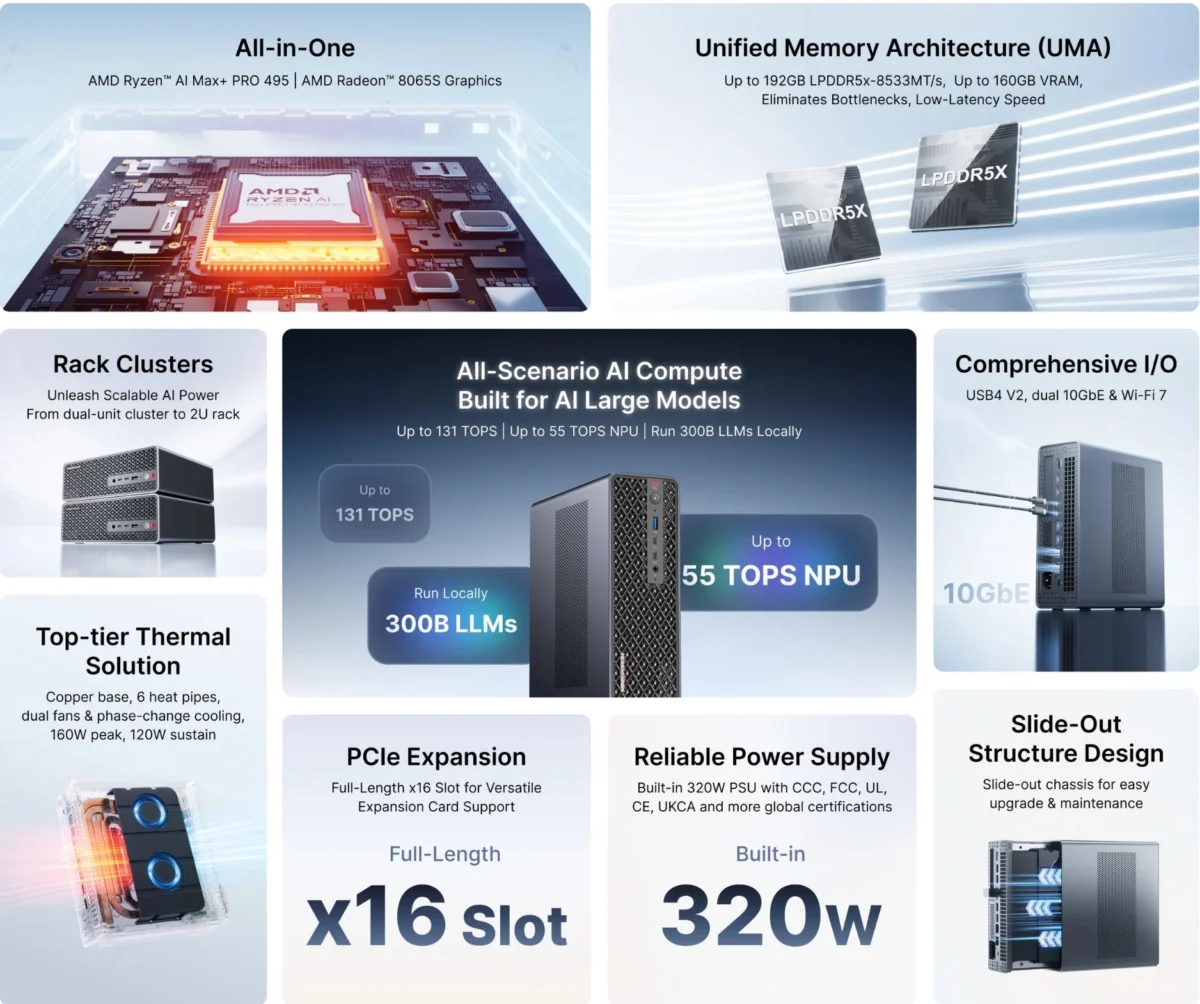
The unveiling of the MS-S1 MAX-P495 at the IFA 2026 trade show marks a significant pivot in the compact computing market, signaling the arrival of "Mini Workstations" designed specifically for the era of generative artificial intelligence. As enterprise demand for localized AI processing grows, Minisforum has positioned its latest flagship as a direct answer to the limitations of cloud-based computing, offering a hardware suite capable of running massive Large Language Models (LLMs) with up to 300 billion parameters directly on the device. By integrating AMD’s cutting-edge "Gorgon Halo" silicon with a memory architecture previously reserved for high-end servers, the MS-S1 MAX-P495 redefines the performance-per-square-inch metric for professional users.
The Silicon Core: AMD Ryzen AI Max+ PRO 495
At the heart of the MS-S1 MAX-P495 lies the AMD Ryzen AI Max+ PRO 495, a processor belonging to the highly anticipated "Gorgon Halo" family. This chip represents a significant leap over the previous Ryzen AI Max+ PRO 395, utilizing the Zen 5 architecture to deliver 16 cores and 32 threads of processing power. The Zen 5 architecture provides a notable increase in Instructions Per Clock (IPC), which translates to smoother multi-threaded performance in demanding applications such as 3D rendering, video encoding, and complex scientific simulations.
The graphical capabilities of the system are anchored by the AMD Radeon 8060S integrated GPU (iGPU). Featuring 40 RDNA 3.5 Compute Units, this iGPU offers performance levels that rival many mid-to-high-range discrete graphics cards. The transition to RDNA 3.5 architecture brings optimizations in power efficiency and compute throughput, which are essential for maintaining performance in the thermally constrained environment of a mini PC chassis.

However, the most critical component for AI-centric workflows is the Neural Processing Unit (NPU). The Ryzen AI Max+ PRO 495 delivers a peak AI compute performance of 131 TOPS (Tera Operations Per Second). This is a slight but vital refinement over the 126 TOPS found in the 395-series predecessor. When combined with the compute power of the CPU and GPU, the total system AI throughput allows the MS-S1 MAX-P495 to handle real-time AI inference and edge computing tasks that were once the sole domain of full-sized desktop workstations equipped with dedicated AI accelerators.
Memory and Storage: A Unified Architecture for LLMs
The standout feature of the MS-S1 MAX-P495 is its staggering 192 GB of LPDDR5X memory, clocked at an impressive 8533 MT/s. Unlike traditional desktop systems where the CPU and GPU have separate memory pools, Minisforum has utilized a Unified Memory Architecture (UMA). This design allows the system to allocate up to 160 GB of that total capacity specifically for the integrated graphics.
This massive VRAM allocation is the primary driver behind the claim that the system can run 300B parameter LLMs locally. Typically, large AI models require immense amounts of high-speed memory to store the model weights during inference. By providing 160 GB of usable graphics memory, the MS-S1 MAX-P495 circumvents the bottlenecks associated with moving data between the system RAM and a discrete GPU’s VRAM. The 8533 MT/s speed ensures that the bandwidth is sufficient to keep the 40 RDNA 3.5 Compute Units fed, minimizing latency in AI-generated responses.
For storage, the device offers professional-grade flexibility. It features dual M.2 slots configured in a PCIe 4.0 x4 and PCIe 4.0 x1 arrangement. The system supports up to 16 TB of total internal storage and offers RAID 0 and RAID 1 configurations. This allows users to choose between maximum data throughput for video editing or data redundancy for critical server-side operations.

Expansion and Connectivity: The Professional I/O Suite
Minisforum has designed the MS-S1 MAX-P495 to serve as a hub for professional peripherals and network environments. The rear I/O panel is densely packed, featuring dual 10G high-speed LAN ports. In a professional setting, these ports allow for high-speed data transfers to Network Attached Storage (NAS) units or integration into high-bandwidth corporate intranets, which is essential for collaborative AI training or large-scale data analysis.
The connectivity suite includes:
- Dual USB4 Ports: Offering 40 Gbps bandwidth and supporting Alt Mode DisplayPort 2.0, allowing for multiple high-resolution 4K or 8K monitor setups.
- USB 3.2 Gen 2: Dedicated ports for high-speed peripherals.
- PCIe x16 Expansion Slot: A rarity in the mini PC segment, this slot allows for the addition of specialized expansion cards. While the slot is electrically capped at PCIe 4.0 x4 mode, it remains ideal for adding high-speed networking cards, additional M.2 NVMe expansion cards, or specialized capture cards.
Background and Market Context: The Shift to Edge AI
The announcement of the MS-S1 MAX-P495 comes at a time when the tech industry is shifting away from "Cloud-Only" AI models toward "Edge AI." High-profile data breaches and the rising costs of cloud computing subscriptions have driven enterprises to seek local hardware solutions. Minisforum’s decision to launch a "Gorgon Halo" based system reflects a broader industry trend seen in competitors like Acemagic, who are also racing to bring AMD’s high-performance APUs to the compact market.
Historically, Minisforum began as a provider of budget-friendly office mini PCs. However, over the last three years, the company has aggressively moved upmarket. The MS series (Workstation Series) represents the pinnacle of this evolution. By partnering closely with AMD to implement the Ryzen AI Max+ PRO series, Minisforum is targeting a niche once dominated by the Apple Mac Studio and high-end Small Form Factor (SFF) builds.

Chronology of Development
The path to the MS-S1 MAX-P495 can be traced through several key milestones in AMD and Minisforum’s recent history:
- Q3 2025: AMD announces the Zen 5 architecture and the "Strix Point" mobile processors, laying the groundwork for high-performance NPUs.
- Q1 2026: Rumors of the "Gorgon Halo" (Strix Halo) silicon surface, suggesting a chip that combines high-end CPU cores with an unprecedented number of GPU compute units.
- Q2 2026: Minisforum releases the MS-01 and subsequent refreshes, testing the market’s appetite for 10G networking and PCIe expansion in mini PCs.
- IFA 2026: Minisforum officially unveils the MS-S1 MAX-P495, showcasing the fully realized "Halo" platform with 192 GB of RAM.
Analysis: Implications for the AI Industry
The ability to run a 300B parameter model on a device that fits in a backpack has profound implications for developers and researchers. Currently, running such models usually requires a cluster of expensive enterprise GPUs (like the NVIDIA H100 or A100) or a high-end Apple Silicon Mac with unified memory. The MS-S1 MAX-P495 provides a Windows/Linux-based alternative that is likely more cost-effective than a server rack while offering more hardware expandability than proprietary ecosystems.
From a technical standpoint, the 131 TOPS NPU is designed to handle "always-on" AI tasks—such as live translation, noise cancellation, and background metadata tagging—leaving the 40-unit GPU free to handle the heavy lifting of generative tasks like image synthesis or LLM inference. This division of labor is key to maintaining system responsiveness during heavy AI workloads.
Pricing and Availability
While Minisforum has not yet provided a specific retail release date, the company’s teaser materials suggest a premium pricing strategy. Given the cost of 192 GB of high-speed LPDDR5X and the high-yield requirements for the Gorgon Halo silicon, industry analysts expect the MS-S1 MAX-P495 to retail for approximately $7,000 or more for a fully configured unit.

The company is currently engaging with its community via platforms like Discord to gauge final interest and offer "surprise" early-bird pricing. This strategy suggests that while the unit is a flagship "halo" product, Minisforum is keen to ensure it reaches the hands of developers who can build the next generation of localized AI applications.
Summary of Technical Specifications
| Feature | Specification |
|---|---|
| Processor | AMD Ryzen AI Max+ PRO 495 (Gorgon Halo) |
| Cores/Threads | 16 Cores / 32 Threads (Zen 5) |
| AI Performance | 131 TOPS (NPU) |
| Graphics | AMD Radeon 8060S (40 RDNA 3.5 CUs) |
| Memory | 192 GB LPDDR5X-8533 (Unified) |
| VRAM Allocation | Up to 160 GB |
| Storage | Dual M.2 (PCIe 4.0 x4 + x1), up to 16 TB |
| Networking | Dual 10G LAN |
| Connectivity | Dual USB4 (40Gbps), USB 3.2 Gen 2, PCIe x16 (x4 mode) |
| Form Factor | Mini Workstation |
The MS-S1 MAX-P495 stands as a testament to the rapid miniaturization of high-performance computing. By bridging the gap between the portability of a mini PC and the raw power of an AI server, Minisforum has created a tool that addresses the most pressing needs of the modern digital landscape: privacy, local control, and the unbridled power of generative artificial intelligence.