Sisilia Frederika
As the dwarf planet Pluto continues its solitary trek through the outer reaches of the Solar System, international teams of astronomers have observed a significant and accelerating shift in its tenuous atmosphere. According to a new study led by Dr. Amanda Sickafoose, a Senior Scientist at the Planetary Science Institute (PSI), Pluto’s atmospheric pressure has begun a marked decline, dropping by approximately 16% between mid-2021 and July 2023. This discovery marks a pivotal turning point in our understanding of the distant world, suggesting that the long-anticipated "freezing out" of its atmosphere is no longer a theoretical prediction but a current reality. Pluto is currently in the early stages of an 88-year journey toward its aphelion—the point in its orbit farthest from the Sun—where it will endure decades of increasing cold and darkness.
The findings, based on data captured during rare celestial events known as stellar occultations, indicate that the nitrogen-rich envelope surrounding Pluto is responding to the diminishing solar energy. While the atmosphere remained relatively stable for several years following the New Horizons flyby in 2015, the most recent measurements suggest that the cooling process has finally overcome the thermal inertia of the planet’s surface. As Pluto moves further into the Kuiper Belt, the gases that constitute its atmosphere are beginning to transition back into solid ice, a process that could eventually lead to the total or partial collapse of the atmospheric column onto the frozen landscape below.
The Mechanics of Pluto’s 248-Year Orbit
To understand the current atmospheric collapse, one must consider the extreme orbital dynamics of the Plutonian system. Pluto follows a highly elliptical and high-obliquity path that takes 248 Earth years to complete a single revolution around the Sun. Its distance from the Sun varies dramatically, ranging from a relatively close 29.7 astronomical units (AU) at perihelion to a staggering 49.3 AU at aphelion.
Pluto reached its perihelion—its closest approach to the Sun—in 1989. For several decades following that event, even as the dwarf planet began to move away, its atmosphere actually continued to expand and thicken. This phenomenon is attributed to thermal lag; the vast reservoirs of nitrogen and methane ice on Pluto’s surface had absorbed enough solar energy during the approach to perihelion to continue sublimating (turning directly from solid to gas) for years afterward. This is analogous to how the hottest part of a summer day often occurs in the late afternoon, well after the Sun has reached its highest point in the sky.
However, the "summer" of Pluto is now definitively ending. The recent 16% drop in pressure suggests that the surface has finally cooled to a point where the rate of condensation (gas turning to ice) has overtaken the rate of sublimation. As Pluto marches toward its aphelion in the year 2114, the solar radiation it receives will continue to dwindle, leading to a projected "global winter" that could last for over a century.

Stellar Occultations: A Window into the Deep Cold
Because Pluto is too small and too distant for its atmosphere to be measured directly by even the most powerful Earth-based telescopes, scientists rely on stellar occultations to probe its characteristics. An occultation occurs when a planetary body passes directly between Earth and a distant background star. As the star’s light passes through the edges of Pluto’s atmosphere before being blocked by the solid disk of the planet, the gases and hazes within that atmosphere distort, bend, and dim the starlight.
By recording the "light curve"—a graph showing the star’s brightness over time during the event—astronomers can extract critical data. The rate at which the light fades provides a profile of the atmosphere’s density and pressure. If Pluto had no atmosphere, the star would blink out instantaneously. Instead, the gradual dimming observed by Dr. Sickafoose’s team reveals a complex, multi-layered gaseous envelope.
The logistics of capturing these events are formidable. Pluto’s shadow on Earth is narrow and moves at high velocities across the globe. To capture a successful occultation, astronomers must position telescopes precisely within the predicted shadow path, which often crosses remote oceans or uninhabited landmasses. The research team utilized a network of observatories, including the Savannah Skies Observatory in Australia, to capture the June 2021 and July 2023 events. These observations were then compared against data from the 2015 New Horizons mission and subsequent occultations in 2017 and 2018 to establish a clear chronological trend.
Comparative Pressure and Atmospheric Structure
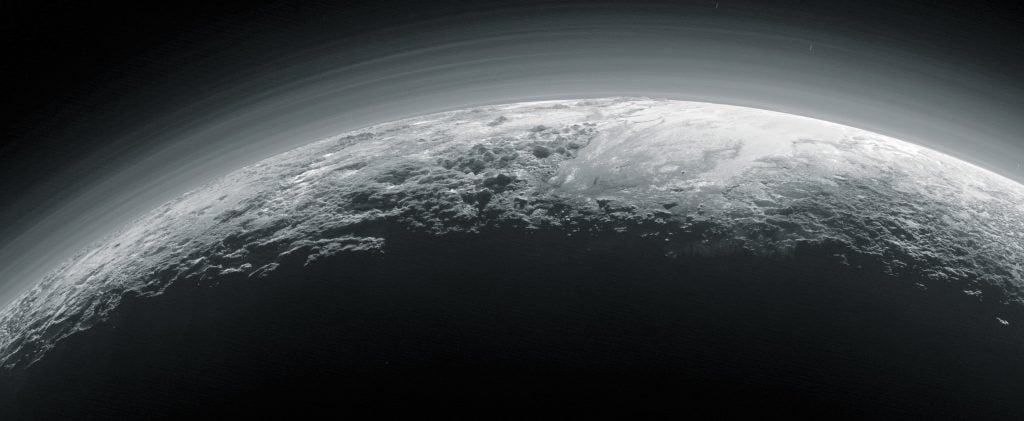
At its peak, Pluto’s atmospheric pressure is roughly 10 millibars, which is approximately 1/100,000th of the atmospheric pressure at sea level on Earth. Despite being so thin, this atmosphere is remarkably complex. It is composed primarily of nitrogen, with trace amounts of methane and carbon monoxide.
The 2023 data revealed not only a drop in overall pressure but also changes in the vertical structure of the atmosphere. The occultations showed variations in how light was absorbed in the upper versus lower layers. Between 2015 and 2021, the pressure at an altitude of 1,275 kilometers remained somewhat consistent, but by 2022 and 2023, the pressure at 1,215 kilometers dropped by an estimated 16% when accounting for haze particles.
One of the most intriguing aspects of the new data is the behavior of Pluto’s haze layers. These hazes are formed when ultraviolet light from the Sun breaks down methane molecules in the upper atmosphere, leading to the creation of complex organic compounds called tholins. These particles eventually settle toward the surface. The recent findings suggest that as the pressure drops, these haze layers are thinning and descending. This "clearing" of the sky could have significant implications for how the surface reflects light, potentially altering Pluto’s albedo and further accelerating the cooling process in a feedback loop.
Scientific Analysis: Buoyancy Waves and Intermittent Dynamics
The study published by Dr. Sickafoose and her colleagues also highlighted the presence of "spikes" in the light curves, which are interpreted as evidence of buoyancy waves—often referred to as gravity waves—within the Plutonian atmosphere. These waves are oscillations in the fluid of the atmosphere, caused by the interaction of winds with surface topography or by thermal fluctuations.
The presence of these waves suggests that Pluto’s atmosphere is not a static, uniform blanket but a dynamic system capable of complex weather-like patterns. The fact that these waves are intermittent indicates that the atmosphere is undergoing localized changes as it prepares for its eventual freeze-out.
"I’m constantly amazed at how the simple technique of watching starlight dim and reappear allows us to study a thin atmosphere—a few millionths of the Earth’s—on a world two-thirds the size of our Moon and 30 times farther from the Sun," Dr. Sickafoose stated. Her work emphasizes that even though Pluto has been reclassified as a dwarf planet, its atmospheric complexity rivals that of much larger terrestrial worlds.
Broader Impact and the Future of Plutonian Exploration
The rapid thinning of Pluto’s atmosphere has profound implications for the future of planetary science. If the atmosphere continues to freeze out at the current rate, it is possible that by the mid-21st century, Pluto will possess only a negligible "exosphere," similar to that of the Moon or Mercury. This creates a sense of urgency for the astronomical community to gather as much data as possible while the atmosphere is still detectable.
There are also comparative lessons to be learned. Pluto is often compared to Triton, Neptune’s largest moon, which also possesses a nitrogen atmosphere. Observations of Triton have shown similar atmospheric variations, suggesting that these "ice dwarf" worlds share a common set of physical processes governed by the extreme temperatures of the outer Solar System. Understanding why Pluto’s atmosphere is thinning now, while Triton’s has shown periods of unexpected thickening, helps scientists refine global climate models for icy bodies.
The data also raises questions for future mission planning. While there are currently no active missions to return to Pluto, any future lander or orbiter would face a vastly different environment than the one encountered by New Horizons. A "frozen-out" atmosphere would mean no atmospheric drag for landing systems, but it would also mean the surface would be coated in a fresh, seasonal layer of nitrogen frost, potentially obscuring the geological features that New Horizons mapped in 2015.

Conclusion: A Decadal Shift
The transition Pluto is currently undergoing is a rare opportunity for scientists to witness large-scale planetary change in real-time. The 16% decrease in pressure recorded between 2021 and 2023 serves as a definitive signal that the dwarf planet’s long summer has ended. As the hazes settle and the nitrogen turns to ice, Pluto will become a quieter, even colder world, locked in a deep freeze that will last until its return toward the Sun in the 23rd century.
For now, Dr. Sickafoose and her team remain focused on the next window of opportunity. "We’re at a particularly interesting point for Pluto," she explained. "Our work suggests that the atmosphere has recently started decreasing in pressure. I am hopeful that we’ll be able to get more data in the next years to decades to specifically confirm or refute this trend."
As the dwarf planet retreats into the darkness of the aphelion, the light of distant stars remains our only way to track the pulse of its dying atmosphere. The coming decades will determine whether Pluto’s air disappears entirely or if it retains a resilient, low-altitude haze that defies current models. Regardless of the outcome, the current thinning trend marks a major milestone in the life cycle of one of the Solar System’s most enigmatic inhabitants.