Sisilia Frederika
The search for worlds beyond our solar system has, for three decades, been a pursuit of shadows and inferences. Since the first confirmed discovery of an exoplanet in the early 1990s, astronomers have relied on indirect methods to populate the cosmic map. We have detected thousands of planets by watching stars wobble under the gravitational tug of orbiting bodies or by measuring the infinitesimal dip in starlight as a planet passes across its host star’s face. In the most advanced cases, we have captured "direct images," which appear as nothing more than solitary, flickering pixels of light—faint signatures of gas giants far from their suns. However, the actual appearance of an Earth-like world—the color of its atmosphere, the shape of its continents, or the glint of its oceans—has remained strictly within the realm of artistic imagination.
A transformative NASA-funded study aims to bridge this gap between inference and observation. Led by physicist Paul Stankus at the Oak Ridge National Laboratory, the "Mapping Alien Continents" project proposes a radical new architecture for space-based telescopes. The goal is to move beyond mere detection and into the era of planetary cartography, resolving the surface features of terrestrial exoplanets located many light-years away. By utilizing a combination of advanced "nulling" interferometry and a 100-kilometer virtual telescope baseline, the concept seeks to achieve what was once thought to be a century away: the ability to see another Earth as a recognizable world.
The Magnitude of the Challenge: The Lighthouse and the Firefly
The primary obstacle to imaging an Earth-sized planet is the overwhelming glare of its parent star. A Sun-like star is approximately ten billion times brighter than an Earth-sized planet reflecting its light in the visible spectrum. To complicate matters, from the perspective of an observer on Earth, these two objects are separated by an angular distance so small it is comparable to trying to see a moth hovering inches away from a powerful searchlight located in another city.
Traditional telescopes, even those as advanced as the James Webb Space Telescope (JWST), struggle with this contrast. While JWST can analyze the chemical composition of atmospheres through spectroscopy, it lacks the "angular resolution" to see surface details. To resolve continents on a planet 10 to 20 light-years away, a telescope would theoretically need a primary mirror several kilometers in diameter—an engineering impossibility with current launch capabilities and materials science.
Phase I: Dynamic Hierarchical Nulling
The Stankus-led proposal addresses the contrast problem through a technique known as "dynamic hierarchical nulling." This process involves a specialized interferometer that combines light from multiple apertures. By precisely shifting the phase of the incoming starlight waves, the instrument causes the waves to undergo destructive interference—essentially canceling the starlight out.
Unlike a coronagraph, which physically blocks light with a mask, a nulling interferometer uses the physics of light waves to create a "null" at the position of the star. The design targets a contrast ratio of ten billion to one. If successful, this would effectively "switch off" the star while allowing the much fainter light from the orbiting planet to pass through the instrument’s optical path. The term "hierarchical" refers to the multi-stage approach of the nulling, which allows for greater stability and a deeper suppression of the stellar glare than previous single-stage designs.
Phase II: Achieving Resolution Through Optical VLBI
Even with the star’s light suppressed, the resulting image of the planet would still be a single point of light without sufficient resolution. To map a surface, the telescope needs a massive "aperture." The study proposes achieving this through Optical Very Long Baseline Interferometry (VLBI).
While VLBI is a standard technique in radio astronomy—used most famously by the Event Horizon Telescope to image a black hole—it is significantly more difficult to achieve at visible light wavelengths. Radio waves are centimeters or meters long, making them easier to synchronize. Visible light waves are measured in nanometers, requiring sub-wavelength precision in timing and positioning.
The concept involves flying two independent spacecraft, each equipped with a nulling instrument, at a distance of approximately 100 kilometers from one another. By combining the light collected by these two "sub-apertures" via Michelson interferometry, the system creates a "virtual telescope" with a resolution equivalent to a single mirror 100 kilometers wide.
A key innovation in Stankus’s design is the treatment of the suppressed starlight. Instead of discarding the canceled stellar photons, the system preserves a portion of the starlight as a separate "reference beam." This beam acts as a high-precision synchronization signal. Much like a conductor’s baton allows two distant sections of an orchestra to stay in perfect rhythm, this reference beam allows the two spacecraft to maintain the picometer-level alignment necessary to combine visible light waves across a 100-kilometer vacuum.
A Chronology of Discovery and the Path to NIAC
The "Mapping Alien Continents" study is currently part of the NASA Innovative Advanced Concepts (NIAC) program. To understand the significance of this milestone, one must look at the timeline of exoplanetary science:
- 1992: First exoplanets discovered orbiting a pulsar (PSR B1257+12), proving planets can exist outside our solar system.
- 1995: Discovery of 51 Pegasi b, the first planet found orbiting a Sun-like star, launching the "Hot Jupiter" era.
- 2009: Launch of the Kepler Space Telescope, which transitioned the field from individual discoveries to statistical analysis, revealing that planets are ubiquitous.
- 2018: Launch of the Transiting Exoplanet Survey Satellite (TESS) to identify the closest Earth-like candidates.
- 2021: Launch of the James Webb Space Telescope, providing the first deep looks into exoplanet atmospheres.
- Present: The NIAC Phase I study for Optical VLBI marks the transition from atmospheric study to surface resolution.
The NIAC program is specifically designed to fund "visionary" ideas that have the potential to transform future NASA missions. These are typically categorized as "low-TRL" (Technology Readiness Level) projects, meaning they are in the earliest stages of theoretical and laboratory validation. Being selected for NIAC does not guarantee a mission launch, but it provides the resources necessary to solve the fundamental physics and engineering problems that currently prevent such a mission from being built.
Technical Constraints and Engineering Hurdles
While the theoretical framework is sound, the engineering requirements for a 100-kilometer optical interferometer are unprecedented. The primary challenge lies in "formation flying." The two spacecraft must maintain their relative positions with a precision of a few billionths of a meter while traveling through the second Lagrange point (L2) or a solar orbit.
Furthermore, the data processing requirements are immense. Reconstructing a surface map from interferometric "fringes" requires complex algorithms to translate interference patterns back into recognizable images. The "Mapping Alien Continents" concept must also account for the rotation of the target planet; as the planet spins, its surface features move, adding a temporal dimension to the imaging challenge.
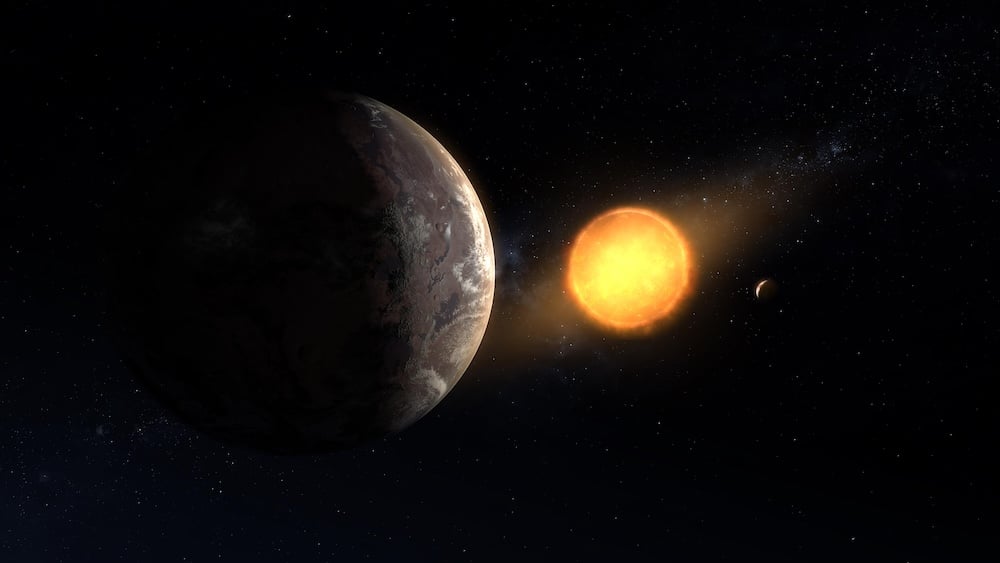
Supporting data from the study suggests that if the 10 billion-to-one contrast and the 100km baseline are achieved, the system could resolve features as small as several hundred kilometers across on a planet 10 light-years away. This would be sufficient to distinguish between large continental masses and sprawling oceanic basins.
Official Perspectives and Programmatic Context
While NASA officials have not yet committed to a specific flight schedule for an Optical VLBI mission, the agency’s leadership has frequently emphasized the importance of high-risk, high-reward research. The NIAC program is managed by the Space Technology Mission Directorate (STMD), which focuses on developing the "cross-cutting" technologies needed for the next generation of exploration.
In statements regarding the NIAC portfolio, NASA representatives have noted that these studies allow the agency to "explore the boundaries of what is possible." By investing in the Stankus study, NASA is acknowledging that the future of exoplanet science lies in direct visualization. This aligns with the goals of the Decadal Survey on Astronomy and Astrophysics 2020 (Astro2020), which identified the search for habitable worlds as a top priority for the coming decades.
Broader Implications: The Search for Life and the Future of Astronomy
The ability to map the surface of an exoplanet would have profound implications for astrobiology. Current methods can detect "biosignatures"—gases like oxygen or methane that might indicate life. However, seeing the surface provides "geosignatures" and "technosignatures."
Mapping an alien world could reveal the presence of liquid water oceans, polar ice caps, or even seasonal changes in vegetation (the "red edge" effect). On a more speculative level, resolving surface features could eventually allow for the detection of large-scale artificial structures or city lights, though that would likely require even larger baselines than the 100 kilometers currently proposed.
Beyond the search for life, this technology would revolutionize our understanding of planetary formation and geophysics. It would allow scientists to compare the geological evolution of Earth with "twins" around other stars, determining if plate tectonics, volcanic activity, and weather patterns are universal or unique to our home.
The "Mapping Alien Continents" concept represents the next logical step in humanity’s quest to understand its place in the universe. If the study proves the feasibility of dynamic hierarchical nulling and formation-flying optical VLBI, it will lay the groundwork for a mission that could, for the first time, show us a "Pale Blue Dot" that is no longer just a dot, but a world with a face of its own. While the hardware may be decades away, the intellectual and mathematical foundation is being laid today, moving us closer to the moment when we can finally look at a map of a world orbiting another sun.