Lina Irawan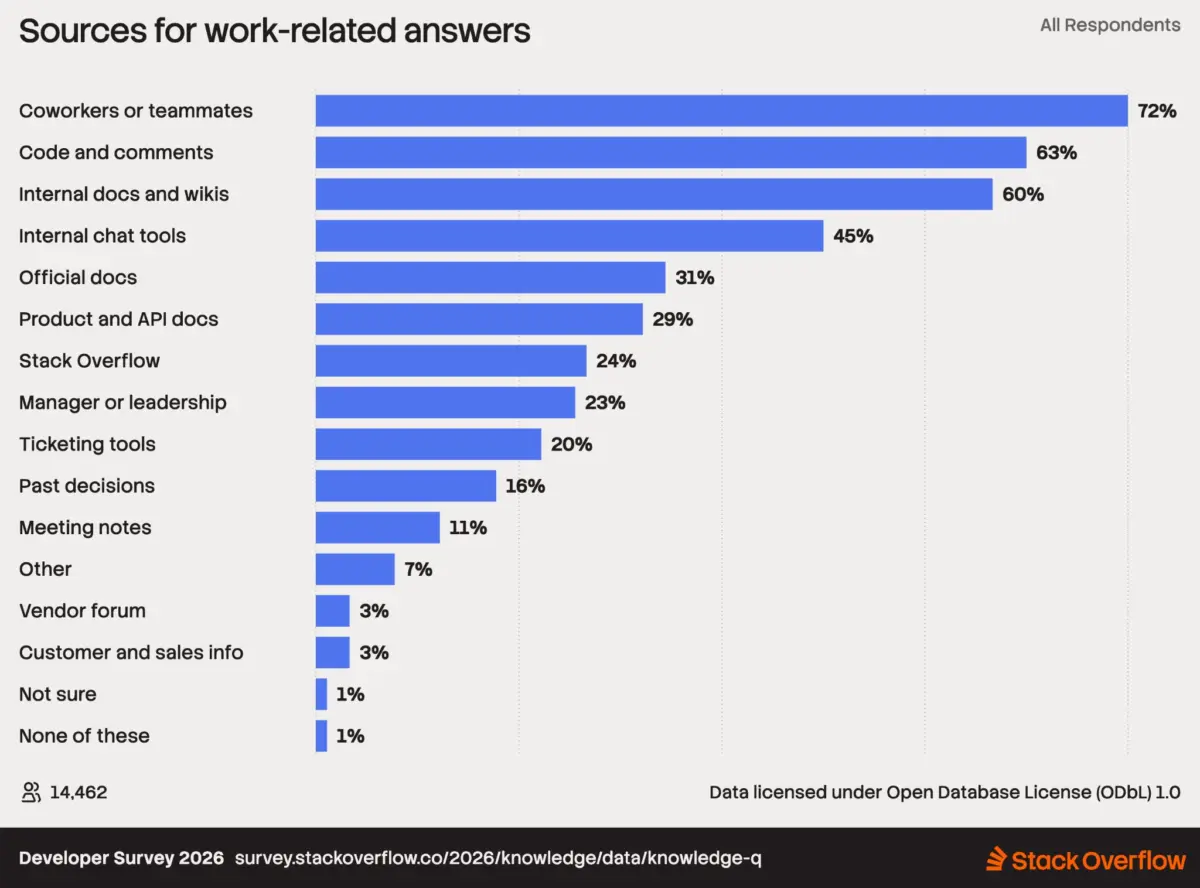
The 2026 Stack Overflow Developer Survey, marking the 16th consecutive year of the comprehensive industry census, has revealed a fundamental transformation in the global software engineering landscape. With more than 30,000 respondents participating over a seven-week data collection period, the findings underscore a significant pivot in how developers work, learn, and interact with emerging technologies. The results indicate that while the core technologies powering the web remain stable, the methodology of software production is undergoing a radical shift driven by economic pressures and the maturation of generative artificial intelligence (AI).
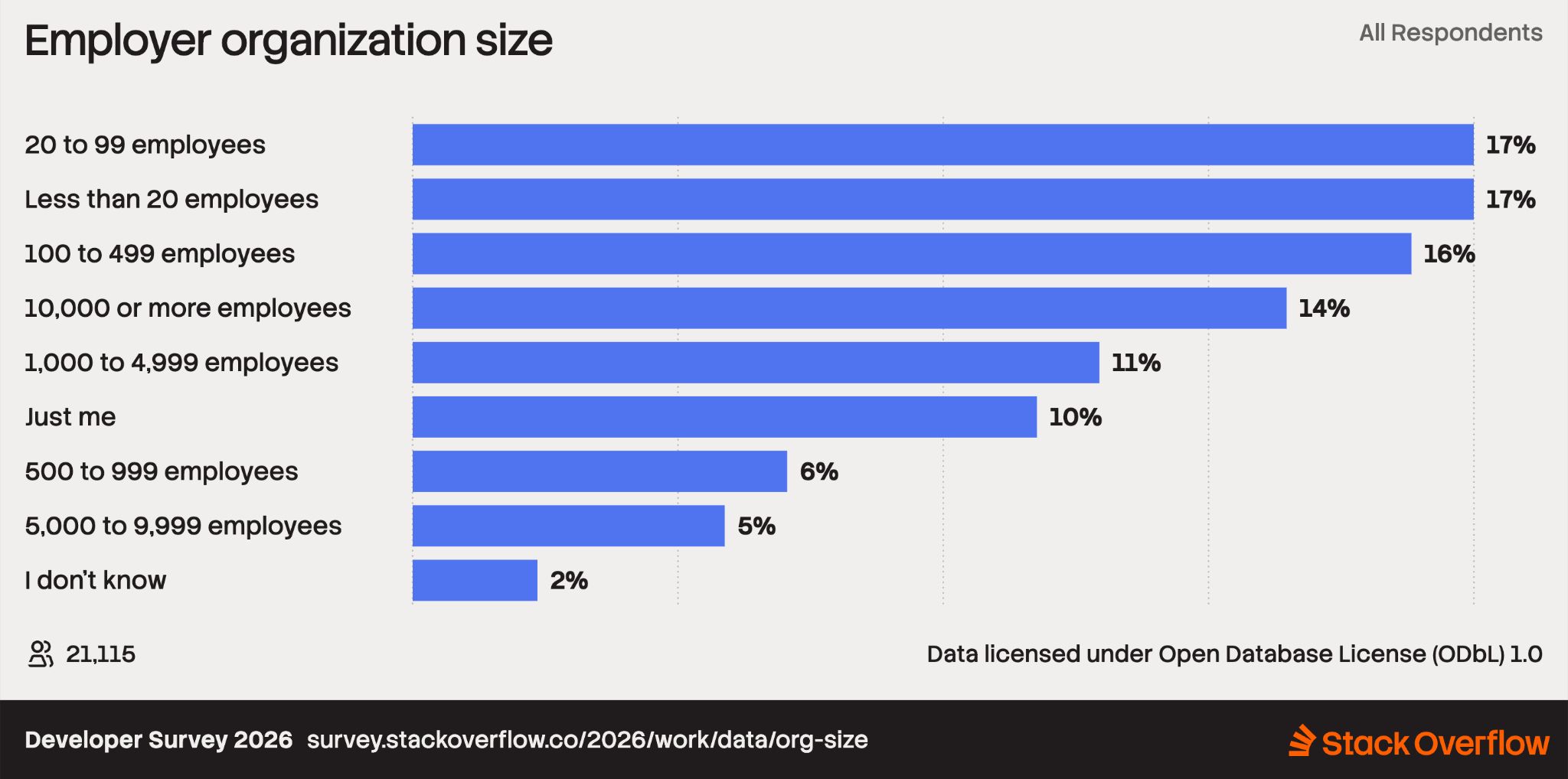
Central to this year’s findings is the continued decentralization of the traditional office environment and a notable rise in independent development. The survey reports that only 18% of developers now work in a physical office every day, a stark contrast to the pre-2020 era. Simultaneously, the data highlights a surge in "solopreneurship," with the percentage of respondents working in organizations of one person jumping from 4% in previous cycles to 10% in 2026. This trend suggests that developers are increasingly leveraging AI agents and automated workflows to launch independent ventures, effectively bypassing traditional corporate structures.
Chronology and Survey Methodology
The 2026 survey represents the longest-running and most influential data set in the developer community. Conducted over a seven-week window, the survey gathered insights from a diverse pool of over 30,000 professionals across various sectors, including fintech, healthcare, and consumer software. The 2026 iteration marks a "coming of age" for the survey, now in its 16th year, providing a unique longitudinal view of the industry.
Throughout the late 2010s, the survey primarily tracked the rise of cloud computing and the stabilization of the JavaScript ecosystem. However, the 2024–2026 period has been characterized by the "AI Inflection Point." This year’s methodology placed a heavier emphasis on "agentic engineering"—the use of autonomous AI agents to perform complex tasks—reflecting the industry’s shift from simple chatbots to integrated development assistants. Stack Overflow has announced that the full anonymized dataset will be released to the public in the coming weeks, allowing for independent secondary analysis by researchers and industry analysts.
The Rise of the Solopreneur and the Changing Nature of Employment
The 2026 data highlights a cooling of the traditional technology job market, contrasted with a rise in self-employment. Industry analysts point to the "AI and layoffs" cycle of 2024 and 2025 as the primary catalyst for this change. Before 2020, the developer market was characterized by high mobility and a surplus of offers. Today, the survey notes that LinkedIn profiles featuring "Open to Work" banners have become more persistent, reflecting a more competitive and selective hiring environment.
In response to these market conditions, developers are increasingly "hiring themselves." The jump from 4% to 10% in one-person organizations indicates a 150% increase in the solopreneur segment. This demographic is reportedly using AI agents to manage tasks that previously required a full team, such as front-end design, database management, and basic QA testing. This shift suggests a democratization of software company creation, where the barrier to entry is no longer the size of the initial team, but the efficacy of the founder’s AI integration.
Technical Rankings: Stability in the Core, Movement in Safety
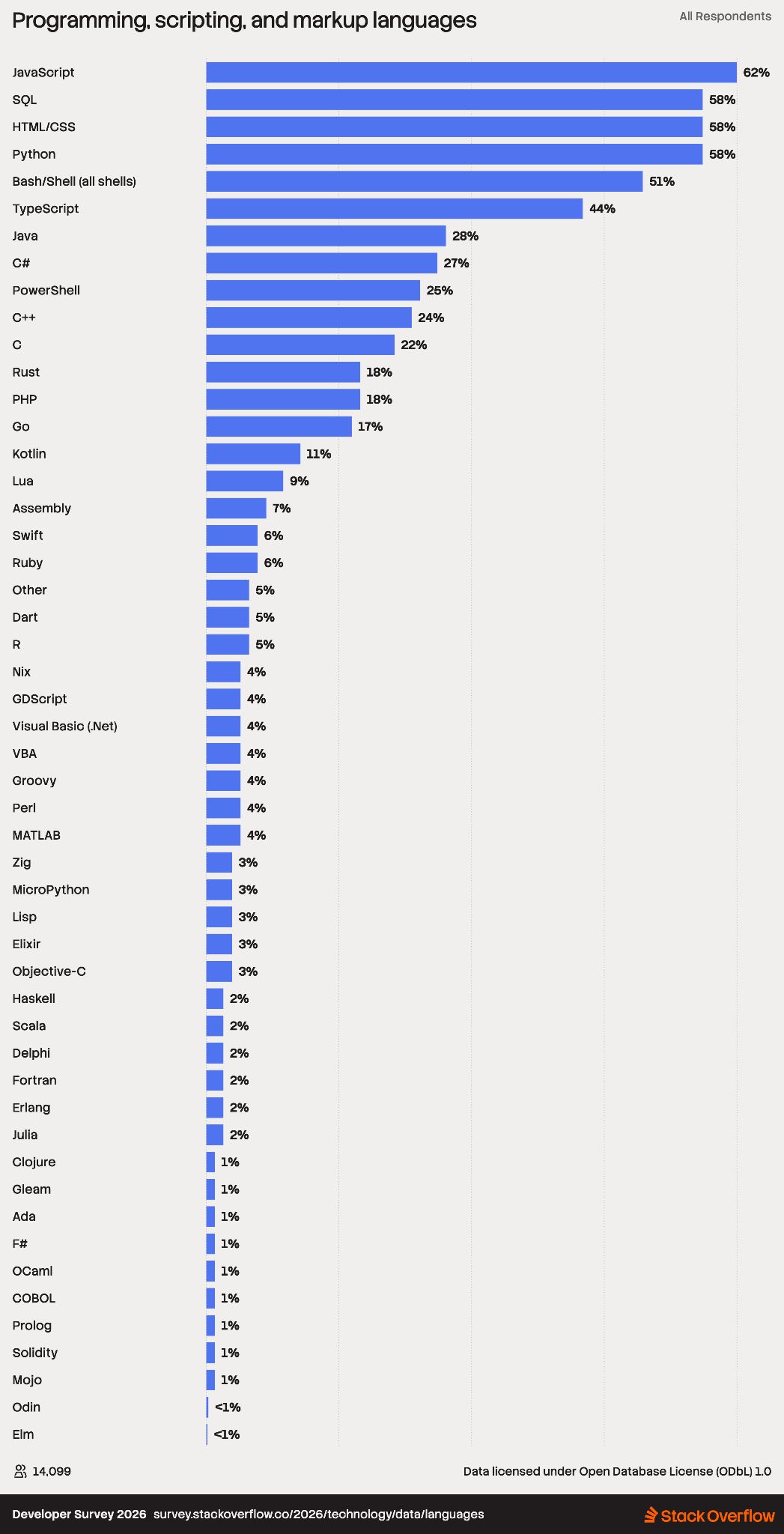
Despite the upheaval in work habits, the hierarchy of programming languages remains relatively stable, though notable shifts have occurred in the top tiers. JavaScript continues its reign as the most-used language, cited by 62% of respondents. However, SQL has moved into the number two spot at 58%, overtaking HTML/CSS and Python. This rise is attributed to the increasing importance of data management and the integration of vector databases essential for AI retrieval-augmented generation (RAG) systems.
One of the most significant movements in the rankings is the ascent of Rust, which moved up to the 12th most-used language. This growth follows a 2024 White House Office of the National Cyber Director memo urging the industry to move toward memory-safe languages to bolster national security. The survey results suggest that institutional pressure and a growing developer preference for performance and safety are finally manifesting in broad adoption rates.
The AI Landscape: Anthropic Gains Ground on OpenAI
The 2026 survey provides a detailed look at the competitive landscape of AI model providers. While OpenAI and Anthropic are currently "neck and neck" in terms of developer usage, the data reveals a nuance in sentiment. Although OpenAI’s GPT models maintain a massive footprint, a higher percentage of respondents expressed a desire to continue using Anthropic’s Claude models over OpenAI’s offerings. Google remains a distant third in the developer preference rankings, though its integration into the broader Google Cloud ecosystem keeps it relevant for enterprise users.
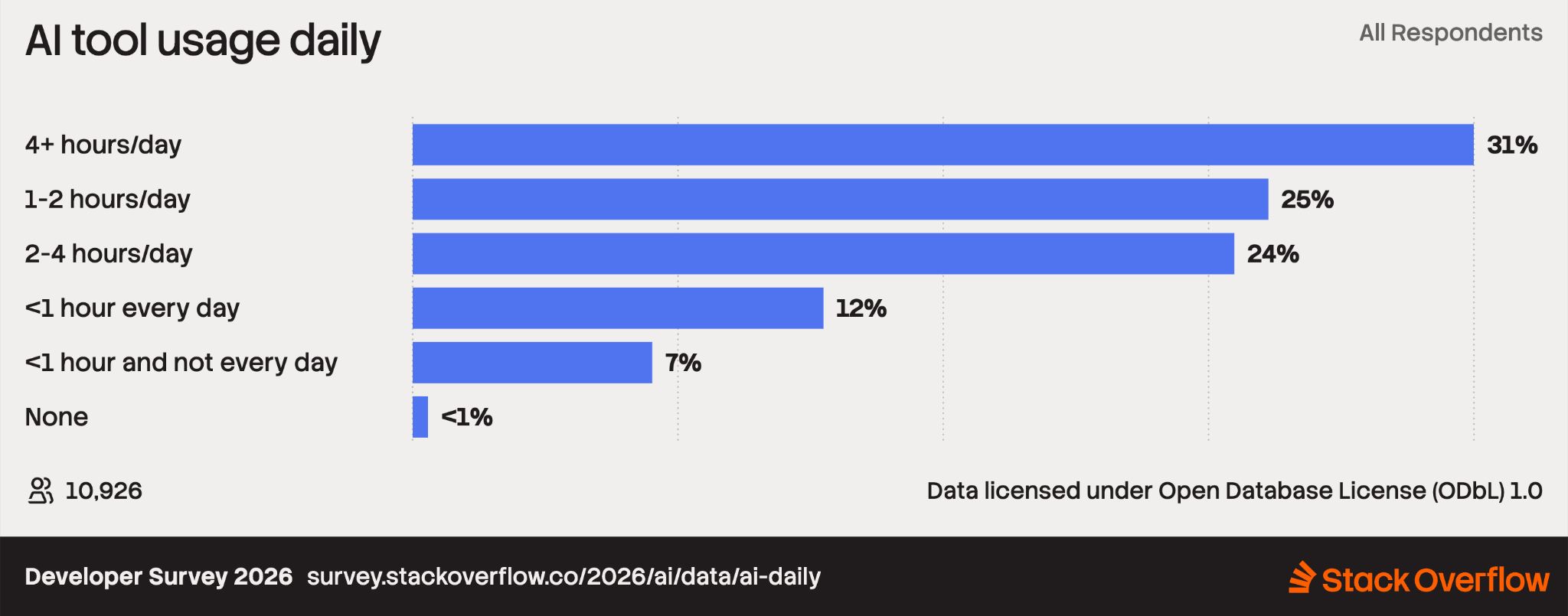
AI adoption has moved beyond the "experimental" phase and into the "integrated" phase. The survey found that 73% of respondents who use AI coding assistants do so on a daily basis. Furthermore, one-third of these daily users spend four or more hours per day interacting with AI tools. This high frequency of use has correlated with a more positive outlook on the technology; 62% of all respondents view AI positively, a figure that climbs to 71% among those who use the tools daily.
Agentic Engineering and the Production Barrier
The 2026 results introduce a clear distinction between where AI is trusted and where it is restricted. Developers are primarily utilizing AI for "familiar" tasks:
- Generating Code (67%): Writing boilerplate or standard logic in languages the developer already understands.
- Debugging (61%): Identifying syntax errors or logical flaws in localized code blocks.
However, a significant "trust gap" exists regarding production environments. Only 20% of developers use AI for deploying, operating, or troubleshooting production systems. This indicates that while AI is a welcome partner in the development and "sandbox" phases, human engineers remain the gatekeepers for live servers and critical infrastructure. The primary tools of choice in this space are Claude Code (66% usage among agent users) and GitHub Copilot (59%).
Information Retrieval and the "Source of Truth" Crisis
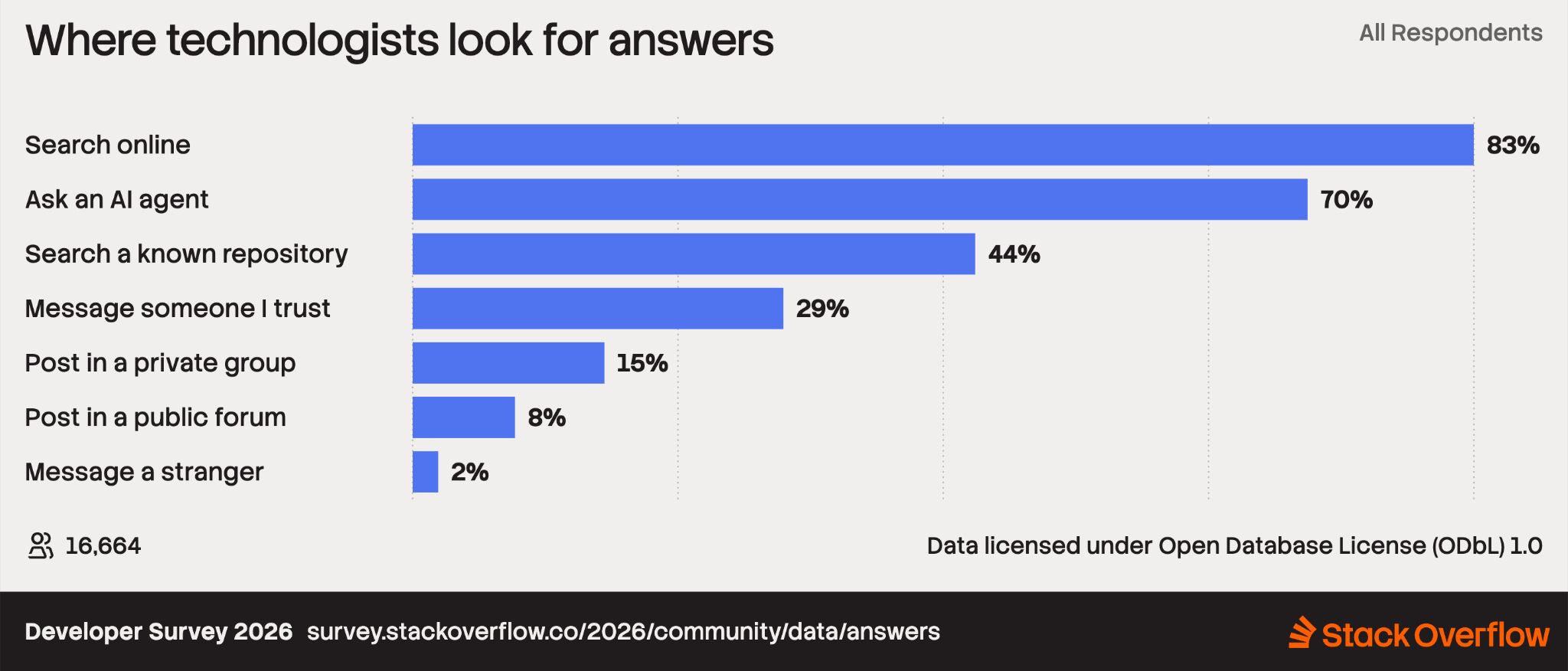
The way developers seek information is undergoing a profound evolution. While 83% of developers still utilize traditional search engines, 70% now consult AI agents for answers. This shift has fundamentally changed the traffic patterns for community-driven platforms like Stack Overflow.
The survey reveals that developers are visiting community sites less frequently for simple, transactional questions (a 64% decrease). However, a new behavior has emerged: 16% of users report visiting Stack Overflow specifically to verify the accuracy of answers provided by AI. This suggests that while AI provides speed, the developer community still serves as the ultimate "source of truth."
Furthermore, the issue of "context" has become a central theme in 2026. Developers report that for AI to be truly effective, it requires source attribution (93% importance) and access to internal documentation. The most trusted sources for work-related answers remain:
- Coworkers (72%)
- Existing Code and Comments (63%)
- Internal Documentation (60%)
Corporate Governance and the Economics of AI
As AI usage scales, the financial implications for organizations have become a focal point of executive concern. The survey notes that organizations are beginning to implement cost-control measures for AI tokens and API usage. Approximately 38% of organizations have set limits on AI usage, while 28% have begun rigorous reviews of spending data.
Despite these controls, developers remain focused on output quality over cost. Seventy-five percent of developers prioritize the quality of the model’s output, while only 38% consider the cost of the prompt. This tension between developer productivity and corporate budgeting has led to the emergence of "model routing," where different models are used for different tasks based on their complexity and cost-effectiveness—a practice adopted by 27% of surveyed organizations.
Analysis of Broader Industry Implications
The 2026 Developer Survey portrays an industry in a state of high-velocity transition. The rise of the solopreneur suggests a future where the definition of a "tech company" may shift from a large organization to a small, highly efficient nucleus of human talent augmented by autonomous agents. This could lead to a proliferation of niche, specialized software products that were previously too expensive to develop and maintain.
However, the "trust gap" in production and the reliance on human coworkers for specific context indicate that the "human-in-the-loop" model is not just a safety preference but a structural necessity. As AI handles more of the "what" (code generation), senior developers are spending a larger portion of their time on the "why" (requirements, goals, and architectural integrity). This evolution suggests that the value of a software engineer in 2026 and beyond lies less in syntax proficiency and more in the ability to provide context and verify the outputs of automated systems.
As the full dataset is released, the industry will likely see further debate on the sustainability of AI-driven development and the long-term viability of the independent developer model in an increasingly automated world.