
 Lina Irawan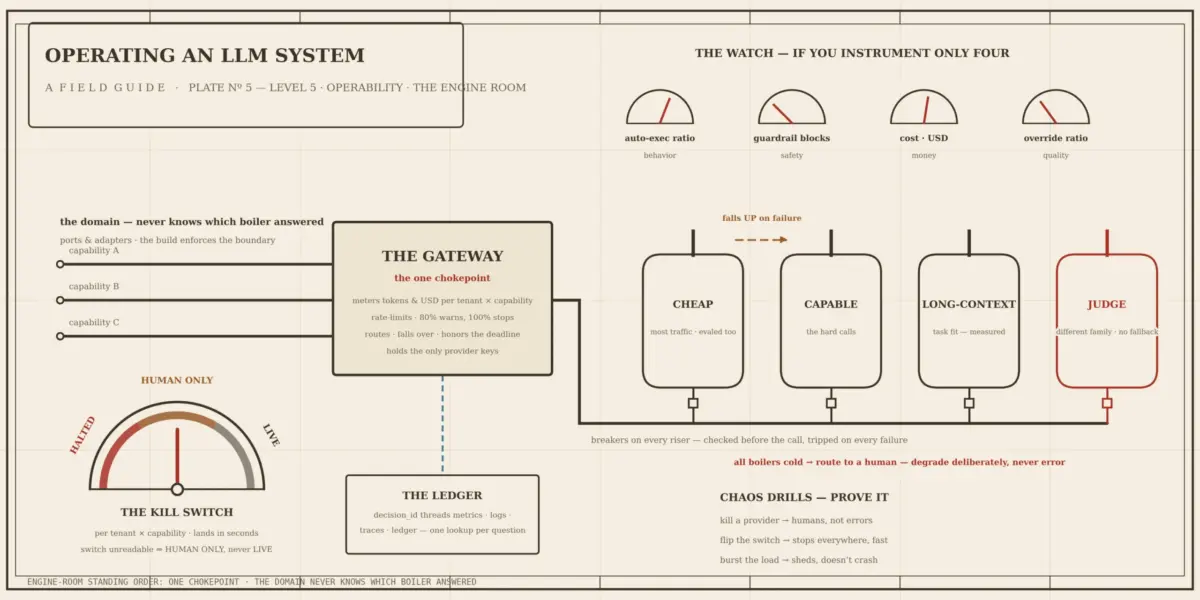
The rapid integration of Large Language Models (LLMs) into the core operational frameworks of global enterprises has necessitated a shift from experimental deployment to a rigorous, six-level maturity model. While the initial stages of this model focus on system functionality and correctness, the industry is now pivoting toward Level 5: Operability. This stage represents a fundamental transition in how organizations manage AI, moving beyond the mere existence of a working model to the implementation of a sophisticated control plane capable of day-to-day oversight, cost management, and crisis mitigation. Unlike traditional software services where failure typically results in a 500-level error code, a malfunctioning LLM system can execute erroneous actions at scale and with high velocity, creating a unique set of risks that traditional DevOps methodologies are ill-equipped to handle.
The Paradigm Shift in AI Operations
As organizations move from simple chatbots to autonomous agents, the definition of system health is being redefined. Operability at Level 5 is characterized by a central "chokepoint" through which all model traffic flows, a unified identity model, and a vendor-agnostic architecture. This structural approach addresses the "asymmetry of failure" inherent in AI systems. When a traditional database fails, the system stops; when an LLM agent fails, it may continue to operate while providing hallucinated data or executing unauthorized API calls, potentially leading to significant financial or reputational damage.
Industry experts suggest that the difference between a successful AI deployment and a catastrophic one lies in the observability signals, cost controls, and routing mechanisms established at this level. The objective is to move from a state of "hoping" the system behaves to having the concrete tools required to stop it in seconds should it deviate from its intended parameters.
A Chronology of AI System Maturity
To understand the necessity of Level 5 Operability, it is essential to view it within the broader timeline of AI adoption:
- Level 1: Prototyping: Organizations experiment with basic prompts and manual testing.
- Level 2: Evaluation (Evals): The introduction of automated testing to ensure the model provides correct answers.
- Level 3: Retrieval-Augmented Generation (RAG): The integration of private data sets to ground model responses.
- Level 4: Agency: The deployment of systems that can take actions, such as calling external APIs or navigating file systems.
- Level 5: Operability (Current Focus): The establishment of a production-grade control layer for monitoring, cost, and safety.
- Level 6: Autonomous Evolution: Future systems capable of self-optimization and automated retraining based on production feedback.
As of late 2024, most enterprise-level AI teams find themselves transitioning from Level 3 or 4 into the complexities of Level 5, driven by the need to justify AI spend and ensure compliance with emerging global regulations.
Advanced Observability: Beyond the RED Metrics
Traditional observability relies on the RED pattern: Rate, Errors, and Duration. While these metrics indicate if a service is "up," they fail to capture whether an AI agent is performing its task effectively. Level 5 introduces a "decision layer" that treats every agent action as a first-class measurable event.
According to technical specifications for Level 5 systems, engineers must implement a specialized metric catalog. Key indicators include the agent_auto_execution_ratio, which tracks the percentage of tasks handled without human intervention, and agent_decision_confidence, a histogram measuring the distribution of the system’s internal confidence scores. Safety metrics such as guardrail_blocks_total and judge_disagreements_total provide a real-time view of how often the system’s primary model is being overruled by safety filters or secondary "judge" models.
Data from early adopters suggests that monitoring the "human override rate" is the most critical predictor of model quality in production. A spike in overrides often precedes a total system failure or a decline in user trust, serving as a leading indicator that the underlying model may need recalibration or that the prompt context has become stale.
Three-Tiered Structured Logging and Traceability
To manage the massive volume of data generated by LLMs, Level 5 systems employ a three-tiered logging strategy designed to balance engineering needs with data privacy regulations.
- Tier 1 (Metadata): Contains decision IDs, timestamps, and outcomes. This tier is used for high-level alerting and is generally accessible to all operations teams.
- Tier 2 (Logic & Context): Includes the non-sensitive portions of the prompt and the internal reasoning chain. This allows engineers to debug why a specific decision was made.
- Tier 3 (The Vault): Contains full PII-sensitive inputs and outputs. This data is encrypted and restricted to compliance officers, used only for legal audits or deep forensic analysis.
A unifying decision_id threads through these logs and into the tracing layer. Unlike a standard HTTP trace, an agent trace must span the internal graph of the AI’s logic, showing the duration and success of individual steps such as context loading, guardrail checks, and model routing. This level of granularity allows a "single trace lookup" to answer why a specific four-second request was eventually rejected.
Financial Controls and the "Silent Multipliers" of AI Cost
One of the most significant challenges in running LLMs in production is the unpredictability of cost. Unlike traditional cloud compute, LLM expenses scale with "tokens," which can fluctuate based on prompt length, model "chattiness," and the number of retries triggered by validation errors.
To combat this, Level 5 operability mandates that all calls be routed through a single gateway. This chokepoint allows for real-time cost attribution per tenant and per capability. By implementing "rate limits" based on estimated token counts and "budgets" that enforce hard stops or warnings, organizations can prevent "retry storms"—where a flaky validation re-calls the model repeatedly—and "unbounded tool loops," where an agent enters a recursive cycle of self-correction.
Data analysis shows that "right-sizing" models—using a smaller, cheaper model for simple tasks and reserving high-parameter models for complex reasoning—can reduce operational costs by 50% to 80% without sacrificing quality. However, this is only possible if the infrastructure can dynamically route traffic based on the complexity of the request.
Reliability Through Routing and the Kill Switch
A robust AI platform must be resilient to provider outages. Level 5 systems do not rely on a single model; instead, they manage a fleet. This includes primary models, judge models for verification, and fallback models for when a provider like OpenAI or Anthropic experiences downtime.
The routing logic within the gateway determines the best model for a given task. If a provider fails, the system executes a "fallback chain," checking circuit breakers to skip dead providers and utilizing a per-attempt timeout to ensure the user does not experience a total hang.
Perhaps the most critical component of Level 5 operability is the "kill switch." This is a runtime state that can halt all AI activity or revert to "human-only" mode across all instances in seconds. Engineers emphasize that a kill switch must be granular, allowing a specific capability for a specific tenant to be disabled without impacting the rest of the platform. This "fail-toward-safe" mentality is what separates experimental AI from production-ready infrastructure.
Architectural Integrity and Identity Management
To ensure long-term viability, Level 5 systems adopt a hexagonal architecture, also known as "ports and adapters." By defining internal interfaces for model calls, the business logic remains isolated from the specific SDKs of vendors. This prevents vendor lock-in, turning what would be a multi-month migration project into a manageable task.
Furthermore, identity management becomes more complex with autonomous agents. When an agent performs a task, it must do so under a "delegated grant"—a short-lived, asymmetrically signed token that limits the agent’s authority to a specific tenant and a specific set of actions. This prevents the "confused deputy" problem, where an agent might inadvertently use its broad system privileges to access data that the initiating user was not authorized to see.
Impact and Implications for the Future of Enterprise AI
The shift toward Level 5 Operability marks the "coming of age" for generative AI in the corporate world. As organizations implement these rigorous standards, the focus moves away from the novelty of what AI can do and toward the reliability of what AI will do consistently.
The broader implications of this maturity model are significant. Regulators in the EU and North America are increasingly looking for the "auditability" and "controllability" that Level 5 provides. Companies that fail to implement these controls risk not only financial loss through unmonitored token consumption but also legal repercussions if their agents act outside of established safety guardrails.
In conclusion, Level 5 Operability is the essential "infrastructure spine" for the AI era. By centralizing traffic through a single gateway, implementing deep observability, and maintaining a vendor-neutral architecture, enterprises can transform AI from a risky experiment into a stable, scalable, and predictable component of their technological stack. The kill switch, the ledger, and the routing table are no longer "nice-to-have" features; they are the prerequisites for sleeping soundly while an AI agent runs the business.









