
 Lina Irawan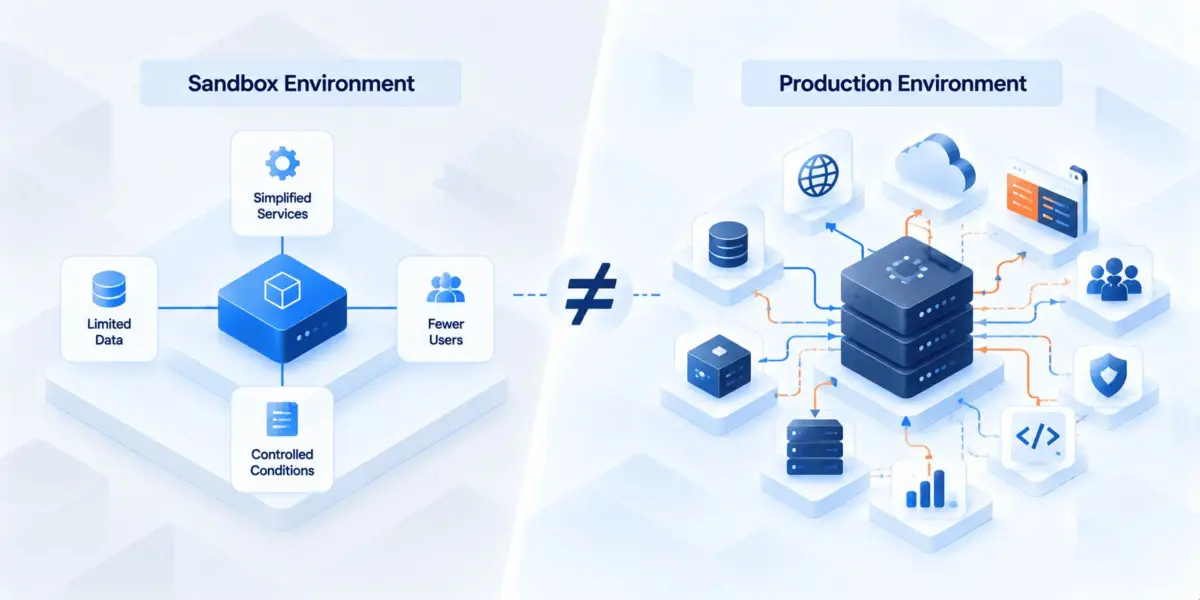
The inherent divergence between sandbox environments and production systems remains one of the most persistent challenges in modern software engineering, representing a structural gap that impacts teams regardless of their scale or technical maturity. For decades, the industry has operated under the ideal of "environment parity," the notion that a testing environment should be a perfect mirror of the live system. However, emerging data and operational realities suggest that this goal is not only increasingly unattainable in the era of microservices but often focuses on the wrong metrics. The discrepancy between these environments is rarely the result of simple negligence; rather, it is a byproduct of the different schedules, triggers, and evolutionary paths that production and testing environments follow.
The Structural Inevitability of Environment Drift
Environment drift is the gradual accumulation of differences between a development or testing environment and the production environment it is meant to simulate. This phenomenon occurs because production is a living entity, constantly evolving through application deployments, infrastructure updates, upstream service API changes, and database schema migrations. In contrast, a sandbox is often a static snapshot.
When a sandbox is first constructed, it typically achieves a high degree of accuracy. Engineers study upstream dependencies, build simulations that reflect current observations, and commit those configurations. However, the moment an upstream service deploys a new version, the sandbox begins its descent into obsolescence. Because these updates are rarely coordinated across different teams or organizations in real-time, the sandbox misses the incremental changes that happen without triggering an explicit update. This structural gap leads to a situation where tests pass in the sandbox but fail in production—a scenario that undermines the very purpose of automated testing.
A Chronology of Environment Decay
The lifecycle of a typical testing environment follows a predictable timeline of degradation. In the "Initial Accuracy Phase," the sandbox is a faithful representation of production, with simulations reflecting current API responses and data formats. This is followed by the "Silent Drift Phase," where upstream services introduce minor, non-breaking changes—such as new optional fields or modified error message strings—that do not yet cause test failures but begin to separate the simulation from reality.
The timeline moves into the "Critical Divergence Phase" when an upstream service deploys a breaking change, such as making a previously optional field required or restructuring a JSON response. Because the downstream team’s sandbox relies on a stale simulation, their CI/CD pipeline continues to report "green" status. The final stage is the "Production Failure Event," where the code is deployed to the live environment, encounters the new behavioral contract, and fails immediately. This chronology highlights that the failure is not "flaky" or "intermittent" but systematic; the testing suite was validating against a reality that no longer existed.
Distinguishing Between Infrastructure Parity and Behavioral Accuracy
One of the most significant insights in modern DevOps is that not all drift is created equal. Industry experts distinguish between "infrastructure divergence" and "behavioral contract drift."
Infrastructure divergence involves differences in hardware, memory limits, instance types, and networking rules. While significant on paper, this type of drift rarely causes an integration test to miss a functional failure. For example, whether a test runs on a t3.medium instance or a production-grade high-compute instance, the logic handling a payment service response remains the same. Pursuing 1:1 infrastructure parity is often a misallocation of resources, as it is expensive to maintain and offers diminishing returns in terms of bug detection.
In contrast, behavioral contract drift is the category that accounts for the majority of catastrophic integration failures. This occurs when the simulated response of a dependency no longer matches the actual response of the deployed service. Behavioral accuracy is significantly harder to maintain than infrastructure parity because it requires ongoing, real-time knowledge of upstream outputs. While you can diff infrastructure configurations to find gaps, identifying a change in an upstream service’s internal state transitions requires constant observation.
The High Cost of Stale Assumptions
The economic impact of environment drift is substantial. According to data from the National Institute of Standards and Technology (NIST), the cost of fixing a bug found in production can be up to 30 times higher than if it were caught during the design or integration phase. When a sandbox provides a false sense of security—validating code against stale assumptions—it allows high-risk changes to bypass traditional safeguards.
Industry analysts note that "green-field" testing environments often lack the "legacy" record formats that exist in real production databases. Production data is "messy," containing records created under older versions of the application logic. If a sandbox database seed only includes "clean" data, it fails to test the application’s resilience against the actual data it will encounter. This lack of data fidelity, combined with stale service simulations, creates a "trust gap" where developers stop relying on the sandbox and begin to view production as the only "real" testing ground, leading to slower deployment cycles and increased developer anxiety.
Trigger-Based Maintenance: Shifting from Reactive to Proactive Updates
The difference between high-performing engineering teams and those struggling with drift often comes down to the "trigger" for environment updates. Most teams follow a reactive model: they update their simulations only when a test fails or after a production incident reveals a discrepancy. This ensures that the sandbox is incorrect for the entire duration between an upstream deployment and the eventual failure.
Top-tier organizations are shifting toward a proactive, event-driven model. In this framework, the trigger for updating a sandbox simulation is the deployment event of the upstream service itself. By tying simulation refreshes to the upstream release cycle, the window of drift is reduced from weeks or months to mere hours. This approach acknowledges that the sandbox is a dynamic dependency that must be managed with the same rigor as the production code itself.
Technological Solutions: The Rise of Observation-Based Simulation
To solve the maintenance burden of manual simulation updates, new tools are leveraging "observation-based" approaches. Rather than requiring developers to manually author mocks and stubs based on documentation—which is itself often out of date—these tools capture real traffic from staging or production environments.
A prominent example of this technology is the use of eBPF (Extended Berkeley Packet Filter) to capture HTTP traffic at the kernel level. Tools like Keploy utilize this method to record actual interactions between services. Because the simulation is generated from observed reality rather than developer assumptions, it includes all the nuances of the real service, including headers, specific error codes, and latent data fields. When an upstream service changes, the tool can capture the new traffic, and a simple "diff" can alert the downstream team exactly how the contract has evolved. This shifts the developer’s role from "authoring simulations" to "reviewing contract changes," which is a far more efficient use of engineering time.
Strategic Implications for Modern Distributed Systems
As organizations continue to adopt microservices and distributed architectures, the goal of "full production parity" is being replaced by "targeted accuracy." The objective is not to replicate the entire production environment—which is a logistical and financial impossibility for most—but to ensure that the specific behavioral contracts being tested are current.
The implications for leadership are clear: investment should be directed toward the mechanisms of synchronization rather than the scale of the sandbox. A small, lightweight sandbox that is updated daily to reflect current API contracts is infinitely more valuable than a massive, multi-million dollar staging environment that hasn’t been synced in three months.
Furthermore, this shift requires a cultural change. Teams must accept that the sandbox has a "boundary." It is designed to catch integration failures and logic errors early and cheaply. It is not designed to catch emergent behaviors under extreme load or edge cases that only surface with millions of concurrent users. By understanding this boundary, teams can use the sandbox for what it’s good at—validating contracts—and rely on production observability and canary deployments to handle the classes of failure that only the "real world" can reveal.
Conclusion: Embracing the Boundary
The gap between the sandbox and production is not a problem to be solved through sheer force of engineering will; it is a structural reality of software development. Drift is the default outcome of independent services evolving at different speeds. The teams that manage this most effectively are those that stop chasing the ghost of perfect parity and instead focus on the accuracy of behavioral contracts.
By aligning simulation updates with upstream deployment events and utilizing observation-based tools to capture reality, organizations can eliminate the most expensive class of failures: the ones that occur because an assumption about a dependency was no longer true. In the end, the sandbox and production are both doing their jobs. The maintenance work of the modern engineer is to keep the sandbox’s coverage accurate within its defined boundary, ensuring that when a test passes, it reflects an integration that will truly hold in the live environment. This strategic focus reduces risk, increases deployment velocity, and ultimately leads to more resilient distributed systems.









