
 Chandra Wibowo
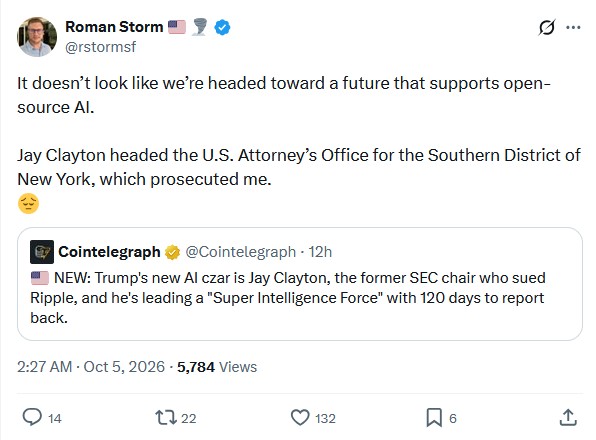
President Donald Trump announced on Sunday, via a post on Truth Social, his appointment of Jay Clayton, the former U.S. Director of National Intelligence, to spearhead the nation’s newly established "Super Intelligence Force." This significant move, initially surfaced through media reports on Friday, signals a strategic pivot towards prioritizing and consolidating national efforts in the rapidly evolving domain of artificial intelligence. The announcement follows a September 20 report by Cointelegraph, which detailed President Trump’s intentions to create an "AI Force," mirroring the structure of the Space Force, and to designate an "AI Czar" to oversee its operations.
The mandate for this new Super Intelligence Force, as articulated by President Trump in his Truth Social post, is to "ensure that America continues to lead the World in Super Intelligence." This directive underscores a commitment to maintaining a competitive edge in a field with profound geopolitical and economic implications. The term "Super Intelligence" itself suggests an ambition to move beyond current AI capabilities, hinting at a focus on advanced, potentially transformative AI systems.
Jay Clayton brings a wealth of experience in regulatory and legal oversight to this critical role. During his tenure as Chairman of the U.S. Securities and Exchange Commission (SEC) under the Trump administration, he was instrumental in shaping the regulatory landscape for financial markets. His tenure concluded with significant actions, including the SEC’s lawsuit against Ripple for the unregistered sale of securities. Prior to his SEC leadership, Clayton served as the U.S. Attorney for the Southern District of New York, where he led the prosecution of Roman Storm, a key figure involved in the decentralized privacy mixer Tornado Cash.
The appointment and the establishment of the Super Intelligence Force have already elicited commentary from various stakeholders. Roman Storm, in a statement, expressed apprehension regarding the future trajectory of AI development under such leadership, stating, "It doesn’t look like we’re headed toward a future that supports open-source AI." This sentiment highlights a potential tension between centralized governmental control and the decentralized ethos often associated with open-source AI development.
Adding another layer of significance to this development, Elon Musk, a prominent figure in the technology and space industries, has reportedly announced his intention to rename SpaceXAI to "SpaceXSI." This rebranding, according to reports, is a direct acknowledgment of President Trump’s directive to shift the terminology from "artificial intelligence" to "superintelligence." This move by Musk suggests an alignment with the administration’s strategic framing and a potential embrace of the new paradigm being championed.

The broader context of this initiative cannot be overstated. The global race for AI supremacy is intensifying, with nations and corporations investing heavily in research, development, and deployment of AI technologies. The establishment of a dedicated "Super Intelligence Force" can be interpreted as a proactive measure by the U.S. government to centralize resources, coordinate inter-agency efforts, and potentially set national standards and policies to foster innovation while mitigating risks. The implications for national security, economic competitiveness, and technological leadership are substantial, positioning the United States to assert its dominance in this critical technological frontier.
NEAR Intents Hack Resolution and Decentralization Debate
In a separate development within the cryptocurrency space, the NEAR Protocol’s SHIELD AI system played a pivotal role in thwarting a significant exploit, albeit sparking a debate about decentralization and intervention. The NEAR ecosystem has experienced a surge in positive sentiment recently, with its native token more than doubling in value over the past month. This week, its SHIELD AI system successfully blocked Bitget’s hacked funds from its INTENTS cross-chain swap platform, a move that garnered both praise and criticism.
The incident involved a $3.8 million exploit targeting NEAR Intents, attributed to a "bug in the Omni deposit and withdrawal infrastructure interaction with NEAR Intents smart contract." For a brief period of approximately seven and a half minutes, market sentiment turned bearish. However, Alex Shevchenko, General Manager of NEAR Intents, took decisive action, publicly identifying the perpetrator and issuing a 48-hour ultimatum to return the stolen funds, threatening legal recourse.
Shevchenko’s firm stance, conveyed through a post stating, "We have identified you, sir," and the subsequent ultimatum, "You know better than most how responsible disclosure works – this is the last window to use it. After 48 hours, that window closes," proved effective. The funds were returned, and Shevchenko urged other potential exploiters to utilize bug bounty programs rather than disrupting services.
This intervention, however, stood in stark contrast to the approach taken by THORChain, which has historically refused to block swaps on its platform, emphasizing its commitment to decentralization and immutability. The decision by NEAR to intervene and block the stolen funds has ignited a furious debate regarding the limits of idealism in decentralized finance. Critics argue that such interventions, while seemingly practical, blur the lines of decentralization and could potentially expose platforms to greater legal liability for future events. The question of whether SHIELD’s action leaves it legally liable for all future platform activities remains a significant point of contention.
Despite the successful resolution of the hack, NEAR experienced a 11% price decline this week, a development that may be influenced by broader market fluctuations and investor sentiment surrounding the decentralization debate. The Bitwise ETF, also debuting this week, saw substantial inflows of nearly $60 million, indicating continued institutional interest in the digital asset space.

Arthur Hayes Predicts Inevitable Money Printing Amidst AI Boom and Financial Stress
Arthur Hayes, Chief Investment Officer at Maelstrom fund and co-founder of BitMEX, has articulated a strong conviction that money printing is becoming an unavoidable consequence of the current global economic landscape, driven by the AI revolution, the United States’ escalating debt crisis, and mounting financial pressures in France. Hayes shared his perspective during a fireside chat at CONNECT by Cointelegraph: Seoul Edition, as part of Korea Blockchain Week.
Hayes highlighted the immense capital requirements of AI companies, which necessitate trillions of dollars for data center infrastructure, even as the prices of their services are reportedly declining. This economic dynamic, he argues, leaves policymakers with limited options, forcing them towards monetary expansion to alleviate financial strain. "They’ve not really given themselves a lot of options other than print money and make it less bad," Hayes stated.
His analysis extends beyond the AI sector, encompassing potential monetary stimulus from China and the growing financial vulnerabilities in France. He pointed to indicators such as credit-default swaps tied to major French financial institutions like BNP Paribas and widening French government bond spreads as signs of increasing financial stress. Hayes’s outlook is one of cautious pessimism, characterizing the impending money printing as a "slow motion train wreck happening underneath the surface."
This prediction carries significant implications for the broader financial markets and the cryptocurrency space. Increased money printing typically leads to inflation and a devaluation of fiat currencies, which historically has driven investors towards alternative assets like gold and, more recently, Bitcoin. The potential for substantial monetary expansion could further fuel the ongoing bull market in cryptocurrencies, as investors seek to preserve their purchasing power.
Blast to Wind Down Ethereum L2 Operations Amidst Unsustainable Costs
The Ethereum layer-2 network Blast has announced its decision to cease operations, citing that its operational costs have outpaced the revenue generated by the chain. In a post on X on Friday, the Blast team stated that they see "no credible path to making the network economically sustainable" and urged users to withdraw their assets to the Ethereum mainnet.
"We launched Blast with the goal of building a self-sustaining chain for users and developers," the team explained. "Unfortunately, the economics of operating the chain no longer make sense." This admission highlights the inherent challenges in scaling blockchain networks and achieving sustainable economic models.
Blast was founded in November 2023 by Tieshun "Pacman" Roquerre, the founder of the NFT marketplace Blur. The network attracted significant attention by offering native yield on Ether (ETH) and stablecoins, coupled with a points program tied to an anticipated token airdrop. This strategy proved highly effective in attracting capital, with over $2 billion in deposits before its mainnet launch in February 2024. However, according to DeFiLlama data, Blast’s total value locked (TVL) in decentralized finance protocols has plummeted by more than 98% since its peak in June 2024, underscoring a rapid decline in user activity and economic viability.
The decision to wind down operations serves as a cautionary tale for other layer-2 solutions and blockchain projects. It emphasizes the critical importance of robust economic models and sustainable revenue streams, rather than relying solely on speculative incentives like token airdrops and yield farming, to ensure long-term success. The failure of Blast highlights the competitive pressures and economic realities within the rapidly evolving blockchain ecosystem.
Ethereum’s Glamsterdam Upgrade Scheduled for Sepolia Testnet
Ethereum developers have set a date for the network’s next significant upgrade, codenamed "Glamsterdam," to activate on the Sepolia testnet on October 6th. This upgrade is a crucial step in the ongoing development and enhancement of the Ethereum network, aiming to improve its performance, security, and scalability.
Node operators on the Sepolia testnet are required to update both their execution-layer and consensus-layer clients prior to the activation, as advised by the Ethereum Foundation. This coordinated update is essential for ensuring a smooth transition and successful implementation of the new features.
Glamsterdam introduces several key improvements, including enshrined proposer-builder separation. This mechanism aims to integrate the process of block building and validation more deeply into the Ethereum protocol itself. By moving the handoff between specialized block builders and validators into the protocol layer, the upgrade seeks to reduce reliance on external middleware and potentially enhance network efficiency and decentralization.
Furthermore, Glamsterdam will implement block-level access lists. These lists will record the specific accounts and storage locations that are accessed during the processing of each block. This granular logging can provide enhanced transparency and security, potentially aiding in the detection and prevention of malicious activities. Additionally, the upgrade is designed to enable parallel processing by clients, a feature that is expected to significantly speed up transaction throughput on the network. These advancements collectively aim to make Ethereum more robust and capable of handling a larger volume of transactions, a critical step towards its widespread adoption for various decentralized applications.

Market Performance: Bitcoin and Ethereum Show Modest Gains Amidst Volatility
At the close of the trading week, the cryptocurrency market exhibited mixed performance. Bitcoin (BTC) registered a gain of 1.4%, trading at approximately $85,821. Ethereum (ETH) also saw a modest increase of 0.6%, settling around $2,701. XRP (XRP) experienced a slight decline, down 0.8% to trade at $1.50. The total cryptocurrency market capitalization stood at approximately $2.92 trillion, according to CoinMarketCap data.
Within the top 100 cryptocurrencies, several altcoins demonstrated significant upward momentum. Midnight (NIGHT) emerged as a top performer with a substantial gain of 60.6%. StarkNet (SRK) also saw positive movement, increasing by 14.5%, while Pump.fun (PUMP) recorded a gain of 26.3%.
Conversely, some altcoins experienced notable downturns. Lighter (LIT) was among the biggest losers, down 22.2%. Zcash (SEC) saw a decline of 16.4%, and Ethena (ENA) dropped by 14%. These movements highlight the inherent volatility within the altcoin market, where significant gains and losses can occur rapidly.
Peter Brandt Forecasts Bitcoin’s Ascent to $600K by 2029
Veteran trader Peter Brandt has shifted to a decidedly bullish stance on Bitcoin, forecasting a potential peak of $600,000 by 2029. This optimistic outlook contrasts with his previous warning in July, where he suggested prices could fall into the high $40,000s.
"There’s a good possibility we have seen the low and now are entering a new bull market cycle in Bitcoin," Brandt stated in a recent interview with Cointelegraph on "Trade Secrets." His revised projections indicate a significant upward revision from his earlier estimates, which ranged between $250,000 and $300,000 for Bitcoin’s next peak.
Brandt’s revised forecast places the potential high for the current bull market cycle between $300,000 and $600,000, with a strong likelihood of reaching the half-million-dollar mark. This renewed optimism is likely influenced by a confluence of factors, including market trends, institutional adoption, and the ongoing narrative surrounding Bitcoin as a hedge against inflation and economic instability. The prediction by a seasoned trader like Brandt can significantly influence market sentiment and investor behavior, potentially attracting further capital into the Bitcoin market.

Crypto Hacks Surpass $768 Million in September, Marking Worst Month of 2026
September proved to be a devastating month for the cryptocurrency industry, with security breaches and exploits resulting in staggering losses exceeding $768 million. Two prominent blockchain security firms, PeckShield and CertiK, have reported significant figures, underscoring a worrying trend in the digital asset space.
PeckShield documented 55 major incidents in September, leading to an estimated $766.5 million in stolen funds. CertiK, meanwhile, recorded 97 incidents, estimating total losses at $768.4 million. This sharp increase in losses marks September as the worst month of 2026 for crypto hacks.
The month was marred by several high-profile breaches, including the $388 million exploit targeting Bitget and a $320 million hack of the Liquid Network. While reports indicate that over $270 million was later recovered from the Liquid Network hack, the overall financial damage remains substantial.
CertiK commented on the severity of the situation, stating, "September was a stark reminder of how quickly the threat landscape can shift." Other notable hacks in September included Safe Wallet, DCENT, and Duelbits, which collectively lost $7.8 million, $6 million, and $5.9 million, respectively. These incidents highlight persistent vulnerabilities in smart contracts, third-party integrations, and overall platform security, necessitating continuous innovation and vigilance in cybersecurity measures within the crypto ecosystem.
Aave V3 Unaffected by Third-Party Adapter Exploit
Stani Kulechov, the founder of the decentralized lending protocol Aave, has clarified that Aave v3 was not impacted by a recent exploit that drained approximately $305,000 from two Safe multisig wallets. The exploit targeted a third-party adapter built on top of the Aave protocol, rather than the core Aave v3 smart contracts.
"This is not Aave v3 contract, it’s third party external adapter built on top of Aave, zero effect on Aave v3," Kulechov stated on X. This distinction is crucial, as it indicates that the security of the main Aave v3 protocol remains intact. However, the incident serves as a reminder of the risks associated with interconnected decentralized finance (DeFi) ecosystems, where vulnerabilities in auxiliary components can still lead to significant financial losses.

Tether Assists in Freezing $550 Million in Iran-Linked USDT
Stablecoin issuer Tether announced that it has assisted authorities in freezing nearly $550 million in USDT linked to Iran throughout 2026. The company stated that it has maintained close collaboration with international law enforcement agencies for several years.
In the current year alone, Tether has frozen over $130 million in USDT across four wallets. Notably, in April, the company froze more than $344 million connected to the Central Bank of Iran. This action comes as Democratic investigators on the Senate Permanent Subcommittee on Investigations released a report alleging that USDT has become a primary channel for Iran to circumvent international sanctions.
The report indicated that a significant majority of crypto wallets sanctioned for their ties to Iran had exclusively or predominantly transacted in USDT. These findings prompted U.S. Senator Richard Blumenthal to call for investigations by the Treasury and Justice departments into potential sanctions violations. Tether’s proactive engagement in freezing illicit funds underscores its commitment to combating financial crime and adhering to regulatory compliance, even within the often-decentralized cryptocurrency landscape.
Magazine Features: Debating Decentralization and Stablecoin Risks
This week’s Cointelegraph Magazine featured several in-depth articles exploring critical issues within the cryptocurrency and blockchain space. A prominent piece, "Furious debate about THORChain vs NEAR shows idealism has limits," delves into the ongoing controversy surrounding the handling of Bitget’s $387.7 million in hacked funds. The article examines the fundamental tension between the ideals of "permissionless and decentralized" technology and the practical necessity of intervention in certain circumstances.
Complementing this discussion, "Could THORChain face prosecution over stolen Bitget funds? Legal opinion" offers a legal perspective on the implications of THORChain’s refusal to block addresses linked to the Bitget hack. Crypto lawyer Yuriy Brisov analyzes whether the developers could face prosecution for money laundering, highlighting the complex legal landscape surrounding decentralized protocols.
Another significant feature, "Stablecoins can drain from banks and nations at lightning speed," explores the broader economic implications of stablecoins. The article posits that their high liquidity and 24/7 settlement capabilities could pose risks to banks and nations by enabling rapid capital outflows. However, it also acknowledges that the perception of stablecoins as a risk or an opportunity ultimately depends on one’s vantage point within the financial system. These articles collectively underscore the dynamic and often contentious nature of innovation in the digital asset industry, highlighting the ongoing dialogue between technological possibility and regulatory, ethical, and economic realities.









