Galang Taruna
Following a wave of viral videos showcasing humanoid robots dancing and performing intricate martial arts routines, Chinese manufacturer Unitree Robotics has once again captured global attention with the dramatic unveiling of its H2-X, dubbed the "Kung Fu Legend Guardian." The demonstration, presented in a style reminiscent of a high-octane action film, depicts a robot capable of extraordinary feats of strength and agility, seemingly positioning itself as the ultimate mechanical bodyguard. However, the spectacular showcase immediately sparks a critical debate: do these impressive maneuvers represent a genuine leap in autonomous capability, or are they a meticulously choreographed performance, potentially controlled remotely?
The Spectacle Unveiled: A Daring Display of Robotic Prowess
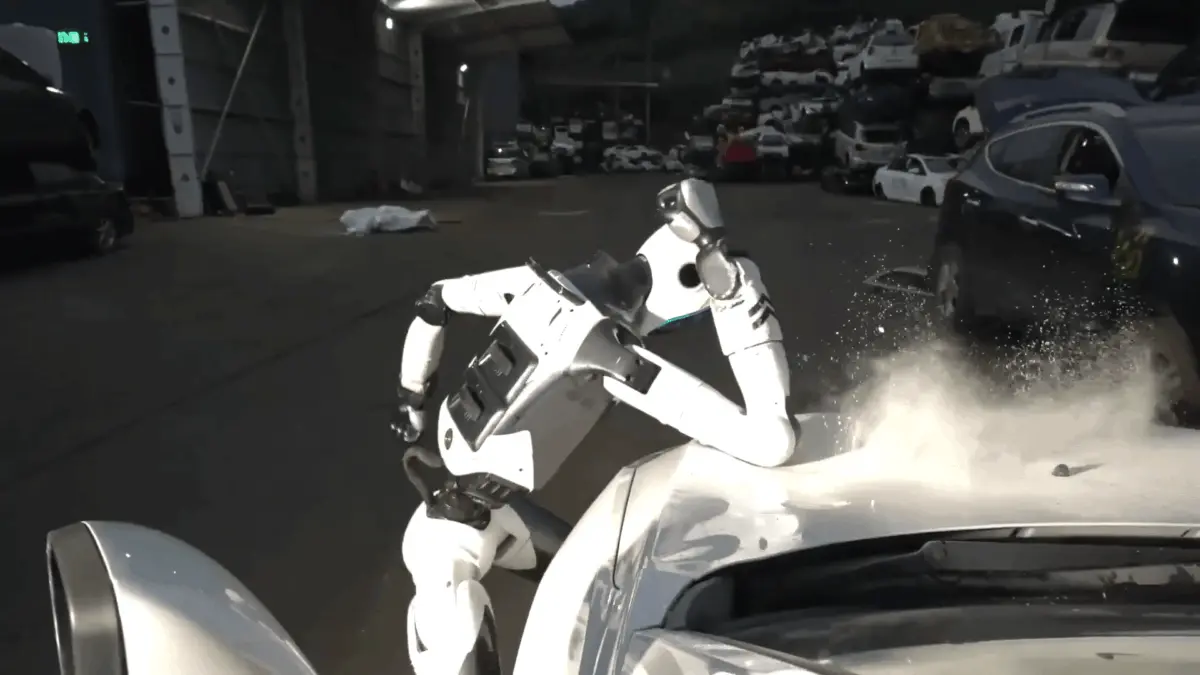
The promotional video, launched on YouTube on October 21st, offers a minute-long montage of the H2-X performing a series of astonishing actions. Viewers witness the humanoid robot denting car bodywork with knee strikes, executing a seemingly effortless jump from a four-meter-high platform, intercepting an assailant armed with a knife, and even lifting the front end of a car to free a trapped victim. These demonstrations are undeniably visually compelling, designed to portray the H2-X not merely as an advanced piece of engineering, but as a formidable protector, capable of operating in high-stakes, life-threatening scenarios. Unitree, a company with a established track record for producing viral content featuring its robots, has previously leveraged such dramatic presentations to market its creations, from nimble quadruped robots like the Go1 and Go2 to its earlier humanoid, the H1. This latest iteration, the H2-X, represents an ambitious pivot towards a role demanding not just physical dexterity, but also complex situational awareness and rapid decision-making.
Under the Hood: Technical Specifications and Lingering Ambiguities
The H2-X is presented as a direct evolution of Unitree’s H2 humanoid, initially introduced approximately a year prior. The base H2 model stands at an imposing 1.82 meters (approximately 6 feet) tall and weighs around 70 kilograms (154 pounds), including its battery. It boasts 31 degrees of freedom (DoF), signifying 31 independent rotational axes for its various limbs, allowing for a wide range of movements. At its computational core, the standard H2 is advertised with up to 2,070 TOPS (Tera Operations Per Second), a metric used to quantify the number of trillions of artificial intelligence (AI) operations it can perform each second. To put this into perspective, this theoretical processing power is nearly three times the 700 TOPS promised by specialized AI chips that Intel is reportedly developing for humanoid robots slated for 2028. Such high computational capacity is crucial for real-time perception, complex motor control, and AI-driven decision-making, all of which would be indispensable for a truly autonomous "guardian" robot.
However, Unitree has remained notably opaque regarding whether the H2-X "Guardian" variant incorporates identical components to its H2 predecessor. The company’s public statements merely mention an approximate eight-hour battery life – a figure qualified as being measured solely in a static, upright position. This detail is significant, as the intense physical exertion depicted in the H2-X’s combat and rescue stunts would demand a far greater and more rapid expenditure of energy, likely drastically reducing its operational endurance in dynamic situations. The discrepancy between claimed battery life in a static state and the implied energy consumption of its high-intensity actions raises immediate questions about the robot’s practical viability for sustained protective roles.
The Autonomy Question: Performance Versus Reality
The central question surrounding the H2-X’s capabilities revolves around the extent of its autonomy. Unitree’s marketing materials deliberately maintain ambiguity, leaving observers to wonder if the humanoid robot operated completely independently, followed a meticulously pre-programmed choreography, or was simply piloted remotely by a human operator. The distinction is paramount for evaluating the true technological advancement. Fully autonomous action in an unpredictable environment represents a monumental challenge in robotics and AI, requiring sophisticated sensors, real-time environmental mapping, advanced path planning, and robust decision-making algorithms that can adapt to unforeseen circumstances. Pre-programmed routines, while impressive, demonstrate motor control but not necessarily intelligent response. Remote teleoperation, conversely, highlights human skill rather than robotic independence.
This isn’t the first time Unitree’s demonstrations have faced scrutiny regarding their claims of autonomy. On September 7th, the company unveiled UnifoLM-X2-1.0, an AI model supposedly enabling its robots to strike, block, and dodge autonomously. The accompanying video featured the smaller G1 humanoid robot in a training combat sequence against a human. Yet, upon closer analysis, publications like Interesting Engineering identified command logs on screen suggesting that the AI was not running onboard the robot itself, but rather on an external server, remotely dictating its movements. This previous incident casts a long shadow over the H2-X’s current "Kung Fu Legend Guardian" presentation, making it difficult to ascertain if the impressive stunts are truly a testament to onboard, real-time autonomous intelligence or a carefully orchestrated spectacle.
Safety First? The Paradoxical Warning
Perhaps one of the most revealing details is a subtle disclaimer embedded at the very end of the H2-X promotional video. Unitree formally recommends maintaining a distance of two to three meters from the robot when it is in operation and strongly advises against any dangerous modifications to the machine. This instruction, while seemingly a standard safety protocol, becomes deeply paradoxical when juxtaposed with the robot’s advertised role as a close-proximity bodyguard. A protector, by definition, must be able to operate in immediate vicinity of the person it guards, often interposing itself between the protected individual and a threat.
The disclaimer implicitly acknowledges an undeniable physical reality: a 70-kilogram automaton, equipped with motors powerful enough to bend sheet metal and execute forceful movements, poses an immediate and substantial danger to humans in its vicinity should there be any malfunction, miscalculation, or loss of control. The very power that makes the H2-X a formidable "guardian" also makes it a potential hazard. This cautionary note underscores the immense challenges in designing, programming, and safely deploying such powerful humanoid robots, particularly in unpredictable environments alongside humans.
A Broader Look: The Humanoid Robot Landscape
Unitree’s dramatic approach to showcasing the H2-X stands in stark contrast to the development philosophies of many other leading players in the burgeoning humanoid robotics sector. While Unitree focuses on viral, action-oriented demonstrations, other prominent companies often emphasize either pure research, practical industrial applications, or a more cautious, iterative approach to general-purpose humanoids.
- Boston Dynamics’ Atlas: Known for unparalleled agility, balance, and advanced research, Atlas primarily serves as a research platform, pushing the boundaries of what humanoid robots can achieve in terms of dynamic movement and interaction with complex environments. It is not currently commercialized for general use.
- Tesla Optimus: Spearheaded by Elon Musk, Tesla’s Optimus robot aims for mass production and deployment in a wide array of tasks, from industrial labor to potentially household chores. Its development focuses on cost-effectiveness and scalability.
- Figure 01: Figure AI, in partnership with OpenAI, is developing Figure 01 as a general-purpose humanoid, designed to learn and perform diverse tasks in human environments, with an emphasis on cognitive capabilities and natural language interaction.
- Agility Robotics’ Digit: This bipedal robot is specifically designed for logistics and warehouse operations, focusing on manipulating objects and navigating dynamic factory and distribution center settings.
While all these companies are contributing to the rapid advancement of humanoid robotics, Unitree’s explicit marketing of a "guardian" robot with aggressive physical capabilities carves out a unique, and potentially controversial, niche.
The Industrial Imperative: Where the Real Race Lies
The spectacular demonstrations of the H2-X, while captivating, ultimately position Unitree somewhat in isolation from the prevailing trend among other major Chinese and global robotics manufacturers. The true "robot wars" in the humanoid space are currently being fought on a much more pragmatic battlefield: the factory floor and industrial assembly lines.
The rationale is clear: industrial environments offer controlled, predictable settings where robots can perform repetitive, dangerous, or physically demanding tasks with high efficiency and precision. This addresses critical needs such as labor shortages, enhances safety by removing humans from hazardous roles, and drives down production costs.
- Xpeng Iron: The Chinese electric vehicle giant Xpeng has already commenced mass production of its Iron humanoid robot, designed to assist in manufacturing processes.
- Xiaomi: Another tech titan, Xiaomi, is utilizing its own humanoid robots to assemble electric vehicles, boasting impressive precision rates of up to 98%.
- BYD: The automotive powerhouse BYD is in the final stages of developing its first industrial humanoid model, signaling its intent to integrate advanced robotics into its manufacturing ecosystem.
- Tesla Optimus: Even American innovator Tesla, despite its broader ambitions for Optimus, is reportedly relying on Chinese suppliers to facilitate the mass production of its humanoid, underscoring the critical role of China’s manufacturing infrastructure in scaling robot deployment.
This concerted focus on industrial applications highlights a fundamental divergence: while Unitree explores the dramatic possibilities of a "guardian" robot, the majority of the industry is pouring resources into developing humanoids that can seamlessly integrate into existing industrial workflows, driving tangible economic benefits and addressing immediate operational challenges.
Navigating the Regulatory Minefield and Ethical Considerations
Beyond the technical hurdles and commercial strategies, the concept of a "guardian" robot like the H2-X faces an almost insurmountable regulatory wall. Currently, no specific legal framework exists to govern the deployment of autonomous machines programmed to physically neutralize threats or intervene in violent altercations, especially for public use.
In Europe, for instance, the new Machinery Regulation, set to become effective on January 20th, 2027, aims to modernize safety requirements for equipment. However, certifying a machine designed to exert significant physical force against individuals for general public use would present unprecedented challenges under existing safety and liability laws. The very act of physical intervention raises profound ethical questions: Who is accountable if the robot makes a mistake, causes unintended harm, or misidentifies a threat? What constitutes "appropriate force" for a machine? The absence of clear legal guidelines and the complex ethical implications of autonomous robots using force make widespread commercialization of such "guardian" models a distant prospect.
Furthermore, the notion of "lethal autonomy" – where robots make independent decisions about using force that could result in injury or death – is a highly contentious issue globally. Many international bodies and experts advocate for human oversight and control in any system capable of applying force. Unitree’s H2-X, in its current portrayal, skirts dangerously close to these ethical boundaries, prompting necessary discussions about the societal implications of deploying machines designed to physically engage with human threats.
Conclusion: More Than a Showcase?
Without a confirmed price or commercial release date, Unitree’s H2-X "Kung Fu Legend Guardian" appears, for now, to be primarily a technological showcase. While undoubtedly a testament to Unitree’s engineering capabilities and a masterclass in viral marketing, it highlights the significant gap between spectacular demonstration and real-world, autonomous functionality, especially in complex, unpredictable, and potentially dangerous human environments. The immediate and critical questions surrounding autonomy, energy efficiency, and fundamental safety warnings cannot be overlooked.
The contrast with the rest of the humanoid robotics industry is stark. While Unitree explores the frontiers of dramatic protective applications, the majority of its rivals are diligently working to integrate humanoids into more predictable industrial settings, addressing pressing economic and logistical needs. While the H2-X offers a tantalizing glimpse into a potential future of robotic protection, the immediate future of humanoid robots, it seems, will be forged not in choreographed stunts, but on the assembly lines and within the structured environments of modern industry. The challenge for Unitree, and indeed for the entire robotics community, will be to bridge the chasm between breathtaking performance and the practical, safe, and ethically sound deployment of advanced humanoid technology.