admin
admin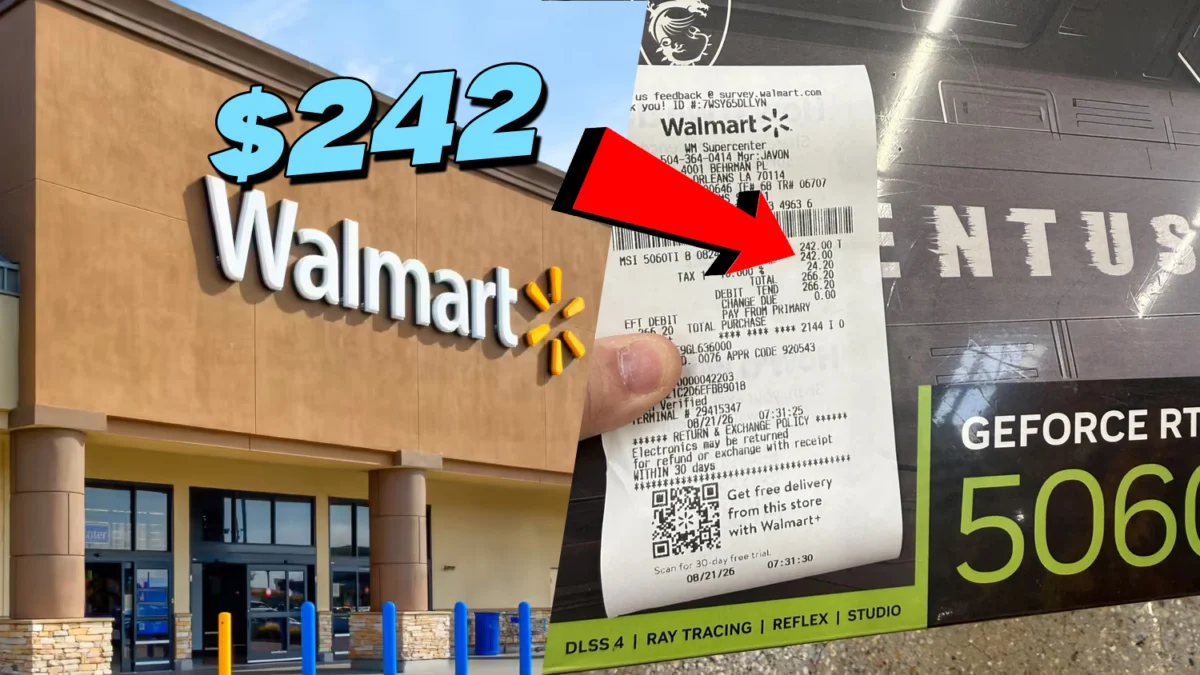
In an era defined by volatile component pricing and a strained global supply chain for semiconductors, the pursuit of affordable PC gaming hardware has transitioned from a simple online search to a localized treasure hunt. While the digital marketplace remains dominated by inflated listings and limited stock, brick-and-mortar retail outlets are occasionally surfacing as unexpected havens for deep discounts. This phenomenon was recently highlighted when a savvy consumer discovered a high-performance NVIDIA GeForce RTX 5060 Ti graphics card at a local Walmart for a fraction of its current market value, signaling a significant disconnect between localized inventory management and broader market trends.
The discovery, shared by a user known as u/enigmussnake, occurred within the "clearance cage" of a Walmart retail location. The item in question, an MSI-branded GeForce RTX 5060 Ti with 8 GB of VRAM, was marked down to a staggering $242. For context, the GeForce RTX 5060 Ti officially launched with a Manufacturer’s Suggested Retail Price (MSRP) of $379. However, due to a combination of inflationary pressures and a critical shortage in memory modules—a situation frequently referred to in the enthusiast community as the "RAMpocalypse"—retail prices for this specific SKU have surged. Current listings at major online retailers like Newegg and Amazon frequently hover near the $500 mark, making the $242 find a nearly 50% discount relative to the MSRP and a substantially greater saving compared to current street prices.
The Financial Breakdown of a Rare Retail Win
According to the documentation provided by the purchaser, the final transaction amounted to approximately $266 after the inclusion of state and local taxes. This figure remains remarkable when compared to the current pricing hierarchy of NVIDIA’s Blackwell-based 50-series lineup. Under current market conditions, even the entry-level GeForce RTX 5050—a card designed for significantly lower performance tiers—is difficult to find for less than $266. By securing the "Ti" variant of the 5060 for this price, the user effectively bypassed two tiers of market inflation.
This specific unit, the MSI 8 GB variant, represents the mid-range workhorse of the current generation. While the 8 GB VRAM capacity was initially a point of contention among hardware critics who argued for higher buffers to accommodate modern AAA textures, the economic landscape has shifted the goalposts. In a market where mid-range cards are being pushed toward the $500 price point, the value proposition of an 8 GB card changes dramatically when the entry price drops below $250. At this price, the RTX 5060 Ti transitions from a scrutinized mid-range option to an undisputed king of the budget-performance category, capable of delivering high-refresh-rate 1080p gaming at ultra settings and competent 1440p performance with the assistance of DLSS (Deep Learning Super Sampling) technologies.
Contextualizing the RAMpocalypse and Market Volatility
The backdrop for this extraordinary deal is a global hardware market currently reeling from what analysts call the "RAMpocalypse." This period is characterized by a severe shortage of GDDR6 and GDDR7 memory modules, which are essential components for modern graphics processing units. The shortage has been exacerbated by increased demand from the artificial intelligence sector, which competes for the same fabrication capacity at major foundries like TSMC, Samsung, and Micron.

Both NVIDIA and AMD have recently issued guidance regarding price adjustments in response to these rising bill-of-materials (BOM) costs. Reports indicate that MSRPs have become largely theoretical, with actual retail prices soaring by 20% to 40% in just the last thirty days. This upward trajectory has made the secondary and clearance markets the only viable options for budget-conscious builders. The Walmart clearance find illustrates a rare "inventory lag," where a physical store may clear out older or "open-box" stock based on local management decisions rather than real-time global market fluctuations.
Timeline of the RTX 50-Series Pricing Evolution
To understand the magnitude of this deal, one must look at the chronology of the RTX 5060 Ti’s market lifecycle:
- Product Launch: The RTX 5060 Ti 8 GB debuted at $379, positioned as the high-volume mid-range solution for the 50-series "Blackwell" architecture.
- Initial Reception: Critics praised the card’s efficiency and frame generation capabilities but criticized the 8 GB VRAM ceiling for long-term "future-proofing."
- The Supply Shift: Six months post-launch, memory shortages began to impact the production of 8 GB and 12 GB modules. Manufacturers prioritized higher-margin cards (such as the RTX 5080 and 5090), leading to a scarcity of mid-range stock.
- Price Escalation: By the third quarter of the fiscal year, retail prices for the 5060 Ti climbed from the $379 MSRP to a $450-$500 range, driven by "dynamic pricing" algorithms used by online retailers.
- The Clearance Event: Amidst these high prices, isolated brick-and-mortar units—often those that were returned, mislabeled, or part of a store-specific inventory purge—began appearing in clearance sections for sub-$300 prices.
Analysis of the "Clearance Cage" Strategy
Retail giants like Walmart and Costco operate on a scale that occasionally leads to internal logistics anomalies. When a product is delisted from a store’s active inventory system or if a specific branch receives a "one-off" return that cannot be sent back to the manufacturer, the item is often moved to a clearance cage. These cages are managed at the store level, and managers are often incentivized to move the product quickly to free up shelf space, regardless of the item’s current global market value.
Industry analysts suggest that these occurrences, while rare, are becoming the primary way for enthusiasts to beat inflation. Unlike online marketplaces, which use automated bots to adjust prices based on supply and demand within seconds, a physical price tag on a Walmart shelf is static. If a card was marked down during a period of temporary overstock or as a "manager’s special," that price remains until the item is sold, even if the global price of the GPU doubles the next day.
Technical Implications: 8 GB VRAM in the Current Climate
The RTX 5060 Ti’s 8 GB of VRAM remains a topic of technical debate. In modern titles utilizing high-resolution texture packs and ray tracing, 8 GB can occasionally become a bottleneck at 1440p or 4K resolutions. However, the hardware community’s consensus is that at a $242 price point, these criticisms are largely invalidated.
The card utilizes NVIDIA’s latest architecture, which includes dedicated Fourth-Gen Tensor Cores and Third-Gen RT Cores. These components allow for advanced features like DLSS 3.5 Ray Reconstruction and Frame Generation, which significantly extend the playable life of the hardware. For a user building a PC today, the 5060 Ti at this price offers a price-to-performance ratio that is currently unmatched by any new product in the AMD or NVIDIA stack. It provides a gateway to modern features that are often locked behind a $400+ paywall.

Official Responses and Consumer Sentiment
While NVIDIA and MSI have not commented on specific retail clearance events, the broader industry sentiment is one of caution. Retailers are increasingly moving toward centralized pricing models to prevent such "losses" in potential revenue. However, as long as physical inventory exists in decentralized warehouses, these opportunities will persist.
The reaction from the PC building community has been a mixture of envy and renewed motivation. Forums are currently seeing a spike in "store-run" reports, where users visit multiple local outlets in hopes of finding similar inventory errors. This shift in consumer behavior marks a return to the "brick-and-mortar" hunting tactics of the early 2000s, moving away from the convenience of online shopping which has become fraught with scalpers and price-gouging algorithms.
Broader Impact on the PC Gaming Market
The fact that an RTX 5060 Ti can be found for $242 while the market demands $500 highlights a growing crisis in the PC gaming industry: the "disappearing mid-range." As the floor for entry-level gaming rises, many potential gamers are being priced out of the hobby or forced toward home consoles.
Events like the Walmart clearance discovery serve as a reminder of the volatility of the current market. They also underscore the importance of local inventory checks for consumers who are unwilling to pay the "convenience tax" of online retail. As the memory shortage continues to put upward pressure on GPU prices, the gap between the MSRP and the actual cost of ownership is expected to widen, making these rare retail finds the only way for many to access current-generation technology.
For the average consumer, the takeaway is clear: the most effective way to combat the current "RAMpocalypse" and the resulting price hikes is to look where the algorithms aren’t. While the digital shelves of the internet are governed by the harsh realities of global supply and demand, the clearance cage of a local retail store remains governed by the simple need to clear out the "old" to make room for the "new"—even if that "old" stock is a high-demand, current-generation powerhouse.