Sisilia Frederika
The National Science Foundation (NSF) and the National Optical-Infrared Astronomy Research Laboratory (NOIRLab) have successfully validated a sophisticated, end-to-end astronomical alert system designed to process the massive data output of the Vera C. Rubin Observatory. This milestone achievement was marked by the rapid identification and classification of four supernovae, demonstrating a seamless integration of software, hardware, and international cooperation. As the Rubin Observatory prepares for its full-scale Legacy Survey of Space and Time (LSST), this successful trial confirms that the global scientific community is equipped to handle the "firehose" of data expected to emerge from the Chilean Andes starting in 2025.
The validation process involved a complex chain of technological components, from the initial detection of light to the final spectroscopic confirmation by ground-based telescopes. This ecosystem is designed to address one of the most significant challenges in modern astronomy: time-domain observation. Because celestial events like supernovae, asteroid flybys, and gamma-ray bursts are fleeting, astronomers must act within hours or even minutes to capture critical data before these objects fade into obscurity. The recent success proves that the infrastructure developed over the last decade is not only functional but highly efficient.
The Mission of the Vera C. Rubin Observatory
Located on the summit of Cerro Pachón in Chile, the Vera C. Rubin Observatory represents a revolutionary leap in survey astronomy. Unlike traditional telescopes that focus on specific, narrow targets, the Rubin Observatory’s 8.4-meter Simonyi Survey Telescope is designed to conduct a wide-fast-deep survey of the entire southern sky. Equipped with the world’s largest digital camera—a 3,200-megapixel behemoth roughly the size of a small car—the observatory will capture the entire visible sky every few nights.
The primary mission of the Rubin Observatory is the ten-year Legacy Survey of Space and Time (LSST). Over the course of a decade, the LSST will produce a 500-petabyte set of data, including images and catalogs. The scientific goals are ambitious: mapping the Milky Way, cataloging the Solar System, and probing the mysteries of Dark Matter and Dark Energy. However, one of its most transformative contributions will be in the realm of transient astronomy. By comparing new images with previous ones, the observatory will identify "transient" objects—anything that changes in brightness or position.
The scale of this task is unprecedented. The observatory is expected to generate approximately 10 million alerts every single night. These alerts represent potential supernovae, moving asteroids, or variable stars. Without a robust, automated system to filter these alerts and direct follow-up observations, the vast majority of these discoveries would be lost.
The NOIRLab Ecosystem: From Alerts to Insights
To manage the deluge of data from Rubin, the NSF and NOIRLab have spent years constructing a multi-layered ecosystem of software and telescope networks. This system begins with "brokers"—sophisticated software platforms that receive the raw alert stream from the observatory. These brokers use machine-learning algorithms to sort through millions of signals, weeding out "noise" and identifying objects of high scientific interest.
One of the primary brokers in this system is the Arizona–NOIRLab Temporal Analysis and Response to Events System (ANTARES). ANTARES is designed to process the LSST alert stream in real-time, cross-referencing new detections with known astronomical catalogs to determine if an object is a known variable star or a brand-new phenomenon like a supernova.
Once ANTARES or a similar broker flags an event, the information is passed to the Gemini Observation and Analysis of Targets System (GOATS). Developed by the Science User Support Department at the Gemini Observatory, GOATS acts as a digital traffic controller. It evaluates the scientific priority of the flagged objects and automatically generates observation requests. These requests are then funneled into the Astronomical Observatory Event Network (AEON).
AEON is a collaborative network of telescopes that includes the Gemini North and South 8.1-meter telescopes, the Southern Astrophysical Research (SOAR) 4.1-meter telescope, and the global network of the Las Cumbres Observatory. This network allows for rapid, "queue-based" observing, where a robotic system can interrupt scheduled observations to pivot a telescope toward a high-priority transient target.
Chronology of the Validation Discovery
The recent validation of this system occurred during a scheduled test run that simulated the full operational workflow of the LSST. The process began when the Rubin Observatory’s testing phase issued a series of alerts. The NOIRLab team, utilizing the ANTARES broker, filtered through the data and identified 18 high-priority candidates that exhibited the light-curve characteristics of supernovae.
Once these 18 alerts were prioritized, GOATS automatically submitted requests to the AEON network. The follow-up campaign utilized a diverse array of instruments:
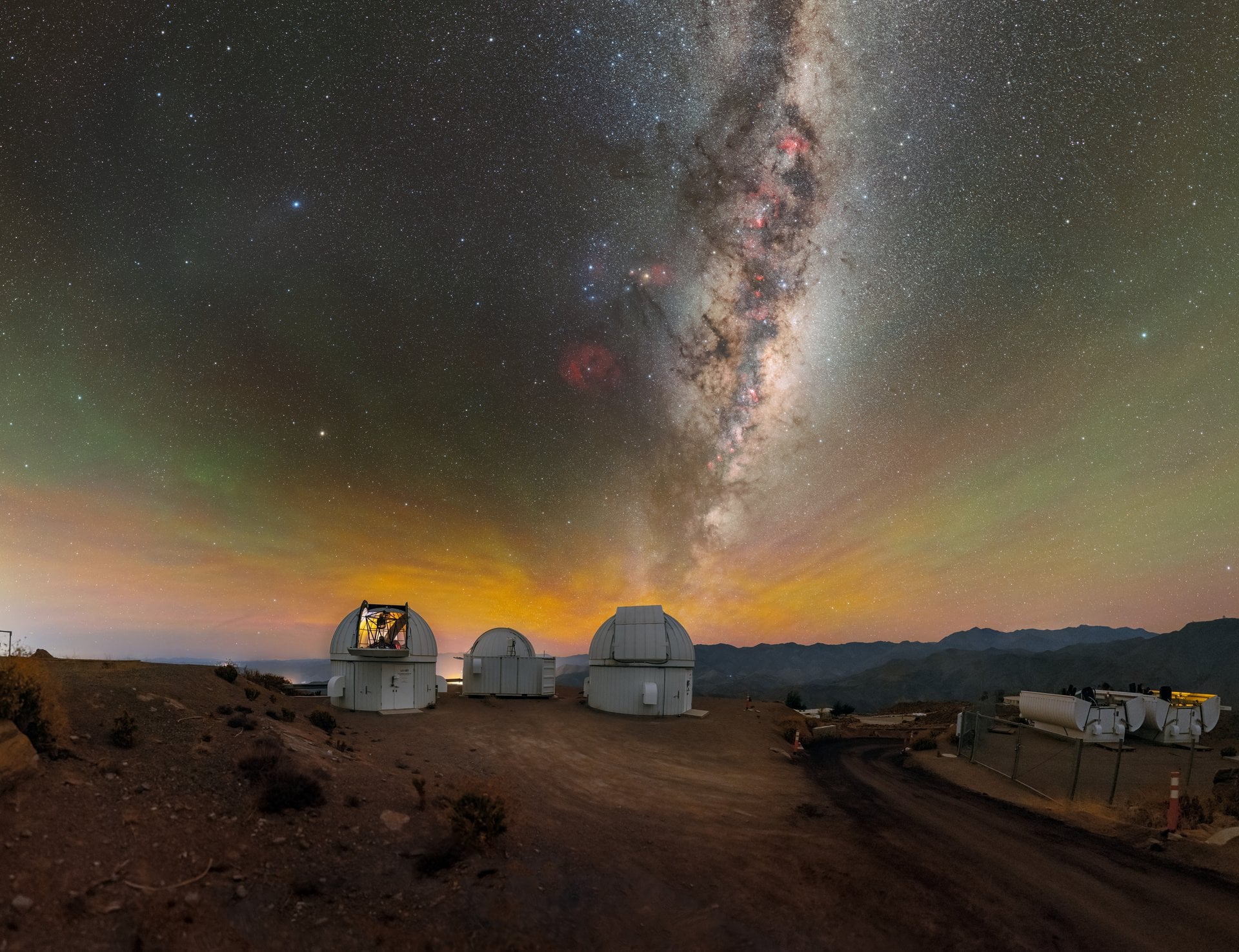
- The Dark Energy Camera (DECam): Mounted on the Victor M. Blanco 4-meter Telescope at Cerro Tololo Inter-American Observatory, DECam provided wide-field imaging to track the brightening of the targets.
- The Goodman Spectrograph: Mounted on the SOAR telescope, this instrument provided the first spectroscopic data, allowing researchers to see the chemical fingerprints of the exploding stars.
- Gemini Multi-Object Spectrographs (GMOS): Located on both Gemini North in Hawai‘i and Gemini South in Chile, these powerful spectrographs provided the high-resolution data necessary for definitive classification.
- Las Cumbres Observatory: The 1-meter and 2-meter telescopes in this global network provided continuous monitoring, ensuring that data was collected even as the Earth rotated and different telescopes moved into daylight.
This coordinated effort resulted in the successful classification of four distinct supernovae. The team identified one Type II supernova, which results from the core collapse of a massive star that has retained its hydrogen envelope. They also identified a candidate Type Ic supernova, a more rare event where a massive star explodes after losing its outer layers of hydrogen and helium.
Most significantly, the system identified two Type Ia supernovae. These are the "standard candles" of cosmology. Type Ia supernovae occur in binary star systems where a white dwarf accretes matter from a companion until it reaches a critical mass and explodes with a predictable luminosity. By measuring how bright these explosions appear from Earth, astronomers can calculate precise distances across the cosmos, allowing them to measure the Hubble-Lemaitre Constant—the rate at which the universe is expanding.
Technical Data and Big Data Management
The scale of the Rubin Observatory’s data output necessitates a shift in how astronomy is conducted. Traditionally, astronomers applied for time on a telescope, traveled to the site (or observed remotely), and analyzed their data individually. The Rubin era marks the transition to "Big Data" astronomy.
The observatory will produce roughly 20 terabytes of raw data every night. Over its ten-year lifespan, the survey will archive 15 petabytes of raw data, which will grow to 500 petabytes of total data products after processing. To put this in perspective, 500 petabytes is equivalent to roughly 50,000 years of high-definition video.
The success of the ANTARES and GOATS platforms demonstrates that machine learning is no longer an optional tool but a foundational requirement for modern astrophysics. The algorithms used in these brokers must be capable of classifying objects within seconds, as the physical processes of a supernova or a kilonova (the collision of two neutron stars) evolve rapidly. The validation run proved that the automated data reduction software could take raw telescope images and convert them into usable scientific measurements without human intervention, drastically reducing the "time to discovery."
Official Responses and Scientific Impact
The successful end-to-end test has drawn praise from leadership across the participating institutions. Bryan Miller, the lead for science operations development at Gemini Observatory, emphasized the long-term planning required to reach this stage. "The time-domain community, including NOIRLab, has been building the infrastructure needed to do efficient follow-up from Rubin alerts for over ten years," Miller stated. He noted that seeing the ecosystem work as envisioned was "very rewarding" and that the lessons learned from this demonstration would be used to refine the systems before the LSST begins in earnest.
The broader scientific community views this as a "proof of concept" for a new era of collaborative science. The integration of the Las Cumbres Observatory, a private-public partnership, with federal facilities like Gemini and SOAR, highlights the importance of a unified global network. This "ecosystem" approach ensures that no single telescope bears the burden of follow-up, and that observations can be conducted 24/7 across both hemispheres.
Broader Implications for the Future of Astronomy
The implications of a fully functional Rubin-NOIRLab alert system extend far beyond the discovery of four supernovae. This infrastructure will fundamentally change our understanding of the "dynamic" universe.
In the Solar System, the LSST is expected to increase the number of known asteroids and comets by a factor of ten. This includes the detection of "Interstellar Objects" (ISOs) like ‘Oumuamua and 2I/Borisov. Because the alert system is now validated, astronomers will have the ability to spot these visitors as they enter our system and deploy the world’s most powerful telescopes to study them before they exit back into interstellar space.
In the realm of stellar evolution, the system will allow for the study of "transient stars"—stars that flare, pulsate, or are consumed by black holes (Tidal Disruption Events). By catching these events in their earliest stages, researchers can observe the physics of extreme environments that cannot be replicated in a laboratory.
Furthermore, the discovery of Type Ia supernovae through this automated pipeline will provide a massive dataset for cosmologists. Currently, our measurements of the expansion of the universe are limited by the number of high-quality supernova observations. Rubin is expected to discover millions of supernovae; if even a fraction of them are followed up with the efficiency demonstrated in this recent test, the precision of our cosmological models will improve by orders of magnitude.
As the Vera C. Rubin Observatory moves toward its formal commissioning, the success of the NSF and NOIRLab follow-up ecosystem stands as a testament to the power of automated, networked science. The night sky is no longer a static map, but a shifting, evolving theater of events. For the first time, humanity has a system capable of watching the entire show in real-time.