Evan Lee Salim
In a significant move within the highly competitive artificial intelligence landscape, Wabi, an AI application now positioning itself as a "personal agent," has successfully raised $55 million in a funding round, achieving a valuation of $1.25 billion. This substantial investment underscores the escalating race among tech innovators and investors to develop the definitive AI assistant, with capital increasingly spread across promising ventures in the burgeoning sector of intelligent digital companions. The announcement, made on Thursday, follows strong early demand for Wabi’s evolving offerings, reflecting a potent blend of technological innovation and strategic market pivoting.
The Genesis and Evolution of Wabi: From App Builder to AI Agent
Wabi’s journey to its current valuation is marked by an adaptive strategy, demonstrating the dynamic nature of AI development. The company was founded by Eugenia Kuyda, a notable figure in the AI space, best known for establishing Replika, an AI companion startup that garnered significant attention for its conversational capabilities and emotional support features. Kuyda’s previous venture, Replika, became a touchstone in AI-driven interaction, showcasing the profound human desire for digital companionship and the technical challenges in delivering it ethically and effectively. This prior experience with large-scale AI interaction and user engagement undoubtedly informs Wabi’s current trajectory.
Initially, Wabi embarked on a mission to democratize app creation, aiming to allow anyone to build applications using simple prompts, envisioning itself as a "YouTube of apps." This early concept positioned Wabi as a platform for user-generated AI tools, tapping into the burgeoning no-code/low-code movement with an AI twist. However, the rapidly evolving AI market, characterized by intense competition and shifting user expectations, prompted a strategic recalibration. Last month, the startup announced a significant pivot, transforming its core offering to become an AI messenger, subsequently refining its identity as a "personal agent." This shift, from a generalized app-building platform to a more focused, interactive agent, reflects a broader industry trend towards more proactive and integrated AI functionalities.
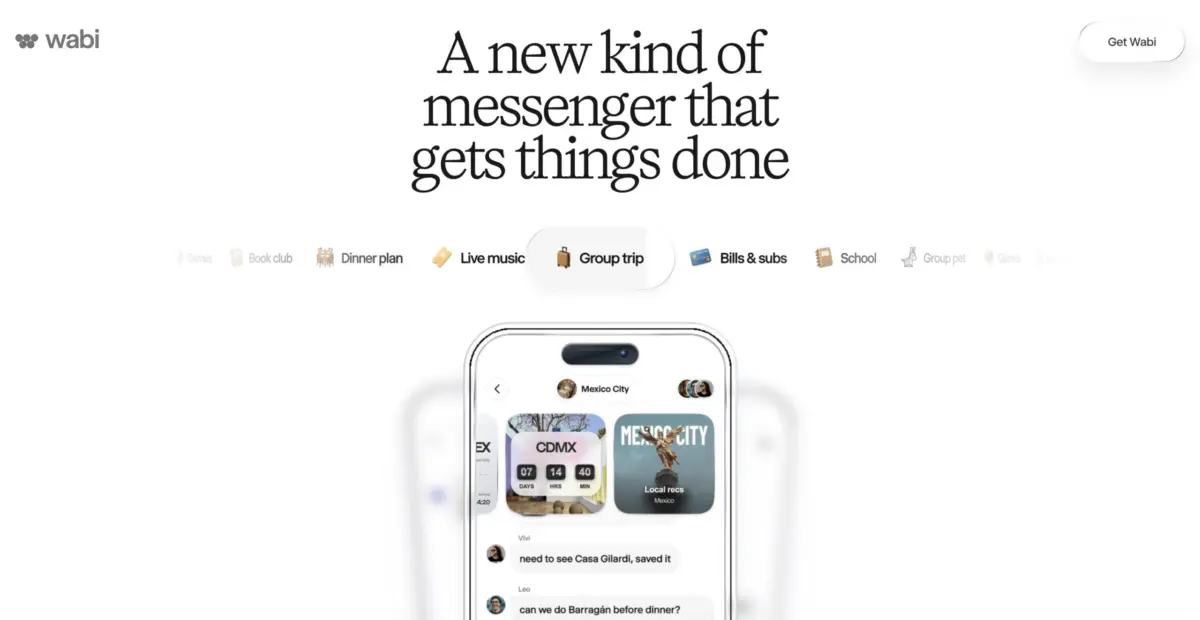
The reimagined Wabi, often referred to as Wabi 2.0, now centers on constructing dynamic interfaces tailored to individual user needs, facilitating the accomplishment of various tasks as a personal AI agent. This vision extends beyond mere conversational AI, aiming to proactively understand and assist users by generating the necessary digital tools and workflows. The company illustrates Wabi’s potential through a diverse range of applications, including sophisticated meal planning, tracking local restaurant preferences, meticulously organizing date nights, crafting personalized fitness routines, and designing intricate, specialized trivia games. These examples highlight a move towards context-aware, utility-driven AI that can seamlessly integrate into daily life, offering both convenience and personalization.
The Broader Landscape of AI Assistants and Agents
The substantial funding secured by Wabi is indicative of a wider investor consensus regarding the immense potential of agentic AI. The market for AI assistants and, more recently, AI agents, is experiencing explosive growth, driven by advancements in large language models (LLMs) and a growing demand for intelligent automation. Industry analysts project the global AI assistant market to exceed hundreds of billions of dollars within the next decade, with a compound annual growth rate (CAGR) often cited in the high double digits. This expansion is fueled by the pervasive integration of AI into consumer electronics, enterprise solutions, and specialized applications designed to enhance productivity and quality of life.
Historically, AI assistants like Apple’s Siri, Google Assistant, and Amazon’s Alexa have paved the way, familiarizing millions of users with voice-activated commands and basic informational queries. However, the current wave of innovation, largely propelled by generative AI, is pushing beyond these reactive models towards more proactive, autonomous "agents." These AI agents are designed not just to respond to commands but to understand complex goals, break them down into sub-tasks, interact with various digital services, and even learn from user behavior to anticipate needs. This paradigm shift represents a leap from simple information retrieval to genuine digital collaboration.
The competitive landscape for AI agents is rapidly intensifying. Wabi’s successful funding round comes amidst a flurry of activity in the sector. Notably, the viral AI agent Instinct recently secured an astonishing $1 billion Series C funding round, valuing it at $10 billion, highlighting the venture capital community’s immense appetite for game-changing AI solutions. Similarly, Tolan, an AI companion designed to help users navigate daily life with a distinctive, muppet-like persona, recently raised $30 million. Beyond these direct competitors, tech giants like OpenAI, Microsoft, and Meta are also heavily investing in agentic capabilities, embedding advanced AI into their ecosystems to create more intelligent and integrated user experiences. Wabi aims to carve out its niche by focusing on dynamic interface generation and personalized utility, differentiating itself from more generalized conversational AI or task-specific bots.

Investor Confidence and Strategic Backing
The $55 million funding round, which propelled Wabi’s valuation past the billion-dollar mark, was led by IVP, a prominent venture capital firm with a history of investing in successful technology companies. Alex Lim, general partner at IVP, articulated the firm’s confidence in Kuyda’s vision, stating, "Eugenia has a unique sense for where AI is headed and a track record of great taste in building it. She has a clear vision for how people will interact with AI, one that goes far beyond the text box or command line. Wabi is the expression of that vision, and we’re thrilled to support her." This statement emphasizes the perceived foresight of Kuyda in anticipating the next evolution of human-AI interaction, moving beyond traditional input methods to a more seamless, integrated experience.
The round also saw participation from a syndicate of other high-profile investors, further validating Wabi’s potential. Andreessen Horowitz (a16z), a venture capital firm renowned for its early and strategic investments in groundbreaking tech companies, including many in the AI sector, contributed to the round. Forerunner, another influential firm known for its focus on consumer technology and brand building, also participated, signaling belief in Wabi’s potential to resonate with end-users. The Amazon Alexa Fund’s involvement is particularly noteworthy, suggesting a strategic interest from Amazon in supporting innovations that could complement or integrate with its own pervasive AI assistant ecosystem.
Beyond institutional investors, the funding round attracted a stellar lineup of angel investors, whose participation offers not just capital but also invaluable industry expertise and strategic connections. This roster includes Shopify CEO Tobi Lütke, Salesforce CEO Marc Benioff, former Yahoo! head Marissa Mayer, former Twitter CEO Dick Costolo, and Alex Pall, one half of the popular electronic music duo The Chainsmokers. The involvement of such diverse and influential figures from e-commerce, enterprise software, internet services, social media, and entertainment underscores the broad appeal and perceived transformative potential of Wabi’s vision. Their collective endorsement lends significant credibility and strategic depth to the startup, opening doors for potential partnerships and future growth opportunities.
Implications and Future Outlook
Wabi’s successful funding round and its strategic pivot carry significant implications for the broader AI industry and the future of human-computer interaction. Firstly, it serves as a powerful validation of the AI agent paradigm, signaling to the market that sophisticated, proactive AI companions are not merely a futuristic concept but a viable and highly investable reality. This will likely spur further innovation and investment in similar ventures, accelerating the development of more capable and personalized AI.
Secondly, the company’s evolution from an app-building platform to an AI messenger and personal agent highlights the iterative and adaptive nature of AI product development. Startups in this space must be agile, willing to pivot based on market feedback, technological advancements, and evolving user needs. Wabi’s ability to attract substantial funding after such a significant strategic shift demonstrates investor confidence in strong leadership and a clear, albeit evolved, vision.
However, Wabi, like all players in the AI agent space, faces considerable challenges. Ensuring user trust, safeguarding data privacy, and developing ethical AI remain paramount. The intensity of competition, coupled with the need to achieve widespread user adoption in a crowded market, will test Wabi’s execution capabilities. Overcoming the "cold start" problem—attracting initial users and data to refine the AI’s performance—will be crucial.
Despite these hurdles, the opportunities are immense. Wabi’s approach to building dynamic interfaces and enabling personalized utility could redefine personal productivity and democratize interaction with complex digital services. By allowing users to create mini-applications and workflows through natural language, Wabi has the potential to make advanced technology more accessible and intuitive. As AI continues to integrate deeper into daily life, companies like Wabi are poised to play a pivotal role in shaping how individuals interact with the digital world, moving towards an era where AI agents act as intelligent extensions of our intentions and capabilities, far beyond the confines of a simple text box or command line. The robust financial backing and experienced leadership position Wabi to be a significant contender in this transformative technological frontier.