Sisilia Frederika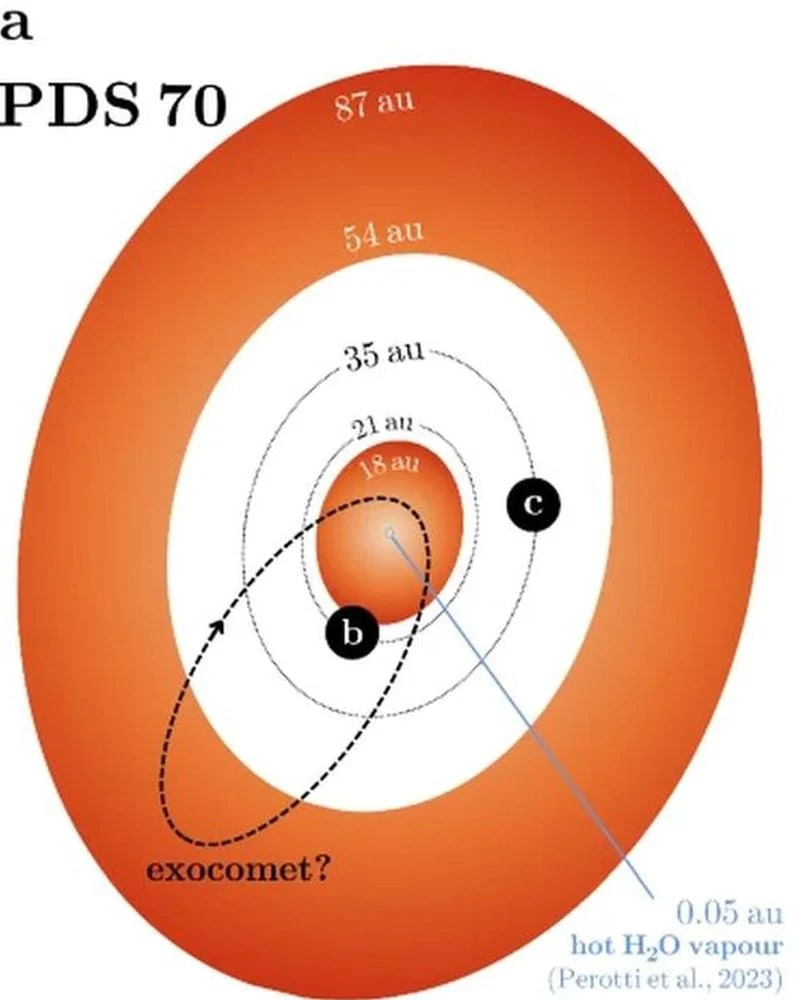
The origin of Earth’s water remains one of the most fundamental mysteries in planetary science, serving as the pivot point for our understanding of how life-sustaining environments are formed. While Earth is the only known body in the Solar System to possess stable surface water, the mechanism by which this liquid arrived—whether through internal volcanic outgassing or external delivery via icy celestial bodies—has long been a subject of intense academic scrutiny. New evidence published in Nature Communications by an international team of researchers suggests that the answer may lie in the chaotic early stages of planetary systems, specifically through the action of "exocomets" delivering volatiles to the inner reaches of a developing solar system.
By observing PDS 70, a young T-Tauri star located approximately 370 light-years away in the constellation Centaurus, a team led by Aline Novais, a post-doctoral researcher at Lund University, has identified signatures of sublimating comets. This discovery provides a rare, real-time glimpse into the "nurture" side of the planetary water debate, suggesting that cometary delivery is a viable and perhaps common method for hydrating young planets.
The PDS 70 System: A Protoplanetary Laboratory
PDS 70 is not merely another distant star; it is widely considered one of the most important astronomical targets for the study of planet formation. At just 5.5 million years old, the star is in its infancy, having not yet reached the "main sequence" stage of stellar evolution. What makes PDS 70 uniquely significant is its status as the first system where astronomers directly imaged forming planets. PDS 70b and PDS 70c, two massive gas giants, were captured by the European Southern Observatory’s (ESO) Very Large Telescope (VLT) in 2018 and 2019, respectively.
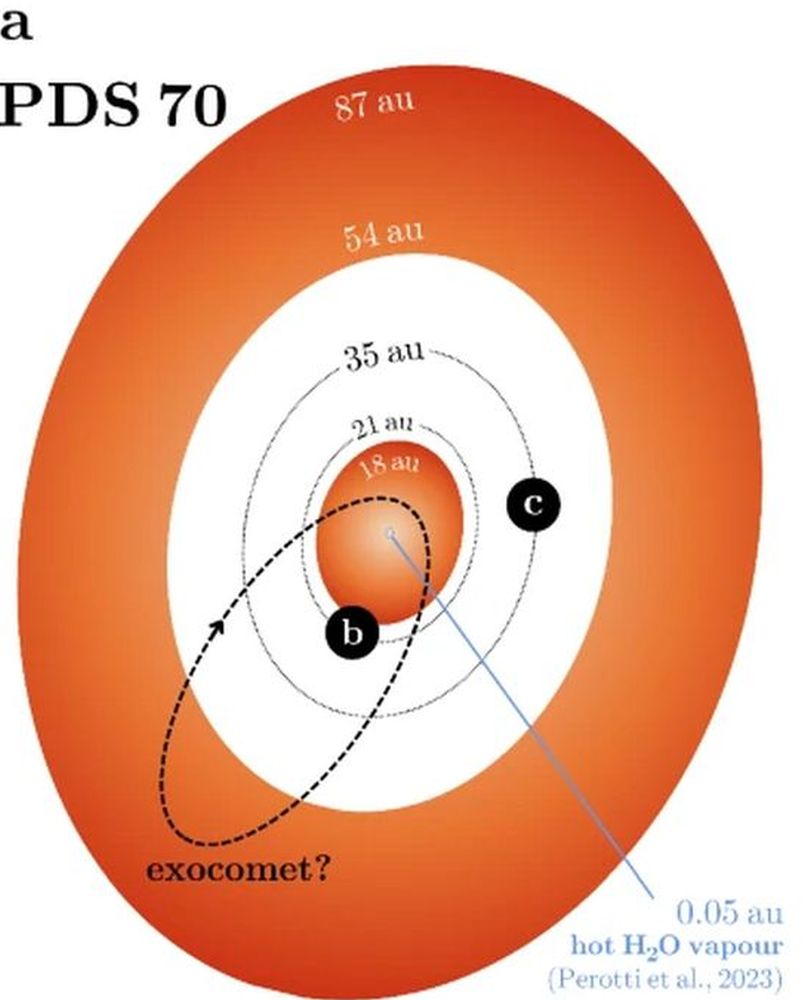
These planets are currently carving a massive gap in the protoplanetary disk of dust and gas surrounding the star. Recent observations from the James Webb Space Telescope’s (JWST) Mid-Infrared Instrument (MIRI) added another layer of complexity to this system when they detected a reservoir of water vapor in the inner disk, very close to the star. The presence of water in this hot, inner region was unexpected, as the intense radiation of a young star typically destroys water molecules or prevents them from condensing. This discrepancy led researchers to investigate whether this water was "native" to the inner disk or was being actively transported from the colder, outer regions of the system.
Spectral Evidence: The Smoking Gun of Sodium Lines
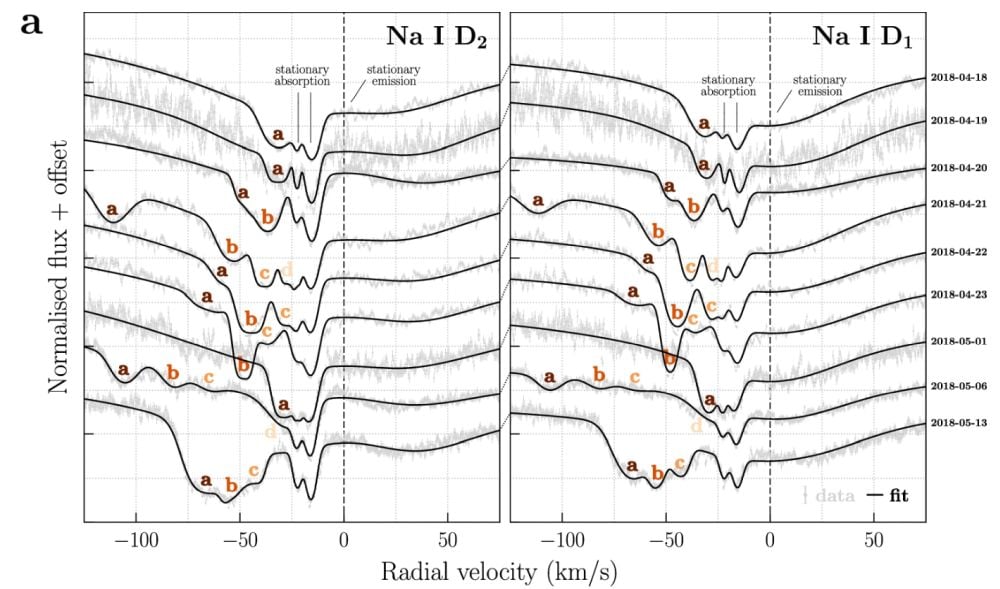
To solve the mystery of the inner-disk water, Novais and her colleagues turned to archival data from the High Accuracy Radial velocity Planet Searcher (HARPS), a high-precision spectrograph located at the ESO’s La Silla Observatory in Chile. By analyzing the spectra of PDS 70, the team identified variable absorption lines of neutral sodium (Na I).
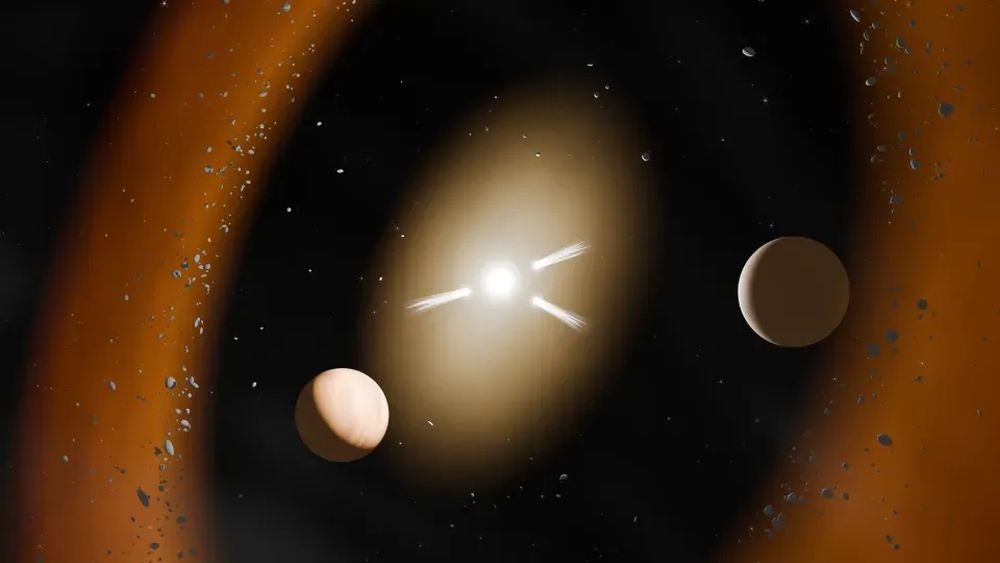
These sodium signatures were not static; they fluctuated significantly on a daily basis in terms of their amplitude, number, and radial velocity. Unlike a steady "disk wind"—a uniform flow of gas moving away from the star—these sodium signals were "clumpy" and spatially confined. The researchers noted that the gas appeared to partially cover the stellar disk and moved at velocities significantly faster than the star’s own rotation or the general movement of the disk.
This stochastic behavior is a hallmark of the exocomet phenomenon. As an icy body on a highly elliptical orbit approaches its host star, it begins to heat up. This process, known as sublimation, causes the ice to turn directly into gas, creating a "coma" and a tail of dust and volatiles. When such a comet passes between the star and an observer on Earth, the gas absorbs specific wavelengths of starlight, leaving behind the variable spectral fingerprints observed by the Lund University team.
A Chronology of Discovery in the PDS 70 System
The investigation into PDS 70 has been a multi-decade effort, with each milestone bringing scientists closer to understanding the mechanics of planetary birth:
- 1992: PDS 70 is first identified as a T-Tauri star with an infrared excess, indicating a circumstellar disk.
- 2006: High-resolution imaging begins to suggest a gap in the disk, hinting at the presence of massive planets.
- 2018: The SPHERE instrument on the VLT captures the first direct image of PDS 70b, a planet several times the mass of Jupiter.
- 2019: PDS 70c is discovered using the MUSE spectrograph on the VLT, confirming a multi-planet system.
- 2023: The JWST MIRI instrument detects water vapor in the inner disk, sparking a debate on its origin.
- 2024-2026: Researchers analyze HARPS archival data, concluding that sublimating exocomets are the likely source of both the sodium signatures and the inner-disk water reservoir.
The Role of Gas Giants in Water Delivery
One of the most compelling aspects of the PDS 70 study is the dynamical interaction between the known planets and the proposed comets. In our own Solar System’s history, the migration of gas giants like Jupiter and Saturn is thought to have destabilized the orbits of icy bodies in the outer reaches (the Kuiper Belt and Oort Cloud), flinging them into the inner Solar System. This period, often referred to as the Late Heavy Bombardment, is a leading candidate for how Earth received its oceans.
The Lund University researchers modeled the gravitational environment of PDS 70 and found a similar mechanism at play. The two gas giants, PDS 70b and 70c, act as gravitational "slingshots." As icy planetesimals from the outer disk migrate inward, they encounter the massive gravity of these planets, which perturbs their orbits into highly eccentric paths that bring them close to the central star.
"Our study suggests that comets may be responsible for transporting water to the inner parts of the planetary system, where planets can form, in the same way as in the early Solar System," stated lead author Aline Novais. This finding bridges the gap between theoretical models of the early Solar System and direct observations of distant stars.
Comparative Analysis: Solar-Type Stars and Exocomet Activity
While exocomets have been detected in other systems before—most notably around the star Beta Pictoris—PDS 70 represents a significant scientific "first." Beta Pictoris is an A-type star, much hotter and more massive than the Sun. PDS 70, conversely, is a relatively cool T-Tauri star, making it a much closer analog to the infant Sun.
Furthermore, PDS 70 is the youngest system ever observed to exhibit exocomet activity. This suggests that the delivery of volatiles begins almost immediately during the planetary formation process, rather than being a late-stage event. The presence of these comets at such an early age (5.5 million years) implies that the building blocks of habitability are being put into place while the planets themselves are still growing.
Scientific Challenges and the "Disk Wind" Alternative
Despite the strong evidence for exocomets, the research team remains cautious. In their report, they acknowledge that a "disk wind" scenario—where gas is launched from the disk by magnetic fields or thermal pressure—cannot be definitively ruled out. The difficulty lies in the uncertainties surrounding the star’s mass loss rate and accretion rate.
"Given that some model parameters are significantly uncertain, this simple model prevents us from definitively ruling out the disc wind scenario," the authors write. However, they emphasize that the stochastic and clumpy nature of the sodium lines is much more consistent with the "exocomet hypothesis" than with the more uniform behavior expected from a disk wind.
Implications for Future Exploration and the Search for Life
The discovery has profound implications for the field of astrobiology. If water delivery via comets is a standard feature of young, solar-like systems, then the probability of finding watery, Earth-like planets across the galaxy increases significantly. It suggests that "water worlds" are not a fluke of our own system’s unique geometry but are a natural byproduct of how gas giants interact with icy debris.
The scientific community is now looking toward the next generation of observatories to confirm these findings. The Extremely Large Telescope (ELT), currently under construction by the ESO in Chile’s Atacama Desert, will possess the sensitivity required to resolve the inner disk of PDS 70 with unprecedented clarity.
"When the Extremely Large Telescope becomes operational in the coming years, we will be able to find out whether there are any further planets in the system and thus gain an even clearer picture of how water and other building blocks of planets are transported," said co-author Jens Hoeijmakers, an astronomy researcher at Lund University.
Conclusion: Nature vs. Nurture in the Cosmos
The debate over Earth’s water source is often framed as a binary choice: was the water here from the beginning (nature), or was it brought here later (nurture)? The PDS 70 findings suggest that this may be a false dichotomy. In a young, dynamic system, both processes could occur simultaneously. While a planet may retain some indigenous water from its initial accretion, the "top-off" provided by a constant rain of exocomets could be what ultimately tips the scales toward habitability.
As PDS 70 continues to evolve, it serves as a mirror to our own past. By watching these distant exocomets sublimate under the heat of their young sun, astronomers are effectively looking back in time, witnessing the same cosmic delivery service that may have filled Earth’s first oceans billions of years ago. The study not only enriches our understanding of a distant star but provides a deeper context for our own existence on a blue planet.