Sisilia Frederika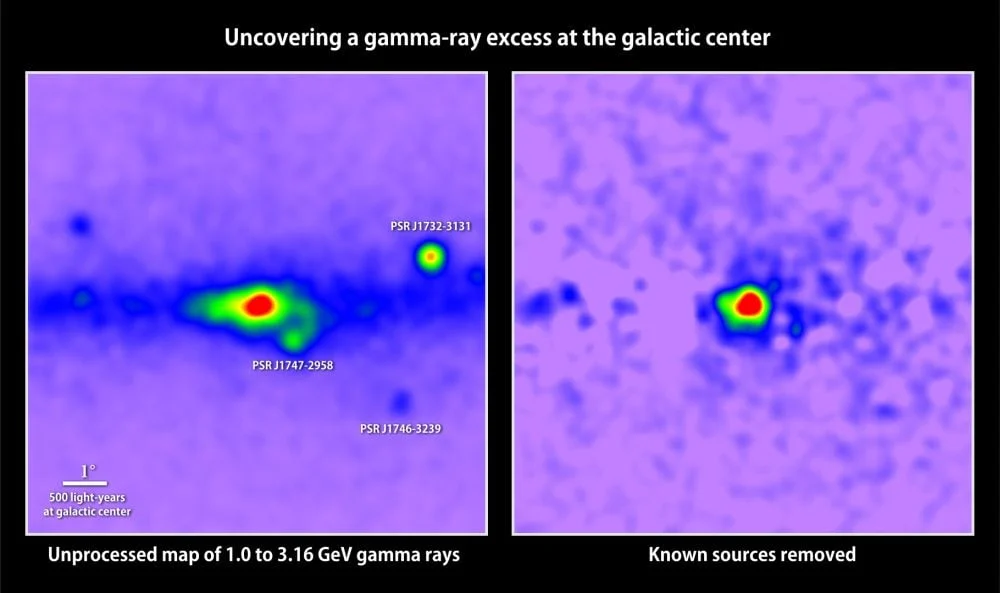
The mystery of a persistent and unexplained glow of high-energy radiation emanating from the heart of the Milky Way has taken a significant turn, as new research suggests that dark matter remains a viable candidate for its origin. For over a decade, astrophysicists have debated the source of the Galactic Center GeV Excess (GCE), an abundance of gamma-ray radiation first identified in 2009. While recent scientific consensus had begun to lean toward a population of undiscovered pulsars as the culprit, a sophisticated study led by researchers at the University of Vienna, published in Physical Review Letters, utilizes advanced machine learning to demonstrate that the dark matter hypothesis is far from debunked.
The study, titled "Energy Distribution of the Galactic Center Excess’s Sources," represents a shift in how astronomers analyze the complex data gathered by the Fermi Gamma-ray Space Telescope. By employing a neural network to process the spatial and spectral characteristics of individual photons, the research team, led by Florian List, has challenged previous statistical models that favored "point sources" like pulsars. Their findings suggest that the GCE is either truly diffuse—consistent with dark matter annihilation—or composed of a far greater number of faint sources than previously estimated, potentially numbering in the tens of thousands.
The Discovery and History of the Galactic Center Excess
The story of the GCE began shortly after the launch of NASA’s Fermi Gamma-ray Space Telescope in 2008. Fermi was designed to map the highest-energy light in the universe, providing a window into cataclysmic events and exotic phenomena. In 2009, physicists Lisa Goodenough and Dan Hooper reported a curious anomaly: an excess of gamma rays with energies in the gigaelectronvolt (GeV) range originating from the Milky Way’s center.
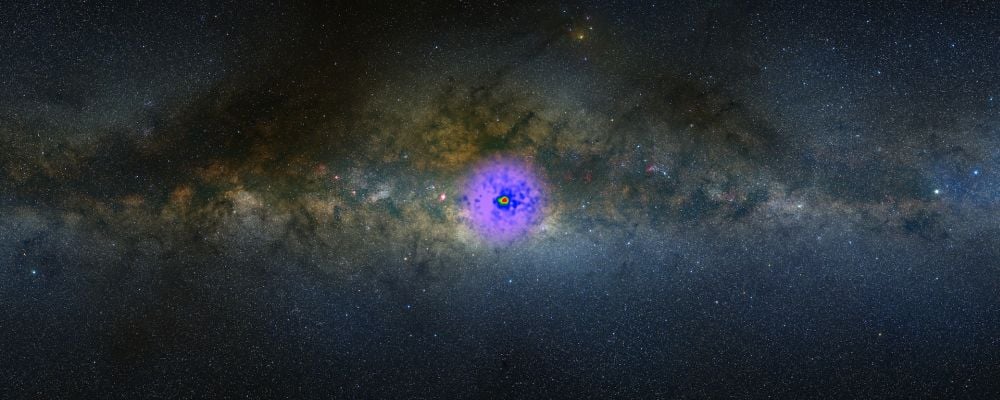
This region, a crowded neighborhood roughly 26,000 light-years from Earth, is home to the supermassive black hole Sagittarius A (Sgr A), dense clusters of stars, and thick clouds of interstellar gas. Despite accounting for all known gamma-ray sources—including supernovae, cosmic rays hitting gas clouds, and known pulsars—an unexplained "glow" remained. The GCE appeared as a roughly spherical distribution of radiation, centered on the galactic core and extending outward for several thousand light-years.
Initially, the most exciting explanation was dark matter. Dark matter is the invisible substance that makes up approximately 85% of the matter in the universe, yet it does not interact with light and has never been directly detected. One leading theory suggests that dark matter consists of Weakly Interacting Massive Particles (WIMPs). According to some models, WIMPs are their own antiparticles; when two such particles collide in the high-density environment of the galactic center, they would annihilate each other, releasing a burst of energy in the form of gamma rays.
The Rival Hypotheses: Pulsars vs. Dark Matter
For several years, the dark matter interpretation gained significant traction. However, by the mid-2010s, a rival theory emerged. Critics of the dark matter hypothesis argued that the GCE did not look perfectly "smooth" or diffuse, as would be expected from a cloud of dark matter. Instead, they suggested the radiation appeared "speckled," indicating it might be coming from a large number of individual, unresolved point sources.
The primary candidates for these point sources are millisecond pulsars (MSPs). Pulsars are rapidly rotating neutron stars—the collapsed cores of massive stars—that emit beams of radiation like celestial lighthouses. Millisecond pulsars rotate hundreds of times per second and are known to emit gamma rays in the GeV range. Proponents of this theory suggested that a massive population of these pulsars, too dim to be detected individually by Fermi, could collectively produce the observed excess.
In 2015 and 2016, two independent studies using different statistical techniques concluded that the GCE was indeed likely composed of point sources. This led many in the scientific community to believe the mystery was largely solved, shifting the focus from the search for dark matter to the study of stellar evolution in the galactic bulge.
A New Perspective via Machine Learning
The new research from the University of Vienna challenges the "point source" victory by highlighting limitations in previous statistical methods. Traditionally, researchers used "template fitting" or non-Poissonian photon statistics to distinguish between a smooth glow and a collection of dots. However, these methods often struggled to account for the extreme "noise" and complexity of the galactic center.
Florian List and his colleagues addressed this by developing a simulation-based inference approach using deep learning. They trained a neural network on more than one million simulated gamma-ray photons, mimicking the environment Fermi observes. Crucially, the researchers included the precise energy levels of individual photons—information that was often aggregated or simplified in previous analyses.
"Interpreting the signal is particularly difficult because the Galactic Center is an exceptionally bright and crowded region of the gamma-ray sky," List explained. The neural network was designed to analyze spatial patterns (where the light is coming from) and spectral data (the energy distribution of that light) simultaneously.
This integrated approach revealed that when the energy of the photons is taken into account, the evidence for point sources weakens. The study found that if the GCE were indeed caused by pulsars, the population would have to be much larger and the individual stars much dimmer than previously assumed.
The 35,000 Pulsar Problem
One of the most striking findings of the new analysis is the sheer number of sources required to explain the GCE under the pulsar hypothesis. Previous models suggested that a few thousand millisecond pulsars could account for the radiation. However, List’s machine learning model predicts that if point sources are responsible, there would need to be at least 35,000 of them—and potentially as many as 100,000.
This presents a significant challenge for the pulsar theory. While the galactic center is dense, an population of 35,000 millisecond pulsars is an order of magnitude higher than what most current models of stellar evolution and galactic dynamics predict. If such a vast population existed, astronomers would expect to see other signs of their presence, such as specific radio emissions or X-ray signatures, which have yet to be found in such quantities.
By showing that the required pulsar population is implausibly large, the research effectively moves the needle back toward the dark matter hypothesis. If the GCE is not made of tens of thousands of tiny dots, it is more likely to be a truly diffuse emission—exactly what one would expect from a halo of self-annihilating dark matter.
Challenges of Galactic Center Observation
The difficulty in resolving this debate stems from the "fog" of the Milky Way. When looking toward the galactic center, Earth-based and space-based telescopes must look through the entire disk of the galaxy. This includes vast amounts of dust that reddens light, gas clouds that reflect and absorb radiation, and the "foreground" of millions of stars.
The Fermi Large Area Telescope (LAT), while revolutionary, has a finite resolution. It can see that a region is bright, but it cannot always distinguish between a single bright object and a cluster of many faint ones. Furthermore, the diffuse gamma-ray background—caused by cosmic rays interacting with interstellar gas—must be modeled and subtracted with extreme precision. Any error in modeling this background can create a "false" excess or mask a real one.
The University of Vienna study acknowledges these difficulties. The authors state that while their work does not "prove" dark matter is the cause, it demonstrates that the data is entirely consistent with dark matter models once the spectral information is correctly integrated.
Broader Implications and Future Research
The implications of confirming dark matter as the source of the GCE would be monumental for the field of physics. It would provide the first indirect detection of dark matter particles and offer clues about their mass and interaction cross-section. This, in turn, would help refine the Standard Model of particle physics and provide a clearer picture of how the universe formed and evolved.
Conversely, if the GCE is eventually proven to be pulsars, it would reveal a much more complex history of star formation in the Milky Way’s core than previously imagined. It would suggest that the galactic center has been a factory for massive stars—and their subsequent neutron star remnants—for billions of years.
The scientific community is now looking toward future instruments to break the stalemate. The Cherenkov Telescope Array (CTA), currently under construction, will have much higher sensitivity and resolution at higher energy ranges than Fermi. By observing the galactic center with unprecedented clarity, the CTA may be able to resolve individual millisecond pulsars or confirm the perfectly smooth profile of a dark matter halo.
In the meantime, machine learning continues to emerge as a vital tool in the astrophysicist’s toolkit. As datasets become larger and more complex, the ability of neural networks to find subtle patterns in "noisy" environments is proving indispensable.
"The origin of the Galactic Center Excess is one of the longest-running debates in astrophysics," List concluded. "Our work does not show that dark matter is responsible for the signal. However, it suggests that it is still too early to rule out this possibility."
The study underscores a fundamental principle of scientific inquiry: as tools and methodologies evolve, previously "closed" cases must be re-examined. For now, the heart of our galaxy remains a place of mystery, holding secrets that could eventually explain the very nature of the matter that holds the cosmos together.