Sisilia Frederika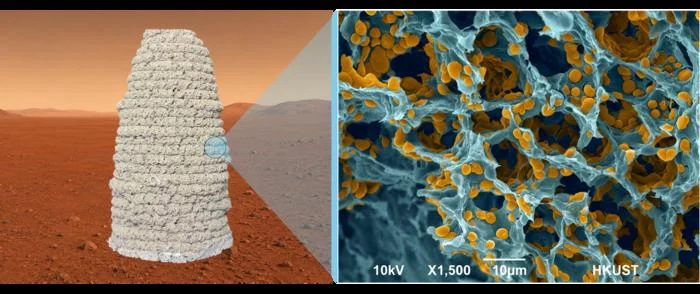
The ambition of establishing a permanent human presence on Mars faces a fundamental logistical hurdle: the prohibitive cost and physical complexity of transporting construction materials across the 140-million-mile void between Earth and the Red Planet. Current estimates suggest that shipping even a single kilogram of payload to the Martian surface costs tens of thousands of dollars, making the export of traditional building materials like steel or pre-cast concrete economically non-viable. To overcome this, researchers are increasingly looking toward In-Situ Resource Utilization (ISRU)—the practice of using local materials to manufacture necessary supplies. A groundbreaking study led by Ning Liu at the Hong Kong University of Science and Technology, recently published in the journal Chem Circularity, proposes a radical biological solution. By utilizing genetically modified baker’s yeast (Saccharomyces cerevisiae) as a primary binding agent for Martian regolith, scientists have developed a new class of "Engineered Living Building Material" (ELBM) that could redefine the future of extraterrestrial architecture.
The Limitations of Thermal Sintering and Traditional Concrete
For decades, the leading candidate for Martian construction has been a process known as sintering. This method involves using high-energy sources—such as industrial lasers, concentrated solar thermal energy, or microwaves—to heat loose Martian soil, or regolith, to temperatures exceeding 1,000°C. At these temperatures, the soil particles fuse together to create a solid, ceramic-like structure. While sintering produces mechanically sound blocks, it is an extraordinarily energy-intensive process. Preliminary calculations indicate that to produce just one cubic meter of sintered material, an entire solar array would need to dedicate several days of its total output. In the resource-constrained environment of an early Martian colony, such energy expenditure represents a significant drain on life-support and scientific systems.
Furthermore, traditional terrestrial concrete, which relies on Portland cement and water, is physically impossible to use in the Martian environment. The Martian atmosphere is roughly 1% as dense as Earth’s and is composed primarily of carbon dioxide. In these near-vacuum conditions, liquid water cannot remain stable; it either freezes instantly or sublimates into gas. This phase transition would cause traditional concrete to crack and lose its structural integrity before it could ever properly cure. These environmental constraints have necessitated a search for "cold" or "low-energy" alternatives that can operate within the unique thermodynamic parameters of the Red Planet.
The Composition and Synthesis of Engineered Living Building Materials
The research team at the Hong Kong University of Science and Technology has pivoted away from high-heat mechanical processes toward synthetic biology. Their proposed ELBM is a bio-composite concrete consisting of three primary ingredients: local Martian sand (simulated regolith), gelatin, and genetically modified baker’s yeast. Unlike traditional methods that fight against the Martian environment, this biological approach utilizes the planet’s low pressure and cold temperatures as part of the manufacturing cycle.
The production process begins at a controlled temperature of 37°C, where the yeast and gelatin are mixed with the regolith. At this stage, the mixture is malleable and can be molded or potentially 3D-printed into specific architectural forms. Once the material is exposed to the Martian atmosphere, the water used in the initial mixing phase begins to sublimate. However, rather than destroying the material, the yeast acts as a stabilizing matrix. As the water leaves, it leaves behind a biopolymer skeleton that locks the sand grains into a rigid, durable structure. This "freeze-drying" curing process allows the material to achieve its final strength without the need for external heating elements.
Genetic Engineering: The Three Pillars of Structural Integrity
The success of ELBM relies on three specific genetic modifications made to the yeast cells, each designed to solve a particular structural challenge inherent in the Martian environment.
First, the researchers engineered the yeast to produce Mussel Foot Proteins (Mfps). In nature, mussels use these specialized proteins to adhere to rocks and ship hulls in turbulent, high-moisture environments. In the context of ELBM, these proteins act as biological "chemical anchors." They allow the yeast cells to bond directly and securely to the individual grains of Martian regolith, creating a cohesive unit rather than a loose collection of particles.
Second, the team implemented a "SpyTag/SpyCatcher" protein system. This is a biochemical technique where two different strains of yeast are engineered to produce complementary molecules that act like a molecular lock-and-key. When these molecules meet, they form covalent isopeptide bonds. These bonds are among the strongest in organic chemistry and are nearly indestructible under normal mechanical stress. This network of covalent bonds creates a microscopic "web" that reinforces the entire structure from the inside out.
The third modification is inspired by natural anti-freeze proteins found in cold-climate organisms. During the curing process, as the material is exposed to the Martian vacuum, water naturally wants to form large, jagged ice crystals. These crystals can act like tiny wedges, prying the material apart and causing structural failure. The anti-freeze proteins ensure that instead of large crystals, a uniform system of 5-micrometer pores is created throughout the material. While this porosity makes the material non-airtight, it prevents the catastrophic fracturing that would otherwise occur during the freezing cycle.
Comparative Performance and Energy Efficiency
In laboratory testing, the ELBM demonstrated impressive mechanical properties. The material achieved a compressive strength of approximately 12 Megapascals (MPa). While this is lower than the 20-40 MPa typical of high-strength terrestrial concrete used in skyscrapers, it is more than sufficient for the low-gravity environment of Mars (which is only 38% of Earth’s gravity).
More notably, the ELBM exhibited a flexural strength of 6 MPa. This is significantly higher than that of traditional concrete, which is notoriously brittle and weak under tension. High flexural strength is a critical requirement for Martian structures, which must withstand the mechanical stress of intense dust storms and the internal pressure required to maintain a breathable atmosphere for human inhabitants.
The most significant advantage, however, is the energy profile. The ELBM process requires nearly two orders of magnitude less energy than sintering. By operating at near-ambient temperatures (relative to the 1,000°C required for sintering), the biological method preserves the colony’s limited power supply for oxygen generation, water recycling, and food production. Furthermore, the material is highly recyclable. By heating the ELBM to approximately 45°C, the gelatin binder reliquefies, allowing the material to be recast into new shapes without losing its structural integrity.
Environmental Hazards and Logistical Constraints
Despite the promising results, the research team acknowledges several significant hurdles that must be addressed before ELBM can be deployed on Mars. The Martian soil is known to contain high concentrations of perchlorates—salts that are toxic to most Earth-based lifeforms. It remains to be seen whether the engineered yeast can survive and function when in direct contact with raw Martian regolith, or if the soil would require pre-treatment to remove these toxins.
Additionally, Mars lacks a thick atmosphere and a global magnetic field, leaving its surface exposed to intense ultraviolet (UV) radiation. Organic polymers and biological cells are susceptible to UV degradation over time. Any structure built from ELBM would likely require an external coating or a layer of untreated regolith on top to shield the biological "glue" from radiation damage.
Furthermore, the porosity of the material means it cannot hold air pressure on its own. An ELBM structure would serve as the "exoskeleton" of a habitat—providing protection against micrometeoroids and radiation—but would require an internal, airtight pressurized bladder or membrane to sustain human life.
Logistically, while yeast can be grown and multiplied on-site using organic waste, the gelatin component currently must be shipped from Earth. The researchers found that yeast alone, without the gelatin binder, produced a significantly weaker material. Future research may focus on identifying Martian-producible alternatives to gelatin, such as specialized starches or cyanobacteria-derived polymers, to achieve a truly closed-loop manufacturing system.
The Future of Extraterrestrial Architecture
The development of Engineered Living Building Materials represents a shift in how space agencies view the challenge of colonization. Rather than relying solely on heavy machinery and high-energy physics, the future of space exploration may lie in the field of synthetic biology. This study contributes to a growing body of research exploring unconventional binders for space construction, including previous proposals to use fungal mycelium, synthetic spider silk, or even proteins derived from astronaut blood and urine.
As NASA’s Artemis program looks toward the Moon and eventually Mars, the ability to "grow" infrastructure will be a vital component of mission sustainability. The work by Liu and his colleagues provides a viable pathway for low-energy, sustainable construction that works in harmony with the harsh conditions of the Martian environment. While the timeline for a human mission to Mars remains a subject of debate, the foundation for the homes they will live in is already being engineered in laboratories today. The humble baker’s yeast, a staple of human civilization for millennia, may soon become the most important organism in the expansion of life beyond Earth.