Sisilia Frederika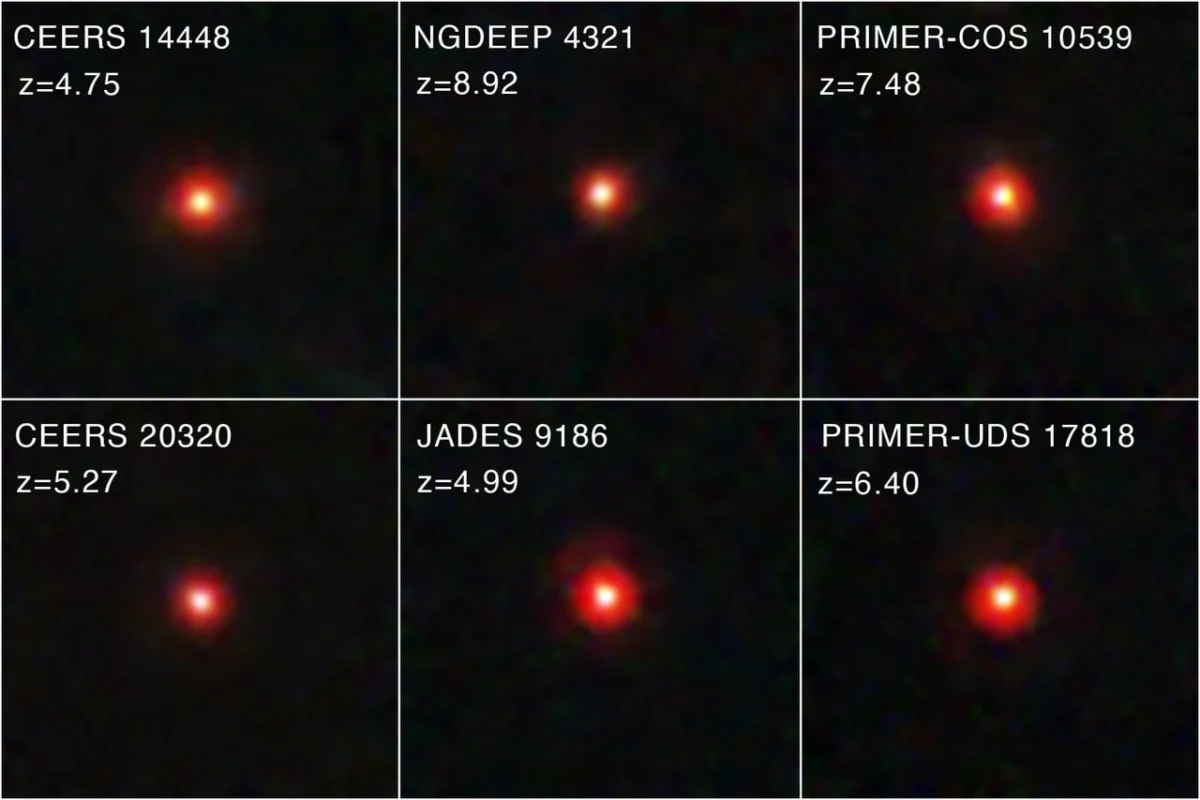
The James Webb Space Telescope (JWST) has fundamentally altered the scientific community’s understanding of the cosmic dawn, revealing a universe that was far more active and complex in its first billion years than previously theorized. Among the most perplexing discoveries made during the telescope’s deep-field observations are the "Little Red Dots" (LRDs). These compact, reddish, point-like objects, appearing in the very early universe, have challenged existing models of galactic and black hole evolution. A recent study published in the journal Nature, titled "Overmassive black holes and little red dots naturally form in simulations," provides a groundbreaking explanation for these phenomena, suggesting that LRDs are not merely distant stars or typical active galaxies, but are instead "overmassive" black holes formed through unique environmental conditions that existed only during the infancy of the cosmos.
The Mystery of the Little Red Dots
When the JWST began its mission to peer into the darkest, most distant reaches of space, astronomers expected to find the faint, nascent light of the first galaxies. While they did find these, they also encountered a class of objects that defied immediate classification. These Little Red Dots are characterized by their extreme distance—observed when the universe was less than one billion years old—and their distinct spectral signatures.
Initially, researchers proposed two primary hypotheses for the nature of LRDs. The first was that they were early active galactic nuclei (AGN), powered by supermassive black holes similar to quasars. However, LRDs lacked the significant X-ray and radio emissions typically associated with powerful black hole activity. The second hypothesis suggested that they were "progenitor stars"—massive, bright stars composed almost entirely of hydrogen and helium (Population III stars). While the spectra of LRDs shared similarities with models of these primordial stars, the data also revealed a significant rotational Doppler shift. This indicated that the objects were rotating at speeds far exceeding what would be expected for the first generation of stars, leaving the scientific community in a state of debate.
Chronology of Discovery and Research
The identification of LRDs followed a timeline of rapid observation and theoretical adjustment. In 2022 and 2023, early JWST data releases, such as those from the CEERS (Cosmic Evolution Early Release Science) Survey, first highlighted the presence of these anomalous red sources. By late 2024, multiple research teams had confirmed that these objects were ubiquitous in the early universe, appearing at redshifts ($z$) greater than 5, corresponding to a time when the universe was roughly 5% to 10% of its current age.
The study led by Sunmyon Chon, Shingo Hirano, and Tilman Hartwig, published in 2026, represents the culmination of several years of high-resolution cosmological simulations. The research team sought to bridge the gap between observation and theory by modeling the specific environmental conditions of the early universe. Their simulations focused on the interaction between gas clouds, radiation fields, and gravity within the first proto-galaxies, eventually matching the simulated data with the real-world observations provided by the JWST.
Theoretical Framework: The Direct Collapse Model
The core of the new research lies in the "direct collapse" model of black hole formation. In the modern universe, black holes typically form from the gravitational collapse of massive stars at the end of their life cycles. However, this process results in "seed" black holes that are relatively small—tens to hundreds of times the mass of the Sun. To reach the supermassive scales observed in the early universe, these seeds would need to grow at rates that are physically improbable under standard conditions.
The study in Nature proposes that LRDs are the result of a different process. In the high-density environment of the early universe, massive clouds of primordial gas were subjected to intense ultraviolet (UV) radiation from neighboring star-forming regions. This UV radiation played a critical role: it prevented the gas clouds from cooling and fragmenting into thousands of individual stars.
Instead of becoming a "stellar nursery," the entire gas cloud remained intact and underwent a monolithic collapse. This process first created a "primordial superstar"—a short-lived, incredibly massive object. Within a short astronomical timeframe, this superstar collapsed directly into a black hole with an initial mass of approximately one million Suns. These are the "overmassive" black holes that the study identifies as the progenitors of the Little Red Dots.
Breaking the Eddington Limit: The Growth of LRDs
A significant hurdle in astrophysics is the Eddington Limit, which defines the maximum rate at which a black hole can consume matter. As matter falls into a black hole, it heats up and emits radiation. This radiation exerts outward pressure; if the pressure becomes too great, it pushes away the surrounding gas, effectively "choking" the black hole’s growth.
The simulations conducted by Chon and his colleagues suggest that the environment of the early universe allowed LRDs to bypass this limit. The team found that the intense radiative environment surrounding these proto-galaxies helped push gas toward the central black hole, acting as a gravitational "force-feed." This allowed the black holes to grow at "super-Eddington" rates.
By consuming material much faster than previously thought possible, these overmassive black holes were able to reach enormous sizes very quickly. This explains why the JWST sees such massive objects so soon after the Big Bang. The simulations showed that the resulting spectral output—a combination of the heat from the accreting gas and the light from the surrounding dense star clusters—perfectly matched the unique "red" signatures observed in LRDs.
Supporting Data and Spectral Analysis
The research team utilized the ATERUI II supercomputer to run three-dimensional, radiation-hydrodynamic simulations. The data gathered from these models provided several key insights:
- Mass Ratios: The simulations showed that the ratio of black hole mass to host galaxy mass in LRDs is significantly higher than in the local universe. In modern galaxies, the central black hole is usually about 0.1% of the galaxy’s mass. In LRDs, the black hole can constitute up to 10% to 100% of the initial stellar mass of the proto-galaxy.
- Spectral Matching: The simulated spectra reproduced the "V-shaped" continuum seen in JWST observations—a blue component from the accretion disk and a red component likely caused by high concentrations of dust and the redshift of the light itself.
- Rotational Velocity: The high rotational Doppler shifts that previously confused astronomers were explained by the simulations as the result of extremely high-velocity gas flows within the deep gravitational well of the overmassive black hole, rather than the rotation of a single star.
Expert Reactions and Scientific Analysis
While the study has been met with acclaim for its rigorous modeling, it has also sparked a broader discussion within the astrophysical community. Dr. Rebecca Bowler, an expert in early universe galaxies (not directly involved in the study), noted that "the ability to match these complex simulations with the actual light profiles of Little Red Dots is a major step forward. It solves the ‘impossible’ problem of how supermassive black holes could exist so early."
Analysts suggest that these findings have two major implications. First, they suggest that the "bottom-up" model of galaxy formation—where small stars form first and eventually build up to galaxies and black holes—is not the only pathway. The "top-down" approach, where massive black holes form first and act as the anchors for future galaxies, appears to be a valid and perhaps dominant mechanism in the early universe.
Second, the lack of X-ray detection in LRDs, which previously puzzled scientists, is explained by the extreme density of the gas surrounding these overmassive black holes. The simulations indicate that the gas is so thick that it absorbs the X-rays before they can escape the galaxy, acting as a "shroud" that hides the true power of the black hole from our current X-ray telescopes.
Broader Impact and Future Observations
The identification of LRDs as overmassive black holes provides a missing link in the history of the cosmos. It suggests that these objects are the direct ancestors of the supermassive black holes found at the centers of giant elliptical galaxies today, including the one at the center of our own Milky Way, Sagittarius A*.
The implications for cosmology are profound. If supermassive black holes form through direct collapse, it changes our calculations for the rate of star formation and the distribution of matter in the early universe. It also suggests that the "dark ages" of the universe ended more violently and rapidly than once thought, as these overmassive black holes would have pumped tremendous amounts of energy into the surrounding intergalactic medium.
Looking ahead, the scientific community is preparing for follow-up observations. The upcoming Nancy Grace Roman Space Telescope, with its wider field of view, is expected to find thousands more LRDs, allowing for a statistical analysis of their distribution. Furthermore, next-generation X-ray observatories, such as the European Space Agency’s Athena mission, may have the sensitivity required to peer through the thick gas shrouds of LRDs and confirm the presence of the high-energy signatures predicted by Chon’s simulations.
Conclusion
The study published in Nature serves as a testament to the power of combining advanced computational modeling with cutting-edge observational technology. By identifying Little Red Dots as overmassive black holes born from the direct collapse of primordial gas, researchers have not only solved a specific astronomical mystery but have also opened a new chapter in our understanding of how the universe began. As the James Webb Space Telescope continues to probe the deep past, the "Little Red Dots" will likely remain a focal point for understanding the violent, brilliant, and transformative era of the cosmic dawn.