Sisilia Frederika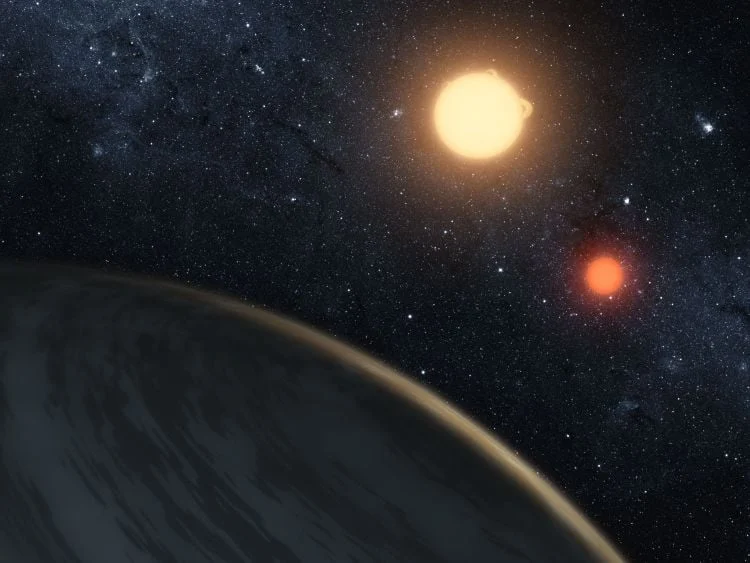
An international collaboration of astronomers has announced the identification of a unique planetary system located approximately 22,800 light-years (7,000 parsecs) from Earth, centered around a Saturn-mass exoplanet designated KMT-2016-BLG-1337Lb. This discovery, detailed in a study published in the Publications of the Astronomical Society of the Pacific, highlights the existence of a gas giant orbiting within a binary star system composed of two M-dwarf stars. The detection was made possible through the use of gravitational microlensing, a sophisticated observational technique that allows researchers to probe distant stellar environments that are often inaccessible to more conventional planet-hunting methods such as transit photometry or radial velocity measurements.
The system, cataloged as KMT-2016-BLG-1337L, presents a complex celestial architecture. While the presence of planets in binary systems is no longer a novelty in modern astrophysics, the specific configuration of this discovery provides critical insights into the resilience of planetary formation in dynamically unstable environments. Unlike circumbinary planets that orbit both stars simultaneously—often referred to as "Tatooine-like" worlds—the data suggests that KMT-2016-BLG-1337Lb likely orbits one of the two stars individually. This "S-type" orbital configuration demonstrates that stable planetary orbits can persist even when subjected to the complex gravitational perturbations of a secondary stellar companion.
The Mechanics of Gravitational Microlensing
The discovery of KMT-2016-BLG-1337Lb relies on the phenomenon of gravitational microlensing, a technique rooted in Albert Einstein’s General Theory of Relativity. Microlensing occurs when a massive foreground object, such as a star or a planet, passes directly in front of a more distant background light source. The gravity of the foreground object acts as a natural lens, warping the surrounding spacetime and magnifying the light from the background star.
Of the more than 6,100 confirmed exoplanets discovered to date, only a small fraction—just over 250—have been identified using microlensing. This is largely because the method requires a near-perfect alignment between two stars at vastly different distances from Earth, an event that is both rare and non-repeating. However, microlensing possesses a distinct advantage over the transit method, which is the primary driver of discoveries from missions like Kepler and TESS. While the transit method requires a planet to cross the face of its host star from our perspective—causing a detectable dip in brightness—microlensing can detect planets at much greater distances and around much dimmer stars, including those in the Galactic Bulge.
In the case of KMT-2016-BLG-1337L, the lensing event was captured by the Korea Microlensing Telescope Network (KMTNet). By analyzing the resulting "light curve"—the graph showing the change in brightness over time—astronomers were able to detect the characteristic "blip" or anomaly caused by the presence of a planet orbiting the lensing star system.
Analysis of the Binary Host Stars
The central host system of KMT-2016-BLG-1337L consists of two M-dwarf stars. M-dwarfs, also known as red dwarfs, are the most common type of star in the Milky Way, characterized by their small size, low mass, and cooler temperatures compared to our Sun. Despite their ubiquity, their low luminosity makes them difficult to study at great distances without the aid of gravitational magnification.
The research team employed various light curve models to determine the physical characteristics of these stars. The consensus across the models indicates that the two stars have masses approximately 0.54 and 0.40 times that of the Sun. They are separated by a distance of roughly 3.5 Astronomical Units (AU), where 1 AU is the distance between the Earth and the Sun. For comparison, this separation is slightly less than the distance between the Sun and the asteroid belt in our own solar system.
The presence of two stars in such proximity creates a challenging environment for planet formation. The gravitational tug-of-war between the binary pair typically truncates the protoplanetary disk, potentially stripping away the material needed to form large planets. The discovery of a Saturn-sized body in this system provides empirical evidence that gas giants can successfully navigate these gravitational hurdles.
Modeling Discrepancies and Planetary Characteristics
While the characteristics of the host stars remained consistent across different mathematical simulations, the specific attributes of the exoplanet KMT-2016-BLG-1337Lb revealed a degree of modeling "degeneracy," a common challenge in microlensing analysis where multiple physical scenarios can explain the same light curve data.
The researchers presented two primary models for the planet:
- The Saturn-Mass Model: The first model suggests the exoplanet has a mass of approximately 0.3 Jupiter masses, which is almost identical to the mass of Saturn. In this scenario, the planet orbits at a distance of approximately 4 AU from its host star.
- The Super-Jupiter Model: An alternative model estimates the planet to be significantly larger, at roughly 7 times the mass of Jupiter, with a much closer orbital distance of 1.5 AU.
Despite these differing interpretations, the scientific community leans toward the first model as it aligns more closely with the observed frequency of planets in similar binary systems. If the first model is correct, KMT-2016-BLG-1337Lb represents a "cold Saturn," a gas giant located beyond the "snow line" of its host star—the region where temperatures are low enough for volatile compounds like water, ammonia, and methane to condense into solid ice grains, facilitating the rapid growth of planetary cores.
Comparative Planetology: KMT-2016-BLG-1337L vs. OGLE-2007-BLG-349L
To understand the significance of this discovery, it is essential to compare it to previous microlensing finds, specifically OGLE-2007-BLG-349L. Published in 2016, the OGLE discovery was the first confirmed Saturn-mass planet in a binary system found via microlensing.
The primary distinction between the two systems lies in their orbital dynamics. OGLE-2007-BLG-349L is a circumbinary planet, meaning it orbits around the outside of both stars as if they were a single gravitational center. In contrast, KMT-2016-BLG-1337Lb is believed to orbit only one of the stars in the binary pair. This distinction is vital for theorists studying planetary migration. It suggests that even in a binary system where a second star is relatively close (3.5 AU), a planet can maintain a stable, independent relationship with its primary sun without being ejected from the system or being pulled into a circumbinary orbit.
Scientific Implications and Future Research
The study of KMT-2016-BLG-1337L underscores the evolving capability of microlensing to expand the census of planets in "dynamically complex" environments. Most of our current knowledge of exoplanets comes from single-star systems, yet the majority of stars in the galaxy exist in binary or multiple-star configurations. To build a truly comprehensive understanding of how planets form and evolve, astronomers must account for these more common, yet more difficult to study, stellar arrangements.
The researchers noted in their publication that this event demonstrates how microlensing can reveal planets that are otherwise "inaccessible to conventional detection techniques." Because microlensing does not depend on the light from the host star, it is uniquely suited to finding planets around the dim M-dwarfs that dominate the galactic population.
Looking forward, the upcoming Nancy Grace Roman Space Telescope, scheduled for launch in the mid-2020s, is expected to revolutionize this field. The Roman Telescope will conduct a massive microlensing survey of the Galactic Bulge, potentially discovering thousands of new exoplanets, including those with masses as small as Mars. Systems like KMT-2016-BLG-1337L serve as essential case studies that help refine the algorithms and modeling techniques that will be used to process the deluge of data from future space-based observatories.
Conclusion
The discovery of KMT-2016-BLG-1337Lb is a testament to the precision of modern astronomical modeling and the international cooperation required to monitor the sky for rare lensing events. By identifying a Saturn-sized world 22,800 light-years away, orbiting within a binary M-dwarf system, scientists have added a crucial piece to the puzzle of planetary diversity.
This system serves as a reminder that the "Star Wars" vision of multiple suns in the sky is not merely a cinematic trope but a widespread reality in our galaxy. While the human exploration of such distant worlds remains a prospect for the distant future, the data gathered today from events like KMT-2016-BLG-1337L allows us to map the architecture of the cosmos with unprecedented detail. As the search for exoplanets continues, each discovery brings the scientific community closer to understanding the conditions necessary for the formation of worlds, moons, and potentially, the life that might one day call them home.