Sisilia Frederika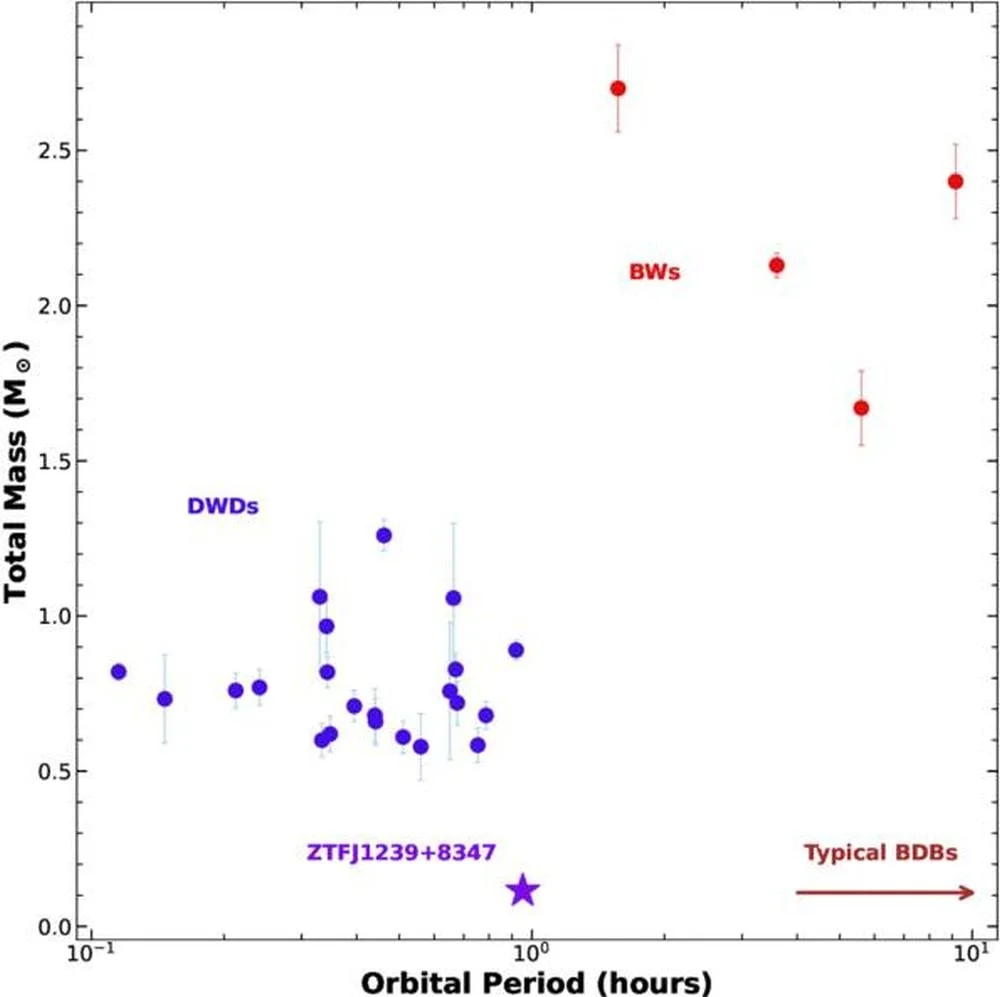
The Nature of the Cosmic In-Between: Understanding Brown Dwarfs
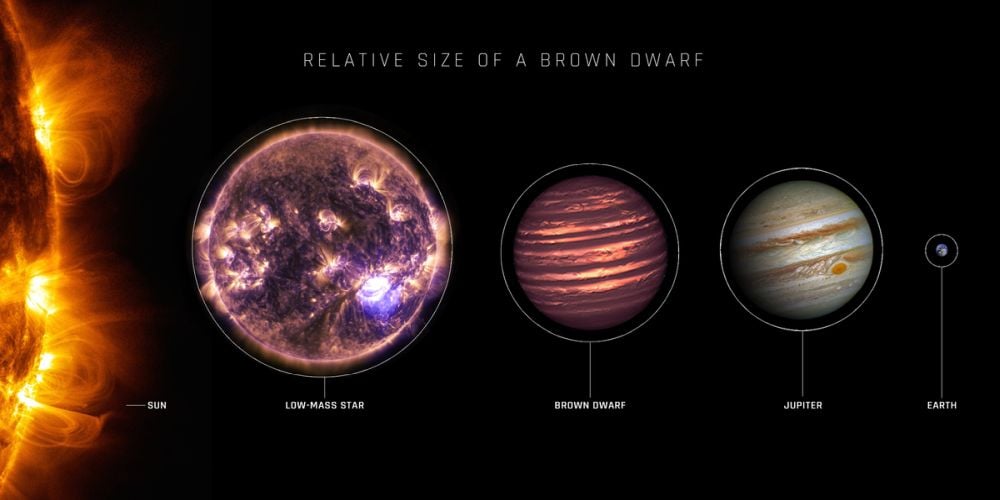
To appreciate the significance of ZTF J1239+8347, one must first understand the unique classification of brown dwarfs. These objects occupy a "no man’s land" in the hierarchy of the universe, bridging the gap between the most massive gas giant planets, like Jupiter, and the smallest main-sequence stars, known as red dwarfs. Typically possessing masses between 13 and 80 times that of Jupiter, brown dwarfs are often referred to as "failed stars" because they lack the necessary gravitational pressure and internal temperature to trigger the sustained thermonuclear fusion of hydrogen—the process that powers the Sun and other stars.
Instead of hydrogen fusion, young brown dwarfs briefly undergo deuterium fusion, which provides a faint glow and a modicum of heat. However, once their limited supply of deuterium is exhausted, they begin a long, slow process of cooling and fading. Because they are so dim, they are notoriously difficult to detect; yet, current estimates suggest the Milky Way could be home to as many as 100 billion of these substellar objects. Like their more massive stellar counterparts, many brown dwarfs exist in binary pairs, but the discovery of mass transfer between two such objects marks a historic first in observational astronomy.
The Discovery of ZTF J1239+8347
The binary system was identified through the Zwicky Transient Facility (ZTF), a wide-field sky survey based at the Palomar Observatory. ZTF is designed to detect objects that change in brightness over short periods, making it the ideal tool for spotting the rapid orbital signatures of close-proximity binaries. Upon analyzing the data, the research team, which included prominent Caltech astrophysicist Thomas Prince, noted a peculiar light curve coming from a source approximately 1,000 light-years away in the northern sky.
Further observations conducted with NASA’s Swift Observatory and various ground-based facilities confirmed the extraordinary nature of the system. The two brown dwarfs orbit one another at a staggering speed, completing a full revolution every 57.41 minutes. This extremely tight orbit is indicative of a "compact binary," where the proximity of the two objects allows gravity to reshape their evolution.
The Mechanics of Substellar Mass Transfer
In binary systems, mass transfer occurs when the outer layers of one star are pulled away by the gravitational influence of its companion. This process is common in systems involving white dwarfs, neutron stars, or black holes, where the high density of the primary object creates a powerful gravitational well. In the case of ZTF J1239+8347, the "accretor" (the denser brown dwarf) is siphoning material from the "donor" (the less dense companion).
This phenomenon is governed by a region of space known as the Roche lobe. When the donor brown dwarf expands or the orbit shrinks to the point where the donor’s atmosphere overflows its Roche lobe, matter begins to stream toward the accretor. Whitebook described the process as matter "sloughing off through a nozzle," as gravity overcomes the donor’s internal cohesion.

The researchers identified a distinct "hot spot" on the surface of the accretor. This feature is created by the kinetic energy of the infalling matter slamming into the atmosphere of the receiving brown dwarf. As the pair orbits their common center of mass, this hot spot moves relative to our line of sight, creating a periodic variation in the system’s total luminosity that allowed the team to confirm the mass-transfer process.
Scientific Skepticism and the Rigor of Verification
The discovery was so unexpected that it met with initial skepticism within the astrophysical community. "These are very exotic objects," noted co-author Thomas Prince. "We’ve told some of our colleagues about them, and they didn’t believe such a thing exists." The skepticism stems from the fact that brown dwarfs have relatively low gravity, and maintaining a stable, detectable mass-transfer stream over such a short orbital period requires a very specific set of physical parameters.
To ensure the accuracy of their findings, the Caltech team systematically ruled out alternative explanations. One possibility was that the system contained a neutron star—a much denser and more massive object. However, a neutron star would generate intense X-ray emissions as it consumed matter, which were notably absent in the Swift Observatory data.
The team also considered whether the system might be a cataclysmic variable (CV), which typically involves a white dwarf accreting matter from a secondary star. While the light curves of CVs can look similar, the optical spectra of ZTF J1239+8347 did not show the characteristic signatures of a white dwarf. Furthermore, the positioning and behavior of the hot spot were inconsistent with an irradiated substellar object orbiting a white dwarf. After exhaustive modeling, the team concluded that a binary brown dwarf system was the only configuration that fit all the observational evidence.
The "Second Chance" at Stellar Life
One of the most compelling aspects of the ZTF J1239+8347 discovery is the potential future of the two objects. Because they are transferring mass, their individual and collective destinies have been fundamentally altered. The researchers have proposed two primary scenarios for the evolution of this system:
- Stellar Transformation through Accretion: As the accretor continues to pull mass from its companion, it may eventually surpass the critical threshold of approximately 80 Jupiter masses. If this occurs, the internal pressure will become great enough to ignite hydrogen fusion. In this scenario, the "failed star" would effectively be "reborn" as a true main-sequence red dwarf.
- The Merger Scenario: The two objects may eventually spiral inward and merge into a single entity. The combined mass of the two brown dwarfs would likely exceed the hydrogen-fusion limit, resulting in a single, more massive, and significantly more luminous main-sequence star.
"The failed stars get a second chance," Whitebook stated. This dynamic demonstrates that even objects without internal nuclear engines can engage in complex physics that leads to significant evolutionary changes.
Broader Astrophysical Implications
The identification of ZTF J1239+8347 serves as a vital "test case" for the physics of mass transfer at the lowest detectable mass scales. While mass transfer is well-studied in massive stars and compact objects, observing it in the substellar regime provides new data on how gas behaves in lower-gravity environments. It also offers insights into the "period minimum" of binary systems—the shortest possible orbital period a binary can reach before the physics of the objects involved forces a change in the system’s structure.
Furthermore, this discovery suggests that the census of the Milky Way’s brown dwarf population may be incomplete. If mass-transferring binaries are possible, there may be many more such systems hidden in our galaxy, currently too dim for our current generation of telescopes to see clearly.
Future Observations and the Role of Next-Generation Telescopes
While the ZTF discovery is a major milestone, much remains to be learned about ZTF J1239+8347. The research team has highlighted the James Webb Space Telescope (JWST) as the logical next step for study. With its high-resolution infrared capabilities, the JWST could peer through the dust and gas surrounding the system to provide more accurate measurements of the temperatures of both the donor and the accretor. It could also provide a more precise mass ratio for the pair, which is essential for predicting whether the system will result in a merger or a stable transformation.
Looking further ahead, the Vera C. Rubin Observatory, currently under construction in Chile, is expected to revolutionize this field. Equipped with an 8.4-meter telescope and a 3,200-megapixel camera, the Rubin Observatory will conduct the Legacy Survey of Space and Time (LSST), a ten-year mission to map the entire available sky.
"We expect the Vera Rubin Observatory to detect dozens more of these objects," Whitebook predicted. "We want to find more to understand the population and how common it is. We predict this happens more than you think."
Conclusion
The discovery of ZTF J1239+8347 marks a shift in our perception of brown dwarfs from static, cooling remnants to dynamic participants in the stellar lifecycle. By proving that mass transfer can occur even at the substellar level, Whitebook and his colleagues have opened a new frontier in binary research. As next-generation observatories come online, the study of these "failed stars" and their second chances at brilliance will likely provide deeper insights into the diverse and often surprising ways that matter organizes itself across the cosmos. This 57-minute orbit is not just a celestial curiosity; it is a window into the hidden mechanics of the billions of dim objects that populate our galaxy.