Sisilia Frederika
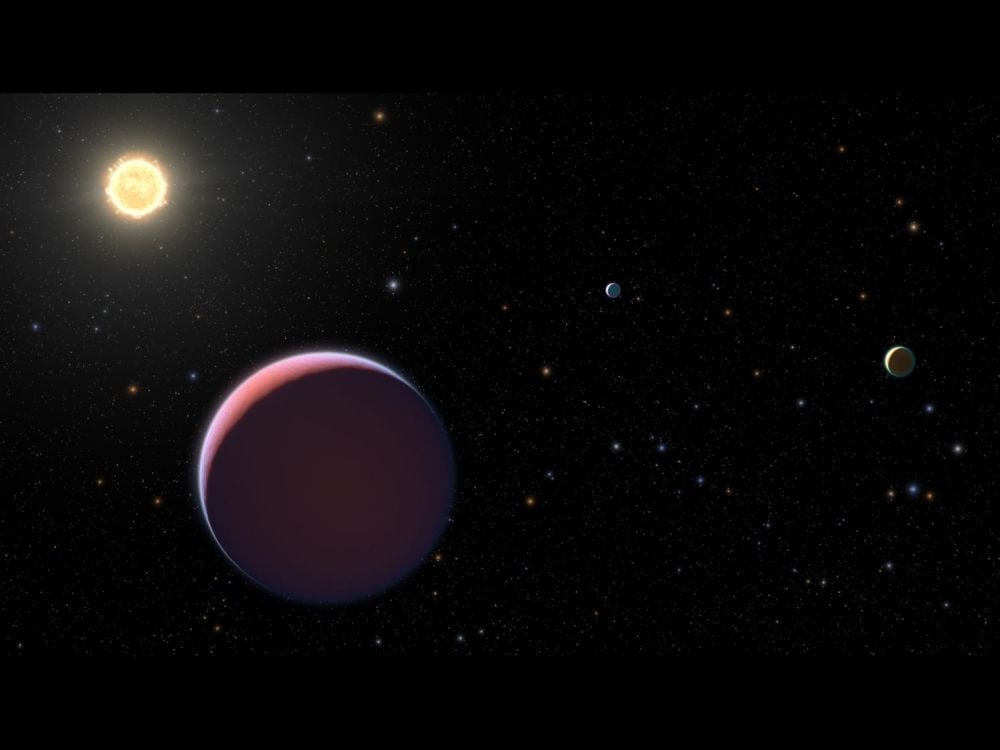
The discovery of exoplanets over the last three decades has fundamentally reshaped our understanding of the cosmos, revealing a gallery of worlds that often bear little resemblance to the eight planets orbiting our Sun. Among the most enigmatic of these findings are the "super-puffs"—a rare class of exoplanets characterized by radii comparable to gas giants like Jupiter or Neptune but possessing masses only a few times that of Earth. These worlds have densities so low they are frequently compared to cotton candy.
Recent research published in The Astronomical Journal has utilized the advanced capabilities of the James Webb Space Telescope (JWST) to peer into the atmosphere of one of the most prominent examples of this class: Kepler-51d. Led by Jessica Libby-Roberts of Pennsylvania State University’s Department of Astronomy & Astrophysics, the study aims to decode the physical processes that allow such a low-density world to exist so close to its parent star.
The Kepler-51 System: A Laboratory of Extremes
Located approximately 2,620 light-years from Earth, the Kepler-51 system is a youthful arrangement centered around a Sun-like star. At roughly 500 million years old, the star is in its energetic adolescence—a period characterized by higher magnetic activity and stronger stellar winds compared to the middle-aged Sun.
The system gained international attention when NASA’s Kepler mission identified three planets orbiting the star: Kepler-51b, 51c, and 51d. All three were identified as super-puffs, but Kepler-51d stands out as the most extreme of the trio. It is the coolest of the three and possesses the lowest density. With a radius approximately 9.3 times that of Earth and a mass of only 5.6 Earth masses, Kepler-51d presents a geometric and gravitational paradox. For comparison, Neptune has a similar radius but is more than 17 times as massive as Earth.
The existence of three such "oddballs" in a single system challenges the conventional core accretion model of planet formation. According to standard theories, a planet must reach a critical core mass (roughly 10 Earth masses) to trigger the rapid runaway accretion of hydrogen and helium gas from the protoplanetary disk. Kepler-51d, with its tiny core and massive envelope, suggests that either the timing of its formation or the environment of its birth disk deviated significantly from the norm.
Analyzing the JWST NIRSpec-PRISM Data
To investigate the composition of Kepler-51d, Libby-Roberts and her team utilized the JWST’s Near-Infrared Spectrograph (NIRSpec) with the PRISM configuration. This instrument allows astronomers to observe "transmission spectra"—the light from a parent star that filters through a planet’s atmosphere as it transits in front of the stellar disk.
Because different molecules absorb light at specific, predictable wavelengths, a transmission spectrum usually acts as a chemical "fingerprint." Astronomers expected to find signatures of water (H2O), methane (CH4), carbon dioxide (CO2), and ammonia (NH3), especially given the planet’s equilibrium temperature of approximately 350 Kelvin (77 degrees Celsius).
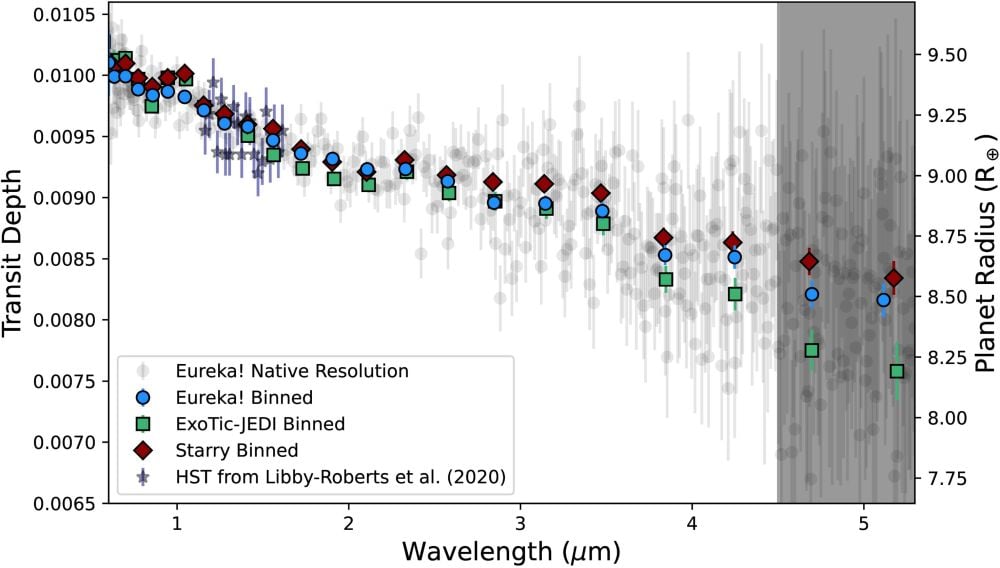
However, the results returned by the JWST were startling: the spectrum was essentially featureless. Instead of the jagged peaks and valleys representing molecular absorption, the data showed a smooth, unremarkable slope spanning the 0.6 to 5.3 μm range.
"At 350 K, we expect to observe a rich assortment of molecular features," the researchers noted in the study. "Instead, the lack of any clear detectable features in an extended H/He-rich atmosphere… is a first for JWST." This featureless spectrum indicates that something is obscuring the deeper layers of the atmosphere, preventing the telescope from "seeing" the chemical composition of the air below.
Testing the Three Leading Hypotheses
The research team evaluated three primary scientific hypotheses to explain the observations of Kepler-51d and the nature of super-puffs in general.
1. Massive Hydrogen/Helium Envelopes
The first possibility is that the planet simply consists of an incredibly large, pristine envelope of hydrogen and helium gas surrounding a small rocky core. While this would explain the low density, it creates a stability problem. Light gases like hydrogen are easily stripped away by stellar radiation, particularly when a planet is as close to its star as Kepler-51d (which orbits at a distance similar to Venus’s orbit around the Sun).
This phenomenon is related to the "Fulton Gap," a observed trend where exoplanets seem to fall into two distinct size categories: small rocky "Super-Earths" and larger "Sub-Neptunes," with very few planets existing in between. Super-puffs like Kepler-51d are thought to be in a transient state, rapidly losing their atmospheres. However, the JWST data’s lack of molecular signatures makes it difficult to confirm this model without accounting for an obscuring layer.
2. High-Altitude Photochemical Hazes
The second, and currently most favored, hypothesis is that Kepler-51d is shrouded in a thick layer of high-altitude photochemical hazes. These hazes are formed when ultraviolet (UV) light from the parent star breaks down methane and other hydrocarbons in the upper atmosphere, creating complex organic soot-like particles called tholins.
This process is famously observed on Saturn’s moon, Titan. On Kepler-51d, these hazes would act as a global "smog" that blocks light across the infrared spectrum, effectively masking the absorption lines of water and carbon dioxide. The JWST’s observation of a linear slope in the spectrum is consistent with the presence of sub-micron-sized haze particles.
"It seems very similar to the haze we see on Saturn’s largest moon Titan," said study co-author Suvrath Mahadevan, a professor at Penn State. "Kepler-51d seems to have a huge amount of haze—almost the radius of Earth—which would be one of the largest we’ve seen on a planet yet."
3. Tilted Ring Systems
The third hypothesis suggests that Kepler-51d might not be as large as it appears. If the planet possessed a vast system of rings—similar to Saturn’s but tilted at an angle toward Earth—the rings would block additional starlight during a transit. This would lead astronomers to overestimate the planet’s radius, thereby underestimating its density.
While a ring system could theoretically fit the transit data, the researchers found several flaws in this explanation for Kepler-51d. First, the planet is so close to its star that the gravitational and thermal environment would make a ring system highly unstable. Rings composed of ice or dust would likely be dissipated within 100,000 years. Given that the system is 500 million years old, the odds of catching the planet during such a short-lived phase are statistically low. Furthermore, rings would block light uniformly across wavelengths, whereas the JWST data showed a specific wavelength-dependent slope that favors the haze model.
Chronology of Discovery and Context
The investigation into Kepler-51d is the culmination of over a decade of astronomical observation.
- 2012–2014: NASA’s Kepler space telescope identifies transits in the Kepler-51 system. Initial data suggests unusually large radii for planets with relatively low gravitational influence on their star.
- 2014: The system is confirmed, and the term "super-puff" begins to gain traction in the scientific community to describe these low-density anomalies.
- 2019: Observations using the Hubble Space Telescope provide the first hints of "muted" spectra, suggesting that clouds or hazes might be present, but Hubble’s infrared range was too limited to be definitive.
- 2023–2024: The JWST utilizes its NIRSpec instrument to provide the most detailed look yet at Kepler-51d, confirming the featureless nature of its spectrum and providing a more precise mass and radius estimate.
Broader Implications for Planetary Formation
The existence of the Kepler-51 super-puffs challenges the "standard model" of how solar systems form. In our Solar System, the transition from small, rocky planets to massive gas giants is distinct. The super-puffs suggest a middle ground—or perhaps a different evolutionary path entirely.
One theory explored by the researchers is that these planets formed much further out in the cold regions of their protoplanetary disk, where ices were abundant and gas was easier to capture. After reaching their current size, they may have migrated inward to their current positions. Because the system is young, we may be observing these planets before they have time to shrink. As the active young star continues to blast the planets with radiation, Kepler-51d is expected to lose its puffy envelope over the next billion years, eventually shrinking into a more conventional "Sub-Neptune" or even a "Super-Earth."
Future Outlook
The research team emphasizes that while the haze hypothesis is the strongest, it is not yet a closed case. The next logical step involves using the JWST’s Mid-Infrared Instrument (MIRI). Observations at longer wavelengths might be able to "peer through" the haze layers that NIRSpec could not penetrate.
"If we could observe the planet at even longer wavelengths… we might be able to detect the materials that would be in a ring or see the full extent of the haze layer," Libby-Roberts stated.
The study of Kepler-51d is more than just an investigation into a single "oddball" planet; it is a vital piece of the puzzle in understanding the diversity of planetary systems in the Milky Way. By pushing the boundaries of what is physically possible according to current models, super-puffs like Kepler-51d force astronomers to refine their understanding of how the universe builds worlds, providing a broader context for the unique—or perhaps common—nature of our own Solar System.