Sisilia Frederika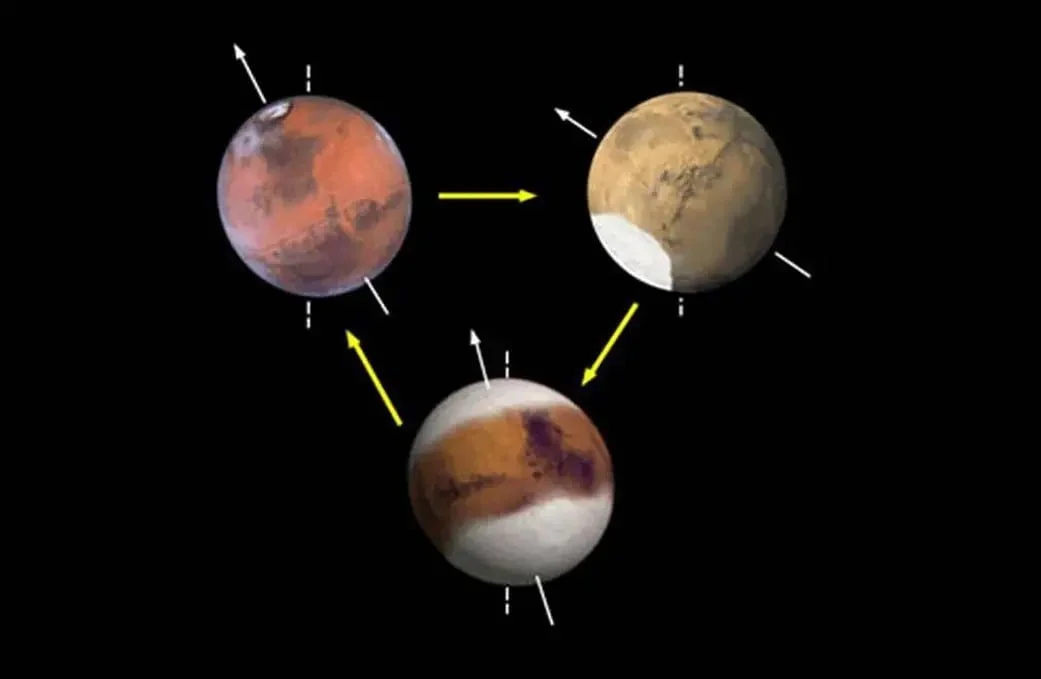
Recent spectroscopic analysis and climate modeling conducted by researchers at the University of Washington’s Applied Physics Laboratory have fundamentally challenged long-held assumptions regarding the composition of the Martian north polar ice cap. The study, published in the journal npj Space Exploration, indicates that the upper layers of the planet’s northern water ice reservoir contain significantly less dust than previously estimated. While prior scientific consensus suggested a dust-to-ice ratio of approximately 25 percent by mass, the new findings suggest a much cleaner composition, with dust accounting for only about 3 percent of the total mass. This discovery carries profound implications for our understanding of the Martian climate history, the behavior of its polar regions, and the feasibility of utilizing these ice reserves for future crewed missions to the Red Planet.
The north polar ice cap of Mars, known scientifically as the North Polar Layered Deposits (NPLD), is a massive structure composed primarily of water ice and dust. Spanning roughly 1,000 kilometers in diameter and reaching thicknesses of up to 3 kilometers, it serves as a critical atmospheric regulator and a chronological record of the planet’s environmental shifts. For decades, the specific ratio of ice to dust within these layers has been a subject of intense debate. Dust plays a pivotal role in the thermodynamics of the ice cap; its presence affects the albedo, or reflectivity, of the surface, which in turn dictates how much solar radiation is absorbed and how quickly the ice sublimes into the thin Martian atmosphere.
A Shift in Compositional Modeling
The discrepancy between the old 25 percent estimate and the new 3 percent figure stems from a refined approach to analyzing orbital data and surface measurements. Previous models often relied on broader generalizations of how dust settles across the Martian surface following the planet’s frequent global dust storms. These models suggested that the north polar cap acted as a primary "sink" for atmospheric particulates, leading to a heavily contaminated ice structure. However, Dr. Aditya Khuller, a senior research scientist at the University of Washington and co-author of the study, suggests that the reality is more nuanced, involving a complex interplay of seasonal cycles and vertical layering.
By synthesizing data from multiple orbital and landed assets, the research team was able to distinguish between transient surface frost and the more permanent ice beneath. The study utilized data from the Observatoire pour la Minéralogie, l’Eau, les Glaces et l’Activité (OMEGA) spectrometer aboard the European Space Agency’s Mars Express, as well as the Compact Reconnaissance Imaging Spectrometer for Mars (CRISM) on NASA’s Mars Reconnaissance Orbiter. Additionally, the team integrated ground-truth data from the Surface Stereo Imager (SSI) on the Mars Phoenix Lander, which touched down in the northern plains in 2008.
The researchers discovered that the "dusty" appearance of the ice in certain observations was largely due to a thin, seasonal veneer of frost. During the Martian winter, a mixture of water and carbon dioxide ice forms a layer that traps atmospheric dust. However, as the northern hemisphere transitions into summer, this seasonal frost sublimes, exposing the older, significantly cleaner water ice beneath. This "cleansing" cycle explains why previous measurements, if taken during specific seasonal windows or without high-resolution spectral differentiation, might have over-calculated the total dust volume within the bulk of the ice cap.
Technical Methodology and Terrestrial Analogies
To arrive at the 3 percent estimate, the team employed modeling techniques frequently used in terrestrial glaciology. On Earth, scientists study the purity of ice sheets in Greenland and Antarctica to track industrial pollutants and volcanic activity through history. By applying similar radiative transfer models—which simulate how light interacts with mixtures of ice and particulates—the researchers could better interpret the spectral signatures returned by Martian orbiters.
The study also accounted for the physical properties of Martian dust, which is rich in iron oxides and magnetite. These minerals have distinct signatures in the infrared and visible light spectrums. By comparing the observed brightness and color of the Martian ice over several seasonal cycles with laboratory-derived data on ice-dust mixtures, the team concluded that a 25 percent dust concentration would result in a surface far darker and more thermally absorbent than what is actually observed. A 3 percent concentration aligns more accurately with the observed albedo and the rate at which the ice cap retreats and advances.
Chronology of Martian Polar Observations
The understanding of Martian poles has evolved significantly over the last half-century. In the 1970s, the Viking orbiters provided the first high-resolution images of the spiral troughs and layered terrain of the NPLD, confirming that the north pole was a permanent reservoir of water ice. In the 1990s and early 2000s, the Mars Global Surveyor and Mars Odyssey missions began mapping the hydrogen distribution and topographical elevation of the caps.
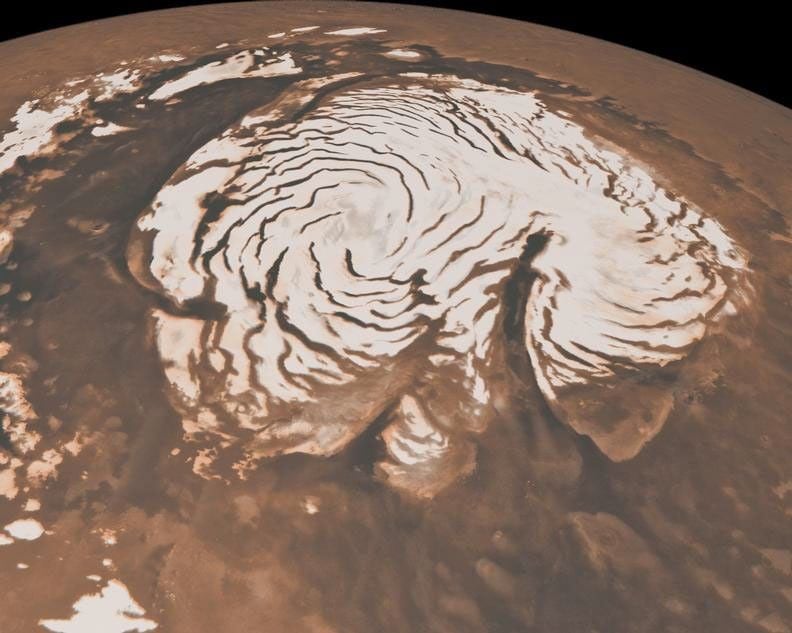
The arrival of the Mars Reconnaissance Orbiter (MRO) in 2006 marked a turning point. Its Shallow Radar (SHARAD) instrument allowed scientists to peer through the ice, revealing internal layering that resembles the rings of a tree. Each layer represents a different epoch in Martian history, influenced by changes in the planet’s orbit and tilt. The 2008 Phoenix mission provided the first direct chemical analysis of the northern soil and ice, confirming the presence of perchlorates and water ice just centimeters below the surface. The current study represents the latest chapter in this chronology, moving from identifying the presence of ice to precisely defining its purity.
The Role of Axial Obliquity and Climate Shifts
The broader context of this research lies in the dramatic climate oscillations Mars experiences due to its lack of a large, stabilizing moon. Earth’s axial tilt, or obliquity, is held relatively steady between 22.1 and 24.5 degrees by the gravitational influence of the Moon. This stability provides Earth with predictable, moderate seasonal cycles over tens of thousands of years.
In contrast, Mars is subject to "whacky" climate shifts. Its tilt can swing violently between 15 and 35 degrees (and potentially as high as 60 degrees over millions of years) on cycles ranging from 100,000 to 1,000,000 years. These shifts fundamentally redistribute where solar energy hits the planet.
During periods of low obliquity (15 degrees), the poles receive very little sunlight even in summer. This causes the polar caps to expand aggressively toward the equator, locking up vast amounts of water and atmospheric carbon dioxide as ice. Conversely, during periods of high obliquity (35 degrees or more), the poles are tilted more directly toward the Sun. This leads to massive sublimation, where the ice caps may partially or entirely disappear, releasing water vapor and dust into the atmosphere. This material eventually settles back down, creating the distinct layers observed today. The finding that the current ice is only 3 percent dust suggests that the most recent "deposition" period was one of relatively low atmospheric dust activity or that the processes of ice accumulation were much more rapid than previously theorized.
Implications for Future Human Exploration
The purity of Martian ice is not merely a matter of academic interest; it is a critical factor for the future of human spaceflight. NASA’s "Moon to Mars" architecture and various private sector plans rely heavily on In-Situ Resource Utilization (ISRU). To sustain a long-term human presence, astronauts will need to harvest water for drinking, oxygen production, and, most importantly, for synthesizing methane and liquid oxygen rocket propellant.
If the Martian north polar ice contained 25 percent dust, the mechanical and chemical systems required to process that ice would need to be extremely robust. Large amounts of silt and mineral particulates can clog filtration systems, abrade mechanical pumps, and contaminate chemical reactors. A reduction in estimated dust content to 3 percent significantly lowers the engineering hurdle for ISRU technology. Cleaner ice means less energy spent on purification and a lower risk of equipment failure, potentially making the northern latitudes a more attractive landing site for early permanent outposts despite the harsh winter conditions.
Scientific Community Reactions and Future Research
While the study has been met with interest, some members of the planetary science community emphasize the need for further localized verification. "These findings provide a compelling case for a cleaner Martian cryosphere, but we must remember that the north pole is a vast and diverse region," noted a representative from the Jet Propulsion Laboratory (JPL) in a summary of recent Martian findings. "The dust content may vary significantly between the spiral troughs and the central plateaus."
The next steps for researchers involve applying these new calculations to the southern polar cap, which is more complex due to its permanent "cold trap" of carbon dioxide ice (dry ice) overlying the water ice. Additionally, future missions, such as the proposed International Mars Ice Mapper, aim to use high-frequency radar to map the purity and accessibility of subsurface ice across the mid-latitudes, where human missions are more likely to land due to milder temperatures.
The revelation that Mars’ north pole is cleaner than previously thought offers a clearer window into the planet’s past. It suggests that the "Red Planet" has periods of relative atmospheric clarity and that its ice caps are more resilient reservoirs of water than once believed. As researchers continue to refine their models, each percentage point of dust removed from the equation brings the possibility of human habitation on Mars one step closer to reality. In the words of the research team, understanding these layers is essential to "piecing together the grand puzzle of Martian history," ensuring that when humans finally set foot on the northern wastes, they will know exactly what lies beneath their boots.