Sisilia Frederika
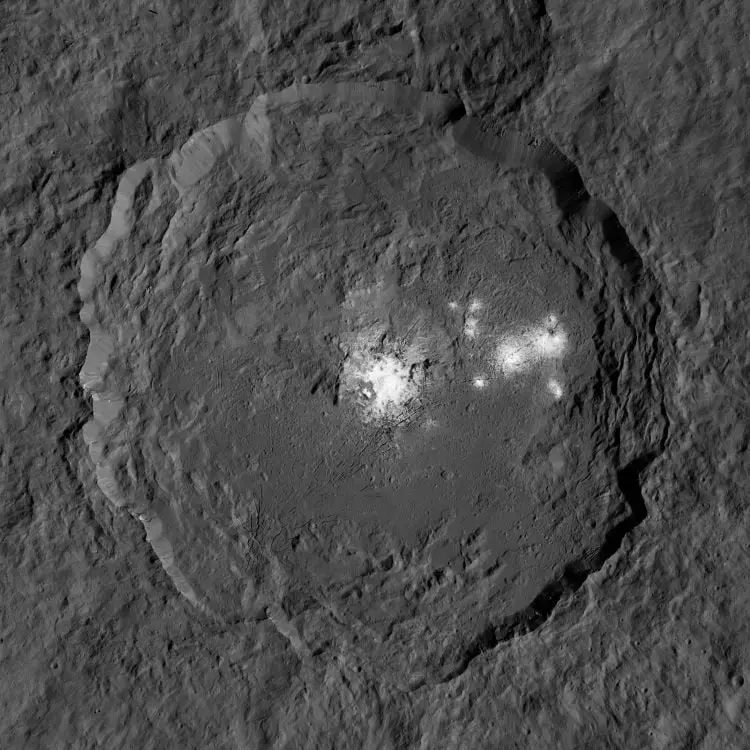
The dwarf planet Ceres, the largest object in the main asteroid belt between Mars and Jupiter, has long occupied a unique and somewhat paradoxical position in planetary science. Despite sharing the "dwarf planet" classification with the more famous Pluto, Ceres is frequently relegated to the status of a mere asteroid due to its location within the debris-strewn belt. However, recent findings from the California Institute of Technology (Caltech) published in the Journal of Geophysical Research: Planets (JGR: Planets) suggest that this overlooked world possesses a geological complexity that rivals its more distant planetary cousins. The study reveals that the salt deposits on the surface of Ceres, which appear as enigmatic "bright spots," may be 30 to 50 percent more abundant than previous data from NASA’s Dawn spacecraft suggested. This discovery not only reshapes our understanding of Ceres’ chemical composition but also provides a new lens through which to view the evolution of icy bodies across the solar system.
The Geologic Giant of the Asteroid Belt
Ceres was discovered in 1801 by Giuseppe Piazzi and was initially classified as a planet, then an asteroid, and finally a dwarf planet in 2006. With a diameter of approximately 940 kilometers (580 miles), it is the only dwarf planet located in the inner solar system. While it is often grouped with asteroids, its physical characteristics tell a different story. Ceres accounts for roughly 25 to 30 percent of the total mass of the entire asteroid belt. Unlike its irregularly shaped neighbors, Ceres is a differentiated body, meaning its interior is layered with a rocky core, an icy mantle, and a thin, dusty crust.
The presence of "bright spots"—highly reflective regions primarily located in the Occator Crater—has been the subject of intense scientific debate since they were first captured in high resolution by NASA’s Dawn mission. These spots, composed largely of sodium carbonates and ammonium chloride, are the tell-tale signs of cryovolcanism, a process where slushy brines from a subsurface reservoir erupt onto the surface. Once the water component of these brines evaporates into the vacuum of space, the salts remain behind, creating high-albedo patches that stand out against the dark, carbon-rich surface of the dwarf planet.
Chronology of Discovery: From Piazzi to Dawn
The scientific trajectory of Ceres has moved from telescopic observation to direct orbital exploration. The most significant leap in our understanding occurred during the NASA Dawn mission, which arrived at Ceres in 2015 after a multi-year stay at the asteroid Vesta.
- 1801: Ceres is discovered and named after the Roman goddess of agriculture.
- 2006: The International Astronomical Union (IAU) reclassifies Ceres as a dwarf planet.
- 2007: NASA launches the Dawn spacecraft, the first mission to orbit two distinct extraterrestrial targets.
- 2015: Dawn enters orbit around Ceres, identifying the famous "bright spots" in Occator Crater.
- 2018: The Dawn mission concludes as the spacecraft runs out of hydrazine fuel, leaving it in a stable graveyard orbit around the dwarf planet.
- 2024: Caltech researchers publish a new analysis in JGR: Planets, indicating that previous interpretations of Dawn’s data may have significantly underestimated the volume of salt on the surface.
The Sublimation Paradox and New Quantitative Findings
The primary challenge in studying Ceres lies in the "optical surface"—the very top layer of the crust that instruments can "see." The Caltech study, led by researchers using a combination of Dawn’s historical data and advanced computer modeling, addressed a longstanding knowledge gap: why the observed amount of surface water ice and salt did not always align with the expected geological behavior of the planet.
The researchers focused on the process of sublimation, where water ice transitions directly into gas without passing through a liquid state. On Ceres, which lacks a substantial atmosphere, sublimation is a constant force. The study found that salt deposits are often intricately mixed with water ice. As the ice sublimates, it leaves behind a concentrated layer of salt. However, this salt can often mask the true extent of the deposits below.
According to the research team, the salt deposits on Ceres are likely 30 to 50 percent more prevalent than earlier estimates. This discrepancy arises because the salt-rich regions are not static; they are the result of a feedback loop. Salt within a water-ice mixture causes the ice to sublimate more rapidly. As the ice vanishes, the salt content at the optical surface increases, making the region appear "salt-rich" when, in reality, it started as a salt-poor ice mixture.
The Role of Mass Wasting and Surface Evolution
A critical component of the Caltech findings is the role of "mass wasting," or landslides. The surface of Ceres is not a stagnant environment. Impact events and internal tectonic stresses cause the movement of material down slopes and crater walls. These landslides expose "fresh" water ice that was previously buried beneath the insulating regolith.
Once exposed to the sun’s rays, this fresh ice begins the sublimation process. The researchers noted that many of the ice deposits observed by Dawn were likely recently exposed by such landslides. This explains why ice is still visible on the surface despite its "geologically negligible lifetime"—meaning that, without a replenishment mechanism, the ice should have evaporated millions of years ago.
The study proposes a qualitative model of long-term surface evolution akin to "thermal segregation" seen on the icy moons of Jupiter and Saturn. In this model, ice moves from warmer, salt-rich regions to colder areas, creating a distinct compositional map of the surface. This sorting process resolves the "paradox" of how salt-rich deposits arise; they are not necessarily born salt-rich but are enriched over time as the water component is stripped away by the harsh environment of space.
Supporting Data and Chemical Analysis
The chemical signatures identified by the Dawn mission’s Visible and Infrared Mapping Spectrometer (VIR) were essential to this new analysis. The salts on Ceres are primarily sodium carbonates, which on Earth are often found in evaporated lake beds. The presence of these salts, along with hydrohalite (a hydrated form of sodium chloride), suggests that the brines originated from a deep, salty ocean or a series of localized melt chambers.
The Caltech researchers utilized these spectral signatures to model how the ratio of ice to salt changes over thousands of years. Their findings suggest that the "bright spots" are essentially the skeletons of former brine flows. By accounting for the hidden salt buried just beneath the visible surface or mixed within the ice, the researchers have provided a more accurate "mass balance" for the dwarf planet’s crust.
Broader Implications for Planetary Science and Future Missions
The implications of this research extend far beyond the asteroid belt. Ceres is increasingly viewed as a "relic ocean world"—a window into the processes that occur on moons like Europa (Jupiter) or Enceladus (Saturn), but without the complicating factor of being in a deep gravity well of a giant planet.
The realization that Ceres is saltier than we thought reinforces the hypothesis that it was once a much more active world, potentially harboring a global subsurface ocean. If the salt content is higher, it suggests that the brine reservoirs were more chemically complex and perhaps more long-lived than previously assumed. This has significant ramifications for the field of astrobiology, as salt-rich environments on Earth are often hotspots for specialized microbial life.
Furthermore, this study serves as a call to action for future exploration. While the Dawn mission provided a wealth of data, its instruments were limited by the technology of the early 2000s and the distance from the surface. A follow-up mission—potentially a lander or a sample-return mission—would be required to confirm the Caltech models and probe the depths of the salt-rich crust.
Conclusion
The findings published in JGR: Planets remind the scientific community that even "well-studied" objects like Ceres still hold significant secrets. By identifying the feedback loop between sublimation and salt enrichment, the Caltech team has resolved a major geological mystery and painted a picture of a dwarf planet that is much more dynamic than its "asteroid" label suggests. As researchers continue to refine their models, Ceres stands as a testament to the complexity of the solar system’s smaller bodies, proving that even a world in the middle of a debris belt can have a history as rich and salty as any planet. For now, Ceres remains a silent, salt-crusted sentinel, waiting for the next generation of spacecraft to uncover the full extent of its hidden treasures.