Sisilia Frederika
The northern polar region of Mars has long served as a primary point of interest for planetary scientists seeking to decode the climatic evolution of the Red Planet. Unlike the southern pole, which is dominated by a thick layer of "dry ice" or solid carbon dioxide, the northern polar ice cap is primarily composed of water ice, making it a closer analog to Earth’s own polar regions. However, despite these similarities, the mechanisms driving seasonal changes within this frozen landscape have remained partially obscured by the complexities of the Martian atmosphere and topography. A recent international study published in the Journal of Geophysical Research: Planets has provided a significant breakthrough in this field, revealing that the accumulation and sublimation of ice within Martian craters are driven more by localized microclimates than by broad, planet-wide atmospheric trends.
The Unique Composition of Martian Polar Caps
To understand the significance of the new findings, one must first look at the fundamental differences between Earth and Mars. Both planets possess polar ice caps, a feature unique among the major celestial bodies of our solar system. On Earth, both the Arctic and Antarctic caps are composed of water ice. On Mars, the situation is more complex. The northern polar cap is a massive reservoir of water ice, stretching approximately 1,000 kilometers across. In contrast, the southern polar cap consists of a permanent core of water ice covered by a layer of carbon dioxide ice that persists year-round.
The disparity between the two poles is largely a function of elevation and atmospheric pressure. The northern hemisphere of Mars sits at a lower average elevation than the southern hemisphere. This difference in altitude affects the boiling and freezing points of volatile substances. Furthermore, the northern water ice cap is one of the most studied regions of the planet because it represents a potential record of Mars’ hydrological history. Scientists believe that by studying how this ice behaves on a seasonal basis, they can extrapolate how the planet’s climate has shifted over millions of years.
Methodology: Two Decades of High-Resolution Observation
The research team, comprised of scientists from multiple international institutions, sought to address a persistent gap in Martian meteorological data: how do specific landforms, such as impact craters, influence the stability and seasonal cycling of ice? To answer this, they utilized one of the most powerful tools currently orbiting another planet: the High Resolution Imaging Science Experiment (HiRISE) camera aboard NASA’s Mars Reconnaissance Orbiter (MRO).
The study spanned an impressive chronological range, analyzing data collected between 2006 and 2025. In the context of Martian timekeeping, this covers Mars Years (MY) 28 through 38. Because a Martian year is nearly twice as long as an Earth year—lasting approximately 668 Martian sols or 687 Earth days—long-term studies are essential to distinguish between temporary weather events and genuine seasonal patterns.
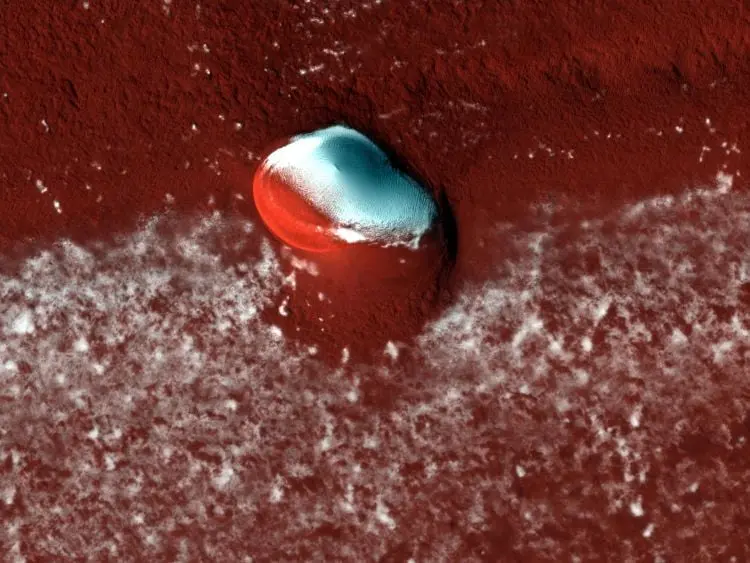
The researchers focused their efforts on 36 specific craters located within the northern polar ice cap region. By comparing high-resolution images of these craters across multiple seasons and years, the team could track the "albedo" or brightness of the crater floors. In planetary science, a sudden increase in brightness typically indicates the deposition of fresh frost or ice, while a decrease suggests sublimation, where the ice turns directly into gas due to rising temperatures.
Key Findings: The Prevalence of Seasonal Change
The results of the analysis provided a clear picture of a dynamic and active polar environment. Out of the 36 craters surveyed, 32 showed definitive evidence of seasonal fluctuations in their ice deposits. During the Martian winter, these craters exhibited an expansion of bright, reflective material across their floors. As the northern hemisphere transitioned into summer, these deposits shrank or thinned, though they did not always disappear entirely.
Interestingly, four of the craters remained static, showing no observable change in brightness or ice extent over the nearly 20-year study period. This discrepancy led the researchers to investigate why some craters react to seasonal shifts while others remain unchanged. The study suggests that the changes observed are not merely a result of the "cap-wide" seasonal cycle but are heavily influenced by the specific geometry of the craters themselves.
The Role of Microclimates and Topography
The most significant conclusion drawn by the research team is that Martian ice dynamics are "localized processes." This means that the climate inside a specific crater can be vastly different from the climate just a few kilometers away. Several factors contribute to this spatial heterogeneity:
- Crater Geometry: The depth and diameter of a crater determine how much sunlight reaches the floor. Deeper craters may create permanent shadows, allowing ice to remain stable even during the peak of summer.
- Thermal Inertia: The materials making up the crater floor—whether fine dust, basaltic sand, or exposed bedrock—absorb and release heat at different rates. This affects how quickly frost can form or sublimate.
- Vapor Transport: Local wind patterns, influenced by the rim of the crater, can trap water vapor inside the depression, leading to higher rates of frost accumulation compared to the surrounding flat plains.
- Slope Aspect: Craters with steep, pole-facing slopes receive significantly less solar radiation than equator-facing slopes, creating a "cold trap" that preserves ice.
The study notes that "seasonal frost cycles and interannual mass balance are localized processes rather than cap-wide phenomena." This insight challenges previous models that assumed the northern polar cap behaved as a single, uniform entity. Instead, the northern pole is a patchwork of thousands of individual microclimates, each responding to the sun in its own unique way.
Implications for Mars’ Climate History
Understanding these localized changes is vital for reconstructing the broader climate history of Mars. Unlike Earth, which has a relatively stable axial tilt (obliquity) thanks to the gravitational influence of the Moon, Mars experiences wild swings in its tilt over millions of years. These swings can range from 0 degrees to as much as 60 degrees.
When Mars’ tilt is high, the poles receive significantly more sunlight, causing the polar caps to sublimate and the water vapor to migrate toward the equator, where it forms massive glaciers. We are currently living in a period of relatively low obliquity (about 25 degrees), where ice is concentrated at the poles. By studying how ice moves today on a small scale—within individual craters—scientists can better model how it moved on a large scale during Mars’ past "ice ages."
Furthermore, the study provides essential data for future human exploration. If humans are to eventually establish a presence on Mars, they will need access to water. The northern polar craters represent some of the most accessible reservoirs of water ice on the planet. Knowing which craters have stable, year-round ice versus those that lose their ice seasonally will be critical for selecting landing sites and resource extraction points.
Analysis of Global Scientific Reactions
While the study was conducted by an international team, its findings have resonated across the global planetary science community. Experts in Martian atmospheric modeling have noted that the "spatial heterogeneity" mentioned in the study explains why previous climate models often struggled to match satellite observations.
"This research highlights the limitations of global circulation models when applied to high-resolution topographical features," said one planetary geologist not involved in the study. "We can no longer treat the Martian poles as flat surfaces. We have to account for the ‘ruggedness’ of the terrain if we want to accurately predict how the Martian atmosphere interacts with the surface."
The longevity of the Mars Reconnaissance Orbiter was also praised. Most space missions are designed to last two to four years. The fact that MRO has provided consistent, high-quality data for nearly two decades allowed this team to observe trends that would have been invisible in a shorter study. This underscores the importance of maintaining long-term "weather stations" in orbit around other planets.
Future Research and the Path Forward
The study opens several new avenues for investigation. The researchers have called for more advanced "modeling work" that can simulate the microclimates identified in the 36 craters. Future missions, such as the proposed international Mars Ice Mapper, could build on this data by using radar to measure the actual thickness of the ice deposits, rather than just their surface brightness.
Additionally, scientists are curious to see if similar localized patterns exist in the southern polar region, despite its different chemical composition. If the "microclimate" theory holds true for the south as well, it would suggest that topography is the dominant driver of volatile cycling across the entire planet.
As we continue to explore Mars, studies like this remind us that the Red Planet is not a dead, static rock. It is a world of shifting frosts, seasonal winds, and complex geological interactions. Each crater tells a story of the planet’s past and provides a clue to its future. By focusing on the small-scale details of the northern polar ice cap, researchers are slowly but surely pieceing together the grand puzzle of Martian climate evolution. The next decade of exploration, fueled by these findings, promises to bring us closer than ever to understanding the life cycle of water on our neighboring world.