Sisilia Frederika

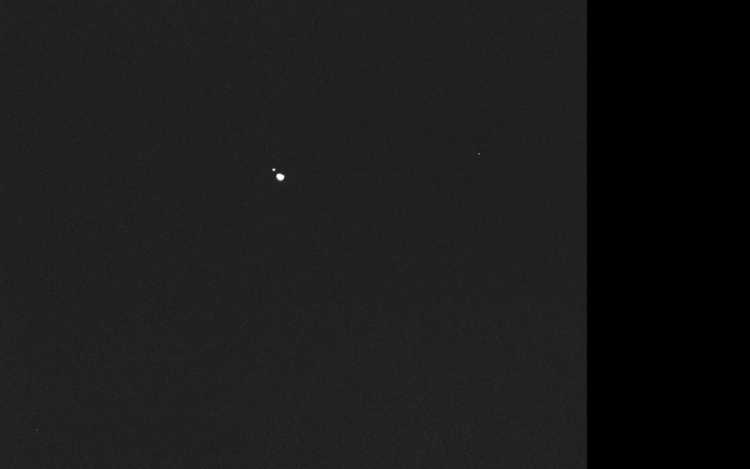
The European Space Agency’s (ESA) Hera spacecraft has successfully transmitted its first images of the Didymos binary asteroid system, marking a critical milestone in the international effort to develop a robust planetary defense strategy. Launched in October 2024, the Hera mission is designed to conduct a "crime scene investigation" of the aftermath left by NASA’s Double Asteroid Redirection Test (DART), which intentionally collided with the smaller of the two asteroids, Dimorphos, in September 2022. The newly released imagery, captured from a distance of approximately 1.28 million kilometers (795,000 miles), confirms that Hera’s optical instruments are functioning as intended, resolving the two asteroids as distinct entities rather than a single point of light. This visual confirmation sets the stage for a high-stakes arrival in late 2026, where Hera will provide the definitive data needed to understand how humanity can protect Earth from potential asteroid impacts.
The First Light: Hera’s Long-Distance Observation
The recent "first light" image represents more than just a technical calibration; it is a symbolic bridge between two of the most ambitious space missions in history. When Hera captured the image, the Didymos system was located nearly 197 million kilometers (122 million miles) from Earth. Despite the vast distance, the spacecraft’s Asteroid Framing Camera (AFC) successfully distinguished the 780-meter-wide Didymos from its smaller companion, the 151-meter-wide Dimorphos.
Ian Carnelli, the ESA Head of the Systems Department and Hera mission manager, expressed the significance of the moment, noting that for the first time, the mission is seeing its target through its own sensors. The spacecraft is currently on a trajectory that will bring it into the immediate vicinity of the asteroids in late 2026. Until then, the images will serve as navigational aids and proof-of-concept for the long-range tracking systems. The ESA has scheduled the first truly detailed, high-resolution images of Dimorphos to be unveiled on November 25, 2026, which will reveal the extent of the cratering and deformation caused by the DART impact.
A Legacy of Impact: Reviewing the DART Mission
To understand the importance of Hera, one must look back at the success of the DART mission. On September 26, 2022, NASA’s DART spacecraft slammed into Dimorphos at a velocity of roughly 6.1 kilometers per second (13,600 miles per hour). The primary objective was to test the "kinetic impactor" technique—the idea that a spacecraft can change the orbital period of an asteroid by simply crashing into it.
The results of the DART mission exceeded all scientific expectations. Prior to the impact, Dimorphos orbited Didymos every 11 hours and 55 minutes. NASA’s minimum threshold for success was a change of at least 73 seconds. However, the impact shortened the orbital period by approximately 32 to 33 minutes. This massive shift was attributed not only to the momentum of the spacecraft itself but also to the "recoil" effect caused by the massive plume of ejecta—dust and rock—thrown into space during the collision. Observations from the Hubble Space Telescope and the James Webb Space Telescope showed a debris trail extending over 10,000 kilometers (6,214 miles), effectively turning the asteroid into a temporary comet.
The Mission Objectives: From Impact to Analysis
While DART proved that we could move an asteroid, Hera’s mission is to explain exactly why the deflection was so effective. There are several unanswered questions regarding the physical characteristics of Dimorphos that Hera is uniquely equipped to answer.
Mass and Composition
Scientists currently estimate the mass of Dimorphos based on its size and assumed density, but Hera will provide a precise measurement. By measuring the gravitational pull the asteroid exerts on the spacecraft, researchers can calculate its mass and density. This is crucial for determining the "momentum enhancement factor" (known as Beta), which quantifies how much the ejecta plume contributed to the orbital shift.
The Rubble Pile Hypothesis
A major focus of the Hera mission is to determine whether Dimorphos is a "monolithic" solid rock or a "rubble pile"—a collection of loose boulders and dust held together by weak gravity. If Dimorphos is a rubble pile, the DART impact may have completely reshaped the asteroid rather than just leaving a crater. Some models suggest that the impact might have caused "global deformation," essentially turning the asteroid inside out or significantly flattening its shape.
Advanced Instrumentation and the CubeSat Deployment
Hera is not traveling alone. The main spacecraft carries a suite of sophisticated instruments, including the Asteroid Framing Camera, a thermal infrared imager (TIRI) provided by JAXA, and a laser altimeter (PALT) for topographic mapping. However, the mission’s most innovative feature is the deployment of two shoebox-sized CubeSats: Milani and Juventas.
Milani: The Mineralogist
Named after Andrea Milani, the late pioneer of asteroid orbit monitoring, this CubeSat will perform close-up hyperspectral imaging. Its primary goal is to map the mineralogical composition of the surfaces of both Didymos and Dimorphos. By analyzing the dust environment around the asteroids, Milani will help scientists understand the origins of the binary system and the nature of the materials ejected during the DART impact.
Juventas: The Radar Specialist
Juventas will perform a feat never before attempted on a small body: using a low-frequency radar (JuRA) to peer deep beneath the surface of Dimorphos. The radar is designed to penetrate up to 100 meters (328 feet) into the asteroid’s interior. This will provide the first-ever look at the internal structure of an asteroid, confirming whether it is a solid core or a porous collection of fragments. At the end of its mission, Juventas will attempt to land on Dimorphos, providing data on the asteroid’s surface gravity and mechanical properties.
A Chronology of the Hera Mission
The timeline for the Hera mission is a testament to the precision required in modern deep-space navigation:
- October 7, 2024: Hera launched from Cape Canaveral, Florida, aboard a SpaceX Falcon 9 rocket.
- Late 2024 – Early 2025: Cruise phase and instrument calibration (including the recently captured "first light" images).
- March 2025: Hera will perform a Mars flyby, using the planet’s gravity to slingshot itself toward the Didymos system. During this flyby, Hera will observe Deimos, one of Mars’ moons, to test its instruments.
- October 2026: Arrival at the Didymos-Dimorphos system. Hera will begin a series of close-proximity maneuvers.
- November 25, 2026: Detailed mapping phase begins, providing the first high-resolution look at the DART impact site.
- 2027: Deployment of Milani and Juventas CubeSats and the conclusion of the primary mission.
The Broader Context: Why Planetary Defense Matters
The urgency of missions like DART and Hera is underscored by historical and recent events. While large, "dinosaur-killer" asteroids are rare and mostly accounted for by astronomers, smaller objects—those between 100 and 300 meters—are much harder to track and could still cause catastrophic regional damage.
The 2013 Chelyabinsk meteor event served as a modern wake-up call. A meteor only 20 meters in diameter exploded over Russia with the force of 30 Hiroshima bombs. The resulting shockwave shattered windows in six cities and injured more than 1,500 people. If an object the size of Dimorphos (151 meters) were to impact a populated area, it could level an entire metropolitan region, causing millions of casualties.
The Hera mission is part of a larger global framework known as the Asteroid Impact and Deflection Assessment (AIDA) collaboration. This partnership between NASA, ESA, and other international space agencies represents the first coordinated effort to develop a planetary defense infrastructure. By validating the kinetic impactor method, Hera ensures that if a real threat is detected in the future, scientists will have a "proven" playbook to follow.
Scientific Analysis: Implications for Future Missions
The data gathered by Hera will have implications far beyond the Didymos system. Understanding the internal structure of asteroids is vital for future resource mining missions and long-term space exploration. If many Near-Earth Objects (NEOs) are indeed rubble piles, any future attempt to divert them—or land on them—must account for their fragile, low-gravity nature.
Furthermore, the Hera mission demonstrates the viability of using small CubeSats for high-risk, close-proximity science. This "mothership-daughter" architecture allows the main, expensive spacecraft to remain at a safe distance while smaller, replaceable units take the risks necessary to gather high-resolution data. This model is likely to become a standard for future exploration of comets, asteroids, and the moons of the outer planets.
Conclusion: A New Era of Space Safety
As Hera continues its two-year journey toward its target, the "first light" images serve as a reminder of humanity’s growing capability to monitor and influence the celestial environment. The transition from passive observation to active intervention marks a new era in our relationship with the cosmos. Through the combined efforts of ESA, NASA, and JAXA, the Hera mission will provide the final pieces of the puzzle started by DART, moving us one step closer to a future where the threat of asteroid impacts is no longer a matter of luck, but a matter of engineering.
As the scientific community awaits the high-resolution data of 2026, the mission continues to embody the spirit of international cooperation and the fundamental drive to protect our home planet. In the words of the Hera team, the goal is not just to study the stars, but to ensure that the stars do not fall upon us.