Chandra Wibowo

Attackers behind Binance’s estimated $6.3 billion hack still control billions of dollars in stolen cryptocurrency despite efforts by token issuers to freeze the proceeds. The massive exploit, which targeted the world’s largest cryptocurrency exchange, has sent shockwaves through the digital asset industry, highlighting persistent vulnerabilities and the intricate cat-and-mouse game between cybercriminals and blockchain security.
The attack, now recognized as the largest in the history of cryptocurrency, commenced at approximately 8:04 PM UTC on Thursday. Investigations have swiftly linked the perpetrators to the same North Korean hacking syndicate implicated in last month’s Bitget hack, a group known for its sophisticated and aggressive tactics. Immediately following the breach, the attackers initiated a calculated strategy to convert the stolen assets. Their primary objective was to transform stablecoins, such as Tether (USDT) and USD Coin (USDC), which are susceptible to freezing by their issuers, into more decentralized and harder-to-trace cryptocurrencies like Bitcoin (BTC) and Ether (ETH).
Evidence of this swift asset conversion emerged rapidly. Dickson Wu, an engineer at blockchain security firm CertiK, meticulously traced a significant portion of the stolen funds. His analysis revealed that $500 million in USDT was transferred to a single address. Within an astonishingly short period of 55 minutes after the hack began, by 8:59 PM UTC, $325 million of this USDT had already been sold to market makers in exchange for ETH. This rapid liquidation underscored the attackers’ intent to obfuscate the trail of illicit funds before any effective countermeasures could be deployed.
The hackers were effectively racing against some of the most powerful entities in the cryptocurrency ecosystem: the stablecoin giants themselves. Issuers like Tether and Circle were quick to respond, initiating the process of blacklisting addresses directly associated with the theft. This proactive measure aimed to prevent the stolen funds from being further moved or cashed out through regulated channels.
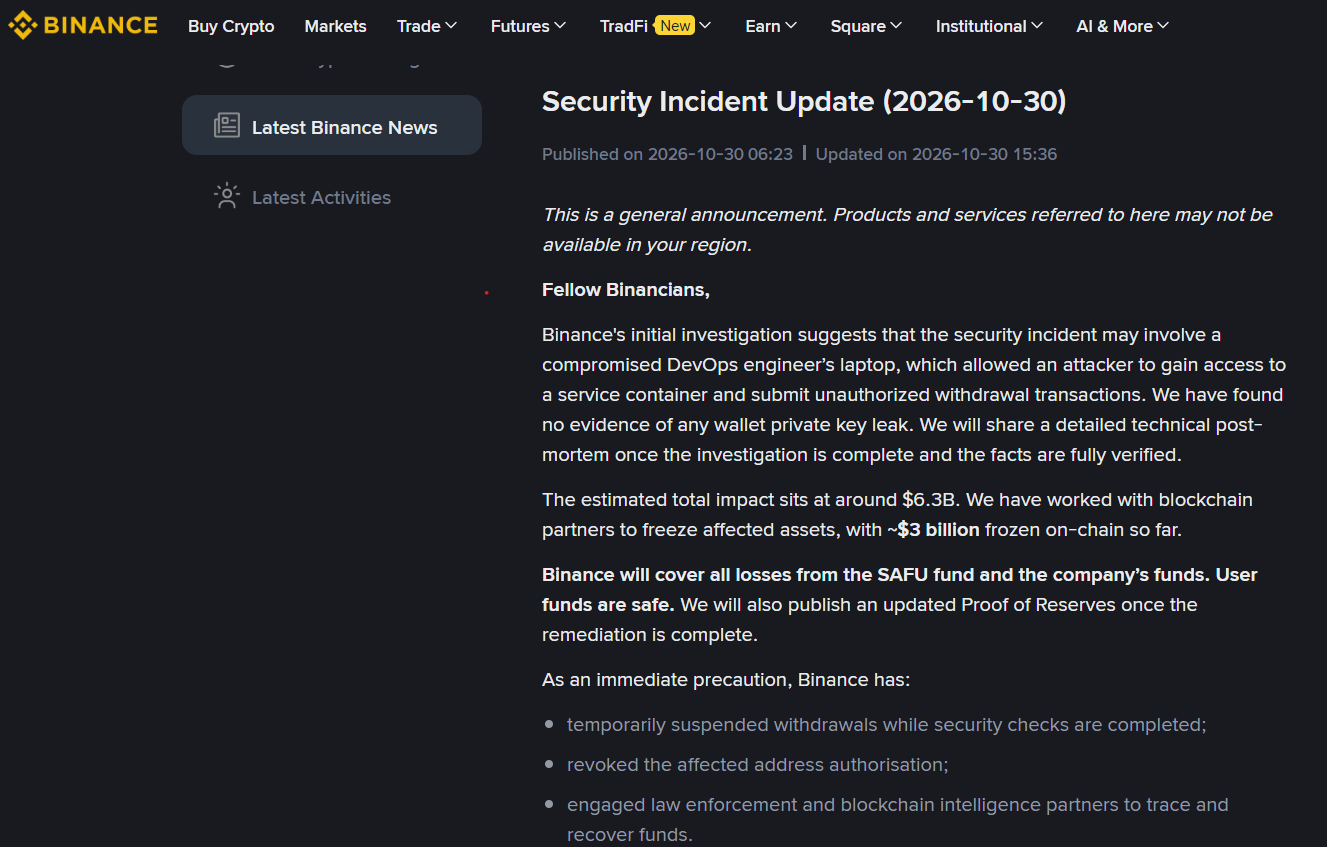
Binance confirmed the scale of the incident on Friday, stating that approximately $3 billion of the estimated $6.3 billion in stolen assets had been frozen on the blockchain. The exchange further announced its active collaboration with law enforcement agencies, token issuers, and specialized blockchain analytics firms to trace and recover the remaining funds. The sheer magnitude of the theft is staggering, even by the volatile standards of the crypto market. However, with nearly half of the stolen assets successfully immobilized, the crucial question remains: how much of this cryptocurrency can the perpetrators realistically convert into spendable assets?
The Double-Edged Sword of Centralized Stablecoins
Unlike truly decentralized cryptocurrencies such as Bitcoin or Ether, which lack a central issuing authority and therefore no single point of control to halt transactions, centralized stablecoins like Tether’s USDT and Circle’s USDC possess issuers with the authority to freeze tokens held at specific wallet addresses. This inherent centralization, while often criticized for deviating from core decentralized principles, provides a critical "off switch" in emergency situations like large-scale hacks.

This power allows these issuers to act with remarkable speed. Tether, for instance, reported freezing a total of approximately $1.567 billion in USDT. The first significant freeze occurred a mere 37 minutes after the stolen funds landed in the attackers’ primary Ethereum wallet. Circle followed suit just three minutes later, freezing around $823 million in USDC. Other issuers, including Ripple and World Liberty Financial, also promptly moved to blacklist associated addresses, demonstrating a coordinated, albeit reactive, industry-wide response.
However, the ability to immobilize crypto assets is not solely confined to stablecoin issuers. Even some decentralized protocols, despite their foundational principles of autonomy, have demonstrated a capacity to intervene. The Arbitrum Security Council, for example, took decisive action by moving approximately $30.5 million in ARB and ETH into an intermediary frozen wallet. These funds can only be accessed or moved following further action by the council or a governance vote by the Arbitrum DAO.
It is crucial to distinguish between "frozen" and "recovered" funds. While immobilizing assets effectively prevents suspected attackers from spending them, it does not automatically facilitate their return to the original owner, in this case, Binance or its users. The frozen assets are essentially held in a digital limbo, awaiting further legal or governance processes for potential repatriation.
The Aave Complication: Lending Protocols and Frozen Collateral
The involvement of decentralized lending protocols like Aave introduced an additional layer of complexity to the recovery efforts. Between 8:58 PM and 9:01 PM UTC, a wallet identified as belonging to the attackers deposited $60 million in USDT into Aave V3 on the Ethereum network. Shortly thereafter, they borrowed $44.6 million in wrapped Ether (WETH). This occurred roughly 40 minutes before the first wave of freezes was initiated by stablecoin issuers.
LlamaRisk, a risk service provider for Aave, noted in an update at 1:00 AM UTC that the attacker’s position was heavily overcollateralized. The wallet held approximately $59.9 million in USDT as collateral against a debt of $43.8 million. Aave itself affirmed that its protocol suppliers were not put at risk by this situation, as the position remained sufficiently collateralized.
The challenge with Aave’s situation stemmed from the fact that the USDT had already been deposited into the lending pool. Consequently, simply blacklisting the attacker’s wallet address by issuers like Tether could not automatically reclaim the collateral held within the Aave protocol. Marc Zeller, founder of the Aave Chan Initiative, explained the technical and philosophical dilemma: "USDT is real money backed by dollars, and the position is criminal but overcollateralized in the eyes of the protocol." This highlighted the protocol’s perspective, where the transaction, though originating from illicit funds, adhered to its established collateralization rules.
To prevent further exploitation and borrowing activity using the compromised funds, Aave implemented a temporary freeze across its V3 and V4 markets. This precautionary measure allowed existing users to continue withdrawing funds, repaying loans, and liquidating positions, but it halted new deposits and borrowing activities. Aave later lifted this precautionary freeze, reiterating that its smart contracts remained unaffected and that all positions continued to be adequately overcollateralized. Zeller’s subsequent remark, "Just another day in crypto," reflected the industry’s ongoing struggle to balance innovation with security and the constant emergence of novel challenges.
The Lingering Billions: What Remains Untouchable?
By 7:00 AM UTC on Friday, cybersecurity firm Elliptic estimated that approximately $2.84 billion of the stolen assets had been frozen. This left the attackers still in control of around $3.33 billion in assets that issuers and protocols were unable, or had not yet managed, to immobilize.
While the successful freeze of nearly half the stolen funds significantly diminished the attackers’ potential profit, it did not guarantee the recovery of the remaining billions. The fundamental difference lies in the nature of Bitcoin and Ether. Lacking centralized token issuers that can blacklist individual addresses, these native cryptocurrencies present a far greater challenge for freezing. Once stolen assets are converted into BTC or ETH, while transactions can be monitored and potentially traced, outright freezing becomes exceptionally difficult, if not impossible, through issuer-level interventions.
In the aftermath of the breach, Binance has made a firm commitment to cover all user losses. This assurance is backed by its Secure Asset Fund for Users (SAFU) and its own corporate funds. According to a recent update from Richard Teng, Binance’s Chief Executive Officer, the exchange has already begun the process of "recovering stolen assets for users," signaling a proactive approach to customer restitution.
The implications of this massive hack extend beyond the immediate financial losses. It serves as a stark reminder of the persistent threats facing the cryptocurrency industry and the ongoing arms race between sophisticated hacking groups and security professionals. The incident underscores the need for continuous innovation in blockchain security, enhanced collaboration between exchanges, issuers, and law enforcement, and a deeper understanding of the complex interplay between centralized and decentralized elements within the crypto ecosystem. The ability of North Korean state-sponsored hacking groups to execute such large-scale operations also raises significant geopolitical concerns, highlighting the growing role of cyber warfare in international relations. As the industry matures, addressing these vulnerabilities will be paramount to fostering trust and ensuring the long-term viability of digital assets.