Chandra Wibowo

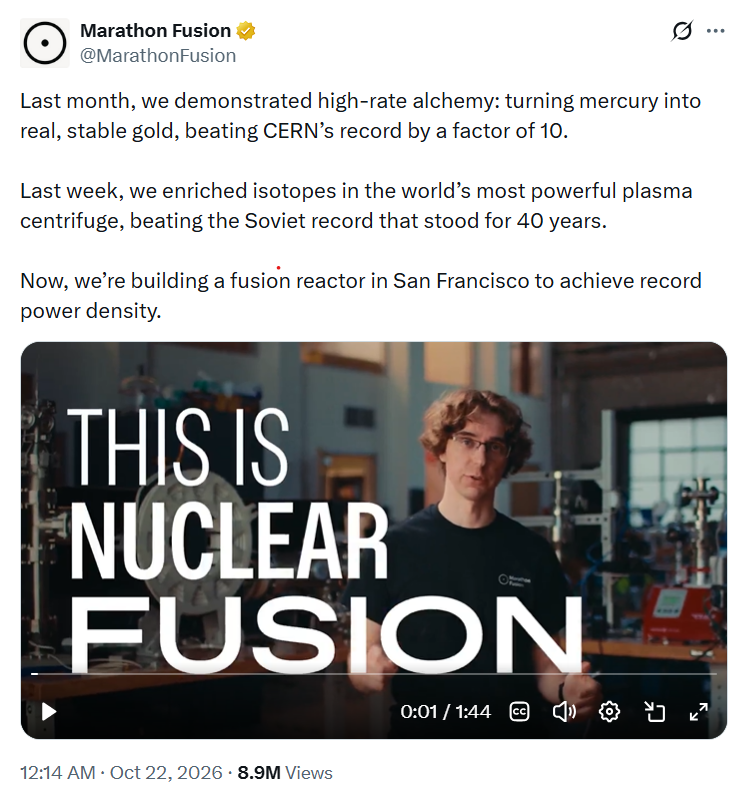
The age-old dream of alchemists, turning base metals into precious ones, has resurfaced in the 21st century with a groundbreaking claim from a US-based fusion startup. Marathon Fusion announced this month that its experimental process has successfully transmuted mercury into gold, a feat that, if proven scalable and economically viable, could have profound implications for the global precious metals market and even digital assets like Bitcoin.
The scientific underpinnings of Marathon Fusion’s claim lie in nuclear transmutation, a process far removed from the chemical trickery envisioned by historical alchemists. According to a research paper published by the company, their method utilizes high-energy neutrons generated from a deuterium-tritium fusion reaction. These neutrons are then used to irradiate mercury-198, a specific isotope of mercury. This irradiation process can induce a nuclear reaction, transforming mercury-198 into a radioactive isotope that subsequently decays into stable gold-197.
This remarkable announcement has ignited discussions about the future scarcity of gold, a metal historically revered for its rarity and perceived as a hedge against inflation and economic uncertainty. Some observers have even drawn parallels to the concept of an "infinite mint bug," a term often used in cryptocurrency circles to describe a flaw that could allow for unlimited creation of a digital asset, thereby devaluing it. The question then arises: what impact could a theoretically limitless supply of gold have on its centuries-old status as a store of value?
The "Digital Gold" Debate: Bitcoin’s Fixed Supply Versus Potential Abundance of Physical Gold
The implications of Marathon Fusion’s achievement extend to the realm of digital assets, particularly Bitcoin, which is frequently referred to as "digital gold" due to its predetermined and capped supply of 21 million coins. Brian Armstrong, the CEO of cryptocurrency exchange Coinbase, has weighed in on this unfolding scenario, drawing a comparison between the potential creation of "net-new gold with alchemy" and the established industry of lab-grown diamonds.
Armstrong articulated his perspective on social media platform X (formerly Twitter), stating, "You can’t invent anything that will increase Bitcoin supply. There will only ever be 21M." His assertion highlights a fundamental difference: while scientific advancements might unlock new methods for producing physical gold, the protocol-defining scarcity of Bitcoin remains immutable. This fixed supply is a cornerstone of Bitcoin’s value proposition as a digital store of value, insulated from the potential inflationary pressures that a more abundant physical gold supply might face.
Jewelers Express Interest Amidst Scientific Skepticism
The potential for lab-created gold has already attracted attention from industries that rely heavily on the precious metal. Kyle Schiller, co-founder and CEO of Marathon Fusion, revealed in an interview with Magazine that the company has been inundated with inquiries from jewelers. This interest suggests that even if the primary application remains as a store of value, as Schiller anticipates, the jewelry sector could be an early adopter of this novel form of gold. "As with regular gold, I think it’ll be mostly used as a store of value," Schiller commented, acknowledging the potential demand from this sector.

However, before the established gold market experiences any significant tremors, it is crucial to contextualize Marathon Fusion’s claimed achievement. Experts in the precious metals industry urge caution, emphasizing that the path from a laboratory breakthrough to commercially viable, large-scale production is fraught with significant challenges.
Nikos Kavalis, managing director at precious metals research firm Metals Focus, expressed a widely held sentiment within the industry: "We are nowhere near a stage where we can talk about production significance." He further elaborated, "While allusions to alchemical dreams make for great headlines, I think gold miners will get to keep their jobs for the foreseeable future!" This sentiment underscores the considerable gap between a proof-of-concept and an industrial reality.
The Scientific Plausibility and the Engineering Hurdles
The underlying nuclear process described by Marathon Fusion is, in principle, scientifically sound. Nuclear transmutation, the conversion of one chemical element into another through nuclear reactions, is a well-established phenomenon in physics. The challenge, as with many advanced scientific endeavors, lies in transforming this scientific principle into an economically sustainable industrial process.
Marathon Fusion has reported that its experimental setup produced stable gold at a rate reportedly ten times that of CERN’s historical records. CERN, the European Organization for Nuclear Research, is renowned for its powerful particle accelerators, which are used to study the fundamental constituents of matter. However, the context of CERN’s experiments is crucial for understanding Marathon’s claims. The ALICE (A Large Ion Collider Experiment) at CERN, during its 2015-2018 operational period, produced an estimated mere 29 picograms of gold nuclei. Furthermore, these nuclei were fleeting, existing for fractions of a second before disintegrating within the high-energy collisions.
Marathon Fusion has not yet disclosed the exact quantity of gold produced in their experiments. Jake Harter, a research engineer at Marathon Fusion, indicated that current quantities remain "microscopic." However, the company has set an ambitious target of achieving "macroscopic milligram quantities in 2027." It is important to note that the larger production figures cited in Marathon’s research paper are projections for a hypothetical future fusion power plant, not based on current experimental output.
The paper models the potential annual production of approximately two tonnes of gold per gigawatt of thermal fusion power. To provide perspective, the World Gold Council reported that global mine production of gold reached 3,672 tonnes in 2025. Therefore, even a single future fusion plant’s output, according to these projections, would represent a modest fraction of current annual global gold extraction.
Achieving these projected output levels, Harter explained, would necessitate scaling up the production of enriched mercury, the specific isotope required for the gold transmutation process, and, of course, the construction of a functional fusion reactor. The company’s roadmap includes studies on materials compatibility, mercury handling and pumping systems, and efficient gold extraction methods.
Drawing Parallels with Lab-Grown Diamonds: A Tale of Economics
The comparison between Marathon Fusion’s nuclear gold and lab-grown diamonds, as highlighted by Brian Armstrong, is a natural one. The lab-grown diamond industry has witnessed a dramatic reduction in wholesale prices, falling by over 90% since 2018 as production scaled up. Unlike earlier diamond simulants, lab-grown diamonds possess the same chemical composition as mined diamonds but are produced at a significantly lower cost. This begs the question: could a similar price deflation occur for gold?
Market analysts, while acknowledging the intuitive comparison, emphasize the distinct economic realities. Nagham Hassan, a market analyst at eToro, noted that "the economics are completely different." She elaborated that while diamond production benefited from the scaling of factory-based manufacturing, producing gold through nuclear fusion would require "highly complex infrastructure that does not yet exist commercially." The sheer scale of investment and technological development needed for commercial fusion power plants, let alone those specifically designed for transmutation, presents a formidable barrier.
Radioactivity and Economic Viability: Lingering Questions
An additional, albeit potentially manageable, complication is the radioactivity of the initially produced gold. Harter explained that the gold would require storage for "a bit over a decade" before its radioactivity diminishes to levels comparable to natural background radiation. However, given that a significant portion of gold is held as an investment rather than used in immediate applications, he suggested this might not be a prohibitive obstacle to commercialization.
A more substantial hurdle remains the fundamental question of economic viability. Kavalis of Metals Focus stated, "There is no demonstration that the process is commercially viable. There are theoretical revenue projections, but nothing about what it will cost to run the reactors." The energy input required for fusion reactions and the complex processes involved in isolating and refining the transmuted gold are significant cost factors that have yet to be quantified in a commercially feasible manner.
The Future of Gold and the Enduring Appeal of Bitcoin
The potential for a future where gold can be manufactured, even at scale, raises critical questions about its role as a store of value and its relationship with assets like Bitcoin. Fabian Schär, a professor of distributed ledger technology and fintech at the University of Basel, offered a straightforward economic analysis: "For any asset, a substantial increase in available supply would, other things being equal, put downward pressure on its market price. Under the hypothetical assumption of inexpensive production at scale, gold would be no exception."
However, the timeline for such a scenario remains distant. With fusion power plants still at least a decade away from widespread deployment, and significant unanswered questions surrounding the economic feasibility of nuclear transmutation for gold production, any immediate impact on the gold market or Bitcoin prices is highly unlikely.
For the foreseeable future, Marathon Fusion’s work is best characterized as a fascinating scientific experiment with potentially groundbreaking applications, rather than an immediate threat to the established gold market. The enduring appeal of Bitcoin, rooted in its digital scarcity and decentralized nature, remains distinct from the evolving dynamics of physical commodity production. Therefore, for now, traditional gold investors and proponents of Bitcoin can likely breathe a collective sigh of relief. The alchemist’s dream, while inching closer to reality, has a long road ahead before it fundamentally reshapes the global economy.