Sisilia Frederika
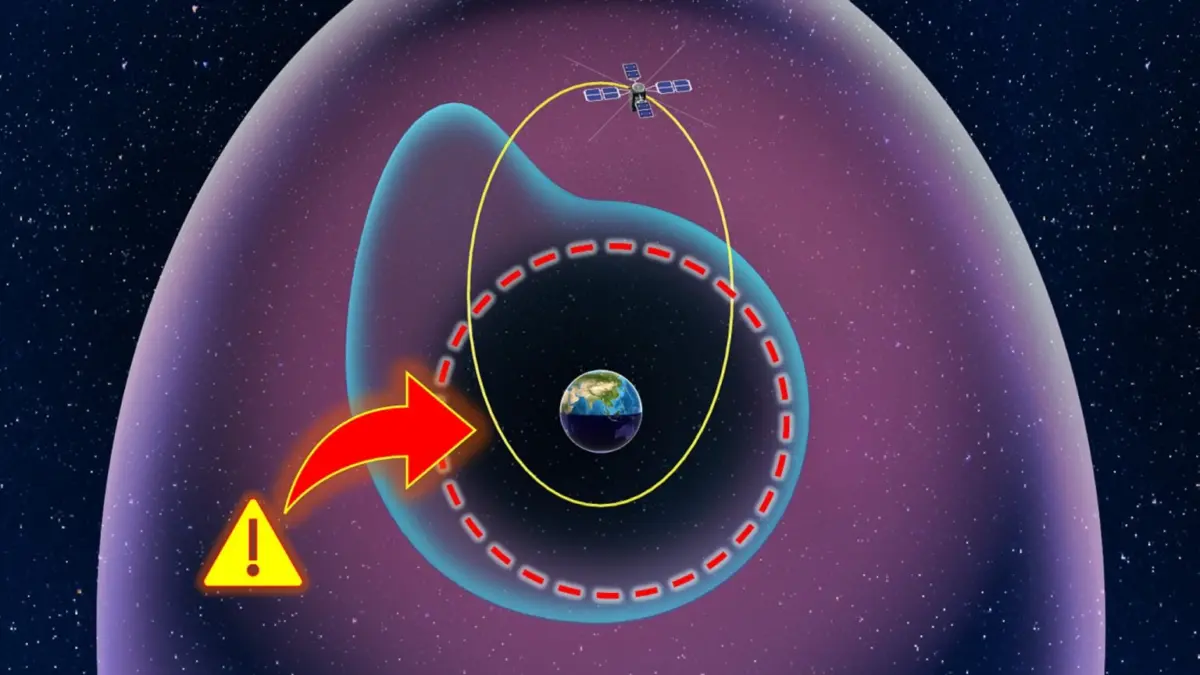
The solar superstorm that battered Earth’s magnetosphere in May 2024 was more than just a spectacular light show for observers in low-latitude regions like Florida and Mexico; it was a transformative event for the planet’s local radiation environment. According to a new study published in the journal Geophysical Research Letters by Yoshizumi Miyoshi of Nagoya University and a team of international collaborators, the storm fundamentally altered the behavior of Earth’s protective shields. The research reveals that the storm’s intensity allowed nearby electrons to accelerate to relativistic speeds within a region previously thought to be protected by an "impenetrable barrier," using a phenomenon known as chorus waves. This discovery challenges long-held assumptions about the stability of Earth’s inner radiation environment and poses new questions regarding the safety of orbital infrastructure during extreme space weather events.
Understanding the Van Allen Radiation Belts
To grasp the significance of the May 2024 findings, it is essential to understand the structure of the Van Allen radiation belts. Discovered in 1958 by James Van Allen using data from the Explorer 1 satellite, these belts are two concentric rings of energetic charged particles trapped by Earth’s magnetic field. The inner belt, typically extending from roughly 1,000 to 6,000 kilometers above the Earth’s surface, consists primarily of high-energy protons. The outer belt, which can stretch from 13,000 to over 60,000 kilometers, is dominated by high-energy electrons.
Between these two regions lies a "slot region" that is relatively devoid of particles. For decades, scientists believed this configuration was a permanent fixture of our planet’s geospace. In 2014, data from NASA’s Van Allen Probes mission identified what appeared to be a hard limit for "killer electrons"—ultra-relativistic particles moving at nearly the speed of light. These particles seemed to hit a "glass wall" at approximately 11,500 kilometers (about 2.8 Earth radii) above the surface, prevented from moving closer to the planet by the dense, cold plasma of the plasmasphere. This boundary was dubbed the "impenetrable barrier," a safeguard protecting the inner magnetosphere and low-Earth orbit (LEO) satellites from the most corrosive forms of cosmic radiation.
The May 2024 Superstorm: A Chronology of Chaos
The stability of this barrier was tested during the geomagnetic disturbances of May 2024. The event was triggered by a series of powerful solar flares and coronal mass ejections (CMEs) originating from a massive, complex sunspot cluster designated AR3664. As these CMEs hurtled toward Earth, they merged and intensified, resulting in a G5-rated geomagnetic storm—the highest level on the National Oceanic and Atmospheric Administration (NOAA) scale and the most intense event since the 2003 Halloween storms.
On May 10 and 11, 2024, solar wind gusts reached staggering velocities of up to 1,200 kilometers per second. This high-speed stream of solar plasma compressed the dayside of Earth’s magnetic field, pushing the magnetopause—the boundary between Earth’s magnetic influence and the solar wind—closer to the planet than usual. The resulting geomagnetic disturbance was so profound that it caused the plasmasphere, the region of cold, dense plasma that usually provides the "dampening" effect for the impenetrable barrier, to be crushed inward toward the atmosphere.
Observations from the Arase Satellite
While the Van Allen Probes concluded their mission in 2019, Japan’s Arase satellite (also known as the Exploration of energization and Radiation in Geospace, or ERG mission) remained in orbit to witness the event. Launched in 2016, Arase is equipped with high-precision instruments designed to measure the distribution of ions and electrons across a wide range of energies.
During the peak of the May storm, Arase’s sensors recorded a staggering spike in radiation levels. Ultra-relativistic electrons were detected at concentrations 5,000 times higher than typical background levels. Crucially, these electrons were found deep within the region usually protected by the "impenetrable barrier." While previous missions had noted radiation spikes during storms, they lacked the resolution to determine whether particles were leaking in from the outside or being generated locally.
To solve this mystery, Miyoshi’s team utilized a sophisticated mathematical approach known as electron phase space density analysis. This method allows researchers to track the distribution of particles based on their energy and motion. If the "killer electrons" had simply breached the barrier from the outer belt, the data would have shown a clear gradient of particles moving inward from space. Instead, Arase detected a distinct peak in density exactly where the barrier used to be. This provided the "smoking gun" evidence for local acceleration: the electrons were not "invaders" from the outer belt, but rather low-energy electrons already present in the inner region that had been supercharged in situ.
The Mechanics of Chorus Waves and Plasma Depletion
The mechanism responsible for this sudden acceleration is a phenomenon known as "chorus waves." These are low-frequency electromagnetic waves that occur in the magnetosphere. When converted into audio signals, they resemble the chirping of birds, hence the name. Under normal conditions, these waves are suppressed by the dense plasma of the plasmasphere, which absorbs their energy.
However, the May 2024 storm created a "perfect storm" of conditions for these waves to thrive. First, the intense compression of the magnetosphere pushed the plasmasphere inward, creating a vacuum of cold plasma in the region of the barrier. Second, the event triggered what is known as a "negative ionospheric storm," which significantly depleted local plasma densities.
In this depleted environment, chorus waves were able to propagate without interference. They interacted with sub-million electron volt (MeV) electrons, transferring energy with high efficiency through a process called wave-particle interaction. This acted like a cosmic particle accelerator, boosting the electrons into the multi-MeV range—transforming them into the "killer electrons" that the impenetrable barrier was supposed to exclude.
Long-Term Persistence and October Reset
The impact of the May superstorm was not a fleeting event. The research indicates that the newly generated high-energy radiation spread both toward and away from the Earth, populating the inner magnetosphere for several months. This persistent radiation belt created a heightened risk environment for any spacecraft passing through the region.
The Arase satellite continued to monitor these elevated radiation levels throughout the summer and early autumn of 2024. It was only in October 2024, when another significant solar storm struck the planet, that the magnetic field configuration was sufficiently disrupted to "reset" the system. This second storm altered the wave-particle dynamics once again, finally dissipating the remnants of the May-induced radiation surge.
Broader Implications for Space Infrastructure and Exploration
The findings published by Miyoshi and his co-authors serve as a stark warning for the aerospace industry. The concept of an "impenetrable barrier" has provided a sense of security for mission planners, particularly for satellites operating in Medium Earth Orbit (MEO) and those transitioning through the radiation belts to higher orbits.
The revelation that this barrier can be bypassed through local acceleration suggests that current shielding standards may be insufficient for G5-class solar events. "Killer electrons" are notorious for their ability to penetrate the outer hulls of satellites, leading to internal charging. This can cause phantom commands, short circuits, or total electronic failure. As the global economy becomes increasingly dependent on satellite constellations for GPS, telecommunications, and climate monitoring, the vulnerability of these assets to localized radiation bursts becomes a matter of national security and economic stability.
Furthermore, these findings have significant implications for human spaceflight. As NASA’s Artemis program and private ventures like SpaceX aim to send crews beyond Low Earth Orbit, understanding the dynamic nature of the Van Allen belts is critical. Astronauts traversing these regions during a solar superstorm could be exposed to much higher doses of radiation than previously modeled if the "impenetrable barrier" fails to hold.
Conclusion: A New Frontier in Space Weather Forecasting
The May 2024 superstorm has demonstrated that Earth’s magnetosphere is a far more dynamic and volatile environment than earlier Space Age models suggested. The discovery of local electron acceleration via chorus waves inside the traditional exclusion zone marks a significant milestone in space physics.
As we approach the solar maximum of Solar Cycle 25, more intense geomagnetic activity is expected. The work of the Arase team highlights the necessity of continuous, high-resolution monitoring of the geospace environment. Future satellite designs and mission profiles will likely need to incorporate more robust radiation hardening and more sophisticated real-time space weather response protocols. Ultimately, the "glass wall" discovered a decade ago has been proven to be more of a "plasma curtain"—one that can be drawn back by the sheer force of the Sun, leaving our most sensitive technologies exposed to the fury of the cosmos.