
 Lina Irawan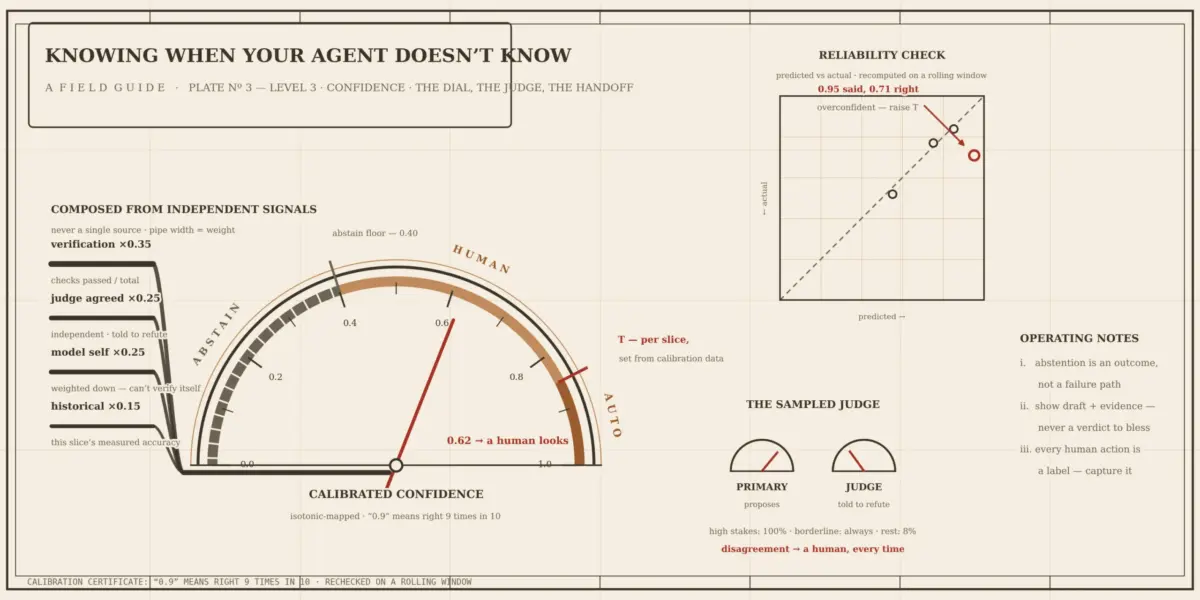
The deployment of Large Language Models (LLMs) has transitioned from experimental prototyping to rigorous production environments, necessitating a shift in how engineers evaluate model reliability. In the current landscape of artificial intelligence, the most critical metric an agent produces is no longer merely its final answer, but rather a calibrated measure of its own certainty. This evolution represents Level 3 of a six-level maturity model for LLM systems, moving beyond basic functionality and observability into the realm of verifiable confidence. By synthesizing independent signals, implementing rigorous calibration, and refining human-in-the-loop (HITL) protocols, enterprises are building systems that effectively "know when they do not know," thereby mitigating the risks of hallucination and automated error.
The Foundations of Level 3 Maturity
As organizations integrate LLMs into high-stakes workflows—such as financial auditing, legal document review, and medical data processing—the limitations of raw model outputs have become apparent. Early-stage deployments, classified as Levels 1 and 2, focused on ensuring the system could perform tasks and that engineers could monitor those tasks in real-time. Level 3, however, introduces "Confidence" as the central governing mechanism.
At this stage, an LLM system does not act autonomously by default. Instead, it operates on a sliding scale where autonomy is granted only when a multi-factor confidence score exceeds a predefined threshold. This mechanism relies on three integrated components: a composed confidence dial, an independent judge model, and a sophisticated human handoff protocol. When synchronized, these elements ensure that high-stakes decisions are scrutinized and that uncertain outputs are routed to human experts in a format that facilitates accurate review rather than mindless approval.
A Chronology of LLM Deployment Standards
The path to Level 3 maturity has followed a rapid chronological progression since the mass adoption of generative AI began in late 2022.
- Phase I: The Prompt Engineering Era (Late 2022 – Early 2023): Initial efforts focused on "Level 1" maturity, where the primary goal was to achieve a functional output through prompt optimization. Systems were largely unmonitored and lacked formal error-handling frameworks.
- Phase II: Observability and Logging (Mid 2023): As systems moved to production, "Level 2" maturity introduced basic observability. Developers began tracking latency, token usage, and simple "thumbs up/down" feedback, though the systems still lacked the ability to self-regulate based on uncertainty.
- Phase III: The Confidence Framework (2024 – Present): The current frontier, Level 3, addresses the "overconfidence" problem inherent in transformer-based architectures. Industry leaders have recognized that self-reported confidence from an LLM is often miscalibrated. Research indicates that models frequently express high certainty even when providing factually incorrect information.
- Future Phases (Level 4 and Beyond): Upcoming standards are expected to focus on real-time self-correction, multi-agent negotiation, and fully autonomous policy adherence.
Engineering the Composed Confidence Signal
To achieve Level 3 maturity, engineers must move away from relying on a model’s self-reported probability. Instead, a production-grade confidence score is "composed" from several independent signals. This multi-input approach ensures that a single point of failure—such as a model hallucinating its own accuracy—cannot bypass the system’s guardrails.
The Four Pillars of Confidence
In a robust Level 3 system, the confidence score is typically derived from a weighted sum of the following:
- Model Self-Reported Score: While notoriously overconfident, the model’s internal probability (logprobs) or self-assessment still holds marginal value. However, in a calibrated system, this is usually given the lowest weight (e.g., 25%).
- Deterministic Verification: This involves checking the output against hard-coded rules or external databases. If a model generates a transaction ID that does not exist in the database, the verification signal drops to zero, dragging the overall confidence score down regardless of the model’s "certainty."
- Judge Agreement: A second, independent model reviews the primary model’s decision. If the two models disagree, the confidence score is significantly penalized.
- Historical Slice Accuracy: The system tracks how well the model has performed on similar tasks in the past. If a model has a 99% accuracy rate on "summarization" but only 80% on "data extraction," the confidence score for an extraction task is adjusted downward to reflect this historical reality.
Data-Driven Calibration and Isotonic Regression
A confidence score is only useful if it is "calibrated," meaning a score of 0.90 corresponds to a 90% empirical success rate. To achieve this, engineers utilize reliability diagrams to bucket decisions by predicted confidence and measure actual accuracy. If a system predicts 95% confidence but only achieves 71% accuracy in that bucket, the system is overconfident and requires recalibration.
Techniques such as Isotonic Regression are now standard for closing this loop. By fitting a monotonic map from raw composed scores to empirical accuracy, developers can ensure that the thresholds used for automation are grounded in statistical reality. This calibration must be recomputed on a rolling window, as "model drift" or changes in input data can cause calibration to rot over time.
The Role of the Adversarial Judge
One of the most significant innovations in Level 3 systems is the implementation of an independent "judge" model. To avoid the "echo chamber" effect, where a model simply agrees with its own logic, industry best practices dictate using a different model family for the judge (e.g., using Anthropic’s Claude to judge an OpenAI GPT-4 output).
The judge is prompted not to confirm, but to refute. By adopting a skeptical or adversarial stance, the judge is tasked with finding the strongest reason why a proposed decision might be wrong or unsafe. This "red-teaming" of individual outputs in real-time serves as a critical insurance policy for high-stakes or irreversible actions.
| Decision Class | Judge Policy | Action on Disagreement |
|---|---|---|
| High Impact/Irreversible | 100% Judged | Immediate Human Escalation |
| Borderline Confidence | Always Judged | Human Review Recommended |
| Low Stakes/Routine | 5-10% Random Sample | Log for Trend Analysis |
Human-in-the-Loop: Optimizing the Handoff
The final component of a Level 3 system is the routing of uncertain decisions to human reviewers. However, the traditional "Approve/Reject" interface is increasingly viewed as a liability. Such interfaces often lead to "rubber-stamping," where fatigued human reviewers approve incorrect AI suggestions to clear their queues.
Professional-grade HITL (Human-in-the-Loop) systems now focus on "Evidence-Based UX." Instead of asking a human to bless a verdict, the system presents a draft along with the evidence used to reach that conclusion. It highlights specific areas of uncertainty—such as "routed because confidence below 0.85"—and provides the human with the reasoning and alternative outcomes.
This approach transforms the human reviewer from a passive observer into a sophisticated editor. Every human action, especially an "edit" to the AI’s proposal, is captured as a rich signal. These edits are then fed back into the system’s "Golden Set" for future training and evaluation, creating a self-improving feedback loop.
Broader Implications and Industry Analysis
The shift toward Level 3 LLM maturity has profound implications for the AI economy and corporate governance. As regulatory bodies like the EU AI Act begin to demand greater transparency and human oversight for "high-risk" AI systems, the confidence-and-routing framework provides a technical roadmap for compliance.
Economic Impact
From an operational standpoint, the ability to safely automate "proven-safe" slices of a workflow while escalating "high-risk" cases allows companies to scale AI without a linear increase in risk or human headcount. By lowering the automation threshold only for specific, high-accuracy categories, businesses can maximize ROI while maintaining a rigorous safety floor.
Ethical and Safety Considerations
The most significant ethical benefit of this model is the institutionalization of abstention. In early AI deployments, a model "failing" was often seen as a system error. In Level 3 maturity, a model saying "I am not sure, please ask a human" is recognized as a successful operation. This "competence edge" prevents the manufacture of false accountability and ensures that the most complex and nuanced cases receive the human attention they require.
Industry experts suggest that organizations failing to implement these Level 3 guardrails face significant "reputational and operational debt." As AI agents become more autonomous, the difference between a successful deployment and a catastrophic failure will depend not on the model’s intelligence, but on its ability to measure its own limitations.
Conclusion
Level 3 maturity represents the professionalization of LLM operations. By moving away from raw, uncalibrated model outputs and toward a system of composed signals, adversarial judging, and high-fidelity human handoffs, engineers are creating a new standard for AI reliability. This framework ensures that AI systems are not just "smart," but are also disciplined, predictable, and ultimately trustworthy enough to handle the complexities of the modern enterprise.









