Sisilia Frederika
The National Aeronautics and Space Administration (NASA) has confirmed that the Perseverance rover, currently exploring the Martian surface, has officially set a new distance record for travel on another world. As of October 11, 2026—marking the 2,006th Martian sol of its mission—the rover has traversed a total of 45.22 kilometers (28.10 miles). This milestone narrowly edges out the previous record held by the Opportunity rover, which covered 45.16 kilometers (28.06 miles) during its nearly 15-year tenure on the Red Planet.
While the raw distance figures suggest a close race between the two robotic explorers, the efficiency and speed with which Perseverance achieved this feat highlight a generational leap in aerospace engineering and autonomous navigation. Perseverance reached the 45-kilometer mark in just five-and-a-half years, whereas Opportunity required nearly a decade and a half of operation to reach the same distance. This achievement underscores the evolving capabilities of NASA’s Jet Propulsion Laboratory (JPL) in managing long-duration, high-mobility planetary missions.
The Technological Evolution of Martian Mobility
The disparity in travel time between Perseverance and its predecessors is largely attributed to two critical factors: its power source and its sophisticated autonomous navigation software. Unlike Opportunity, which relied on solar panels that were susceptible to the accumulation of Martian dust and the seasonal variations of sunlight, Perseverance is powered by a Multi-Mission Radioisotope Thermoelectric Generator (MMRTG). This "nuclear battery" converts the heat from the natural decay of plutonium-238 into a steady, reliable stream of electricity, allowing the rover to operate through the night and during the planet’s intense dust storms.
However, power is only one part of the equation. The true catalyst for Perseverance’s record-breaking pace is "AutoNav," the rover’s autonomous navigation system. While earlier rovers like Spirit and Opportunity used a first-generation version of AutoNav for only about 5% of their total driving distance, Perseverance utilizes its advanced iteration for approximately 90% of its travel.
AutoNav allows Perseverance to "think while driving." The system continuously captures images of the terrain ahead, generating high-resolution 3D maps of potential hazards such as sharp rocks or treacherous sand dunes. By processing this data in real-time, the rover can plot and execute a safe course without waiting for human intervention from Earth. This capability enables Perseverance to travel at or near its top speed for extended periods, achieving daily distances of up to 412 meters (1,351 feet)—a feat unimaginable for the rovers of the early 2000s.
A Chronology of Discovery in Jezero Crater
Perseverance landed in Jezero Crater on February 18, 2021. The site was meticulously chosen by scientists because it was once the home of an ancient paleolake and a river delta. The primary objective of the Mars 2020 mission is astrobiology, specifically the search for signs of ancient microbial life.
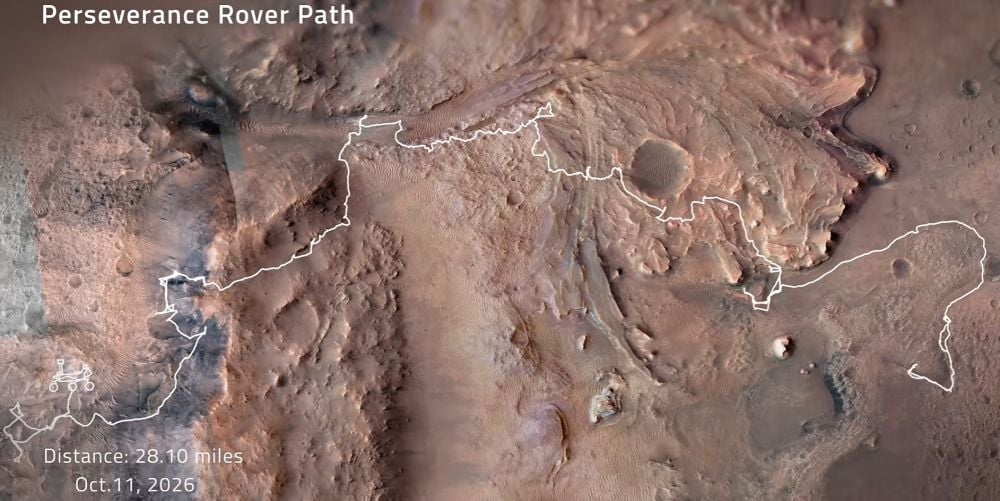
The rover’s journey can be divided into several distinct phases:
- The Landing and Initial Checkout (Early 2021): After a successful "seven minutes of terror" landing, the rover spent its first months testing its scientific instruments and deploying the Ingenuity Mars Helicopter, which served as a scout for the rover’s future paths.
- The Crater Floor Campaign (2021–2022): Perseverance explored the floor of Jezero Crater, where it made the surprising discovery of igneous (volcanic) rocks. Scientists had expected sedimentary rocks, but the presence of igneous formations provided a crucial tool for dating the crater’s history.
- The Delta Front Campaign (2022–2024): The rover moved toward the ancient river delta, where it began collecting samples of sedimentary rocks. These layers are considered the most likely environment to have preserved organic molecules or biosignatures.
- The Margin Unit and Beyond (2025–Present): Perseverance is currently navigating the western rim of the crater in a region named "Lac de Charmes." It is currently en route to a geological feature known as "Idubi."
Scientific Breakthroughs and the "Holy Grail" of Astrobiology
The record-breaking distance is not merely a statistical achievement; it represents a massive increase in the volume of scientific data collected. By moving faster and further, Perseverance has been able to visit a wider variety of geological sites than any previous mission.
One of the most significant findings during this record-setting trek has been the discovery of fluorite. This mineral typically forms when rock interacts with heated water, providing definitive evidence of ancient hydrothermal activity. In the field of astrobiology, hydrothermal systems are often referred to as the "Holy Grail" because they provide the three essential ingredients for life: liquid water, an energy source (heat), and complex chemistry.
The rocks Perseverance is currently targeting at "Idubi" are estimated to be some of the oldest on the planet. On Earth, plate tectonics and erosion have recycled and destroyed the vast majority of rocks from the planet’s earliest history. Mars, however, lacks active plate tectonics, meaning its surface acts as a "time capsule" of the early solar system. By studying these ancient formations, scientists hope to find fossilized evidence of microscopic structures or microbial mats that may have existed billions of years ago.
Official Reactions and Future Mission Objectives
The achievement has been met with praise from leadership at NASA and JPL. Steven Lee, the project manager for both the Curiosity and Perseverance missions at JPL, emphasized that the rover has far exceeded its initial design parameters.
"The original mission called for no more than 12.4 miles of driving. We’ve blown well past that," Lee stated. "It is an honor to be working on Perseverance at a moment when the technology has evolved to the point that drives like these are routine. With all mobility systems fully operational and favorable extended-ground-life test results, we expect Perseverance to keep adding to this record for many years to come."
Mark Maimone, the deputy team chief of Perseverance’s robotic operations, highlighted the success of the rover’s decision-making capabilities. "The rover that broke this record did so by making its own decisions about the path," Maimone said. "Our newest software teaches Perseverance to steer less and roll more, and to check its own position against orbital maps mid-drive."
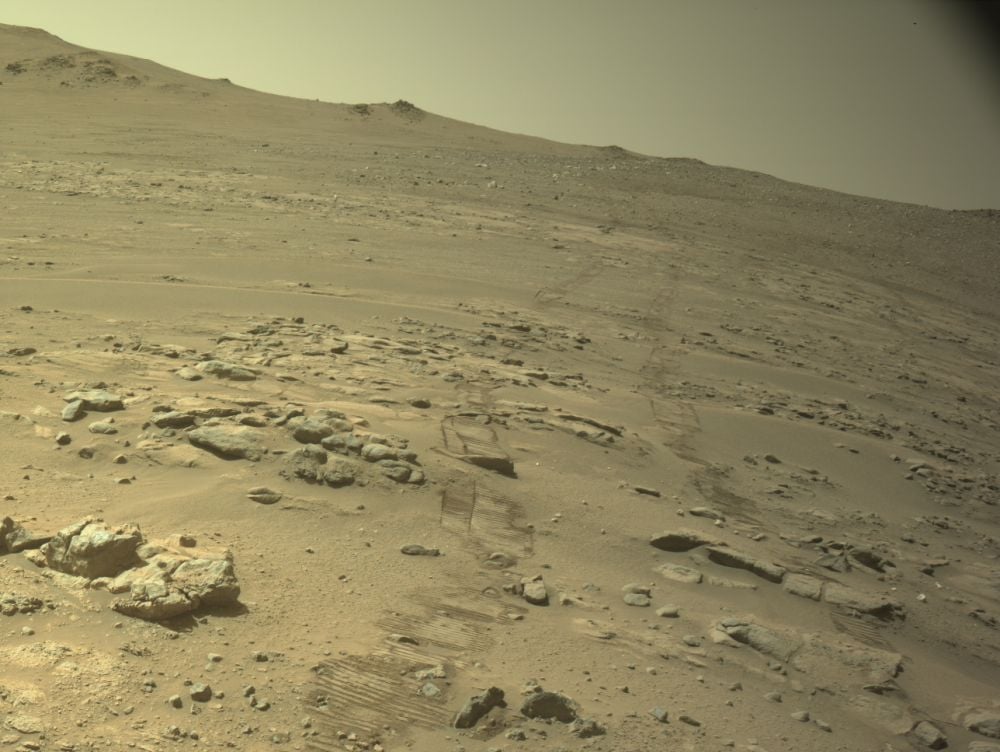
Despite these successes, the team is already looking to overcome the next set of challenges. One of the primary obstacles for AutoNav is sun glare. Currently, when the rover is driving directly toward the sun in the mid-afternoon, the glare can blind its navigation cameras, forcing the team to halt operations earlier than desired. Engineers are working on software updates to help the rover "see past" these artifacts, which would further extend its daily working hours.
The Broader Implications: Samples and Future Missions
The success of Perseverance is inextricably linked to the future of the Mars Sample Return (MSR) mission. To date, the rover has cached 29 samples of Martian rock and regolith (soil) in titanium tubes. These samples represent a diverse geological record of the Jezero Crater region and are intended to be retrieved by a future mission and brought back to Earth for high-precision laboratory analysis.
However, the MSR mission currently faces significant hurdles. Jointly planned by NASA and the European Space Agency (ESA), the project has come under scrutiny due to rising costs and technical complexities. While Perseverance has fulfilled its part of the bargain by collecting and caching the samples, the timeline for their return remains uncertain. Some critics and policymakers have raised concerns about the mission’s budget, leading to ongoing debates about the prioritization of planetary science goals.
Despite these challenges, the legacy of Perseverance’s mobility is already shaping the next generation of space exploration. The success of AutoNav provides a blueprint for future missions that could involve swarms of smaller rovers or Unmanned Aerial Vehicles (UAVs) working in tandem. Such systems could explore regions that are currently inaccessible, such as deep Martian caves, steep crater walls, or the icy moons of Jupiter and Saturn.
Conclusion
The 45.22-kilometer record set by Perseverance is a testament to the rapid advancement of robotic autonomy and the resilience of human engineering. By covering in five years what previously took fifteen, NASA has demonstrated that the pace of planetary discovery is accelerating.
As Perseverance enters its extended mission, exploring the rim of Jezero Crater through 2028, it continues to serve as a mobile laboratory on the frontier of human knowledge. Each kilometer traveled brings the scientific community closer to answering the fundamental question: Did life ever exist on Mars? While the definitive answer may still lie within the cached samples awaiting their return to Earth, the journey of Perseverance has already rewritten the record books of space exploration.