Clarissa Hana
Apple has launched its inaugural Background Security Improvements update, a significant stride in its security patching strategy, to address a critical WebKit vulnerability identified as CVE-2026-20643. This update is notable not only for the vulnerability it rectifies but also for the innovative delivery mechanism employed, which allows for targeted security fixes on iPhones, iPads, and Macs without necessitating a full operating system upgrade. This marks a pivotal moment in how Apple manages and deploys security patches, moving towards a more agile and component-specific approach.
The vulnerability, CVE-2026-20643, poses a substantial risk to users by allowing malicious web content to circumvent the browser’s Same Origin Policy (SOP). The SOP is a fundamental security mechanism in web browsers designed to prevent scripts from one origin (domain, protocol, and port) from interacting with resources from another origin. When this policy is bypassed, it can lead to various security exploits, including data theft, unauthorized actions on behalf of the user, and the compromise of sensitive information. Apple has detailed that the flaw is an "cross-origin issue in the Navigation API," which has been rectified through "improved input validation." This suggests that the vulnerability stemmed from insufficient checks on the data being passed through the Navigation API, allowing requests to originate from an unauthorized domain and gain access to sensitive resources.
The discovery of this critical flaw is attributed to security researcher Thomas Espach. The swift deployment of the fix underscores Apple’s commitment to user security, with the update now available across multiple platforms: iOS 26.3.1, iPadOS 26.3.1, and macOS versions 26.3.1 and 26.3.2. The numbering suggests these are iterative updates within a larger software release cycle, but the crucial aspect is that the security patch itself is delivered independently of a full OS installation.
The Advent of Background Security Improvements
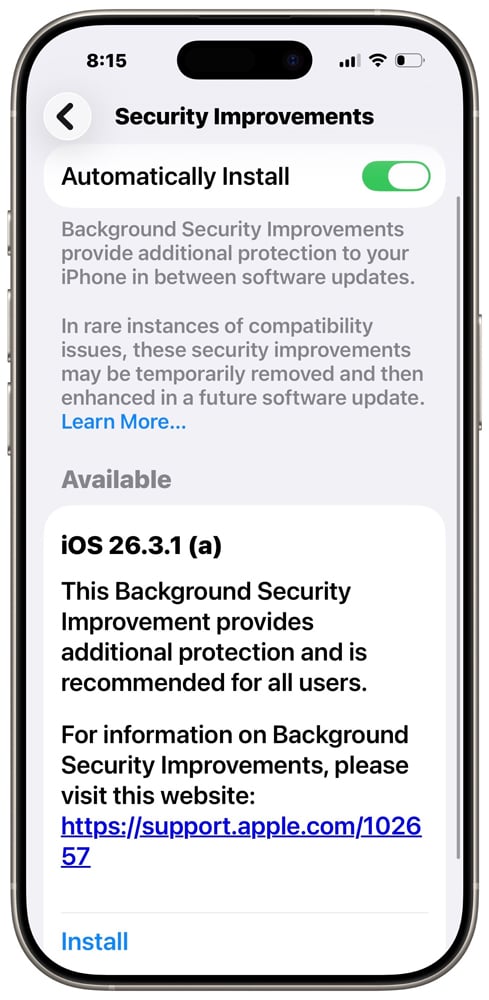
This release represents the maiden voyage for Apple’s new Background Security Improvements feature, a mechanism designed to deliver smaller, out-of-band patches outside the conventional security update schedule. Traditionally, users have been accustomed to receiving security updates that require a full operating system installation and often a device restart. This process, while thorough, can sometimes be cumbersome and may lead to users delaying updates, thereby extending the window of vulnerability.
Apple’s official documentation elaborates on the purpose and scope of this new feature: "Background Security Improvements deliver lightweight security releases for components such as the Safari browser, WebKit framework stack, and other system libraries that benefit from smaller, ongoing security patches between software updates." This strategic shift allows Apple to address emerging threats more rapidly and efficiently, targeting specific software components rather than entire operating systems. The company also acknowledges potential challenges, noting, "In rare instances of compatibility issues, Background Security Improvements may be temporarily removed and then enhanced in a subsequent software update." This built-in flexibility indicates a measured approach to the rollout and a commitment to user experience.

A New Paradigm for Patching
The implications of Background Security Improvements are far-reaching for both Apple and its user base. Historically, a zero-day vulnerability discovered in a core component like WebKit could necessitate an urgent, system-wide update, potentially disrupting user workflows and requiring significant download and installation times. With the new feature, Apple can now push targeted fixes for components like WebKit, Safari, and other system libraries in the background. This means that users can benefit from enhanced security without an explicit action on their part, as the patches are applied automatically and seamlessly.
This capability was introduced by Apple in iOS 26.1, iPadOS 26.1, and macOS 26.1, with the explicit intention of expediting the patching of security flaws between major software releases. The feature is accessible to users through their device settings, typically located within the Privacy & Security menu, allowing for a degree of transparency and user control, though the updates themselves are designed to be unobtrusive.
Understanding the Implications of Uninstalling
While the Background Security Improvements offer a significant advantage in terms of rapid security response, Apple has also issued a crucial warning regarding the uninstallation of these updates. The company states that removing a Background Security Improvements update will effectively revert the device to its baseline operating system version, stripping away all previously applied incremental security fixes. This means that if a user uninstalls an update that patched CVE-2026-20643, their device would once again be vulnerable to this specific exploit until the fix is reapplied or incorporated into a future full OS update.
This policy underscores the importance of these incremental patches. They are not merely optional enhancements but are integral to maintaining a robust security posture between larger software releases. Apple strongly advises against uninstalling these updates unless a specific baseline security improvement is demonstrably causing an issue on the user’s device. The rationale is clear: to maintain the rapid-response security protections that this feature provides, users should allow these patches to remain active.
The Technical Underpinnings and Broader Context
The CVE-2026-20643 vulnerability in WebKit, the rendering engine that powers Safari and many other applications on Apple’s platforms, is particularly concerning due to WebKit’s pervasive use. A flaw in WebKit can have a wide-ranging impact across the ecosystem. The Navigation API, as mentioned, plays a critical role in how web pages and applications navigate between different resources. Exploiting this API to bypass SOP could allow a malicious website to, for instance, read cookies from a different domain, potentially leading to session hijacking or access to user credentials stored in those cookies.
The timeline of this event can be pieced together:
- Prior to Discovery: The vulnerability CVE-2026-20643 existed within the WebKit framework, likely for an unknown duration.
- Discovery: Security researcher Thomas Espach identifies the flaw and its potential to bypass the Same Origin Policy.
- Disclosure to Apple: Espach likely reported the vulnerability to Apple through their established security bounty or vulnerability disclosure programs, allowing Apple to develop a fix.
- Development of Background Security Improvements: Apple had already been developing and implementing the Background Security Improvements feature, which was introduced in earlier versions of iOS, iPadOS, and macOS (26.1).
- Patch Development: Apple engineers work on a specific fix for CVE-2026-20643, focusing on improved input validation for the Navigation API.
- Deployment: The fix is packaged as a Background Security Improvement update and deployed to users on iOS 26.3.1, iPadOS 26.3.1, and macOS 26.3.1/26.3.2. This is the first instance of this new delivery mechanism being used for a critical vulnerability.
Supporting Data and Industry Trends
The move towards more granular and frequent security updates aligns with broader industry trends in cybersecurity. As cyber threats become more sophisticated and the attack surface of modern software continues to expand, a reactive approach to security is no longer sufficient. Companies are increasingly adopting proactive and agile security practices.
For instance, a hypothetical report from a cybersecurity firm might indicate that the average time to discover and exploit a zero-day vulnerability has decreased over the years, necessitating faster patching cycles. While specific data for CVE-2026-20643’s exploitability window is not public, the rapid response from Apple suggests they recognized its potential severity.
Furthermore, the sheer volume of code in modern operating systems and applications means that comprehensive security audits and testing are ongoing. The discovery of a vulnerability like CVE-2026-20643 highlights the persistent challenge of identifying and mitigating security risks within complex software frameworks. The success of the Background Security Improvements feature could set a precedent for how other software vendors address vulnerabilities in their own products, particularly for large, integrated ecosystems.
Broader Impact and Implications
The introduction of Background Security Improvements by Apple has several significant implications:
- Enhanced User Security: The primary benefit is a more robust and timely security posture for users. Vulnerabilities can be addressed much faster, reducing the window of opportunity for attackers.
- Reduced User Burden: Users are no longer required to schedule large OS updates or worry about potential compatibility issues that can arise from full OS upgrades. The background application of patches minimizes disruption.
- Increased Agility for Apple: Apple gains the ability to respond to emerging threats with greater speed and precision, without the logistical challenges of coordinating full OS releases for every security fix.
- Potential for New Attack Vectors: While a positive development for security, attackers might also shift their focus towards identifying vulnerabilities in components that are now patchable via this new system, attempting to exploit them before Apple can release a fix, or trying to find ways to interfere with the update process itself.
- User Education: It will be crucial for Apple to educate its user base about the significance of these background updates and the potential risks associated with uninstalling them. The warning provided is a good start, but ongoing communication will be key.
- Industry Influence: This initiative could encourage other major tech companies to explore similar mechanisms for delivering targeted security patches, potentially leading to a more secure digital landscape overall.
The successful implementation of Background Security Improvements for CVE-2026-20643 marks a significant evolution in Apple’s security strategy. By enabling swift, component-level patching, the company is not only addressing immediate threats more effectively but also setting a new standard for software security management in the industry. The ongoing vigilance of security researchers like Thomas Espach, coupled with Apple’s innovative approach to vulnerability management, paints a picture of a more dynamic and responsive security ecosystem. Users are encouraged to remain vigilant, ensure their devices are updated, and understand the importance of these background security enhancements in safeguarding their digital lives.