Sisilia Frederika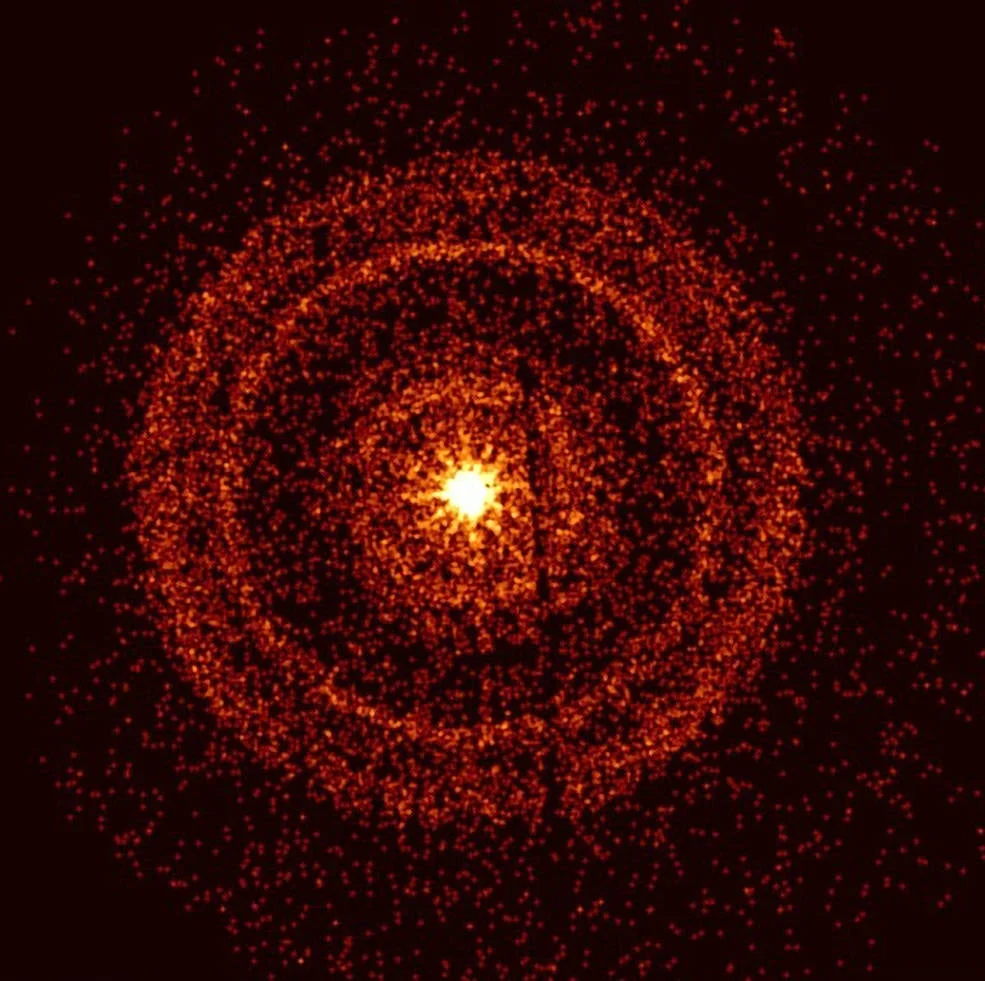
The landscape of time-domain astronomy underwent a significant transformation on January 26, 2026, when the Submillimeter Array (SMA) successfully demonstrated a new automated rapid-response capability by capturing the afterglow of a gamma-ray burst (GRB) within minutes of its detection. Located near the 4,200-meter summit of Maunakea in Hawaii, the SMA—an eight-element radio interferometer—bridged a long-standing gap in astronomical observations. Historically, while optical and X-ray telescopes could pivot to observe transient events almost instantly, millimeter and submillimeter-wave observatories remained hindered by technical complexities and slower response protocols. This milestone, achieved by scientists from the Harvard & Smithsonian Center for Astrophysics (CfA), marks the official debut of the SMA Sub/millimeter Program to Rapidly Investigate Novel Time-domain Sources (SMA SPRINTS), a system designed to revolutionize how we study the most violent explosions in the known universe.
The Chronology of a Cosmic Eruption
The event began deep in space, approximately 1.8 billion light-years from Earth, where a cataclysmic stellar event released a torrent of high-energy radiation. This flash was first detected by NASA’s Neil Gehrels Swift Observatory, a space-based telescope specifically designed to hunt for gamma-ray bursts. At the moment of detection, the Swift satellite’s automated systems calculated the coordinates of the burst and broadcast a global alert through the Gamma-ray Coordinates Network (GCN).
What happened next represented a departure from traditional radio astronomy. Within 90 seconds of the Swift detection, the SMA’s new automated system received the alert and notified the on-duty operator in Hawaii. Unlike previous years, where such a notification might require manual intervention, data re-calibration, and hours of preparation, the SMA SPRINTS software began the process of re-tasking the eight telescope dishes immediately. By the 13-minute mark, the telescopes were fully slewed to the target coordinates and were actively collecting data.
Simultaneously, a separate automated analysis pipeline began processing the incoming data streams. By combining the signals from the eight separate dishes—a process known as interferometry—the system generated images of the explosion in near real-time. This 13-minute response time is approximately two orders of magnitude faster than the typical response time for submillimeter arrays, which usually operate on schedules planned weeks or months in advance and require significant manual oversight to pivot to "target-of-opportunity" observations.
Understanding the Physics of Gamma-Ray Bursts
Gamma-ray bursts are categorized as the most powerful electromagnetic events in the universe. They are typically classified into two types: long-duration bursts, which result from the collapse of massive stars (supernovae), and short-duration bursts, which are thought to occur when two compact objects, such as neutron stars or a neutron star and a black hole, merge (kilonovae). Both processes result in the formation of a central engine—likely a black hole—that ejects material at relativistic speeds, forming narrow, highly collimated jets.
As these jets plow into the surrounding interstellar medium, they create a complex series of shockwaves. Astronomers identify two primary components in these shocks: the forward shock (FS) and the reverse shock (RS). The forward shock moves outward into the local environment, and its emission provides data primarily regarding the total energy of the explosion. However, it is the reverse shock, which propagates backward into the ejected material, that holds the secrets to the jet’s internal physics.
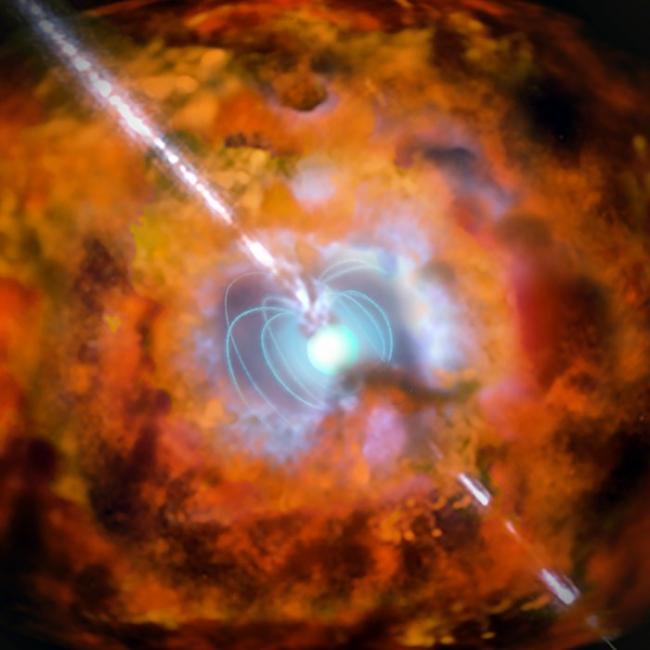
Because the reverse shock is short-lived and its peak emission often occurs at millimeter and submillimeter wavelengths, capturing it requires extreme speed. By observing the burst within minutes, the SMA was able to probe the magnetization and composition of the jet itself. This data is essential for understanding how black holes or magnetars are able to launch particles at 99.9% of the speed of light.
Technical Innovation: The wSMA Upgrade
The success of the January 26 observation was made possible by the ongoing wideband upgrade of the Submillimeter Array, known as the wSMA. This upgrade significantly enhances the sensitivity and bandwidth of the instrument, allowing it to detect much fainter signals across a broader range of frequencies simultaneously. In the context of time-domain astronomy, this means the SMA can capture the rapidly evolving "color" of a GRB afterglow, which changes as the shockwaves cool and expand.
Traditional interferometry is a data-intensive process. Usually, the light from multiple telescopes is recorded and then correlated later, often requiring days of post-processing to produce a clear image. The SMA SPRINTS system bypasses this delay by utilizing high-speed computing clusters on-site that can perform correlation and imaging tasks on the fly. This "real-time" capability allows scientists to see the source fade or brighten as it happens, providing a dynamic view of the event rather than a static snapshot taken long after the peak physics have concluded.
Garrett Keating, the Deputy Director of the SMA and lead of the rapid-response effort, noted that the January event was the first test of the fully integrated system. "It was an incredible thing to watch in real time," Keating stated. "Being able to react and process data this quickly is a big departure from how SMA usually operates, but it was absolutely critical for capturing an event where minutes matter." Keating further suggested that with continued optimization, the response time could eventually be reduced to as little as two to three minutes, nearly matching the speed of the fastest optical telescopes.
Scientific Significance and Expert Reactions
The ability to capture submillimeter data so early in a GRB’s lifecycle provides a "missing link" in multi-wavelength astronomy. While X-ray and optical telescopes provide a wealth of data, they are often affected by "extinction"—the obscuring effects of dust in the host galaxy. Submillimeter waves pass through dust relatively unimpeded, offering a clearer view of the explosion’s immediate surroundings.
Follow-up observations conducted two days after the initial January 26 event confirmed that the source had significantly faded. This fading is a hallmark of a transient afterglow; a background source, such as a distant active galactic nucleus, would typically remain constant in brightness over such a short period. This confirmation solidified the success of the SPRINTS initiative.
Tanmoy Laskar, an Assistant Professor of Physics and Astronomy at the University of Utah and co-author of the study published in The Astrophysical Journal Letters, emphasized the transformative nature of the system. "This new capability opens a unique window into the physics behind some of the most powerful stellar explosions," Laskar said. "With the SMA, we can now probe the structure and composition of the ejecta in unprecedented detail, bringing us closer to understanding how these explosions launch their powerful jets."
The Broader Impact on the Astronomical Community
The success of the SMA’s rapid-response system arrives at a pivotal moment for the global astronomical community. We are entering the era of "Big Data" astronomy, driven by next-generation facilities such as the Vera C. Rubin Observatory in Chile and the Nancy Grace Roman Space Telescope. The Rubin Observatory, through its Legacy Survey of Space and Time (LSST), is expected to generate millions of alerts per night as it scans the entire southern sky, identifying everything from moving asteroids to distant supernovae.
Without rapid-response follow-up from radio and submillimeter telescopes like the SMA, many of these alerts would result in lost scientific opportunities. The SMA SPRINTS program provides a model for how existing observatories can be retrofitted with automated logic to handle the coming flood of transient data. By narrowing the gap between detection and submillimeter observation, researchers can create a more holistic "movie" of cosmic events, combining data from across the entire electromagnetic spectrum.
Furthermore, this development has implications for the study of gravitational wave events. Since the first detection of a binary neutron star merger in 2017 (GW170817), the hunt for "multi-messenger" counterparts has become a priority. These mergers produce kilonovae that emit across the spectrum, but the radio and submillimeter signals often peak later or require rapid follow-up to distinguish them from other sources. The SMA’s ability to pivot quickly makes it a vital tool in the search for the electromagnetic signatures of gravitational waves.
Conclusion and Future Outlook
The demonstration on January 26, 2026, serves as a proof of concept for a more agile and responsive form of radio astronomy. By moving away from the rigid scheduling of the past and embracing automation and real-time processing, the Submillimeter Array has positioned itself at the forefront of the study of the transient universe.
As the wSMA upgrade continues to roll out, increasing the array’s sensitivity even further, the frequency of these observations is expected to rise. Astronomers are no longer just waiting for the universe to reveal its secrets over eons; they are now fast enough to catch the universe in the act of its most violent and fleeting moments. The gap for millimeter and submillimeter observations is closing, and with it, a new chapter in our understanding of high-energy astrophysics is beginning.